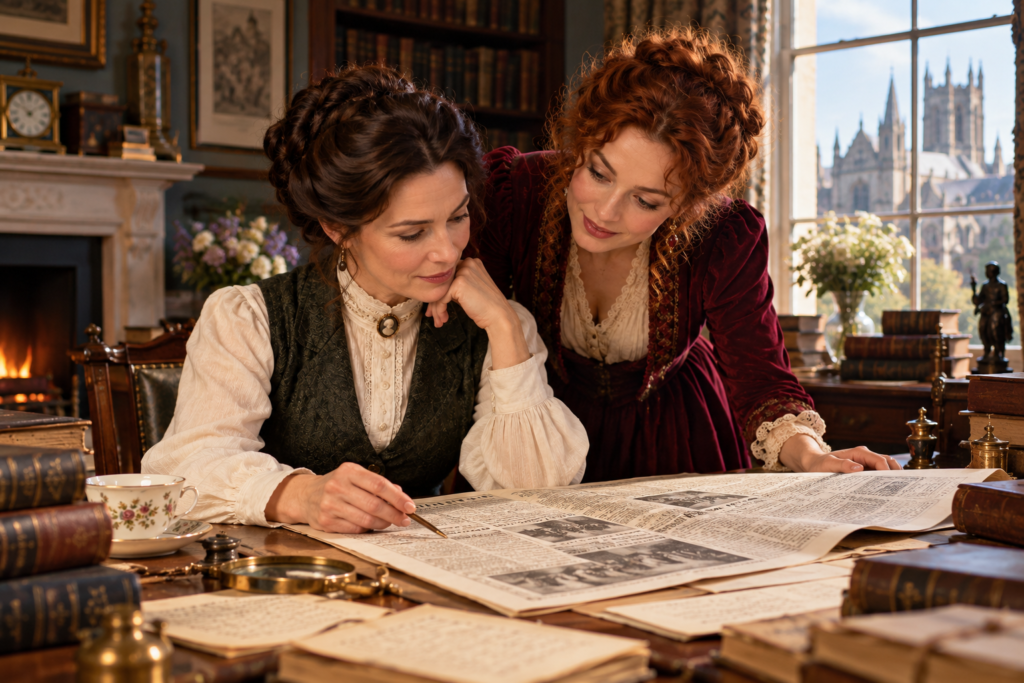
Canterbury, March 1900
The newspaper lay open on Jemima Hartford’s desk, its columns crowded with the familiar mixture of human misery, official pronouncements and details that most readers would forget before they reached the bottom of the page.
Jemima did not forget such details.
She had been reading the Whitstable Times, following one small report through to its conclusion, when a name caught her attention.
“Bella,” she called towards the adjoining room. “Have you a moment?”
Her younger sister appeared in the doorway. Bella Mead, actress by profession and incurable observer of human nature by inclination, was wearing a rather magnificent dressing gown and carrying a cup of tea.
“Is it a murder?”
“No.”
“An elopement?”
“Not precisely.”
“Then I hope it is at least a respectable scandal.”
“I’m not sure that respectability comes into it.” Jemima turned the newspaper towards her. “A woman named Charlotte Baker has been charged with bigamy.”
Bella settled into the chair opposite her sister.
“Married twice, then? How very careless of her.”
“Her first husband is still alive.”
“Ah. That does complicate matters.”
“Her name was Charlotte Branch when she married Edward Baker at Holy Cross Church, Canterbury, on Christmas Day 1894. On the eleventh of February this year, she married Arthur Shoebridge at St Barnabas, Tunbridge Wells.”
Bella put down her tea.
“Christmas Day! That sounds almost romantic. And five years later, she marries another man. What happened to the first husband?”
“That,” said Jemima, “is precisely what I intend to discover.”
“Was he dead?”
“No.”
“Abroad?”
“Not that we know.”
“Then perhaps he was unbearable.”
Jemima gave her sister a look.
“You have arrived at that conclusion rather quickly.”
“I have spent years observing men in theatrical dressing rooms. I have learned to recognise the possibility of unbearable behaviour at a distance.”
“Edward Baker, according to the newspaper, was a labourer. He and Charlotte were both recorded as twenty-two when they married. They gave the same address in Canterbury.”
Bella considered this.
“So they began together, at least on paper. And then she left him.”
“After about two years, according to the report.”
“Did she run away with Arthur?”
“We don’t know. Nor do we know when she first met him.”
Bella reached for the newspaper.
“Then let us find out what sort of man Edward Baker was. If Charlotte abandoned a husband, I should like to know whether she was wicked, foolish, unhappy, or merely sensible.”
“Those are not necessarily mutually exclusive,” Jemima replied.
Bella smiled.
“My dear, you are going to be very difficult to entertain if you insist on making every mystery complicated.”
“And you are going to be very difficult to inform if you insist on deciding the answer before reading the evidence.”
“Fortunately, we have each other.”
Jemima drew a sheet of paper towards her and wrote at the top: Charlotte Branch — Bigamy, 1900.
Underneath, she began a list of questions.
Edward Baker proved easier to find in the newspapers than Charlotte had been in the census.
There he was in the reports of Canterbury Police Court: Edward Baker, labourer, a familiar figure before the magistrates. In September 1894, shortly before his marriage, he had been charged with drunkenness and disorderly behaviour. The superintendent told the court that Baker had appeared before the Bench on six previous occasions.
In February 1898, another report described him as a labourer of no fixed abode. Two months later, he was again before the court, this time for being drunk and disorderly and assaulting a constable. Superintendent Farmery referred to twelve previous convictions.
Jemima laid the reports side by side.
“Twelve convictions by 1898,” she said. “And fifteen, according to the report of Charlotte’s trial.”
“Then we need not imagine him to have been a murderer,” Bella observed. “He seems to have managed quite well without committing anything so dramatic.”
“We mustn’t assume that every conviction was for drunkenness or disorderly conduct. We haven’t found them all.”
“No, but we know enough to understand that he was frequently in trouble.”
Jemima nodded. “And we know that Charlotte left him around 1896.”
Bella leaned forward.
“Then perhaps we have the beginning of an explanation. Imagine being married to a man who repeatedly gets drunk, quarrels with the police and has no fixed abode. One might begin to think that matrimony had been oversold.”
“Perhaps. But we cannot say that these were the reasons Charlotte left. Nor do we know what their life together was like.”
“Must we always be so scrupulous?”
“If we are to understand Charlotte, yes.”
Jemima returned to the papers. She had found a baptism at St Mildred’s, Canterbury, for an Edward Baker on 11 September 1872. The child was the son of Henry and Sarah Baker; Henry was a labourer, and the family lived at Housedens Passage. The 1881 census showed a household that fitted those details.
The evidence made a persuasive case for identifying this family as Edward’s. It did not, however, reveal what had happened in the years between his childhood and his marriage.
Nor did every criminal record bearing the name Edward Baker belong to him. Jemima had compared several prison descriptions and rejected an apparent match where the height, colouring and distinguishing marks did not agree.
“A common name,” she explained, “can be a terrible obstacle. One man has a bird tattooed on his wrist; another has a scar above his breast. It is tempting to combine them into one person, but the evidence does not permit it.”
Bella peered at the notes.
“So we have a man with fifteen convictions, but not fifteen crimes we can confidently place at his door.”
“Exactly.”
“And a wife who left him, but whose reasons we cannot prove.”
“Exactly.”
“And a second husband whose part in the story remains obscure.”
Jemima looked up.
“You are beginning to understand.”
“Don’t look so pleased. I am still waiting for something more interesting than a labourer’s criminal record.”
Jemima tapped the newspaper.
“Then perhaps Charlotte herself will provide it.”
The first report gave them an address in Upper Norwood. Inspector Greenwood had gone there on Thursday, 22 March, and from what he learned had proceeded to Hawley Road, Aveley, in Essex. There he found Charlotte and told her he had a warrant for her arrest.
Her reply was brief.
“It is quite true; this is what my friends have done for me.”
Bella read the words twice.
“Oh, that is a speech worth remembering.”
“What do you think she meant?”
“What any woman might mean when she discovers that people she trusted have delivered her into the hands of the police.”
“Do we know who these people were?”
“No. But she says friends, and I doubt she was thanking them.”
Jemima wrote down the words, taking care not to add an interpretation to the quotation.
The addresses led them no further. The people recorded at the houses in the 1901 census were of no help, and the sisters could not identify any connection between the occupants and Charlotte. There was no reason to assume that either household had employed her, although domestic service remained a possibility.
By the end of March, Jemima had assembled the known facts, but the case remained unsatisfactory.
Charlotte had married Edward in 1894. She had left him, apparently around 1896. She had married Arthur in February 1900. Her first husband was alive, and the law regarded her second marriage as bigamous.
But why had she done it? Why had her sister encouraged the marriage? And why, if she had helped Charlotte towards Arthur, had that same sister apparently been instrumental in bringing about the prosecution?
They would have to wait for the trial.
Bella was not accustomed to waiting for the final act.
“Surely,” she said one afternoon, “someone must know what happened between those two marriages.”
“Someone almost certainly does,” Jemima replied. “The difficulty is finding them.”
“Perhaps Arthur knows.”
“Perhaps.”
“Perhaps the sister knows.”
“Almost certainly.”
“Then why are we sitting here?”
“Because we cannot interrogate people simply because they might know something.”
Bella sighed.
“Genealogy is a cruel profession.”
“Fortunately, you are an actress.”
“And therefore free to imagine what the genealogist cannot prove.”
Jemima did not argue with that.
Canterbury, July 1900
The trial report arrived with the morning papers.
Jemima read it in silence. Then she read it again, more slowly.
“Bella,” she said at last, “you must come and see this.”
Her sister entered, already suspicious.
“Has someone been murdered after all?”
“No. Charlotte has pleaded guilty.”
Bella sat down.
“And the sentence?”
“One day’s imprisonment. The judge intended that she should be released immediately.”
Bella’s expression changed.
“That is a remarkably lenient sentence for bigamy.”
“The report explains why. The judge was sympathetic. He believed Charlotte had been improperly used by the man she married and had endured a wretched life.”
Bella looked at the newspaper.
“Then he thought her more sinned against than sinning.”
“That seems a fair summary of his attitude, though those are your words, not his.”
Jemima pointed to another passage.
“And here is the detail we were missing. Charlotte’s sister was instrumental in persuading her to marry Arthur. She sent the certificate, supplied information and initiated the prosecution.”
Bella stared at the page.
“Her own sister?”
“So the report says.”
“But why? Why persuade Charlotte to marry Arthur, then help bring a prosecution against her for doing so?”
“That is the question.”
Bella rose and began pacing.
“Perhaps she wanted Charlotte to escape Edward. Perhaps she thought Arthur would give her a better life. Perhaps she knew the marriage was unlawful and later regretted her part in it. Or perhaps there was some family quarrel of which we know nothing.”
“You have produced four explanations in as many seconds,” Jemima said.
“And none of them can be proved. I know. But you must admit the sister’s behaviour is extraordinary.”
“It is certainly unexplained.”
Bella stopped by the desk.
“And Charlotte’s remark to the inspector? What my friends have done for me. She believed someone had betrayed her.”
“Possibly. The remark sounds bitter, but we cannot know precisely whom she meant. The newspaper does not establish that she was referring to her sister.”
“Yet the sister’s role gives the remark a new significance.”
“Yes,” Jemima said. “It gives us a possible explanation. Not a certain one.”
Bella returned to her chair, subdued for once.
“What a miserable story. A woman marries on Christmas Day, leaves a husband who appears to have made her life difficult, marries another man, and finds herself in court. Her sister’s part is unclear, and the law concerns itself with the fact that the first husband is still alive.”
“The law had to establish whether the second marriage was lawful,” Jemima replied. “It could not decide the whole of Charlotte’s life for her.”
“But the judge seems to have looked beyond the charge.”
“He appears to have done so. We should not invent the details of his reasoning, but his sentence and reported sympathy tell us something about how the case was regarded.”
Bella was quiet for a moment.
“Do you think Charlotte loved Arthur?”
Jemima looked at the two marriage dates on her notes.
“I don’t know. We have no letters, no account from Charlotte herself, and no reliable evidence of how the relationship began. We know only that she married him and that the court later heard evidence suggesting she had been encouraged to do so.”
“Then we cannot even give her a happy ending.”
“No,” Jemima said. “We cannot.”
Bella gave a small, rueful smile.
“You are a most inconvenient investigator.”
“And you are an incurable romantic.”
“Someone must be.”
That evening, Jemima returned to her notes and added the trial report to the file. She did not write that Charlotte had been driven to bigamy by an intolerable husband, nor that her sister had betrayed her. Both were possible. Neither was proved.
Instead, she recorded what the documents established: two marriages, a first husband with a substantial record of convictions, a police search that led from Upper Norwood to Aveley, a sister whose involvement was both decisive and unexplained, and a judge who showed Charlotte unusual sympathy.
At the bottom of the page she wrote:
The case is legally resolved. The human mystery remains.
Bella read the sentence over her shoulder.
“That sounds like the ending of a play.”
“It is the ending of the evidence.”
“And what would you call the play?”
Jemima considered it.
“The Friends Who Did It for Her, perhaps.”
Bella laughed.
“Too long. I should call it A Wife’s Wretched Life. It would sell very well in the provinces.”
“You would make a melodrama of it.”
“I should make a sympathetic melodrama. There is a difference.”
Jemima closed the file.
They had not discovered why Charlotte’s sister first encouraged the marriage and then helped prosecute her. They did not know what Charlotte felt for Arthur, whether she had hoped to escape Edward permanently, or what she thought her sister had done to her. They could not prove the precise reasons for her departure from Edward, nor reconstruct every year of her missing life.
But they had learned to look beyond the simple label in the newspaper.
Bigamist.
It was the word the court required. It was not the whole woman.
And perhaps that, Jemima thought, was the real work of an investigator: not to invent a neat answer where none survived, but to recover enough of a life that the person at its centre could be seen again.
Case status: Partially resolved.
The marriages, the prosecution and the sentence are documented. Charlotte’s motives, her sister’s reasons and the private history of the three people involved remain uncertain.
Jemima placed the papers in their folder.
Bella took up her tea.
“Well,” she said, “I hope the next mystery contains at least one person who tells the truth.”
Jemima smiled.
“Don’t be unreasonable, Bella. Where would the mystery be in that?”