This project started as a device for me to present the stories I had discovered in Victorian newspapers, but has evolved into something that now has a life of its own.
My initial idea was to find a newspaper article that triggered my interest – it might involve death, murder, suicide or bigamy or something on a human level – then research the story using all available online data to find out more about the case and the people behind it,
But there were two things that has made this project different. Firstly, I used ChatGPT to help me analyse my findings, transcribe documents like wills and letters, produce a summary of my findings in which it explains the Victorian attitudes and values that influenced the case, and then generate images of the key people involved together with an image that visually summarises each case that we have worked on,
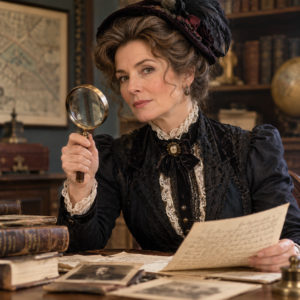 But secondly, and more significantly, I used my Victorian alter ego, Jemima Hartford to present this collection of mysteries, which I called Jemima Hartford Investigates Victorian Mysteries,
In my mind Jemima started investigating these mysteries around 1890 and had worked on them into the 1920s. This of course requires quite a bit of artistic licence because she wouldn’t have had access to online records or seen census records (like I can today) or, in fact, know of anything that happened later in the 20th century. But I didn’t want that reality to spoil the fun and enjoyment of using this wonderful Victorian looking lady sleuth!
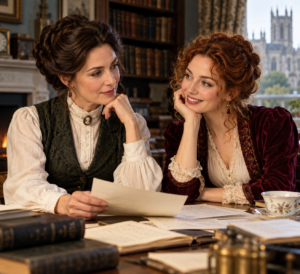
I then introduced Bella, an actress and Jemima’s younger sister, into the mix in order for them to be able to discuss some local Kent stories that she was researching, and I presented these in another collection called The Curious Cases of Jemima Hartford and Bella Mead.
(Once again – I worked with ChatGPT on this who not only helped me with the research, but who generated each story of their discussions. We had to use artistic licence here too , in terms of what the sisters could have realistically known at that time of their discussion, Finally, ChatGPT generated an image of the two sisters discussing the case in Jemima’s home or out on a walk in the area)
So, what is the difference between the two series?
Jemima Hartford Investigates Victorian Mysteries: This focuses on the rigorous historical investigation: newspaper reports, census returns, parish registers, wills, birth and death certificates, and all the wonderful genealogical twists and turns. Jemima is the researcher, weighing evidence, testing theories, following elusive family connections and being honest about what can — and cannot — be established. The question: What can we discover about what really happened?
The Curious Cases of Jemima Hartford and Bella Mead: This is the storytelling strand. We meet Jemima and Bella as people, watch them discuss a case, challenge each other’s assumptions, follow promising leads and wrestle with the human dilemmas behind the newspaper headlines. Their conversations bring the evidence to life. Bella’s instincts and understanding of people complement Jemima’s genealogical expertise, and together they decide what they believe the evidence tells them. The question: How might two remarkable women have made sense of this mystery together?
So who is Jemima Hartford?
At first, Jemima was just a ChatGPT-generated image that I used to give a bit of colour to my work, but she has now taken on a life of her own. I decided to develop Jemima’s character and understand her background, to explain her interest in researching Victorian mysteries, and how and why she was tackling them.
Jemima lives in Canterbury, Kent. She was born in 1855 to a country doctor, Dr Henry Kingsley and his wife Mary Ann. She was the third of four children, Arabella (or Bella, as she was known) was the 4th child – born ten yers after Jemima. At an early age Jemima discovered a love of learning and history, and there were a number of influences in her life, but the major one was her maternal uncle, Samuel Mead, who was a local schoolmaster.
Then, in 1877, she met an eminent archeologist Edward Alexander Hartford who opened her eyes to an even wider world of historical research. Unfortunately, he died in an archeological dig in Mesopotamia in 1881, only three years after their marriage.
Although Edward left Jemima financially secure, she decided to continue her love of history and began to help out in The Cantium Museum of Historical Antiquities and Folk-Lore in Canterbury, where she catalogued their extensive collection of Kent artefacts. This was the place where she began and honed her skill in family history research.
After a donation of a large newspaper collection to the Cantium Museum in 1886, Jemima began to take a closer look at Victorian mysteries that seemed forgotten in the closely-printed text. She wanted to uncover what happened after a reported event and who the people were behind the stories.
So, as I now had a picture of Jemima’s life story in my head, I decided to flesh out her wholw life and not only present her early years, her marriage, her life and work but also her later years in her memoirs.
Jemima Hartford’s Memoirs
- My childhood in Kent (1855-1877): Jemima’s childhood in the Kingsley family, her life in a Kent village, her parents, siblings, grandparents and uncles and aunts – and their interactions and influences on her – good and bad (written 1881)
- My Marriage to Edward (1877-1881): Jemima’s meeting and subsequent marriage to Edward Alexander Hartford, their life together and trips to archeological digs, and his early death (written 1881)
- My Life and Work (1881-1901): Jemima’s work in the Cantium Museum, how she got started with family research and her newspaper investigations on her own and her discussions with her sister, Bella Mead (written 1901)
- My Life with Beatrice (1901-1912): this is what happened when Bella’s daughter unexpectedly arrives on the scene, and how Jemima juggles her research work with being a hands-on aunt. She also discovers more about Edward’s family life, and begins writing her historical novels. (written 1912)
- My life in a Changing World (1913-1923): this is an update on the family story, but focuses on life during and after the Great War (written 1923)
Historical novels
In the early 1900s, inspired by some of the stories that Jemima had found in her family histories, she turned to her hand to writing some short historical novels. This was quite a different undertaking from simply recording the facts about an individual and their family, she had to use her imagination to fill in the gaps, to write scenes as well as some dialogue between the characters in the stories. (Once again ChatGPT helped in putting together these novels.)
- Jemimah and Madhav – is the fictional story of Jemima’s great-aunt, Jemimah Charlotte August Fairfax, set in the early19th centrury
- Part 1 – Where the River Leads, Calcutta 1800-1809 – Jemimah’s life in Calcutta in India, and her elopement with Madhav Basu (published 1905)
Part 2 – Where the Letters Lead, Penang 1809-1829 – Jemima and Madhav’s subsequent life in Pengang in Malaysia, told through her letters to her sister, Georgiana (published 1922)
- Part 1 – Where the River Leads, Calcutta 1800-1809 – Jemimah’s life in Calcutta in India, and her elopement with Madhav Basu (published 1905)
- Jack – The Life and Fate of a Kentish Thief – is the fictional story of Jemima’s great-great-uncle.. It is set in the late 18th century and based on the pamphlet Jack wrote after his sentence of transportation to Australia for 7 years in 1789 for stealing four geese, and Jemima’s subsequent research of his fate (published 1913)
Sequential Reading
All the different parts of this project can be read independently, but if you want to read them so that Jemima’s Memoirs provide the context for her research and novels, then read them in this sequence.
1 – My childhood in Kent (1855-1877) (written 1881)
2 – My Marriage to Edward (1877-1881) (written 1881)
3 – My Life and Work (1881-1901) (written 1901)
- Jemima Hartford Investigates Victorian Mysteries (1886-1920s)
- The Curious Cases of Jemima Hartford and Bella Mead (1890s-1900s)
4 – My Life with Beatrice (1901-1912) (written 1912)
- Jemimah and Madhav: Part 1 – Where the River Leads (published 1905)
5 – My life in a Changing World (1913-1923) (written 1923)
- Jack – The Life and Fate of a Kentish Thief (published 1913)
- Jemimah and Madhav – Part 2 – Where the Letters Lead (published 1922)
What happened next?
The Jemima Hartford project takes on a new dimension, when Bella’s great-granddaughter, Sasha Jane Sloane, revisits and develops Jemima’s research and memoirs in the late 20th century.