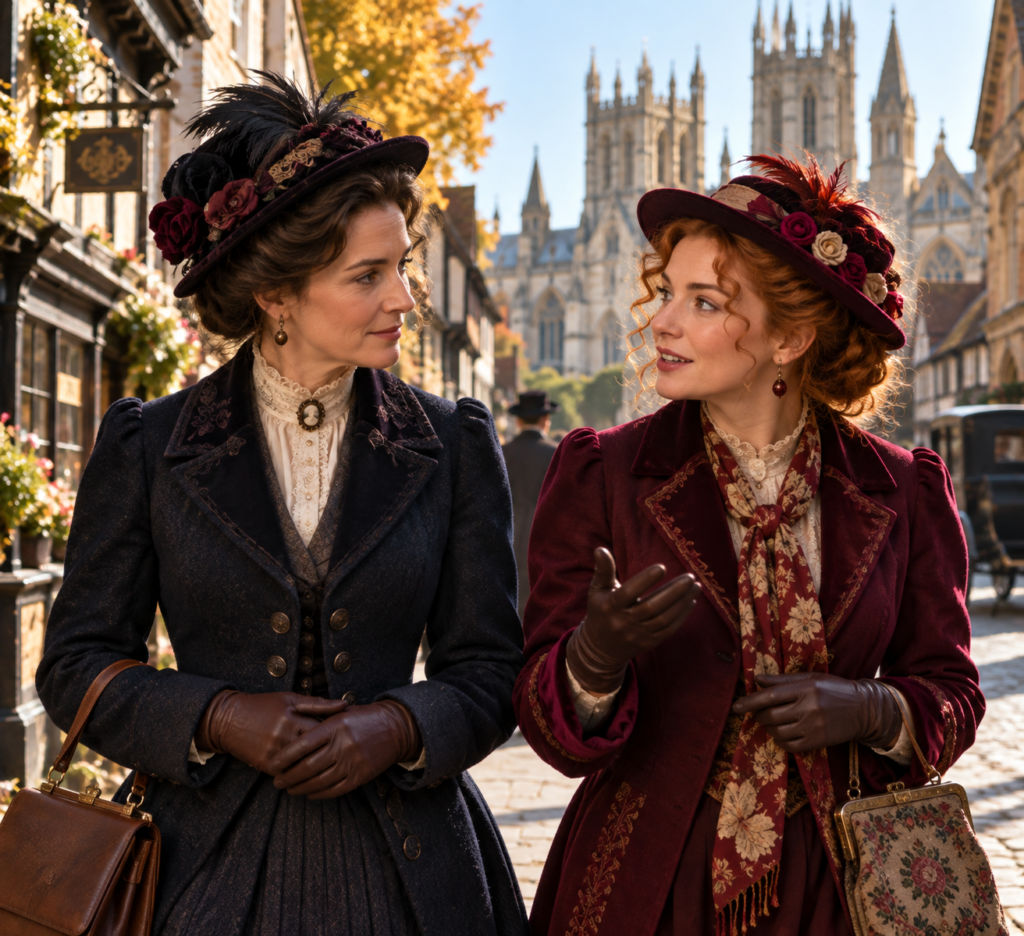
Canterbury, Kent – Autumn 1900
The newspaper had been lying on Jemima Hartford’s desk for the better part of a week. It was folded carefully at the page containing the report of a trial held at Maidstone more than twenty years earlier. Beside it lay a prison calendar, several census extracts, a marriage certificate and a small collection of notes in Jemima’s neat handwriting.
She had followed the case from its beginning to what appeared to be its conclusion. Yet she had not quite been able to put it away.
The name at the centre of it was Louisa Dolden.
Jemima had been reading the trial report again when her sister appeared in the doorway.
Bella Mead, actress, occasional visitor and persistent interrupter of genealogical investigations, surveyed the desk.
“Good heavens, Jemima. Have you been reading that thing all morning?”
“I have been reading it for twenty minutes.”
“Then you have been reading it for twenty minutes too long.”
Jemima smiled. “I thought you were going out.”
“I was. But the weather is glorious, and I decided that a walk would be more agreeable than sitting in my dressing room trying to persuade a particularly stubborn hat to remain upon my head.”
Bella removed her gloves and came to the desk. Her auburn curls, escaping in several directions from their pins, gave her the appearance of someone who had already had a busy morning.
“What is it this time?”
“Louisa Dolden. A young woman tried at Maidstone in 1878. She was accused of murdering her newborn child.”
Bella looked down at the newspaper.
“And did she?”
“No. At least, that was not the verdict.”
Jemima turned the paper towards her.
“The jury found her guilty of concealing the birth of her child. She was sentenced to nine months’ hard labour.”
Bella drew up a chair.
“Nine months?”
“Yes.”
“For a young woman who had just given birth?”
Jemima nodded. “She was twenty-two according to the prison calendar, although her birth registration suggests she may actually have been a little older. The records are not entirely consistent.”
Bella began reading the report. Her expression changed as she reached the details of the discovery.
The body of a newborn boy had been found near Bensted’s quarry, on the London Road outside Maidstone. It had been wrapped in brown paper, a piece of newspaper and sacking. The subsequent investigation had led the police to Louisa, who was employed as a domestic servant in the household of Mrs Stanger at Bedford Place.
There had been evidence about the wrapping, an apron, a bottle of steel drops and an afterbirth found in an ash-hole. A surgeon had testified that the infant was fully matured and had suffered a wound to the neck.
Bella put the paper down.
“How awful.”
“It was a distressing case,” Jemima agreed. “The prosecution alleged murder, but the defence challenged whether the child had been born alive. The jury did not convict her of murder.”
“Yet she went to prison.”
“Yes. For concealing the birth.”
Bella looked again at the newspaper.
“Do we know what happened to her afterwards?”
“That is what has made the case particularly interesting. I have traced her afterwards. In 1881 she was working as a servant in Rochester, for an ironmonger and his wife.”
“So she returned to domestic service.”
“She did. And in December 1885 she married a man named Lewis William Jenner, a painter, at St Philip’s Church in Maidstone.”
Bella smiled faintly.
“Then she had a life after all.”
“She did. There was a little girl, Nellie May, born in 1883, before the marriage. Later, Louisa and Lewis had another daughter, Millie Louisa. Sadly, the little girl died when she was about a year old.”
Bella was silent for a moment.
“And that is all we know?”
“Not quite. We know where Louisa lived, where she worked, whom she married and that she had children. But we do not know what happened to her immediately after prison. We do not know who helped her, whether she returned to her parents, or how she found employment again.”
“Or whether her husband knew?”
Jemima looked up.
“No. We cannot know whether she told him about the trial. Perhaps she did. Perhaps he knew the whole story before they married. Or perhaps it was something she never spoke about.”
Bella picked up the newspaper once more.
“I should like to have met her.”
Jemima raised an eyebrow.
“You would have had to travel back twenty years.”
“I know. But I should like to have talked to her. Not about the trial, necessarily. I should like to have known what she was like.”
Jemima began gathering her papers.
“You are thinking like an actress.”
“Of course I am.”
Bella smiled, and Jemima pushed her chair back.
“Come along. We shall take a walk. Perhaps you can tell me what you think of her character while we are out.”
Bella laughed.
“Her character? My dear Jemima, I haven’t even met her.”
“Precisely.”
—
The sisters set off through the streets of Canterbury, where the autumn sunshine caught the pale stone of the old buildings and the cathedral towers rose above the rooftops.
Jemima carried a small notebook in her pocket. She had promised herself that she would not take it out unless something particularly important occurred to her.
They passed a group of schoolchildren and continued towards the cathedral precincts.
“I have been thinking about Louisa,” Bella began.
“I rather suspected you might.”
“You see, when I am given a new part, I have to discover the woman behind the words. I cannot simply learn my lines and repeat them. I have to imagine her childhood, her circumstances, her hopes and disappointments. I have to understand why she behaves as she does.”
“And if the play tells you very little?”
“Then I have to use my imagination. But I must be careful. I cannot play a woman convincingly if I have decided beforehand that she is wicked, foolish or ridiculous. I have to find something human in her.”
Jemima glanced at her sister.
“And what have you found in Louisa?”
Bella considered the question.
“Very little that I can be certain of. But I keep thinking about her age. She was a young woman, employed as a servant in someone else’s household. She would have had very little privacy and probably very little control over her own circumstances.”
“That is true of many domestic servants,” Jemima said. “They were dependent upon their employers for wages and often for their accommodation. A servant who lost her position might find it difficult to secure another.”
“And a young unmarried woman expecting a child?”
“More difficult still.”
Bella stopped briefly to look at a shop window.
“People talk about Victorian morality as though everyone lives by the same rules. But the consequences are surely very different for men and women.”
“They certainly could be,” Jemima replied. “An unmarried mother might lose her employment, her reputation and her place in respectable society. A man involved in the same circumstances might suffer far fewer consequences.”
“Then perhaps Louisa was frightened.”
“Perhaps. We must not turn that into a fact simply because it makes a compelling explanation.”
Bella gave her a sideways glance.
“I know. You are always telling me not to embroider the evidence.”
“And you are always telling me that I must look beyond it.”
“Perhaps between us we might manage something useful.”
They resumed their walk.
Bella was quiet for a while before speaking again.
“I don’t want to judge her for having another child before she married. Nellie was born in 1883, two years before the marriage. We don’t know the circumstances, and we don’t know whether Lewis was her father.”
“No,” said Jemima. “The birth registration does not establish that. Later records give us the name Nellie May Jenner Dolden, and the census describes her as Louisa’s daughter in the household. But that does not prove biological paternity.”
“Yet someone might look at those dates and decide they knew everything about Louisa.”
“People often do.”
Bella turned towards her.
“I think that is what troubles me about these cases. A woman is brought before a court, and suddenly the whole of her life is reduced to one dreadful episode. Everyone has an opinion about her, but very few people ask what became of her afterwards.”
Jemima smiled.
“You are beginning to sound like a genealogist.”
“Don’t say such things. I have a reputation to maintain.”
They both laughed.
—
They had reached a quieter part of the city, where the noise of the streets was softened by the trees and the sound of their footsteps on the pavement.
Bella returned to the subject that had been troubling her.
“Tell me about the prison sentence. What exactly did nine months’ hard labour mean for a woman?”
Jemima took a moment before answering.
“It is worth remembering that a sentence of hard labour was not simply a matter of being kept behind a locked door. Prison authorities believed that punishment should be harsh, monotonous and disciplinary. The intention was to deter prisoners and impose a strict routine.”
“But what would Louisa actually have done?”
“We cannot say with certainty. I have not found a record telling us what particular work she was assigned. Women prisoners might be employed in laundry, sewing, knitting or picking oakum.”
“Oakum?”
“Old rope was unravelled into fibres. It was often tarred and unpleasant to handle. The fibres could then be used for caulking ships.”
Bella made a face.
“And that was considered useful work?”
“It was repetitive and deliberately tedious. Prison labour was not necessarily intended to teach a woman a trade or prepare her for employment afterwards. It was part of the punishment.”
“What about the treadwheel? I have seen illustrations of prisoners walking endlessly upon one.”
“That is more commonly associated with male prisoners. We should not assume Louisa was put to such work. The conditions and duties varied, and I would not want to describe something as her experience when we have no evidence for it.”
Bella nodded.
“And the food?”
“Prison diets were deliberately plain. The regime was austere. There were strict rules, long periods of silence and very little personal freedom. Prisoners could be separated from one another, depending on the establishment and the regulations in force.”
Bella looked ahead.
“Nine months of that. After childbirth. With the knowledge that her baby was dead and that the world outside would know why she had been imprisoned.”
Jemima did not answer immediately.
“Yes,” she said at last. “It must have been a very difficult sentence to endure. But again, we cannot know what she experienced in every detail.”
“Did anyone help women when they came out?”
“There were charitable organisations concerned with prisoners and their welfare. The Discharged Prisoners’ Aid Act of 1862 provided a means for approved societies to assist people after release. Some offered practical help, perhaps money for travel or assistance in finding work.”
“Then Louisa might have received help?”
“She might. But we have no evidence that she did. Nor have I established that a particular society assisted her in Maidstone.”
Bella looked thoughtful.
“So she may have walked out of prison with nowhere to go.”
“Or she may have had family waiting. She may have returned to her parents. She may have found work through someone who knew her. We simply do not know.”
Bella drew her coat closer around her.
“I think that would be the part I should find most frightening. Not knowing what awaited me beyond the prison gates.”
Jemima looked at her sister.
“You have had your own difficulties, Bella.”
“Not that sort.”
“No. But you know what it is to take a risk and find that the world is not quite as welcoming as you had hoped.”
Bella smiled.
“I certainly do. I remember how Mother and Father felt about my becoming an actress. They thought I was throwing away every opportunity they had given me.”
“And yet you persevered.”
“I had to. I wanted it too much to give it up. But I have never forgotten how vulnerable a young woman can be when she has to make her own way.”
Jemima looked at her affectionately.
“Perhaps that is why you are so interested in Louisa.”
“Perhaps.”
—
By the time they returned towards the centre of Canterbury, Bella had become absorbed in her own thoughts.
“I keep imagining her as a young woman in that house in Bedford Place,” she said. “Going about her duties, carrying water, preparing meals, cleaning rooms, answering the bell. Perhaps she was quiet. Perhaps she was cheerful. Perhaps she was neither. We don’t know.”
“Quite right.”
“And then something happened which brought her before a court, with strangers examining every detail of her private life.”
“That is the nature of a public trial,” Jemima replied. “The newspapers reported the evidence, often in considerable detail. The proceedings were treated as matters of public interest.”
“Public interest,” Bella repeated. “A rather convenient expression when it is somebody else’s private misery.”
Jemima smiled, but she did not disagree.
They stopped near the cathedral gates.
“Do you remember another case I told you about, Ann Carter?” Jemima said. “Do you recall her dead child’s body was found hidden a month after her own death, and that he was wrapped in newspaper, too?”
Bella nodded.
“Yes. The little detail that might have seemed insignificant to someone reading the report at the time, but which became important to us.”
“Exactly. In Louisa’s case, the wrapping of the infant was also discussed in court. The brown paper was connected by the prosecution with a coffee mill purchased by a man named Edmett in Southsea. The newspaper and other materials formed part of the evidence.”
“And yet the newspaper itself cannot tell us why Louisa did what she did.”
“No. It tells us what was printed, what witnesses said and what the jury decided. It does not give us access to her private thoughts.”
Bella looked down the street.
“Perhaps that is what I want to do. Not to decide what happened inside her mind, but to imagine the woman who had to live through all this.”
Jemima took her notebook from her pocket.
“You are not going to write a play about her, are you?”
“Not unless you can find me a suitable leading role.”
“Bella!”
“I am joking.”
She looked at her sister, her expression softening.
“But I should like people to remember that she was more than the woman in that newspaper report. She was a daughter, a servant, a mother and eventually a wife. She had a life before the trial, and she had one afterwards.”
Jemima opened her notebook.
“That, I think, is worth remembering.”
Back in Jemima’s study, the papers were waiting exactly where they had left them.
Bella settled into the armchair near the window, while Jemima returned to her desk and arranged the documents in chronological order.
“Let us see what we can say with confidence,” Jemima began.
She picked up the first sheet.
“Louisa Dolden was born in Kent in 1854, according to the birth registration. Her parents were John Dolden and Elizabeth Westover, who had married in 1840. She appears with her family in the Wateringbury census returns of 1861 and 1871.”
“So she grew up in Wateringbury?”
“That is what the records suggest. Her father was described as a bootmaker on her later marriage certificate.”
Jemima moved to the next paper.
“By December 1877, Louisa was employed as a domestic servant at Bedford Place in Maidstone. A newborn boy was found near Bensted’s quarry on the London Road on 11 December. The police investigation led to her arrest on 10 January.”
“And then the trial?”
“At the Maidstone Assizes in March 1878. The charge was wilful murder. The jury found her guilty of concealing the birth of her child, and she was sentenced to nine months’ hard labour.”
Bella looked down at the papers.
“And in 1881 she was in Rochester.”
“Yes. Working as a servant again. That is an important discovery. It shows that she had returned to employment, although it does not tell us how she managed to do so.”
“Had she moved there deliberately?”
“We cannot tell. It may have been a new position, an opportunity through an acquaintance or simply somewhere she could begin again.”
Jemima placed the marriage certificate on the desk.
“In December 1885 she married Lewis William Jenner in Maidstone. She was recorded as a domestic servant, living in Orchard Street. He was a painter, living in Brunswick Street.”
Bella leaned forward.
“And Nellie?”
“Nellie May was born in December 1883. Her birth registration does not establish a father. In 1891 she appears in the household of Louisa and Lewis, described as their daughter.”
“Which is all we can say.”
“Precisely.”
“And Millie?”
“Millie Louisa, their younger daughter, was born in 1891. Sadly, she died in infancy.”
Bella was silent.
“So Louisa had another child, and lost her too.”
“Yes.”
“Poor woman.”
Jemima looked at her sister.
“I have been trying to decide whether to describe her story as a happy ending. I am not sure that I can.”
“No,” Bella replied. “It isn’t a happy ending. Not if we include the little boy who died, or the months in prison, or the little girl she lost later.”
“But she did rebuild her life.”
“She did. And that matters. Perhaps we should not demand that every story end happily. Sometimes it is enough that someone finds a way to continue.”
Jemima looked again at the marriage certificate.
“There is one question I keep returning to. Did Lewis know about her conviction?”
Bella considered this.
“I hope he did.”
“Why?”
“Because I should like to think that he knew her whole story and married her nevertheless.”
“And if he did not?”
“Then perhaps she had found a way to leave it behind. We cannot know. But I don’t think we should make a judgement either way.”
Jemima nodded.
“That is a sensible answer.”
“Thank you. I shall treasure the occasion.”
—
The afternoon light had begun to fade. Jemima gathered the documents into a folder, but left the newspaper report on the desk.
Bella came to stand beside her.
“Are you finished with her?”
“I think so, for the present.”
“And what will you write?”
Jemima considered the question.
“I shall write what we know. The discovery, the investigation, the trial and the verdict. I shall explain the sentence and what hard labour might have involved. Then I shall follow Louisa into the years afterwards, as far as the records allow.”
“And what about the woman herself?”
“I shall leave room for you.”
Bella looked surprised.
“For me?”
“You have spent the afternoon trying to understand her. Perhaps you can help me write the parts that the records cannot supply, provided we make it clear that they are possibilities, not facts.”
Bella smiled.
“I should like that.”
Jemima returned to her desk and took up her pen.
“There is something else I want to make clear. Louisa was charged with murder, but she was not convicted of it. The distinction matters. We must not allow the original accusation to become the verdict simply because it makes a more sensational headline.”
“Agreed.”
“And we must not assume that the events of December 1877 defined every day of the rest of her life.”
“No,” said Bella. “She went on working. She married. She raised a family. She had happiness, I hope, as well as sorrow.”
Jemima dipped her pen.
“Then perhaps that is where we should end.”
She began to write, slowly and carefully.
In the winter of 1877, Louisa Dolden became the subject of a distressing and widely reported criminal investigation. The newspapers recorded the discovery of a newborn child, the evidence presented in court and the sentence imposed upon a young woman whose private circumstances were laid bare before the public.
But the court proceedings were not the end of her story.
By 1881 Louisa had returned to domestic service, working in Rochester. Four years later she married Lewis William Jenner in Maidstone. She had two daughters, although the younger, Millie Louisa, died in infancy. The records do not tell us what she thought of her past, whether she spoke of it to her husband, or who helped her through the difficult months after her release.
They do, however, allow us to follow her beyond the courtroom.
Bella read the words over her shoulder.
“That’s good, Jemima.”
“Is it?”
“Yes. But I think you need one more sentence.”
“What would that be?”
Bella looked at the old newspaper.
“Something about the fact that she was a person before she became a case.”
Jemima thought for a moment, then added:
It is easy to remember Louisa Dolden as the young woman who stood accused at Maidstone Assizes. It is harder, but perhaps more important, to remember that she was a woman with a life beyond that moment: a daughter, a worker, a mother and someone who, despite the hardships she endured, found a way to continue.
Bella read the passage again.
“That’s how I should like her to be remembered.”
Jemima put down her pen.
“And perhaps that is the most useful thing we can do for her.”
Bella moved towards the door, then paused.
“You know, Jemima, when I am on stage, I sometimes think the audience sees only the character I am playing. They don’t see the woman I have imagined behind her. All those private thoughts and little histories that never appear in the script.”
“Perhaps that is true of our newspapers too,” Jemima said. “The reader sees the accused woman, the witnesses, the judge and the verdict. But the life beyond the printed page remains invisible.”
Bella turned back.
“Until someone looks for it.”
Jemima smiled.
“Until someone looks for it.”
The newspaper remained on the desk, its old type slightly faded and its account of the trial as dramatic as it had been when first printed. But beside it now lay a marriage certificate, a census return and the names of two little girls.
Louisa Dolden had not disappeared into the past after all.
She had left a trail.
And two sisters, one with a genealogist’s patience and the other with an actress’s imagination, had followed it as far as the records would allow.