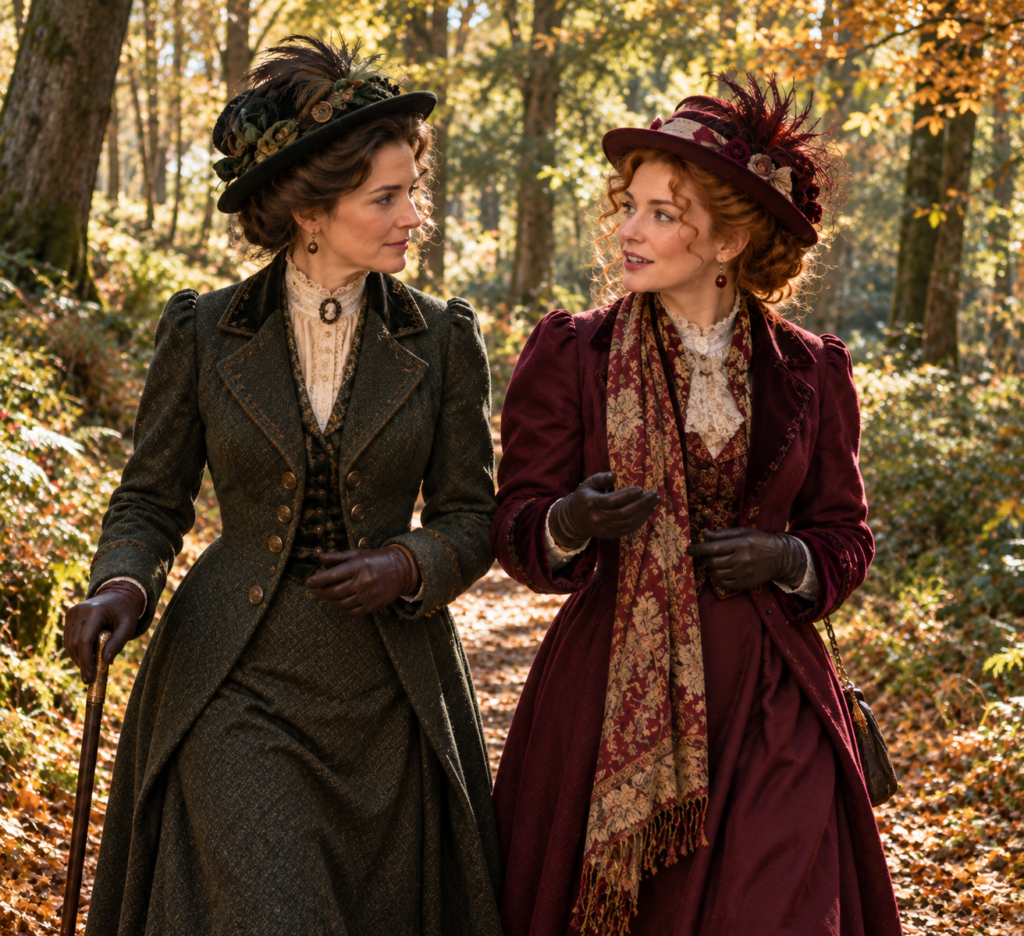
It was a wet October afternoon when Bella Mead came into her sister’s sitting room carrying a newspaper cutting between two fingers, as though she were uncertain whether she ought to touch it at all.
“Jemima, I think you should read this.”
Jemima looked up from the parish register she had been examining.
“That sounds ominous.”
“It is rather.”
Bella laid the cutting on the desk. It was from the Whitstable Times, dated 10 October 1874, and concerned the discovery of a body in a wood near Wrinstead Court, in the parish of Lenham.
Jemima read it once, then again.
The body had been found by men gathering nuts on Sunday, 4 October. It was in an advanced state of decomposition, almost reduced to a skeleton. The newspaper described the condition of the remains in some detail, including the separation of the head and right leg. A rope was mentioned, as was a razor found stuck in a tree.
The deceased was identified as George Neaves, a labouring man associated with Harrietsham.
“He had been missing since May,” Jemima observed.
“Since Whit Tuesday, apparently. The police had been looking for him because he was wanted in connection with an assault upon a little girl.”
Jemima looked at her sister.
“Yes. It is a dreadful business.”
“And the newspaper seems to think we need every detail about the condition of his body.”
Jemima folded the cutting.
“The doctor believed he had taken his own life.”
“Do you think he did?”
“I don’t know, Bella. Neither, I suspect, did the doctor. He could only give his opinion.”
Bella pulled out a chair and sat down.
“Then perhaps we ought to find out who George Neaves was before we decide what to make of his death.”
It was a sensible suggestion. They knew almost nothing about the man beyond his name, his alleged offence and the circumstances in which his body had been discovered.
Jemima began with the newspapers, but it was not long before she realised that George had a history considerably longer than the brief account of his death suggested.
And it was not a particularly happy one.
—
The first difficulty was his name.
Neaves appeared in some records, Neeves in others, and occasionally Neeve. Such variations were hardly unusual in nineteenth-century documents, but they could make the tracing of an individual troublesome.
Jemima eventually found a baptism at Otterden in November 1829, for George, son of Richard and Mary Ann.
A possible connection was provided by the 1851 census, which recorded a George Neaves at Lee Farm, Lenham. His circumstances were unusual. Rather than being comfortably established in a cottage or lodging house, he was described as a beggar in a barn.
“That is a miserable beginning,” Bella remarked when Jemima showed her the entry.
“It tells us something about his circumstances, though not necessarily how he came to be there.”
Jemima was beginning to suspect that George had lived a rather unsettled existence. There were possible relatives in the surrounding villages, and a family tree suggested several brothers and sisters, although she was careful not to accept every relationship without further evidence.
Then she found the criminal records.
In June 1851, George Neaves had appeared before the Maidstone Quarter Sessions. He was convicted of stealing iron, having previously been convicted, and sentenced to ten years’ transportation.
Bella stared at her.
“Ten years! For stealing iron?”
“Remember that the record refers to a previous conviction. We must not assume this was his first appearance before a court.”
“But transportation! That is an extraordinary sentence.”
“It was a serious punishment. And it seems that George’s story did not end with the sentence.”
For Jemima had discovered something much more revealing than the court record itself.
In August 1853, a petition had been sent from Lenham to the Home Secretary, Lord Palmerston, asking that George be shown mercy.
The petitioners described him as a man of weak intellect, easily led astray by others. They referred to his previous employers, who were apparently willing to take him back into employment, and to his physical disability. They described him as a cripple.
Most importantly, they were prepared to put their names to an appeal for his release.
Bella read the document slowly.
“So people cared about him.”
“At least some people did.”
“And they thought he was not entirely responsible for his actions?”
“That is how they presented him. We must remember that they were asking for mercy, and naturally wished to make the strongest possible case.”
“Still,” said Bella, “they could have left him to his fate. They didn’t.”
That was true. Somewhere in Lenham there had been people who believed George deserved another chance.
—
The next discovery came from the prison records.
Jemima had found references to a criminal establishment at Gosport, and the petition confirmed that George was there in 1853. She then began following his name through the surviving registers.
The records were difficult to read. Names were spelt inconsistently, columns were crowded, and the handwriting was often almost indecipherable. But gradually a picture emerged.
In 1855, George was still in custody. His behaviour was recorded as good.
There was also a description of his appearance.
He was about five feet six inches tall, with dark hair, a dark complexion and hazel eyes. But it was the physical description that arrested Jemima’s attention.
The register referred to a squint and paralysis affecting his left side, with a particular reference to his left wrist.
She went back to the 1874 newspaper.
There, in the brief description of the man who had been found in the wood, was a reference to a malformation of the left arm.
Jemima read both descriptions again.
“Bella, I think these records belong to the same man.”
Bella came to stand beside her.
“The man in the wood?”
“Yes. The physical descriptions are remarkably consistent, and the name, age, court and sentence all agree.”
“So he was disabled?”
“Apparently quite significantly. We do not know the cause of the paralysis, or when it began. It may have been congenital, or the result of an illness or injury. The records do not tell us.”
Jemima found a further register entry relating to June 1861. His ten-year sentence had been respited on the 30th of that month.
“So he was not transported after all?” Bella asked.
“No. He had spent years in custody, and his sentence was eventually respited. We do not yet know precisely when he was released, or where he went afterwards.”
Jemima leaned back in her chair.
“Think of it, Bella. A young man from Otterden, already in trouble with the law, living in a barn, then sentenced to transportation. His neighbours petition for him. He spends years in custody, with a serious physical disability, and eventually receives a reprieve.”
“And then?”
“That is where our records become much less helpful.”
—
Jemima spent several days trying to trace George after 1861.
There were possible family connections in Lenham and Hollingbourne, and she began to think that his sisters might be the key. The prison register had specifically referred to sisters living in Lenham.
But she could not establish where George went after his sentence was respited.
The next definite appearance was in 1870.
Once again, George Neaves was before the court, this time convicted of indecent assault. He received a sentence of two years’ imprisonment.
Bella was very quiet when Jemima told her.
“That is a dreadful offence.”
“Yes.”
“And there is no question of an allegation here. He was convicted.”
“No question at all. We must be quite clear about that.”
Jemima searched for further records of the case, but found little beyond the indictment and the sentence.
It seemed likely that George was in prison on the night of the 1871 census. His two-year sentence would have taken him through that period, assuming it began shortly after conviction.
After that, Jemima could find no reliable account of his movements.
By 1874 he was back in Kent, described in the newspaper as a labouring man of Harrietsham.
He was again wanted in connection with an alleged indecent assault upon a child.
But this time there was no trial. George was found dead before the matter could be brought before a court.
Jemima made a note in her book:
The 1874 allegation remains unproven. No conviction can be attributed to him in respect of this charge.
Bella watched her write.
“Do you think he did it?”
“I cannot say.”
“But he had been convicted of a similar offence before.”
“That is true. But we cannot turn a previous conviction into proof of a later allegation. Nor can we know whether people in the neighbourhood had already decided what to think of him.”
“Perhaps they remembered the young man who had been in prison for so long.”
“Perhaps. Or perhaps there were people who were genuinely concerned about the child. We must allow for both possibilities.”
Bella looked again at the cutting.
“And then he was found in the wood.”
“Yes.”
They had followed George through more than forty years of records, but the final few months of his life remained obscure.
—
A few days later the sisters went out towards Lenham.
The weather had improved, and the countryside was pleasant, although the thought of the discovery in the wood made the walk a sombre one.
Jemima wanted to see the general area for herself. A map could tell her where Wrinstead Court lay, but it could not convey the character of the countryside or the isolation of the surrounding woodland.
Bella walked beside her, occasionally stopping to look at the houses and lanes.
“Do you suppose he came here often?” she asked.
“Possibly. He was associated with Harrietsham, so this would not have been unfamiliar country to him.”
“And where do you think he lived?”
“I wish I knew.”
They had no evidence that George had returned to live with any of his sisters. Nor could Jemima establish whether he had found work after his release in 1861, or whether he had spent those years moving between villages.
His disability must have made life difficult. If his left side was paralysed, he may have walked with a limp and found many kinds of labour beyond his abilities.
“Do you think people avoided him?” Bella asked.
“I cannot know. The petition suggests that he had people willing to help him in 1853. Whether that goodwill lasted another twenty years is quite another matter.”
“And if people knew about his criminal record?”
“That may have made matters harder. A man who had spent years in custody, with a physical disability and a reputation for offending, might have found it difficult to establish himself again.”
Bella stopped beside the lane.
“Poor man.”
Jemima looked at her.
“You feel sorry for him?”
“I do. And then I remember the little girl in the newspaper report, and I feel uncomfortable about feeling sorry for him.”
Jemima understood what she meant.
“We need not excuse his crimes in order to recognise that he suffered hardship, Bella. Nor should we assume that every accusation against him was true simply because he had offended before.”
Bella considered this.
“I suppose we are trying to understand him, not defend him.”
“Precisely.”
They walked on.
Jemima found herself thinking about the people who had petitioned for George in 1853. They had known him as a young man and believed that he deserved another opportunity. She wondered whether any of them had been alive in 1874, and whether they had recognised his name in the newspaper.
Perhaps they had read the account of the discovery in the wood with the same sense of bewilderment that the sisters now felt.
—
That evening, after tea, Bella returned to the newspaper cutting.
“I still cannot understand why they printed so much about the condition of his body.”
“Newspapers have always been interested in unusual deaths,” Jemima replied. “But the practice of describing them in such detail has a long history.”
She explained that accounts of murders, executions and violent deaths had circulated in Britain long before the Victorian period. Broadsides and pamphlets had been printed about notorious crimes, often describing the circumstances in lurid language and sometimes presenting the criminal’s fate as a moral lesson.
By the eighteenth century, newspapers were carrying increasingly regular reports of criminal proceedings and unusual deaths. The nineteenth century brought a much larger reading public, and the removal of newspaper taxes and duties during the middle decades of this century helped newspapers become more accessible.
“Which is why they tell us everything,” Bella said.
“Not everything. Only what the editor thinks will interest us.”
“That is perhaps worse.”
Jemima smiled.
“Crime reporting had several purposes. It informed readers about events in their neighbourhood, warned them of dangers, and sometimes offered examples of behaviour that society wished to condemn. But it also sold newspapers.”
“And a gruesome discovery sells newspapers.”
“Apparently.”
Bella picked up the cutting.
“Do you suppose the journalist thought about George’s family when he wrote this?”
“I cannot say. But I wonder whether he thought about them at all.”
“Or the people who had petitioned for him years before.”
“Probably not.”
Bella examined the article again.
“There is something rather curious about the way newspapers describe people. When they are alive, they are criminals, rogues, villains or unfortunate persons. When they are dead, they become bodies, remains and discoveries.”
“That is a very perceptive observation.”
“And nobody seems interested in the ordinary things. Whether he had a sister who visited him, whether he had a place to sleep, whether anyone spoke to him in the village.”
Jemima looked at her sister.
“Perhaps that is why we have spent so much time looking at the records.”
“Because the newspapers didn’t tell us enough?”
“Because the newspapers told us what happened, or what people believed had happened. They did not tell us everything about the person.”
Bella folded the cutting and placed it on the table.
“I think I prefer the people in the story to the newspaper.”
“So do I.”
—
Jemima thought about George Neaves long after the sisters had put their papers away.
They could not know whether he had taken his own life, although the doctor who examined the circumstances believed that he had. They could not know what had passed through his mind in the days before his death, or whether the allegation made against him in 1874 had contributed to his despair.
It was tempting to draw a straight line through his life: a young man convicted of theft, a long sentence, a disability, another conviction, another accusation, and finally a death in the wood.
But lives were rarely so simple.
There were people in Lenham who thought George deserved mercy. There were former employers apparently prepared to take him back. He had sisters, although the sisters had not yet established what became of them or whether they remained in contact with him.
He was not merely a criminal record, nor was he necessarily the innocent victim of a cruel society.
He was a man whose life contained both wrongdoing and hardship, and whose final chapter remained uncertain.
Bella came to stand beside Jemima’s chair as she closed her notebook.
“Do you think we have found out what happened to him?”
“We have found out a good deal about his life. But not everything.”
“And do you think he was guilty of the last charge?”
“We cannot know. He died before the matter could be tried.”
Bella was silent for a moment.
“Then I think the newspaper should have been more careful.”
“Perhaps. But newspapers are not always written with the same care that historians would wish to bring to them.”
Bella laughed softly.
“Well, I shall never read a newspaper account of a dreadful discovery quite so innocently again.”
“Nor shall I.”
Jemima put the cutting away with the other papers.
They had begun with a gruesome report of a body found in a wood. They had ended with something rather different: a glimpse of a young man who had struggled with poverty, disability and the law; a community that had once pleaded for him; and a life whose final years remained largely hidden.
They had not solved every mystery.
But Jemima felt that they had done something worthwhile.
They had remembered George Neaves as a person.