Written in 1901
A few words before we begin
It is now twenty years since I first set down an account of my family and my early life. A great deal has happened in the intervening years, both to those I love and to myself. Some of the people who once formed the centre of my world are no longer here, while others have grown up, married and begun families of their own. I have also found a purpose in life which, had anyone suggested it to me when I was a young girl, I should scarcely have believed possible.
I think it best to begin where I left off: with Edward’s death in September 1881, and with the rather unexpected discovery that, although I had lost my husband, I had not been left without the means to make a life for myself. Edward had made proper provision for me, and I was financially secure. That was a great comfort, although at the time I was too overwhelmed by grief to appreciate what it meant.
The years that followed were to bring me work, friendships, discoveries and, inevitably, further sorrows. They also brought me closer to some members of my family than I had ever expected. But all that came gradually.
December 1881 – Learning to live again
I remained in deep mourning throughout December, as was only proper after Edward’s death. I was not inclined to make any alteration to my appearance, nor did I have much interest in the world beyond the immediate circle of my family.
During that month I began writing down everything I could remember about my life with Edward. I wanted to preserve the details before time and the ordinary business of living began to blur them. But I soon realised that I could not write about our marriage without first describing how we had met, and so I found myself going back to the beginning.
In this way, what I had intended as a few private recollections gradually became the first two parts of these memoirs. The writing was unexpectedly comforting. I found that by recalling our early days together, our conversations, our travels and the small habits which had become so familiar, I could almost persuade myself that I had not lost him entirely. I was not bringing him back, of course, but I was keeping something of him alive.
I spent Christmas Day with my parents and Bella, who were anxious that I should not be alone. It was a subdued occasion. They did their best to make the day pleasant, and I am sorry that I was too absorbed in my own sorrow to respond as warmly as they deserved. I was grateful for their kindness, even if I could not properly show it.
After the Christmas festivities I returned to Blackfriars Street. I remember being particularly glad to open the front door and find myself at home. It was a house of my own, and although every room reminded me of Edward, it was also the place where we had made our life together. I had no wish to leave it.
For several days I continued much as before, sleeping badly and finding little pleasure in anything. I remembered how long Grandmamma had remained in half-mourning after the death of her husband, and wondered whether I too might spend the rest of my life dressed in black. I knew, however, that this was not what Edward would have wished for me.
New Year’s Day 1882 – Edward’s study
The first day of the new year was also my twenty-seventh birthday. I woke that morning with a determination which had been growing quietly within me. I could not continue to live as though the whole of my future had ended with Edward’s death. I had to find a way forward, although I had not the least idea what that might be.
I decided that my first task would be to deal with Edward’s study.
I had entered it only twice since receiving the news of his death. Everything remained almost exactly as he had left it. His papers were spread across the desk, books lay open beside the maps he had been consulting, and his spectacles rested near a letter which he had evidently been reading before he went away. The expedition papers were still there, and I could see the route we had once intended to travel together, marked in his familiar hand.
For a little while I stood in the doorway, unable to begin. I could not bring myself to touch the papers, so I decided to start with the artefacts he had brought home. There were pottery fragments and other small objects, each carefully wrapped or placed in a box. I knew that I could not keep everything, and it seemed to me that these things ought to be somewhere they could be properly cared for and appreciated.
I spent much of January wrapping and packing them. I was determined that nothing should be damaged in transit, and took considerably longer over the task than might have been strictly necessary. There were, however, a few small pieces I could not part with. Among them were some bronze hairpins, one of which I remembered particularly well from Edward’s work at the Roman villa. It was a simple thing, slightly bent, with a modest decorative head. Edward had been interested in the archaeological evidence it provided, but I found myself wondering about the woman who had once worn it. I kept several such small objects and eventually found a little curio box in which to display them.
The books took longer. I wanted to retain some of Edward’s collection, particularly those volumes which had been important to his work or which had a personal association for us. The remainder I packed with the artefacts. By the time I had finished, several large cases were occupying much of the study, and I knew I must find a suitable home for them.
I went out for a walk around Canterbury to consider the matter and came upon a small private establishment which I had not previously noticed: the Cantium Museum of Historical Antiquities and Folk-Lore. It was not a large museum, but it was an attractive little place, and I thought Edward’s collection might be of interest to them. I went inside and spoke to the gentleman on duty. He was most welcoming and said they would be delighted to accept the objects, as well as the books.
I returned home, made the necessary arrangements and, a little later, the cases were collected. The study was now considerably less crowded, and I could turn my attention to the papers.
That proved to be a much more difficult undertaking. There were letters, notebooks, maps, calculations, sketches and records of earlier work. I could not simply bundle them together and put them away. I wanted to understand what I was keeping and why, and to preserve anything which might be of use to another archaeologist. It took me several months to work through them.
In the meantime, I began to think that perhaps the study need not remain Edward’s room alone. I had been treating it almost as a shrine, preserving everything and scarcely daring to enter. But I wanted to be able to sit there, read by the fire and write at the desk. I wanted to feel close to Edward, not shut away from him.
I rearranged the bookshelves, bringing in some of my own books from the sitting room. The volumes I had decided to keep of Edward’s were now interspersed with mine. I placed fresh flowers near the window, rearranged some of our pictures and brought in others from different rooms. A pair of candlesticks and a handsome old clock found a place on the mantelpiece.
When Bella next stayed with me, she was surprised by the changes. She was pleased to see that I seemed happier, but I think she was also a little concerned that I was trying to erase Edward from the room.
“You haven’t got rid of everything, have you?” she asked, looking around.
“Certainly not,” I replied. “Why should I?”
“I thought perhaps you wanted to make it your own.”
“It is my own, Bella. It was ours, and now it must be mine. That doesn’t mean I wish to forget him.”
She looked at me for a moment and then smiled. “I think Edward would have approved.”
“I hope so. I have no intention of allowing his books to be banished to a cupboard simply because he is no longer here to read them.”
There remained one final task: Edward’s clothes. I had left these until last because I knew how difficult I should find them. Some still seemed to retain his presence, and I could scarcely bear to handle them. My mother helped me, and together we sorted through the wardrobes. I kept his wedding suit and some of the working clothes he had worn on the excavation where we first met. The better suits were offered to male relatives and acquaintances who might make use of them, while other garments were given away. It was a sad business, but by the time we had finished I felt that I had at last begun to take possession of my own life again.
June 1882 – The Cantium
By June I was sufficiently settled to call at the Cantium and see what had become of Edward’s collection. I was rather disappointed to discover that nothing of Edward’s was on display. The gentleman I had spoken to earlier explained that they had no one available to catalogue the objects or prepare them for display.
I found myself offering to do the work.
He pointed out that the Museum could not pay me, but I assured him that I was not asking for payment. I should be very happy to come in a couple of days each week and organise the collection. I was not entirely sure what I was letting myself in for, but I knew that I wanted Edward’s work to be properly presented.
When I began, I discovered that the room in which the cases were stored contained a great many other boxes, some of which had also been waiting for attention for some time. It seemed that the Museum had accumulated rather more material than it had the resources to catalogue and display. I began with Edward’s objects, unwrapping, examining, cataloguing and labelling them in my best copperplate .
The work occupied much of the summer. I was not inclined to spend every fine day indoors, and consequently the task took longer than it might otherwise have done. When I had finished, I began arranging the objects in one of the display cabinets. I brought in the maps and logbooks I had kept at home, and these helped to give the collection a more complete appearance.
I wanted the display to be a fitting record of Edward’s work, rather than merely a collection of interesting objects. After some thought, I settled on a simple heading:
In Memory of Edward Alexander Hartford (1840–1881)
Archaeologist and Antiquarian
This collection of antiquities, maps and papers represents a selection of the work undertaken by
Edward Alexander Hartford, whose archaeological interests and researches are preserved here.
When I stood back to look at it, I felt a quiet satisfaction. It was not a memorial in the conventional sense, but it was a way of allowing others to see something of the work to which he had devoted so much of his life.
Mr Charles Hemmingway, the owner of the Cantium, was pleased with the result. He congratulated me on the arrangement and said that I had shown a particular aptitude for cataloguing and exhibiting objects. He then asked whether I might be willing to undertake some work on the other collections in the storeroom. He could offer me a modest payment.
I accepted at once. I had enjoyed the work far more than I had expected, and although I did not need the money, I thought it only right to accept his offer.
And so, quite unexpectedly, I found myself with a new occupation.
Late summer 1882 – A curious discovery
My work at the Cantium soon brought me into contact with all manner of objects and papers whose origins were not immediately apparent. Some required a little research before I could identify them, and I began to enjoy the process of following a clue from one source to another.
Among the papers I came across a small pamphlet dated February 1789. Its title was striking enough: Jack Kirby: A Sketch of the Life of that notorious House-Breaker, Horse-Stealer, and Highway Robber. It contained the confession of a man named John Kirby, born in Blean in 1761, who had been sentenced to transportation for seven years for stealing four geese.
I found the account fascinating. Jack seemed to have known many of the people from whom he stole, and I was struck by the ordinary, everyday nature of the neighbourhood in which he had committed his crimes. There was something rather unsettling about the thought that a man might be familiar to the very families whose houses he entered. I also discovered that he had given evidence against an accomplice, who was subsequently hanged.
The surname caught my attention because my mother’s mother had been a Kirby and had been born in Blean. I began to wonder whether there might be a family connection. A few careful questions to my mother, followed by a search through the parish records, led me to discover that my mother’s grandfather, Joseph Kirby, was in fact Jack Kirby’s younger brother.
For me, the discovery was a revelation. I had always thought of family history as a matter of names, dates and relationships, but here was a man whose life had been almost entirely forgotten by his descendants. I began to understand how much might be concealed behind a familiar surname, and how rewarding it could be to follow an apparently insignificant clue.
I was thoroughly hooked.
I was also intrigued to discover what had happened to Jack after his sentence in 1789. By consulting some old prison registers, I learned that he had been sent to a prison hulk on the River Medway, where he remained for two years before being put aboard the convict ship, the Albermarle, bound for Australia. He never reached his destination, however, and died at sea, somewhere off the Cape of Good Hope, on 27 August 1791 – exactly 5 months after the ship had set sail from Portsmouth.
My investigations had taken me beyond the history of our own family and into the wider story of the Bloody Code of the eighteenth century, with its severe penalties of death and transportation for even relatively minor offences. I began to learn about the harsh conditions endured by prisoners on the hulks and aboard the convict ships, and to appreciate how a single family discovery could lead into so many other areas of history.
Mead Family Research
I then turned my attention to the family of my maternal grandfather, Thomas Mead. Having begun to investigate my mother’s family, I soon found myself absorbed in the old parish registers at Boughton-under-Blean. The Meads had been farming at Dunkirk for generations, and I was able to trace their history back to a Thomas Mead, born about 1710, who owned Mead Farm before his son James inherited it.
Following the familiar custom of passing the land through the male line, James’s grandson, Thomas, my maternal grandfather, eventually inherited the farm. His sister Elizabeth, who never married, remained devoted to the family and helped care for the household. She died relatively young, but I discovered that she had possessed a lovely singing voice and had sung in the church choir. My mother remembered her only faintly, but when I mentioned this, she recalled her aunt’s beautiful voice. I wondered whether Bella might have inherited something of that musical gift.
Thomas’s younger brother Samuel chose a different course, leaving Dunkirk to establish his own farm near Sarre. He lived with Ann Baker, his housekeeper, for many years before marrying her in 1848. Their daughter Harriet eventually took over the farm and proved herself a capable farmer in her own right. It was a departure from the traditional expectations of the Mead family, where the sons had always been expected to continue the farming line.
I found the whole investigation fascinating. The registers had revealed not only names and relationships, but something of the customs and expectations that had shaped the family. I had also discovered that even a diligent researcher must sometimes accept defeat. Although I could trace my great-great-great grandfather, Thomas Mead’s marriage and burial, the earlier pages of the register containing his baptism had been lost. His parents, and the generations before him, remained beyond my reach.
I was beginning to understand that genealogy was not simply about discovering who had come before us. It was about recovering something of the lives they had lived, while accepting that some stories would always remain incomplete.
1883 – Bella chooses her own life
My first serious attempt to pursue my father’s family history had to wait, for early in 1883 I found myself confronted with a rather more immediate family matter.
Bella had decided that she wished to become an actress.
Our parents had always been quite happy for her to take part in amateur theatricals. She had a natural talent, and there had been many evenings when we had all been entertained by her performances. But the idea of her making a profession of the stage was quite another matter.
Bella, however, had made up her mind. She had applied to a repertory company in London, which also undertook provincial tours, and had been offered an engagement. She came to tell me the news, scarcely able to contain her excitement.
I was delighted for her, although I did ask whether she had told our parents.
“Not yet,” she said.
“Bella!”
“I wanted to know whether I had been accepted first. There seemed little point in telling them about something which might not happen.”
A few days later she returned to Blackfriars Street with a travelling bag and announced that she had left home.
“Can I stay with you for a little while?”
I was not entirely surprised, although I had hoped she might find a way to persuade our parents to accept her decision. She explained that they had been quite firm in their objections. They considered the stage an unsuitable profession for a young woman, and feared that actresses were exposed to all manner of temptations and dangers.
Bella had apparently asked what, precisely, they thought happened to actresses.
“They are seduced,” our mother had whispered.
Bella had not found this a particularly convincing argument.
Her engagement was due to begin in a few weeks, so she proposed to remain at my house until then. She had also decided that she would not use the Kingsley name professionally.
“I shall be Bella Mead,” she announced.
“Mead?”
“Mamma’s name. I think it has a rather good sound, don’t you?”
I had to agree that it did.
I knew I should have to inform our parents that Bella was staying with me. It was not a comfortable conversation, but I assured them that I would keep an eye on her and that she would be quite safe in my house. They were unhappy, but I think they were relieved that she had not gone off without telling anyone where she was.
Bella’s first engagement was not quite what she had imagined. She had rather hoped to be given a principal part, but instead she was taken on as an understudy, with responsibility for several smaller female roles. It was a useful introduction to the profession, although she was initially disappointed.
She soon discovered that the work was far from glamorous. There were long rehearsals, unfamiliar theatres, hurried costume changes and considerable time spent learning other people’s parts. She had to be ready to step in at short notice, and she learnt quickly that an actress must be prepared to do rather more than simply appear on stage and deliver her lines.
Her opportunity came when one of the actresses was unable to perform. Bella took her place and acquitted herself well. A favourable notice in The Era followed, and she sent me the cutting with a note which made it quite clear that she considered this a personal triumph.
A little later the leading lady fell ill, and Bella was asked to take over the principal part. It was a considerable responsibility, but she rose to the occasion. The production was well received, and the manager recognised that she had more ability than her original position suggested.
I managed to attend a matinee performance and was delighted to see her on stage. She was still my little sister, of course, but I could see that she had begun to develop real confidence and presence as an actress. I was proud of her.
When the engagement ended, Bella returned to Canterbury for a short stay. She was soon offered another part in a touring production, which would take her around the country for several months. She was eager to accept, and I encouraged her to do so.
Her room at Blackfriars Street remained available whenever she came home. At first it was simply a spare room, but gradually it began to acquire signs of its regular occupant: photographs, programmes, costume pieces, feathers and various little souvenirs from her travels. I sometimes wondered whether I was running a private theatrical museum in addition to working at the Cantium.
1883 – A new arrival and a wedding
In the early summer of that year Amelia had her sixth child. She had previously been advised not to have any more children, and we had all been concerned when she became pregnant again. This time, however, the pregnancy and confinement passed without difficulty, and she gave birth to a healthy boy.
She named him Edward Thomas, in memory of my late husband and our father. I was deeply touched by this, and even more so when she asked me to be his godmother. He consequently holds a particularly special place in my affections.
There was further happy news later that summer, when my brother, Bertie, married Alice Flora Harwood in London.
He was thirty-two and had established himself as a general surgeon at St Mary’s Hospital in Paddington, where he had trained. His progress had been the result of many years of hard work. His medical education had involved long hours of study, hospital appointments, practical instruction and the demanding business of learning to treat patients under the supervision of experienced surgeons. He had worked his way through the various stages of training and hospital service, and had gradually earned a reputation as a capable and conscientious doctor.
By the time of his marriage he was a respected member of the hospital staff, and his professional life occupied a great deal of his time.
Alice was a few years younger than he was and had her own occupation as a music teacher. She gave piano and singing lessons, and was a sensible young woman who understood that Bertie’s work would always make considerable demands upon him. She had her own interests and did not expect him to abandon his profession in order to devote himself entirely to domestic life.
I attended the wedding with my parents. Bella was away touring and could not be present, which was perhaps just as well, given that relations between her and our parents had not yet been restored.
Bertie and Alice settled into married life and, in the years that followed, had three sons: Charles in 1884, Joseph in 1886 and George in 1888.
1884 – Research and travel
Although I continued to work at the Cantium, my attention during 1884 was increasingly occupied by my father’s family history. I had begun with the Meads, but I now wanted to learn more about the Kingsley and Fairfax families.
The Kingsley Family
My father’s family proved rather more interesting than I had anticipated, although it was not nearly so extensive as the Meads. The Kingsleys had not been rooted in Kent for generations, and their history took me away from the familiar villages of my mother’s relations into Sussex.
My father told me that his father, Thomas Cyrus Kingsley, had been born in Chichester in 1796, but had moved to London at an early age to train as a solicitor. It was there that he married Frances Fairfax, and where they made their home, bringing up my father and his sister, Catherine.
Father believed that his own father had had a brother and two sisters, but confessed that he knew very little about them. I therefore decided to travel to Chichester to discover more about the Kingsley family. There I established that Thomas had indeed had an older brother, Edmund Cyrus, born in 1793, an older sister, Elizabeth Keziah, born in 1795, and a younger sister, Augusta Jane, born in 1800.
Their parents were Cyrus Kingsley and Keziah Penfold, who had married in Bosham in 1792. Both were born there, so I decided to continue my enquiries in the village itself. It was at Bosham Harbour that I found the baptism of Cyrus, who was born in 1768. He was the son of yet another Cyrus Kingsley and his wife, Susannah, who had married the previous year. Beyond these entries, however, I could discover very little.
I was disappointed. After walking around the harbour for some time, I eventually sat on a bench to consider what I might do next. An older woman sitting nearby struck up a conversation. She had evidently noticed that I was not a local and asked what had brought me to Bosham. When I explained that I was trying to trace my great-great-grandfather, Cyrus Kingsley, she thought for a moment before suggesting that her friend Walter might be able to help. He was a Kingsley, she told me, and she promptly sent a young boy off to fetch him.
It was a most fortunate encounter. Walter, who was in his early sixties, turned out to be the middle child of Edmund Cyrus Kingsley, my grandfather’s elder brother. He was therefore my father’s first cousin. His brother and sister had both died, but Walter was able to tell me much about the Sussex branch of the family, including what had been passed down about the earlier Cyrus Kingsley.
My great-great-grandfather, Cyrus Kingsley, had been born at Falmouth in Cornwall around 1725. He was a mariner, and much of his life appears to have been spent at sea. His voyages eventually brought him to Bosham, where he settled for a time and married a local woman, Susannah Tupper. She was considerably younger than he, having been born around 1745, and their only known child, Cyrus junior, was born in Bosham shortly after their marriage.
Cyrus senior remained in the village for a few years after his son’s birth before returning to sea. He was never heard of again, and no one seems to have known what became of him. There had always been a question in the family as to whether he might have been married before coming to Bosham. He was already in his forties when he arrived and met Susannah, and had spent many years travelling. It is possible, therefore, that his marriage to her was not his first, although there is nothing to prove it.
So it was Susannah who brought up their son, largely on her own. She died in 1818, by which time Cyrus junior had established himself as a successful merchant and importer in Chichester. He had not followed his father to sea, but had built a prosperous business through hard work and determination. I suspect that much of his resilience and practical judgement came from the example of his mother, who had managed to raise him without the support of her husband.
It was an odd but pleasing experience to discover my father’s cousin and to learn that his relations had been living in Bosham all along, quite unknown to our London household. When my grandfather had left Chichester there had been no family quarrel, it seemed, merely the gradual loss of contact as one branch remained in Sussex and the other made its life in London.
I returned to Kent with a much better understanding of my father’s ancestry, though not with all the answers. Cyrus senior’s disappearance remains unexplained, and I have not abandoned the idea of one day investigating his Cornish beginnings. Perhaps there is more to discover about the mariner who arrived in Bosham, left a son behind, and then vanished from the family story.
The Fairfax Family Research
Of the four family histories I have pursued, none has affected me quite so deeply as that of my grandmother’s family, the Fairfaxes. What began as an attempt to discover something of my grandmother’s early life became an investigation into a past that had been concealed for more than half a century. When the truth was at last revealed, it altered many of my thoughts about the people I had known and loved.
I began by asking my father what he knew of his mother, Frances Fairfax. He told me that he believed she had been born in Somerset, in a village whose name contained the word “English”; that she had been an only child; and that her parents had died not long after her marriage to my grandfather.
A search of the map soon led me to Englishcombe, a village just south-west of Bath. I wrote to the vicar of St Peter’s Church, asking whether I might examine the parish registers. He very kindly agreed, and I arranged to travel to Bath, where I stayed overnight before proceeding to the village the following morning. It was a long journey by train, involving several changes, but I was eager to begin my enquiries.
When I arrived, I found that the vicar had thoughtfully brought the registers from the church to the Vicarage, where I could examine them in greater comfort than in the rather cramped vestry. I settled myself in his study, with the old volumes spread before me.
I soon found the baptism of my grandmother, Frances Mary Louisa Fairfax, on 17 August 1799, daughter of Edward and Charlotte Fairfax. Turning to the marriage register, I discovered that Edward William Augustus Fairfax had married Charlotte Augusta Adelaide Langford on 25 September 1783, almost sixteen years earlier. I wondered whether they had had other children in the intervening years, and accordingly worked backwards through the baptismal entries. There I found Sophia Catherine Elizabeth, baptised in 1789; Georgiana Caroline Adelaide, in 1786; and, to my great surprise, Jemimah Charlotte Augusta, in 1784.
My grandmother, therefore, had been the youngest of four daughters, and there was a gap of ten years between Frances and Sophia, much the same as the difference in age between Bella and myself.
If my grandmother had indeed been an only child, as my father believed, I wondered whether her three elder sisters had died in infancy or childhood. I searched the burial register carefully, but could find no such entries. The first burial that caught my attention was that of their mother, Charlotte Augusta Adelaide Fairfax, in December 1823. Her abode was given as Brislington House. When the vicar came in with a cup of tea, I asked him where this place might be. To my dismay, he explained that it was a private asylum near Bristol.
I next searched for marriages among the three elder daughters. I found an entry for Georgiana in 1814, and another for Sophia in 1816, but no marriage for Jemimah. At least two of the sisters, therefore, had lived to marry, though I was still unable to discover what had become of the eldest.
All this raised more questions than it answered. Nevertheless, I was determined to pursue my genealogical research, and continued tracing the Fairfax family backwards until I reached John Fairfax, born in 1695, who would have been my three-times-great-grandfather.
Having carefully entered my findings in my notebook, I thanked the vicar for his kindness and returned to Bath, making the journey back to Kent the following day.
I lost no time in telling my father what I had discovered. My grandmother had, it seemed, had three elder sisters, but I did not know what happened to them as I could find no account of the family during the fifteen years between Frances’s baptism in 1799 and Georgiana’s marriage in 1814.
It was when I mentioned Georgiana’s name that my father suddenly exclaimed, “Good God! After your grandmother’s death, I received a letter of condolence from a woman who described herself as the granddaughter of a Georgiana. She mentioned that she possessed some letters which I might find of interest. I had no idea what she meant. Her letter remained on my desk for some time while I wondered what to do with it. In the end, I forgot all about it.”
“Grandmamma died in 1878,” I replied. “That was more than twenty-five years ago. Do you suppose you might still have the letter?”
“I have no idea,” my father answered. But my mother, who had been listening quietly, said, “My dear, you keep everything! It must be somewhere in your study.”
I confess that I had little expectation of its being found. A few weeks later, however, my father arrived at Blackfriars Street, looking exceedingly pleased with himself and holding the letter in his hand.
It was from Miss Charlotte Appleby, whose address was given as Bathwick Hill, Bath. I lost no time in writing to her, apologising for the extraordinary delay in replying and asking whether she still possessed the letters to which she had referred. I scarcely expected an answer; she might have moved, or even have died in the intervening years. I was therefore delighted when, within a week, a reply arrived. She confirmed that the papers were still in her possession and invited me to visit her, explaining that although she could not part with them, I was most welcome to read them in her sitting room.
I immediately arranged another journey to Bath. A few weeks later I found myself sitting with Charlotte Appleby over a cup of tea. I explained that we had only recently discovered that my grandmother, Frances, had three elder sisters. She smiled knowingly and said, “I suspected as much.”
She then told me that, after Frances’s birth, the family had gone to Calcutta, where Edward had been employed in the service of the East India Company. It was there, she explained, that an event had occurred which changed the lives of the whole family.
“But Georgiana can best tell you the story herself,” she said.
I looked at her in some surprise.
“She kept diaries, you see,” she continued, indicating a pile of handsome, leather-bound volumes upon the table. “Everything is recorded in them. And then there are the letters to her from Jemimah.”
Beside the books lay several bundles of letters, carefully tied with ribbon.
“My grandmother made my mother promise that she would never destroy them, and my mother exacted the same promise from me. I think Georgiana simply could not bear to part with them. Perhaps she hoped that one day someone would wish to know the truth. I shall leave you in peace to read them. They are arranged in chronological order, and you may take as long as you need. If you wish to return tomorrow, they will still be here.”
Over that afternoon and the following day, I read through Georgiana’s diaries and the correspondence, piecing together the story of Jemimah. I made copious notes, recording both my own observations and passages from the diaries and letters which I wished to preserve. The whole history was a complex one, but its principal events were these.
Jemimah had been an intelligent, lively and independent young woman, much loved by her family. Even her youngest sister, Frances, though considerably her junior, appears to have been especially attached to her. In about 1805, in Calcutta, Jemimah became acquainted with Madhav Chandra Basu, a Bengali gentleman of considerable education and standing. Their friendship developed over several years into an attachment which neither could readily relinquish.
When their affection became known, the objections of both families were considerable. My great-grandparents had previously welcomed Madhav into their social circle and admired many of his qualities. Yet they could not accept him as a husband for their daughter. The distinction they had been willing to overlook in friendship became, in their eyes, insurmountable when marriage was proposed.
The diaries made it clear that Jemimah and Madhav had not acted upon a sudden impulse. They had considered the difficulties before them and made arrangements over several months to establish a life together away from Calcutta. In 1809 they left India for Penang, determined to make a home for themselves there. It was a courageous decision, though one whose consequences neither could fully have foreseen.
The effect upon the family was grievous. Charlotte’s whole understanding of her life had rested upon her family, its respectability and its place in the world. The disappearance of her eldest daughter, and the scandal which followed, shattered those certainties. Her distress deepened rather than lessened with time.
Not long after Jemimah’s departure, my grandmother Frances was sent to England and placed at a school in London. She subsequently lived under the care of a respectable guardian, whose household provided her with security and the opportunity to continue her education. Her father maintained her financially and visited when he could, but he carefully shielded her from the full extent of the family tragedy.
After the family’s return to England, Charlotte’s condition continued to deteriorate, and she was eventually admitted to Brislington House, the private asylum near Bristol. Frances, who was by then a married woman, was spared the knowledge of where her mother had spent her final years. She was told only that her mother had died after a long illness.
Edward’s hope, I believe, was to spare his youngest daughter the suffering which had already overwhelmed the rest of the family. He wished her to enjoy as ordinary and secure a young womanhood as he could provide. His intentions were kindly, although the silence which surrounded those years left Frances with a very incomplete understanding of her own family.
Georgiana’s part in the story moved me particularly. She had known the truth of Jemimah’s attachment and had helped her sister with the final arrangements for her departure, though her part in them remained unknown to their parents. She kept the correspondence for the rest of her life, preserving not merely the record of Jemimah’s affection but the history of a woman whose story might otherwise have been lost. I came to understand something of the burden Georgiana had carried, and of the loyalty which had prevented her from destroying those precious papers.
When I eventually returned to Kent and told my parents what I had discovered, my father sat for a long time in silence. At last he bowed his head and covered his face with his hands.
There was one consequence of my discoveries that concerned my own childhood. I had always believed that my grandmother Frances did not particularly care for me. She rarely called me by my name, preferring instead to address me simply as “Child”, and I had taken this as a sign of indifference, if not dislike.
I began to wonder whether the name itself had been a source of distress. When my father named me Jemima, he did so in complete ignorance of the family history. He could not have known that his mother had once had an elder sister of that name, whom she had loved dearly and then lost in circumstances she had never fully understood. Frances had been only nine years old, approaching ten, when Jemimah disappeared from her life, and she never saw her sister again.
I cannot know exactly what my grandmother felt when she first heard my name. Perhaps it recalled a sister whose disappearance had left a wound which time had never entirely healed. She may not have known the whole truth of what had happened, but she knew that she had lost her sister, and had been given little explanation. What I had understood as a personal rejection may therefore have been an expression of grief which she could neither explain nor bring herself to discuss.
It is strange to think that I spent my childhood believing my grandmother disliked me, when the very name she could scarcely bring herself to speak connected me to the sister she had loved and lost. I wish I had known the truth while she was still alive. I might have understood her better, and perhaps we might have been closer.
I have also thought, since learning more of my grandmother’s early life, about the promise she exacted from my Aunt Catherine that she should never leave her. At the time, I understood it simply as the attachment of a widowed mother to a daughter upon whom she had come to depend. Catherine was devoted to her, and I knew that her affection for Philip had long been tempered by the knowledge that marriage would mean leaving her mother. It was only after my grandmother’s death that Catherine felt free to marry him, having kept her promise until there was no longer any need for her to remain.
I wonder now whether there was more behind my grandmother’s insistence than I ever understood. She had herself been a child when her family was broken apart, and had known the loss of those she loved without ever being told the full circumstances. Perhaps the fear of being left was something she carried from those early years, though she would never have spoken of it. I cannot know. What I have learned, however, is that silence can conceal a great deal, and that what appears to be a simple family attachment may have roots far deeper than those who witness it can imagine
My enquiries into the Fairfax family taught me that a family history may contain far more than surviving records reveal, and that silence can be as significant as any document. They reminded me, too, that those who appear in our family trees merely as names and dates were people who loved, feared, hoped and sometimes suffered in ways which left no official record.
This was perhaps the most demanding of the family investigations I had undertaken, for it required not only patience in following the evidence, but a willingness to reconsider my own memories. It has made me more cautious in judging the past, and more conscious of the responsibility I bear when attempting to restore a forgotten life to its proper place in the family story.
1885 – Bella Mead makes her mark
By 1885 Bella had been working professionally for two years, and she was beginning to make a name for herself. The eighteen-year-old who had arrived at my door with a travelling bag and a determination to become an actress was now gaining experience in a variety of productions.
She had worked her way through supporting parts and understudy duties, and was becoming increasingly confident in her abilities. She had learnt to manage the practical demands of touring, to adapt to different companies and to make the most of the opportunities which came her way.
Her name began to appear more prominently in theatrical notices. She was not yet a celebrated star, but she was no longer an unknown young actress either. There was a growing appreciation of her expressive manner and her ability to convey feeling without resorting to unnecessary exaggeration.
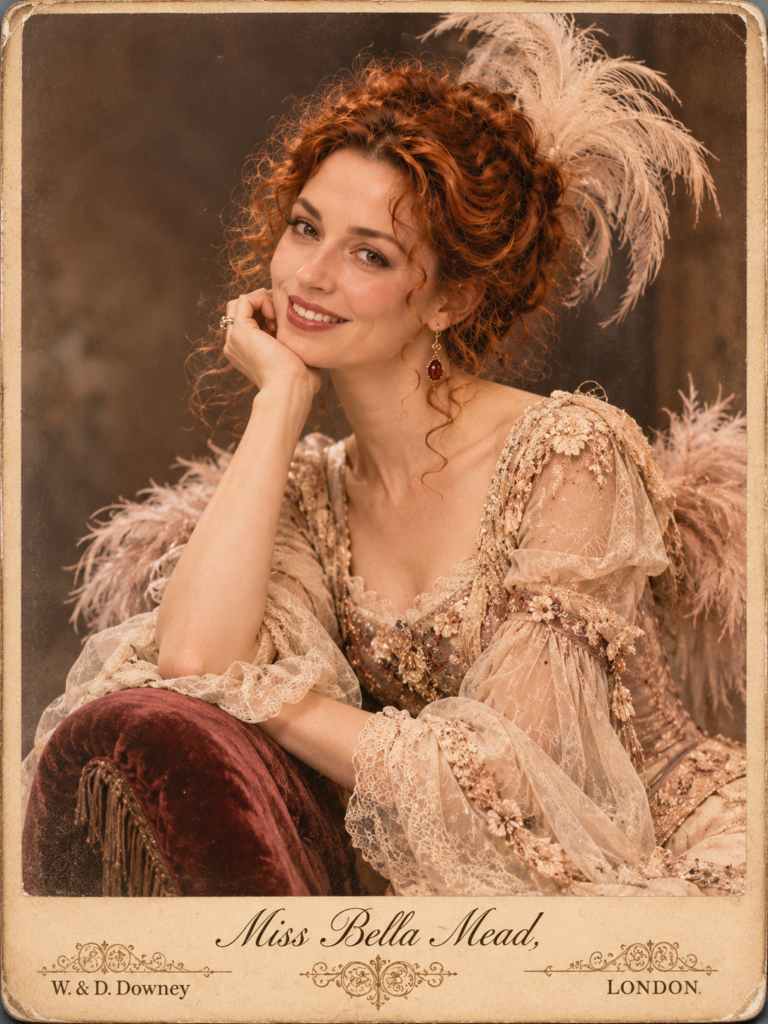
She also had her first proper professional portrait taken. It was a cabinet card, showing her with her auburn curls arranged becomingly. She looked remarkably assured, and I thought the photographer had captured something of her character. She had copies made, and naturally I was given one. The name printed beneath the portrait was Miss Bella Mead. I kept it among my own papers, although I later found a place for it where I could see it every day.
I was proud of her, not simply because she was succeeding, but because she had found something she loved and had worked hard to achieve it. I sometimes thought of the uncertainty of those first weeks, when she had left home and come to me, and wondered whether either of us could have imagined how far she would go.
1886 – The first newspaper collection
In 1886 the Cantium received a substantial collection of old newspapers from a donor. They arrived in several large bundles, and I was immediately fascinated by them. Mr Hemmingway, however, was less enthusiastic. The Museum had neither the space nor the resources to preserve every newspaper which came into its possession, and he was quite clear that we could not possibly keep them all.
He suggested that I examine the collection and select anything of particular interest to the history of Kent. Those papers, and reports concerning local people, places or events, would be retained by the Museum. The remainder, he said, I might take away for my own use if I wished.
I was delighted. I began by taking a few bundles home at a time and reading them in Edward’s old study. By then it had become my favourite room in the house, and I found that the newspapers offered an endless supply of interesting material.
There were accounts of ordinary lives, unexpected tragedies, curious disappearances, unexplained deaths, family disputes and strange occurrences which had once attracted considerable public attention but had long since been forgotten.
I found myself wondering what had happened to the people involved. Had the missing person ever been found? Was the unfortunate death really an accident? Had a family scandal been accurately reported, or had the newspaper merely repeated the rumours of the neighbourhood?
Before long I was no longer simply reading the newspapers. I was following up the stories, searching for names in parish registers, looking for subsequent reports and trying to discover what had become of those whose lives had briefly occupied the public attention.
A story which appeared at first to be quite straightforward might lead me into a much wider investigation, involving several generations of a family or uncovering circumstances which had never been mentioned in the original report.
It was at about this time that I began to think of recording some of these investigations under the title Jemima Hartford Investigates Victorian Mysteries. Most were entirely my own work, undertaken at my desk in the evenings or whenever my duties at the Cantium allowed.
Bella occasionally became involved. When she was staying with me between theatrical engagements, I would sometimes tell her about an especially intriguing case. She had a lively imagination, a sharp eye for human behaviour and, unlike myself, little patience with an overly complicated explanation. She was not always convinced by my conclusions, and I sometimes found that explaining the evidence to her forced me to reconsider something I had taken for granted.
These conversations became a separate pleasure, and eventually I began to think of them as The Curious Cases of Jemima Hartford and Bella Mead. They were rather different from my solitary investigations. Bella brought enthusiasm, intuition and a theatrical appreciation of human nature, while I generally insisted upon examining the records before reaching a conclusion.
Looking back, I can see that the newspaper collection marked the beginning of a new chapter in my working life. My earlier genealogical researches had taught me to look beyond names and dates, to question family traditions and to recognise how much might be concealed by silence or lost through incomplete records. The newspapers offered an entirely different starting point: a brief account of an incident, sometimes no more than a few lines, from which I could attempt to reconstruct the lives behind it.
I had begun by sorting old newspapers for the Museum. Before long, I was collecting mysteries of my own.
1886–1888 – The older generation
The middle years of the decade brought a number of changes in the Mead family. My mother’s brother William died in 1886. He had lived and worked at Mead Farm with his elder brother James, but by this time the older men were beginning to leave much of the daily work to the younger generation.
William’s stepson Hugh Durling and his son Alfred were taking on an increasing share of the responsibility, alongside their cousins Taylor and Reuben. The farm was in capable hands, and I was pleased to see that the younger men were maintaining the family connection with the land.
William’s death also brought another matter to the surface. Relations between Bella and our parents had remained strained, and although nobody spoke openly of it, I think we had all begun to recognise that the estrangement could not continue indefinitely.
My mother was particularly affected. She did not want the years to pass without seeing her daughter properly reconciled to the family. William’s funeral brought us together, and afterwards I decided that I must do something to bring about a meeting.
Bella’s company was due to perform at the Theatre Royal in Canterbury, and she had an important part in the production. When I next visited Faversham I told our parents about it, and suggested that they attend. They were reluctant, particularly my mother, who still found the idea of Bella’s profession difficult to accept. But I reminded them that she was their daughter, that she had worked hard and that they might at least allow themselves to see what she had made of her life.
Eventually they agreed.
I accompanied them to the theatre. Bella gave a very good performance, and I watched our parents as much as I watched the stage. I could see that they were impressed, although my father was determined not to show too much enthusiasm. My mother, on the other hand, applauded with rather more warmth than she had perhaps intended.
Afterwards I arranged for Bella to meet them privately. At first there was some awkwardness, and Bella was not quite sure whether to embrace her mother or wait to see what she would say. Then my mother took her in her arms.
She told Bella that she had missed her, and that she had been proud of her performance.
It was not a declaration that all their former objections had disappeared, nor did I expect it to be. But it was a beginning. My father remained more reserved, although he asked several questions about Bella’s engagements and her work. I thought this a considerable advance.
I soon realised they had begun to accept that Bella’s career was not a passing adventure, but the life she had chosen for herself. They were not always comfortable with every aspect of it, but the affection between them had been restored.
In 1888 my Uncle William’s wife Hannah also died. She had been part of the Mead household for many years, and her death marked another change in the family. The older generation was gradually passing, while the younger people were taking on the responsibilities which had once belonged to their parents.
1889 – My mother
My mother had not been well for some time, and although we had all hoped she might recover, it became increasingly clear that her health was failing. Her death in 1889 was therefore not entirely unexpected, but that did not make it any less painful.
I found it difficult to think of myself without her. She had been part of my life for as long as I could remember, and although we had not always agreed, I had never doubted her affection. In the years since Edward’s death she had been a source of comfort, and I had come to rely upon her presence more than I realised.
I spent as much time with her as I could during her final illness. Bella returned whenever her engagements allowed, and it was reassuring to see the two of them together. Whatever differences had arisen between them, they had not destroyed the bond between mother and daughter.
My mother had lived through many changes in her family. She had seen her children grow up, make their own choices and establish lives which were very different from those she might have imagined for them. I hope she had come to feel that we had all done reasonably well.
Her death affected us in different ways. My father was naturally bereft, and I worried about how he would manage without her. Bella, for all her independence, was deeply upset. I found myself thinking that the family home would never quite be the same again.
I also thought about the women of earlier generations whose lives I had been studying. A death in a family was never simply an entry in a register. It altered the lives of those left behind, changed the arrangements of a household and sometimes brought to an end a whole way of living.
I had known this in theory. Now I understood it in a more personal way.
1891 – Uncle Samuel and Uncle James
In 1891 I lost two of my mother’s brothers.
The death of Uncle Samuel affected me particularly deeply. He had been one of the most important influences in my childhood, and I had always felt a special affection for him. He was the person who first encouraged me to be curious, to ask questions and to take an interest in the world beyond the immediate concerns of the household.
As a child I had thought of his encouragement as something quite natural. Only as I grew older did I appreciate how much it had meant. He had never suggested that my curiosity was unbecoming in a girl, nor had he discouraged me from asking questions simply because the answers might be difficult to find.
When I began my work at the Cantium, and later my investigations into family history, I often found myself thinking of him. Edward had given my curiosity a direction, and the Cantium had given it a purpose, but Samuel had first taught me to be curious.
I was grateful for that, and I hope I had made good use of the gift he had given me.
Uncle James also died that year. He had been the older brother at Mead Farm, and his passing marked another stage in the gradual transfer of responsibility to the younger generation. His wife Martha remained for a little longer, dying in 1893.
I was pleased that the farm remained in the family. Taylor and Reuben were well established, and the next generation was ready to continue the work. There was something reassuring about knowing that, although the people changed, the farm itself would remain a familiar part of the landscape.
1894 – My father
My father died in 1894.
His death was another great loss, although by then I had already begun to understand how quickly the older generation could disappear. He had been without my mother for five years, and although he had continued with his own affairs, I do not think he had ever quite recovered from her death.
I had always been conscious of his support, even when I had not fully appreciated it. He had given me an education, encouraged my interests and allowed me a degree of independence which was not always expected of young women. He had not understood every decision I made, and there had been times when we disagreed, but I knew that he had wanted me to be happy and secure.
I was also grateful that he had lived long enough to see Bella’s reconciliation with the family. I think he had gradually become proud of her achievements, even if he was never quite at ease with the theatrical world.
With his death, the family home and the world of my childhood became things of memory. I was now without either parent, and I felt the absence of them both more keenly than I had expected.
Yet I was no longer the young widow who had returned to Blackfriars Street in the winter of 1881, uncertain how to begin again. I had my work, my home, my friends and my family, and I had learnt that life could continue even after the people who had shaped it were gone.
1895 – Bella’s success
By 1895 Bella had been a professional actress for twelve years. She had come a very long way from the young girl who had left home with little more than a travelling bag and an engagement in a touring company.
She was now an established performer, receiving leading parts and prominent billing on theatre posters and programmes. Her name, Miss Bella Mead, was becoming a considerable attraction in its own right.
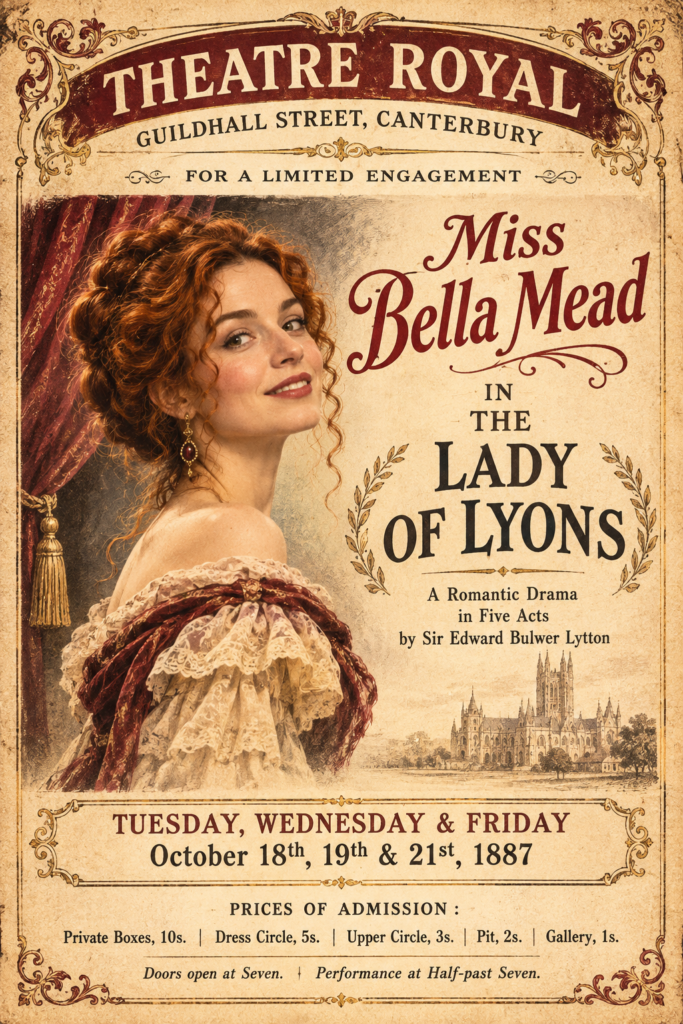
I had kept a particular memento of one of Bella’s earlier engagements in Canterbury, a handsome theatre poster advertising her appearance at the Theatre Royal in Guildhall Street in October 1887, when she had played in The Lady of Lyons. I remembered the excitement of seeing her name displayed so prominently, and had managed to obtain one of the original bills, which I treasured. By 1895, such notices were becoming increasingly familiar, but I think I was always especially fond of that first one, for it marked how far my sister had travelled from the uncertain young girl who had arrived at my door twelve years before, determined to make her own way upon the stage.
She had moved beyond the smaller companies with which she had begun, and was now appearing in more prestigious productions, both in London and on tour. She had developed a particular talent for romantic drama and drawing-room comedy, although she was equally capable of more serious roles.
The theatrical newspapers had begun to take notice of her. One review described her as an actress of considerable charm and growing distinction, while another praised her expressive performance and the ease with which she held the attention of an audience.
I was particularly pleased that the praise was not simply for her appearance, although Bella was certainly a handsome woman. It was her ability and hard work which had brought her success.
She was now financially independent and able to choose her engagements with greater care. She had professional friends, travelled widely and was accustomed to the demands of a busy theatrical life. Yet she continued to regard Canterbury as home, and whenever she returned to Blackfriars Street she seemed to bring half the theatre with her.
Her room had become something of a curiosity. There were photographs, programmes, costume pieces, feathers, fans and all manner of little objects collected during her travels. I sometimes wondered how she managed to fit herself into it.
I was immensely proud of her. I remembered the determination with which she had first announced her plans, and the courage it had taken to pursue them in the face of our parents’ disapproval. She had not been given an easy beginning, but she had made something of herself.
Bella had occasionally dropped hints about the gentlemen she had encountered during her theatrical travels, and I had gathered that there had been one or two who had attracted her attention. She was never particularly forthcoming, however, and I had not thought it my place to question her too closely. She was a grown woman, with a career and a life of her own, and I had always respected her privacy. I sometimes wondered whether there might be rather more to these passing references than I had supposed. Perhaps, when she was ready to tell me, I might at last hear some of the stories behind them. Bella was never short of a story, after all, although she did have a habit of deciding for herself when it was time to tell it!
1896 – Another collection of newspapers
In 1896 another substantial collection of old newspapers arrived at the Cantium. This time the bundles covered a period of approximately ten years, and Mr Hemmingway, knowing of my interest in such material, once again asked me to examine them.
By now I had become accustomed to spending a considerable part of my leisure time among old newspapers. I had developed a fairly systematic way of working through them, although I confess that I was not always as disciplined as I intended to be. A headline which caught my attention could easily lead me away from the task in hand for an entire evening.
I continued to select reports concerning Kent for the Museum, but I was also increasingly alert to stories from elsewhere which might repay further investigation. I had learnt that the most promising cases were not necessarily those which occupied the largest headlines. Sometimes a brief account of a disappearance, an unexplained death or an unusual family circumstance contained the beginnings of a much more interesting story than the newspaper itself had recognised.
I was also becoming more selective. Not every tragedy was a mystery, and not every curious report justified weeks of research. I had learnt to distinguish between a story which merely sounded remarkable and one for which there was sufficient evidence to pursue the matter further. Nevertheless, I continued to collect anything that aroused my curiosity, for I had discovered that an apparently insignificant detail could sometimes prove important much later.
My study was consequently rarely free of newspapers, notes and correspondence. I kept separate files for cases I was actively pursuing and for those which I intended to return to when time permitted. Some investigations were completed relatively quickly; others led me into a maze of family relationships and conflicting accounts which took months to unravel.
Bella continued to take an interest in some of the more unusual cases whenever she was at home between engagements. By this time our discussions had become a familiar feature of her visits. She was particularly good at recognising the human motives and emotions which might lie behind an incident, although I still insisted that a plausible explanation was not the same thing as a proven one.
The arrival of this second collection provided me with no shortage of new material. It also confirmed that my interest in these forgotten newspaper stories was no passing enthusiasm. What had begun as an opportunity to read papers which the Museum could not accommodate had become a substantial part of my working life, and one which I found increasingly rewarding.
1898–1901 – A new generation
After the succession of deaths in the family, it was a pleasure to have some happier events to record.
In 1898 my sister, Amelia’s eldest daughter, Charlotte, married James Brockenhurst, a solicitor. James was already known to the family through his professional association with Amelia’s sons, Louis and Rupert, who worked with him at Page and Page in Canterbury. He was a friend and colleague of her two elder brothers, and the marriage seemed a very natural development.
Amelia was delighted to see her eldest daughter settled, although I think she was also rather surprised by how quickly the years had passed. It did not seem so long since Charlotte had been a little girl, and now she was setting up a household of her own.
A son was born to Charlotte and James in 1899, and a daughter followed in 1901. I thus became a great-aunt for the first time, a description which I found rather more alarming than I care to admit. It seemed only yesterday that I had been the young aunt myself, and now another generation was beginning to appear.
Lily Jane, Amelia’s fourth child, was still at home, but it was her younger sister Violet Elizabeth who provided one of the more interesting family discussions of the period.
In 1898, Violet came to see me in Canterbury. She was seventeen, and I was pleased to discover that she had begun to think seriously about her future. She told me that she wished to become a schoolmistress, and that she hoped, in time, to teach at a school of her own choosing. I was delighted. Violet was a thoughtful girl, with a good understanding and a quiet determination, and I could see no reason why she should not make something of herself.
Her mother, however, had not received the news with quite the same enthusiasm. Violet told me that Amelia had exclaimed, “I gave you such a pretty name and you want to be a schoolmistress!”
But that, it seemed, was only the beginning. In the course of their disagreement, Amelia had gone on to reproach her daughter for the trouble she had caused during her pregnancy, adding that, because of it, I had remained with her rather than being with my poor Edward when he died. She had finished by telling Violet that she had caused her trouble ever since.
I was deeply troubled to hear this. I knew that Amelia’s confinement had been difficult, and that I had stayed with her at a time when she needed me. I had never blamed her, nor had I ever regarded Violet’s arrival as anything other than a blessing. Edward’s death had been a terrible loss, but it was not something for which either my sister or her daughter should carry responsibility. I could understand that Amelia might have spoken out of frustration or fear for Violet’s future, but I did not want the girl to believe that she owed her mother a lifetime of gratitude for having been born.
I told Violet that I was very glad she had come to me, and that we should talk it through calmly. Rather than send her home with more to think about, I suggested that she stay the night. I could make up a bed for her in Bella’s room, and in the morning, when she had had a little time to clear her head, we could consider what she might do next.
Violet was fascinated by Bella’s room, which by then had become an Aladdin’s cave of theatrical possessions. She examined them with great interest, although I suspect she was rather more interested in the idea of a woman making her own way in the world than in the objects themselves.
The next day I listened to her carefully. I did not wish to encourage her to quarrel with her mother, but neither did I think she should abandon an ambition simply because it was inconvenient to someone else. I advised her to find out exactly what training would be required, to make certain she understood the demands of the profession and to explain to Amelia that she was not making an idle or childish decision.
I also told her that a young woman could respect her mother’s feelings without necessarily allowing those feelings to determine the whole course of her life.
Violet was encouraged by this. She had already made enquiries about teacher training and was particularly interested in Bishop Otter College at Chichester. I knew the town from my own researches into the Kingsley family and was able to tell her a little about it. It seemed a suitable place for her to begin.
In the end Violet got her wish. She went away to train as a teacher, and I was pleased to see her take this first step towards the life she wanted. Amelia did not entirely abandon her reservations, but she gradually came to accept that her daughter was serious.
There was, I thought, a curious irony in the whole situation. My mother had been so troubled by Bella’s determination to make acting her profession, believing that the stage was no proper occupation for a young woman, while Amelia was equally dismayed that her own daughter should wish to become a schoolmistress. One might have supposed that a respectable profession such as teaching would have been welcomed without question, yet here was Amelia objecting to it just as firmly as our mother had once objected to Bella’s choice. It seemed that mothers, however much they wished their daughters to make good lives for themselves, did not always agree with the lives their daughters wished to lead. I could not help smiling at the contradiction.
1901 – Bella’s news
By 1901 Bella’s career was flourishing. She had been on the stage for eighteen years and was now an established actress, receiving leading roles and prominent billing. She appeared regularly in London and undertook selected engagements elsewhere, and her name was familiar to theatre audiences in many parts of the country.
She had become a polished and experienced performer. Her earlier enthusiasm had not deserted her, but it was now accompanied by the confidence of a woman who knew her profession and understood her own abilities. She had also become more independent in her choices, and I believe she enjoyed the freedom which her success had brought her.
She continued to visit me whenever she could, and although her stays were sometimes brief, I always looked forward to them. We had developed a comfortable habit of talking over our various concerns, and I had come to value her opinions on my investigations almost as much as she valued my willingness to listen to her theatrical news.
It was therefore a considerable surprise when, one day in 1901, she arrived at Blackfriars Street looking rather more serious than usual.
I remember the day very clearly; it was Monday 4 November 1901. She seemed hesitant, and I soon realised that she had something important to tell me.
Eventually she explained that she had just discovered she was expecting a child – and she had already made up her mind that she intended to keep the baby.
She did not ask my permission, nor did I expect her to. It was her decision, and I knew that she had thought carefully about it.
Nevertheless, I was apprehensive. Bella’s career was now at its height. She had worked for many years to establish herself, and I knew that the arrival of a child would inevitably alter the arrangements of her life. An unmarried actress with a baby would not find the world particularly accommodating. There would be practical difficulties, as well as the inevitable opinions of people who felt entitled to judge her.
I was also conscious that Bella would need more than affectionate words. She would need support, and perhaps a good deal of it. I did not yet know what she would expect of me, or what I should be able to offer, but I knew that I would not turn away from her.
I told her that we would face whatever came together.
At the time, I had little idea how much this news would alter the course of our lives. I thought only of Bella and the child she was carrying, and of the uncertainties that lay before us. I could not yet imagine the place that her little girl would come to occupy in my own life, or how completely she would change it.
But that belongs to another part of my story.