Written in 1881
A few words before I begin
I have sometimes been asked whether I remember my childhood clearly. The question is not so easily answered as it might appear. I could not, if required, set down every occurrence in its proper year, nor would I pretend that the order of all my recollections is certain. There are scenes which remain as distinct in my mind as though they had happened yesterday, while other years have become little more than a succession of familiar faces and ordinary occupations.
It is not my intention, therefore, to give a strict account of each year from my birth onwards. I shall write instead of the people who surrounded me, the places in which I grew up, and those incidents which, for one reason or another, have remained in my memory. Some recollections belong to my earliest childhood; others I can date with greater confidence. I shall not always be able to distinguish one summer from the next, but I hope that the affection with which I remember them will make up for any uncertainty in their arrangement.
My childhood was spent principally in Faversham, in Kent, in a household which was comfortable, busy and, I think, on the whole a happy one. It was presided over by parents whose temperaments were very different, and enlivened by a brother and two sisters, each of whom seemed to have been born with a quite separate idea of what life ought to be.
How my parents met
My father, Henry Thomas Kingsley, came to Faversham as a young doctor and at first lived in lodgings. He had joined the practice of an older medical practitioner, whose patients came not only from the town but from the farms and villages around it. In the beginning he was at an assistant, learning the habits of the practice and becoming acquainted with the people who depended upon it. The older doctor was approaching retirement, and in time my father was to take over the practice with his predecessor’s agreement. It was a sensible start for a young man, allowing him to acquire experience and a reputation before setting up a household of his own.
The story of their meeting was told to me more than once, and I have no reason to doubt its general truth. In the summer of 1849 my maternal grandmother, Jane Mead, became seriously ill. My father was called to attend her, and for a time he visited Mead Farm every day. My mother, being the only daughter, was naturally much occupied with her mother’s care. The illness was what my father described as rheumatic fever. It kept my grandmother in bed for many weeks, and although she recovered sufficiently to resume much of her former life, she never entirely regained her strength. There were, I understand, lasting effects upon her heart, and in later years she was more easily tired and sometimes short of breath.
My grandmother recovered sufficiently to leave her bed and take up many of her usual interests, although she was never again quite so strong. My father, meanwhile, had discovered that his visits to Mead Farm had become agreeable for reasons beyond his medical duties. He asked my mother to marry him, and she accepted, but she would not leave her parents until she had made proper arrangements for the household.
There were three sons in the family, but my mother was the only daughter and had taken a large share in the daily work of the farm and house. Before she could go to her new home, she wished to see that a capable servant had been engaged to assist her mother, and that her brothers understood something of the domestic duties which she had hitherto undertaken. She was not a person to leave matters in confusion merely because a marriage had been arranged.
My parents were married on Christmas Day 1849 at Faversham, after which they rented a house in West Street, which was to become our family home. My father had saved what he could while living in lodgings, but he was not yet in a position to purchase a substantial house outright. He was content to rent while his practice became established. It was not until the death of his own father in 1854, and the inheritance which followed, that he was able to buy the house and secure it for his family.
Our family
My brother Thomas was the first of us, born on 4 February 1851. His second name was Bertram, and although my parents generally called him Thomas, my sisters and I knew him as Bertie. My mother had been brought up among names which were familiar and traditional — James, William, Mary Ann and Samuel — and while she respected family usage, she liked to give her own children names with a little individuality. Thomas was required by both grandfathers; Bertram was her own choice.
Amelia Jane followed on 20 January 1853. Her first name was chosen by my mother, while Jane honoured my mother’s mother. I was born at four o’clock on the morning of New Year’s Day 1855. My mother named me Jemima, and my father wished that I should bear his mother’s name, Frances, as my second name. For a long time I accepted it without question. In later years I became less pleased with it, though the reasons for that belong to another part of my recollections.
For ten years my parents supposed their family complete. Then, on Midsummer Day, 21 June 1865, my youngest sister Arabella arrived. She was soon called Bella by everyone who loved her, although when she had tried my parents’ patience her full name, Arabella, was restored with considerable emphasis. My father had a fondness for the name Elizabeth, and so it became her second name.
The arrival of a baby after so long an interval altered the arrangements of the household considerably. Thomas was fourteen, Amelia twelve, and I was ten. We were no longer a family of very young children, and each of us received the newcomer in a different fashion. Bertie regarded her at first with the practical interest of a boy who had discovered a new subject upon which to exercise his ingenuity. Amelia was old enough to consider herself nearly grown up, and although she did her share when required, she was not especially inclined to return to the nursery. I, on the other hand, took to Bella at once. She was a small, warm, lively creature, and I found her company a delight.
It is perhaps one of the oddities of family life that children born under the same roof may have so little in common, and yet remain attached to one another. We were not rivals. We had different dispositions and different interests, and as the years passed our paths led us in very different directions. But there was affection between us, and I do not remember any serious quarrel which endured.
My father
My father was a good-natured and patient man. His profession occupied much of his day, and often a considerable part of his night. He saw patients at his surgery, visited those who were unable to come to him, and travelled out to farms and villages in the neighbourhood. A confinement might keep him away for many hours; an unexpected summons could take him from his supper or his bed. It was not unusual for him to return home to find another patient waiting.
I remember the sound of his arrival more clearly than I can describe the details of his working day: the carriage or horse brought to the door, the opening and closing of the front entrance, and the familiar voice greeting my mother or asking whether anything had occurred in his absence. There was generally something more to be done, but he seldom brought impatience into the house. If he was tired, he did not make a great display of it.
His work gave us a comfortable home and opportunities which were not available to every family in our position. He valued education, and although he did not make a scholar of himself in the domestic sense, he was never inclined to discourage a child’s curiosity. He was especially tolerant of my reading, even when it interfered with some task which my grandmother would have considered more suitable.
My father was not a man who enjoyed disputation. He would listen to a strongly expressed opinion, consider it, and then quietly proceed according to his own judgement. I sometimes saw him smile when another person had delivered a particularly emphatic pronouncement. If I asked him what amused him, he would say only that certain people had always held very definite views. I came to understand that this was his way of avoiding an argument without necessarily surrendering his own opinion.
He was affectionate without being demonstrative, and I knew that I could go to him with a question. He did not always give me the answer I wanted, but he rarely made me feel that the question itself was foolish. I believe this did much to encourage my habit of inquiry.
My mother
My mother was the centre of our household. She was caring, practical and attentive, not only to her husband and children but also to her brothers and their families. She had been brought up to understand the work of a farm and the management of a home, and she brought the same good sense to our life in Faversham.
She was not, however, a woman who expected all her children to be alike. She took pleasure in our different interests, provided that we behaved with proper consideration for others. She could be firm when necessary, but she was not given to making a contest of every disagreement. I think she understood that Bertie, Amelia, Bella and I required different kinds of encouragement.
There was always something being attended to in our house: meals to be prepared, rooms to be kept in order, correspondence to be answered, clothing to be mended, visitors to be received, and arrangements to be made for my father’s work. We had a cook and a housemaid, and their help made the smooth running of the household possible, though my mother remained very much at its head. She knew what was required, saw that things were done properly, and took a personal interest in the comfort of us all. There were still plenty of small matters that fell to her, and she rarely seemed to regard them as a burden. When she sat down in the evening, she had generally earned her rest.
I owe her more than I can easily set down. It was she who taught me that affection is shown as much in the small duties of every day as in grand declarations. She was also the person who kept the wider family together, remembering birthdays, enquiring after an ailing brother, and making certain that no one at Mead Farm or elsewhere was forgotten.
Bertie and Amelia
Bertie was four years older than I, and as children we were perhaps the nearest in temperament. He was interested in how things worked and liked to learn, though he had none of my inclination to sit quietly with a book for the greater part of an afternoon. He had a practical turn of mind and an early interest in medicine, no doubt encouraged by watching our father at work.
He was a boy among sisters, and I daresay he sometimes thought himself hard done by. Yet he did not appear to resent us. He was happiest when he could be outside, or when he had some experiment or occupation of his own. Bertie’s ambition was to become a doctor like our father, so when Bella was born, he took a great interest in her welfare, and I remember him attempting to bandage her little arms and legs with the seriousness of a surgeon. Bella submitted to these attentions only so long as they suited her; she was not a patient patient.
Amelia and I looked rather alike, with dark hair and dark eyes, though in disposition we were very different. She was pretty in a manner which pleased the eye at once: neat, graceful and attentive to her appearance. She was also more interested than I in the accomplishments and occupations expected of a young lady. She liked society, enjoyed family occasions, and had a settled idea of the life she wished to lead.
Amelia wanted a husband and children of her own. When Bella arrived, she was twelve and already considered herself beyond the nursery. She was kind enough to help when asked, but she did not share my delight in the baby. I think she had begun to imagine the household she would one day manage herself, rather than wishing to return to the care of a small child.
She met Arthur Page, the son of a Faversham solicitor, when she was about sixteen. She took to him readily, and it was plain that she would have married him at once had our parents allowed it, but they thought her too young, so she had to wait until she was twenty-one.
Bella
What am I to say of Bella? She came into our family when I was ten, and from the beginning there was something about her which made it impossible to overlook her. She was a beautiful child, with glorious auburn hair, and an expression which changed from solemn innocence to mischief in the space of a moment. She had a way of persuading people to do what she wished, not by argument, but by looking at them as though the matter had already been settled.
She was fond of an audience, certainly, and could be something of a show-off. But it would be unjust to dismiss her performances as mere vanity. Bella possessed a voice of extraordinary beauty. Even as a child, when she recited a poem or sang a song, one found oneself listening. Her voice was clear and full, with a sweetness and strength which seemed remarkable in so young a person. When she read aloud, familiar words acquired a new life; it was almost as though one had never heard the passage before.
She had also an instinct for expression. She noticed how people spoke, the turns of their heads, the little movements of their hands, and could imitate them with astonishing accuracy. Sometimes this was very amusing; at other times it was perhaps a little too accurate for the comfort of the person being imitated. She liked to invent characters and give them voices, and could turn an ordinary family occurrence into a small drama.
I remember one afternoon when she had been asked to recite a piece for the amusement of the family. She began with such gravity that we all settled ourselves to listen. Halfway through, she gave one of the characters a voice so like that of a familiar neighbour that Bertie nearly choked with laughter. Bella did not falter. She continued to the end, apparently unaware of the disturbance she had caused, and then looked round to discover whether she had pleased us. She had, though perhaps not in precisely the manner intended.
To us she was the youngest child, lively, affectionate and occasionally troublesome. Even as a little girl, Bella had a voice that could command attention, a remarkable memory and an imagination that seemed always to be at work. She delighted in pretending, in making up stories and in giving expression to the characters she invented. We thought these were simply the amusements of a lively child, though I sometimes wondered whether there might be rather more to them.
Bella and I were ten years apart, and our interests were not the same. Yet I felt from an early age that we had a particular understanding. She was not like Amelia, nor was she like me; she had a spirit entirely her own. I was fond of her not because she resembled me, but because she did not. I have often been grateful that our affection survived the differences in our temperaments and the very different lives which lay before us.
Our home and the town of Faversham
Our house, Fairfield House, stood in West Street, Faversham. It was a comfortable Georgian house, with a consulting room near the front entrance, a family sitting room, a dining room, kitchen and domestic quarters, and four bedrooms upstairs. The arrangement suited my father’s work well: patients could come to the surgery without passing through the family rooms, while the rest of the house remained our own.
I knew the house by its sounds as much as by its rooms: the movement of the servants below stairs, the opening of the front door, my father’s footsteps, the rattle of crockery, and the voices of visitors. There were times when the house seemed full of people who had come to consult my father, speak with my mother, or deliver some message from the town or countryside.
There was a small garden behind the house, not large enough to be called an estate, but quite sufficient for our needs. My mother took an interest in the flowers, and there were borders of roses, lavender and other familiar cottage-garden plants, together with a few shrubs and a small patch where herbs were grown. There was also a lawn, though I doubt it would have met the approval of a modern gardener, and a paved area where we could sit on fine days. In summer it was a pleasant place to spend an hour or two, away from the bustle of the house.
As children, we made the most of it. We played games, chased one another between the flower beds, and sometimes set up elaborate imaginary worlds in which the shrubs became forests and the garden path a road to somewhere quite distant. Bertie was inclined to devise games with rules, Amelia preferred things to be orderly, and I was often content to sit with a book in some quiet corner. Bella, when she was old enough to join us, brought a good deal more noise and movement to proceedings. I suspect the garden suffered from our attentions more than my mother would have liked, though she was generally indulgent.
Faversham was a busy place, and a child had much to observe. There was the Creek and the activity of the port, with vessels bringing and carrying goods; the market and its stalls; the shops and workshops; and the traffic of carts, horses and people passing through the streets. The surrounding country supplied the town with produce, while brewing and other industries gave employment to many families. The smell of malt and hops could sometimes be detected in the air, and the sound of drays and horses was familiar to us.
The town was not merely a collection of streets and shops. It had its own rhythms and its own news. One heard of a marriage, an illness, a change of employment or some mishap in a neighbouring village, and before long the story had travelled through several households. My mother knew many people by name, and my father, through his profession, knew a great many more. I was often struck by how closely the lives of the town and the countryside were connected.
I was allowed to walk about the town as I grew older, to visit shops on small errands and to observe the market. I liked watching the tradespeople at their work and listening to the conversations which took place around me. I doubt that I was always as inconspicuous as I imagined. A child who is interested in everything is apt to be noticed, especially when she pauses to examine something which everyone else has passed without a glance.
The carriage and the stable
For the first few years after my parents’ marriage, Mother walked to Mead Farm whenever she wished to visit her family. It was a journey of several miles, and she thought little of making it on foot. After Father’s inheritance in 1854, when he was able to purchase Fairfield House and the practice was more securely established, the household acquired a horse and a light open carriage. There was a small coach house and stable behind the house, reached from the rear yard. A stableman came in regularly to attend to the horse and keep the carriage and harness in order.
Mother used the carriage for visits to Mead Farm and to her brother Samuel at Boughton-under-Blean, as well as for other journeys. She did not regard it as a grand possession, but it gave her a freedom she had not previously enjoyed. As we grew older, Bertie took an increasing interest in the horse and its care. He would watch the stableman grooming it, examining its feet or adjusting the harness, and ask questions about its legs, muscles and joints. He was fascinated by its teeth and by the way its breathing changed after exercise. The stableman was patient with him, though I suspect he sometimes wondered why a boy should wish to know so much about the construction of a horse.
Bertie’s interest was not confined to riding. He wanted to understand how the animal was made and what might cause it pain or lameness. Father encouraged his questions, and I sometimes think that his curiosity about the workings of the body began with that horse as much as with anything he saw in Father’s surgery.
My governesses and my education
My education, such as it was, took place almost entirely at home. Father considered it important that his daughters should be properly educated, although I doubt he ever gave much thought to precisely what that education ought to comprise. Mother, who had been brought up in a farming household, had received a sound practical education herself, but she was keen that her children should have opportunities beyond those available to her when she was young. Between them, they arranged for us to be taught by governesses, who came and went over the years as circumstances and our changing needs required.
My earliest recollections are of Miss Eleanor Price, who was responsible for Amelia and me when we were still quite young. She was a serious woman, always neatly dressed, with her hair drawn firmly back from her face and an expression that suggested she was rarely surprised by anything we might do. She believed in order, good manners and regular application, and she was not easily distracted from a lesson once it had begun.
Under Miss Price we learned to read and write properly, to spell, to perform our sums and to acquire the rudiments of history and geography. She was particularly particular about handwriting. A poorly formed letter, an untidy line or an ink blot could result in an entire exercise being repeated. I remember being thoroughly dissatisfied on one occasion when, having completed a page of copybook writing, I was told that the final line was not quite satisfactory. I thought it a very small imperfection, but Miss Price evidently disagreed.
She was not an unkind woman, and I believe she did her duty conscientiously. She taught us to be careful and methodical, qualities which have since proved useful to me, although I cannot say that I was grateful for them at the time. Amelia was generally more willing than I to please her. She took pride in a neat exercise book and rarely needed to be reminded to finish her work. I, on the other hand, was inclined to become impatient if I could not see the purpose of an exercise, and sometimes found myself looking out of the window when I ought to have been attending to my sums.
Miss Price remained with us for several years, but as we grew older Father and Mother decided that our lessons should be broadened. It was then that Miss Caroline Bennett came to Fairfield House.
Miss Bennett was quite different. She was younger, or at least seemed so to us, and possessed a liveliness which made her lessons considerably more agreeable. She was interested in literature, history and the natural world, and she had a way of turning an ordinary lesson into something which invited further questions. She encouraged us to read beyond the books prescribed for our instruction, and was not displeased if I returned to her with a question arising from something I had discovered for myself.
It was Miss Bennett who first encouraged me to keep notes of things that interested me. If I came across an unfamiliar place in a book, she would suggest that I find it on a map. If I read of a historical person or event, she might ask me to discover what else had been happening at the same time. I did not then appreciate that these small exercises were teaching me to look for connections between things, but I enjoyed them immensely.
She also introduced me to a wider range of literature. I had always liked stories, but under her guidance I began to read history and biography with rather more interest. She did not insist that every book should be treated as a lesson, and sometimes allowed us to read simply for pleasure. This was a welcome departure from the more rigid approach to our earlier instruction.
I remember her with particular affection because she never made me feel that asking questions was an impertinence. If she did not know the answer, she would say so, and would sometimes suggest that we should try to discover it together. I found this most encouraging. I had previously imagined that a governess was expected to know everything, and it was a relief to discover that even an educated woman might have something left to learn.
In time, our lessons included French, drawing and music, as well as the more academic subjects. For a period we had the services of Mademoiselle Louise Martin, a Frenchwoman whose arrival brought a rather different atmosphere to the schoolroom. She was particularly concerned that we should speak French correctly, and would sometimes interrupt a perfectly satisfactory conversation to correct a pronunciation which she considered atrocious.
Amelia applied herself diligently to French, as she did to most things, but I was less dependable. I enjoyed reading French passages and learning about the country, but conversation was another matter. I could understand considerably more than I could comfortably say, and Mademoiselle Martin was inclined to believe that this was due to a want of confidence rather than a want of ability. She was probably right.
She also taught us drawing, and encouraged us to observe things carefully before attempting to put them on paper. I was never especially accomplished with a pencil, but I enjoyed drawing flowers, buildings and objects from nature. Music was another matter. I learned the piano sufficiently well to accompany a simple tune, but I never possessed Amelia’s patience for practising scales. Mademoiselle Martin was not without humour, and I suspect she understood that some of her pupils would never become the accomplished young ladies their mothers might have wished.
I sometimes wonder what became of these women. Governesses occupied a curious position in a household. They were not servants, and yet they were not quite members of the family. They shared our days, knew our habits and witnessed many of our small triumphs and disappointments, but their place was always a temporary one. When their employment ended, they went elsewhere, and we were left with the lessons they had taught us and the memories of their company.
Looking back, I can see that each gave me something different. Miss Price provided the foundations and taught me the value of care and accuracy. Miss Bennett encouraged my curiosity and made me feel that learning need not end when a lesson was over. Mademoiselle Martin gave me some knowledge of another language and a glimpse of a world beyond our own.
I was fortunate in having parents who considered the education of their daughters worth the expense and trouble. I do not believe that either Amelia or I was ever expected to pursue a profession, and our lessons were intended, in part, to prepare us for the lives that young women of our position were generally expected to lead. Yet Father never discouraged my interest in subjects which might have seemed unnecessary for a girl, and Mother was indulgent of my habit of reading whenever I could find a quiet moment.
I owe them both a good deal for that. I did not always make the best use of the opportunities placed before me, and there were lessons I would gladly have escaped. But I was given the means to follow my interests, and, perhaps more importantly, I was allowed to develop interests of my own.
Bertie’s education was rather different from ours. As Father intended him for a profession, he arranged for a gentleman to visit the house several times a week to give him instruction in subjects beyond those included in our lessons. I remember seeing them together in Father’s study, with books and papers spread across the desk, and hearing the tutor occasionally express his dissatisfaction with Bertie’s arithmetic or Latin. Bertie was not always an enthusiastic pupil, although he was naturally curious and particularly interested in anything connected with the human body or the workings of the natural world. Father sometimes joined them, and I suspect that Bertie learned almost as much from those informal conversations as he did from his regular lessons.
Christmas at Fairfield House
Christmas was always a splendid time at Fairfield House, and I particularly remember one Christmas in 1867, when Bella was two years old, and the particular excitement which attended the arrival of our tree. My father had arranged with a woodman, who knew the family, to obtain a small fir from a planted part of the woodland near the Blean. The trees there were managed, and it was not a matter of wandering into the wood and cutting down whichever one took our fancy. Bertie accompanied the woodman to collect it, and returned in considerable spirits, although he complained that the tree was not quite as symmetrical as he would have wished.
This was a criticism which my mother did not share. She declared it a very fine tree, and that was the end of the matter. The difficulty came when we attempted to bring it into the house. It was taller than we had expected, and Bertie, who was by then quite a substantial young fellow, had to manoeuvre it through the doorway while Father guided the branches. One of the lower limbs caught against the doorframe, scattering a shower of needles over the floor. Amelia declared that we should never get it into the parlour without ruining it, while I thought this a very small price to pay for having such a magnificent tree.
At last it was safely installed in its stand, and we set about decorating it. Mother had kept many of the ornaments from previous Christmases. There were little coloured glass decorations, ribbons, paper ornaments and strings of sweets. We also hung apples and oranges among the branches, together with small presents tied with ribbon. I particularly liked the ornaments which caught the light, although Bertie maintained that they were placed rather haphazardly and offered to rearrange them. Amelia took charge of the ribbons, I was entrusted with the smaller decorations, and Bertie was allowed to place the heavier ornaments where he thought the branches would bear them.
Bella was still very little, and regarded the whole business with great interest. She was especially attracted by the sweets, and more than once we discovered her standing on tiptoe, attempting to remove one from a lower branch. Mother eventually decided that it was better to give her one than to spend the rest of the afternoon rescuing the decorations.
The candles were not lit until we were all assembled in the parlour, and Father took particular care to see that they were safely secured. When they were lighted, the tree seemed transformed. The little flames shone among the branches, catching the glass and making the ornaments sparkle. We stood admiring it, and even Bertie, who had found fault with its shape, declared that it looked very well after all.
I remember the warmth of the room, the scent of the fir, and the pleasure of being gathered together around it. It was one of those occasions which seemed entirely ordinary at the time, but which remain remarkably clear in the memory. Christmas at Fairfield House was our own family occasion, noisy and cheerful, and quite sufficient unto itself.
The Meads of Dunkirk
My mother’s family belonged to the countryside. Mead Farm, at Dunkirk, was the home of my maternal grandparents, Thomas and Jane Mead. It lay away from the main road, at the end of a farm lane beyond the little settlement, with fields around it and the woodland of Blean not far away. The farm was mostly arable, with some sheep, and had been in the Mead family for generations.
My grandmother Jane died in 1856, when I was still very young, and I have no proper recollection of her. I know her chiefly through what my mother told me. She had been seriously ill in the year before my parents’ marriage, and the rheumatic fever from which she suffered left her with a weakness that never entirely passed. It would be wrong to imagine her as helpless; she continued to take an interest in the farm and household, but she could no longer undertake all that she had once done.
My grandfather Thomas lived until 1866, and I remember him. He was a farmer of the old school, up early and out among his fields for much of the day. He was not a man to waste daylight, and I suspect that he thought a great deal of talking a poor substitute for useful work. He loved his grandchildren, though I sometimes wondered whether he knew quite what to do with girls. The boys could be taken out to see the farm, the animals and the work in the fields; we girls were more often expected to keep out of the way and not hinder proceedings.
There were, however, plenty of boys at Mead Farm. My mother’s elder brothers, James and William, had both married in quick succession soon after my mother left home. James married Martha Taylor in 1850, and they had two sons, Taylor and Reuben. William followed shortly afterwards, marrying Hannah Durling, a young widow who already had a little boy, Hugh; she and William later had a son of their own. The marriages had taken place at their sister’s urging. Mother had been anxious that there should be women in the household to help maintain the family home, and had made her wishes on the matter quite plain. The farm was consequently a lively place when all the family gathered, and Bertie was glad of the company of his male cousins.
I remember the noise and movement of those visits: boys running in and out, the men discussing crops or livestock, and the women attending to the arrangements of the house. There was always something to eat, though it was not always served at the hour which we children would have preferred. My grandfather might be found at the table for a short while before returning to his work, and the boys would be eager to follow him. I was often content to remain indoors and look at whatever books or papers I could find, though I liked the farm itself and the freedom of being in the country.
My mother’s younger brother Samuel was quite different from his elder brothers. He had been brought up to do his share of the farm work, but his inclination was towards books and teaching. He became a schoolmaster, and he was one of the people who most encouraged my curiosity.
Uncle Samuel’s schoolroom
Of all my mother’s family, it was Samuel who had perhaps the greatest influence upon my interests. He never married, and became schoolmaster at Boughton-under-Blean, where he lived in the schoolhouse. My mother remained very fond of him and took care to visit him regularly. After Father had purchased our carriage, she could make the journey more easily, and I often went with her. Sometimes, when the road was quiet and I was old enough to be trusted, she allowed me to hold the reins for a short distance. I remember the importance I attached to this responsibility, and the care with which I tried to imitate her hands.
The schoolroom itself was a place of endless fascination. It contained maps, globes, books, fossils and other curious objects which Uncle Samuel had collected or found. He kept these things in the schoolroom for the children to enjoy rather than in his own rooms, and delighted in showing me a new discovery: a fossil he had found, a book about the history of Kent, or some object whose purpose was not immediately apparent. He never treated my questions as an inconvenience.
I remember that Uncle Samuel was the first person to explain to me what an archaeological excavation really involved. I had read of ancient cities and the remarkable objects discovered in distant countries, but until then I had thought of such things as belonging to another world, far removed from our own. One afternoon, he showed me a small fragment of pottery which he had acquired from a gentleman interested in local antiquities. It was little more than a curved piece of reddish-brown clay, with part of a pattern still visible upon its surface. I could not see why he considered it particularly interesting. He explained that it might have belonged to a vessel used by someone who had lived in Britain many hundreds of years ago. The vessel itself had long since broken, but fragments such as this could survive in the earth long after the people who had made and used them had disappeared.
He went on to tell me how archaeologists searched for the remains of earlier settlements, sometimes following clues in old writings or accounts, sometimes investigating places where walls or other traces could still be seen, and sometimes following discoveries made quite by accident when men were digging foundations or working in the fields. They might uncover the foundations of a house, the remains of a hearth, pieces of pottery, coins, tiles, tools or even bones. Each discovery could help to establish how people had lived, what they had eaten, what they had made and how their settlements had been arranged.
I asked how anyone could know the age of something so old, and Uncle Samuel explained that the objects themselves offered clues, but that their position in the ground was often just as important. It was not enough simply to collect whatever looked interesting; one had to pay attention to where it had been found and what else lay nearby. I found this idea particularly fascinating. It seemed to me that the earth was rather like a great book, with its pages hidden one beneath another, and that the people who undertook these excavations were attempting to read a history which had been lost to ordinary sight. Uncle Samuel was pleased by my interest and promised that, should an opportunity arise, he would let me see an excavation for myself. I remember being delighted at the prospect, though I had no notion then that I should one day have the opportunity to do so.
Among Uncle Samuel’s pupils
Although I had a private governess to oversee my own education, I was occasionally permitted to spend time in Uncle Samuel’s schoolroom when I accompanied Mother on her visits to Boughton. I was always interested to see him at work, and he seemed quite happy for me to sit quietly to one side and observe his pupils. I found it fascinating to watch the different children, each with their own abilities, difficulties and temperaments. Some appeared eager to learn, while others were easily distracted or struggled with their lessons. I sometimes wondered how Uncle Samuel managed to keep so many young minds occupied at once, and I came to admire the patience with which he approached his work.
I remember one boy who found reading difficult and was often slow over his lessons. I had formed the childish opinion that he was not particularly clever. One day Uncle Samuel asked him about a matter connected with his father’s farm, and the boy gave an answer of such detail and accuracy that I was quite taken aback. He knew the habits of animals, the condition of the fields and the signs of changing weather far better than I did. Afterwards Uncle Samuel said to me, “There is more than one way of being clever, Jemima. You must not mistake a person’s difficulty with one thing for a lack of ability in everything.” I had not considered the matter in that light before.
Another incident stayed with me. There was a girl in the school, a little older than I, who was particularly good at reading and arithmetic. I had come to expect to see her whenever we visited. Then one day she was absent, and I learned that she had left school because her mother needed her at home. There were younger children to care for and work to be done, and the family could not spare her any longer.
I was troubled by this. I asked Uncle Samuel whether she might return when matters were easier, and whether it was not a pity that a girl who learnt so readily should have to leave. He explained that her mother had not taken the decision lightly. The family needed the girl’s help, and the work of the household could not be put aside. “You must remember, Jemima,” he said, “that not every child is free to spend her days learning. Some have duties which cannot be put aside, however much they might wish it.” I had never before thought that a child might be obliged to give up school for reasons which had nothing to do with her ability or inclination. It was the first time I understood, even imperfectly, that the opportunities I took for granted were not equally available to everyone.
The map on the wall gave me a different kind of lesson. I would sometimes ask Uncle Samuel about a place I had read of in a book, and he would find it on the map and tell me something of the country and its people. I remember asking whether children in distant places lived as we did in Faversham, and whether they went to school in the same way. He explained that customs, work and opportunities differed greatly from one place to another. The map ceased to be merely a collection of names and coloured boundaries; it became a reminder that there were people living lives of which I knew almost nothing.
I owe Uncle Samuel a great deal. My father encouraged my education, but my uncle helped me to look beyond the lesson itself. He showed me that people might be clever in ways I had not recognised, that circumstances could limit what a person was able to do, and that the world was much wider than the small portion of it I knew. I did not at the time understand how much these lessons would remain with me.
A September Day in the Hop Gardens
Another incident that reminded me how lucky I was to have had my education came one September, when I was perhaps fifteen or sixteen, Mother took me to visit a farmer whose land lay not far from Faversham, at a time when the hops were being picked. I had heard much of the harvest, but until then I had not seen the work at close quarters. The hop gardens were unlike the fields I knew from Mead Farm. The tall bines climbed their poles in close rows, and the air was full of voices, movement and the particular sharp, green scent of the hops.
Women and children worked along the rows, pulling the ripe clusters from the bines and filling their baskets. Some of the families had come from London for the season. Their arrival brought a temporary population into the countryside, and the farm had made arrangements to accommodate them for the weeks of the picking. Their circumstances were not all alike, and I learned that some came year after year, regarding the harvest as an opportunity to earn money and to spend a little time away from the city.
I spoke for a while with a girl about my own age who was helping her mother and younger brothers. She was lively and quick in her conversation, and told me something of the place in London where they lived. She said that she liked coming to Kent, though the work was tiring and there was little time to waste. She earned money by picking, and the family depended upon what they could make during the season. She had left school because her help was needed at home and because there was work to be done. She did not speak of this as a tragedy; it was simply the arrangement of her life.
I remember asking whether she missed her lessons. She said that she had liked some of them, but that there was no use wishing for what could not be managed. Her mother needed her, and the younger children had to be looked after. I was struck by the matter-of-fact way in which she spoke. I had never had to consider whether I might leave school or give up reading because my family required me elsewhere. It was not that I had been unaware that other people worked hard; I had seen men and women at their occupations in Faversham and around the farms. But this was the first time I had spoken at length with a girl of my own age whose daily choices were so different from mine.
Mother was kind to the family and spoke with the girl’s mother before we left. I remember the baskets, the rows of poles, the busy hands and the tired faces, but I remember the girl most clearly. I never knew what became of her. Perhaps she returned to the hop gardens in later years; perhaps her life took an entirely different course. I have sometimes wondered whether, had I known her name, I might have been able to discover something of her afterwards. At the time, however, I was simply a young girl from Faversham who had spent an afternoon seeing a little more of the world beyond her own door.
Grandmamma Frances and Aunt Catherine
My father’s father, Thomas Cyrus Kingsley, died in 1854, before I was born. He had been a solicitor in Hammersmith and, from what I have been told, had done well in his profession. His affairs were sufficiently comfortable for him to make provision for his family. My father received an inheritance which enabled him to purchase Fairfield House, while my grandmother Frances retained the means to live in comfort, and provision was also made for my aunt Catherine’s future. I do not know the precise arrangements of his will, but I understand that he had considered the needs of his wife and children carefully.
Grandmamma Frances was a formidable person. She had definite opinions upon almost every subject which concerned the upbringing of children, the conduct of young ladies, marriage, family duty and a person’s proper station. She expressed these opinions readily, and expected them to be taken seriously. Her standards were very clear, and she was not easily persuaded to make exceptions.
She came to stay with us in Faversham at least twice a year. In the earlier days she travelled by carriage; after the railway reached the town, the journey became easier and she sometimes came by train. She always required a room of her own, which meant that the rest of us had to rearrange ourselves to make room for her. At first I thought this a great adventure. Beds were moved, belongings transferred, and the house took on a different appearance. I was not old enough to understand that what seemed to me a pleasant disturbance was, to my mother, another task to be managed.
Grandmamma doted upon Bertie and Amelia, or so it seemed to me. She praised Bertie’s seriousness and was pleased by Amelia’s growing interest in the accomplishments of a young lady. I remember her telling Amelia, “You are becoming quite the young lady, Amelia,” in a tone of great satisfaction. My own interests did not please her in the same way. If she found me reading when she thought I ought to be helping my mother, she would say, “Child, take your nose out of that book and go and do something useful.”
There was one peculiarity which I noticed early. She addressed Thomas and Amelia by their names, but to me she very often said simply “Child”. I could never discover why. It was not that she did not know my name, for she was careful to remind me that my second name was Frances, and that I ought to regard it as an honour. The more she insisted upon it, the less I liked it. On more than one occasion, when asked my second name, I answered “Ann”. I had no particular claim to that name, but it was my mother’s, and it seemed to me a much pleasanter one to give.
So as a little girl I looked forward to Grandmamma’s visits, partly because they upset the ordinary arrangement of the house., but as I grew older, I became less eager for them. I knew that my books would be regarded with suspicion, that my posture and manners might be corrected, and that some opinion would be offered upon what I ought to be doing. I did not dislike my grandmother altogether; indeed, I was sometimes pleased when she showed affection. But I found it difficult to be at ease in her company.
My father dealt with his mother’s pronouncements in his own quiet fashion. He listened, made no unnecessary reply, and then carried on as he thought best. Sometimes, when Grandmamma had delivered a particularly emphatic opinion, I caught him giving me a small, knowing smile. If I questioned him afterwards, he would say, “Your grandmother has always held very definite views, Jemima.” He did not encourage me to be disrespectful, but neither did he expect me to accept every opinion as a command.
My father’s sister Catherine lived with her mother in West London. She was a gentle aunt, always willing to make time for us, and seldom inclined to speak of herself. As a child I thought her merely quieter than my mother. She never seemed quite so carefree as the rest of us, though I could not have explained why. When we visited Grandmamma in London, I sometimes saw Catherine corrected over some small matter and quietly comply. My father would remain silent, and I wondered why Aunt Catherine did not answer back. I was too young to understand that people may respond differently to the same family circumstances.
I sometimes wondered why Aunt Catherine seemed to have so little time entirely to herself. She accompanied her mother, attended to her wishes and rarely appeared to make demands of her own. When Grandmamma came to stay with us, I occasionally wondered what Aunt Catherine did with her time when she was not required to be at her mother’s side. Grandmamma would sometimes reassure us that her daughter had her own interests and occupations, and that we need not concern ourselves with her. She said it quite matter-of-factly, as though there were nothing unusual in the arrangement. I accepted this at the time, but looking back I believe I understand rather more than I did then. Aunt Catherine had a life and hopes of her own, which she kept largely apart from the household in which she lived with her mother. I suspect Grandmamma knew this perfectly well, even if she never chose to discuss it with us.
A story from Grandmamma’s youth
On one visit, when I was perhaps twelve or thirteen, Grandmamma surprised us in a different fashion. We were sitting together after dinner, and Bertie had been recounting some small adventure of his own. Grandmamma observed that young people nowadays seemed to think amusement required very little restraint. Father remarked that he suspected children had always found ways of amusing themselves, whatever their elders might think of it.
Grandmamma considered this for a moment and then, quite unexpectedly, began to tell us of something she had done as a girl. With the assistance of a young companion, she had contrived to slip away from the supervision of her governess and attend an occasion which she had been expressly forbidden to visit. The adventure involved a considerable amount of planning, an unfortunate encounter with a muddy path, and a rather ingenious explanation when she eventually returned.
What astonished me most was the evident pleasure with which she recalled it. She described the incident with such animation that we were all listening intently. When she came to the end, Father asked whether she had been punished. “Naturally,” she replied. “And very properly, I might add. I was quite intolerable.” We all laughed, but I think I laughed most of all. It was difficult to imagine Grandmamma as a girl who had been intolerable, or who had gone to such lengths to enjoy herself.
She looked at me across the room and said, “You needn’t look so astonished, Child. I was not born an old woman.” I have never forgotten that remark. It did not make her less formidable in my eyes, but it gave me a glimpse of someone I had not previously thought to look for.
A family portrait
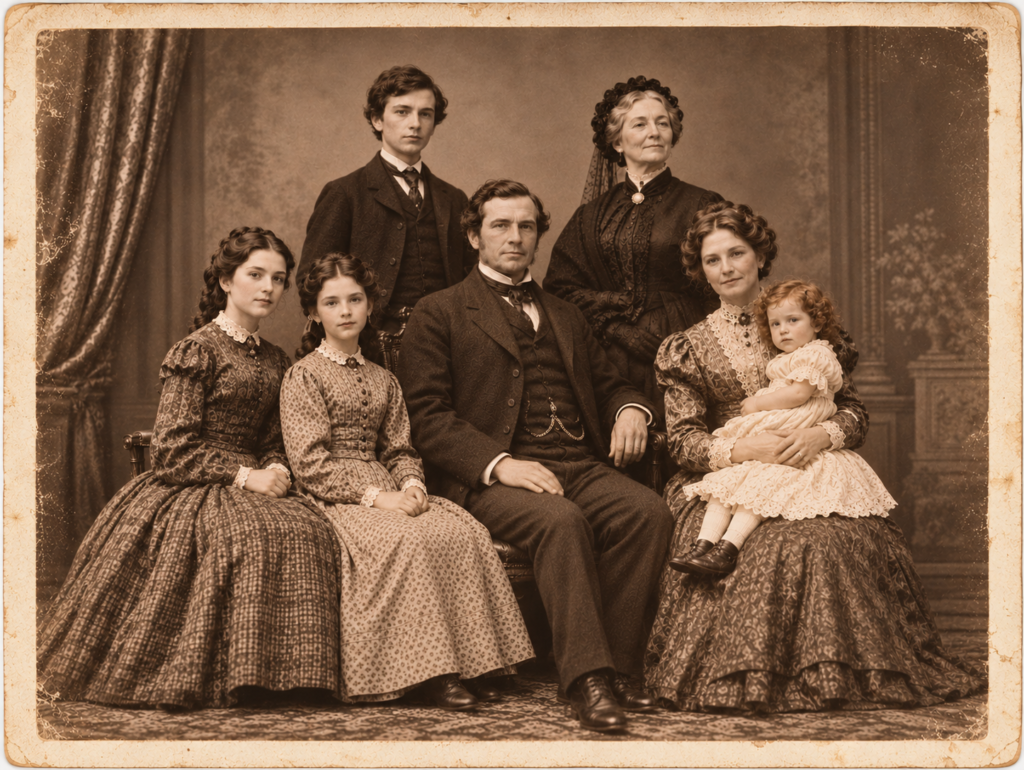
Another of Grandmamma’s visits to Faversham produced an occasion which surprised me almost as much as anything I can remember about her. Father had decided that we ought to have a proper family photograph taken, and Grandmamma was much in favour of the idea, although she naturally had definite opinions about how we should be arranged. She was sixty-six by then, and wore a dark half-mourning dress, as she continued to observe mourning for Grandpapa even after so many years.
She considered that Bertie ought to stand behind Father, that Amelia and I should sit together, and that Bella, being the youngest, should be held by Mother. Grandmamma herself was to be included, of course, and she took care that there should be no uncertainty about where she was to stand. Everyone was to look directly at the camera and, above all, remain perfectly still. The photographer, who had evidently dealt with families before, listened patiently, moved us about several times, adjusted the chairs and eventually declared that we were ready.
It was then that he asked Grandmamma to look pleasant. She regarded him for a moment before replying, quite seriously, “My good man, I have been looking pleasant for the last forty years. I see no reason to begin again today.” Father burst out laughing, and even Mother found it difficult to maintain her composure. I was astonished. I had never heard Grandmamma make such a remark, and certainly had not expected her to be the cause of so much amusement. The photographer, to his credit, managed to retain his professional manner, although I suspect he was relieved when we were finally allowed to leave.
I have kept that photograph all these years. Whenever I look at it, I remember Grandmamma’s remark to the photographer, and cannot help smiling. It is one of the few photographs in which we are all together, and I have always been rather fond of it.
Summers at Broadstairs
Our summers at Broadstairs remain among the clearest recollections of my childhood. We generally spent a fortnight by the sea, and Grandmamma Frances came with Aunt Catherine. They did not lodge in the same house as we did. Grandmamma insisted upon quiet and a room of her own, and four excited children, delighted to be near the sea, were more than she cared to endure under the same roof.
The arrangement suited everyone better than it might at first appear. We had our own boarding house, and Grandmamma and Catherine had another. We met during the day, walked together and sometimes took our meals in company, but the older ladies could retreat to their own rooms when the noise and activity became too much. The boarding houses varied from year to year, as did the precise arrangements, but the division between the two parties remained.
To us children, Broadstairs meant freedom. There was the shore to explore, the changing tide, the boats, the cliffs and the sand. We were eager to be out of doors, and I remember the pleasure of walking with the others, looking for shells and peering into rock pools. We were not always as careful as our mother would have wished, and returned to the house with damp hems, sandy shoes and pockets full of things which we considered treasures.
Grandmamma did not share our enthusiasm for such excursions. She preferred a measured walk and a comfortable chair, and she had little patience with noise or disorder. I remember her saying on more than one occasion that in her day children had been taught to be seen and not heard. I cannot say that this made us quieter, though it certainly made us more aware of when she was within earshot.
Catherine often accompanied her mother back to their lodging after an afternoon together. Afterwards she would sometimes go for a walk by herself. I noticed that she seemed particularly pleased when a certain gentleman, Mr Philip Redmond, appeared at Broadstairs. His visits had a curious regularity, but Catherine would greet him with a composure which did not quite conceal her pleasure. She was not a person who readily betrayed her feelings, and for that reason the change in her manner was all the more noticeable.
Of all our summer visits to Broadstairs, there is one small incident which I remember particularly, although at the time I thought very little of its significance. We had been staying there for several days when Philip Redmond appeared, as he often did, quite unexpectedly. He had a way of arriving without much announcement, and I always suspected that Aunt Catherine knew rather more about his intended visits than she admitted.
On this particular afternoon, we had all gone down towards the harbour. Bertie and I had been occupied with the boats, while Amelia was walking with Mother. Grandmamma and Aunt Catherine had remained a little behind, and Philip was accompanying them. I remember that the weather had been changeable. There was a brisk wind coming off the sea, and although the sun appeared from time to time, the air was not particularly warm. Aunt Catherine had brought a light shawl, which she had draped over her shoulders.
At some point, she dropped it without noticing. Philip picked it up and, rather than simply handing it back, placed it carefully around her shoulders. He said something to her which I could not hear, and she smiled at him in a way I had rarely seen her smile at anyone else.I thought it a very unnecessary fuss over a shawl, but what happened next puzzled me more.
Grandmamma, who had observed the exchange, remarked that Aunt Catherine was perfectly capable of looking after herself. Philip replied, with a smile, that he had never doubted it, but that there was no harm in making certain she was comfortable. Grandmamma made no answer, although I noticed that she looked rather displeased.
Later, when we were returning to the house, I found Aunt Catherine walking beside Philip. They were talking quietly, and although I could not hear what they said, I noticed that neither seemed particularly anxious to join the rest of us.
I asked Mother whether Philip was a relation of ours, since he seemed to visit so often. She said that he was a very old friend of Aunt Catherine’s, and that I need not concern myself with such matters. This seemed to me an unsatisfactory answer, but I did not pursue it.
I remember thinking that Philip was a very agreeable gentleman, and that Aunt Catherine seemed much happier when he was with us. I could not understand why Grandmamma did not appear equally pleased by his company. It was many years before I understood that there was considerably more to their friendship than I had imagined I shall have more to say about that in a later part of these memoirs.
Seasalter and other excursions
Not all our pleasures required a fortnight away from home. We sometimes went to Seasalter or Whitstable for an afternoon, when my father’s work allowed it or when my mother arranged an outing for us. Such expeditions were a welcome change from the town. We enjoyed the sea air, the open shore and the chance to walk without having to mind the traffic of the streets.
I remember the preparations almost as much as the outings themselves: food to be packed, shawls and extra clothing found, and some discussion as to whether the weather was likely to hold. My father was not always able to accompany us, for a doctor’s engagements cannot be arranged entirely at the convenience of his family. When he did come, he seemed glad to be away from his patients for a little while, though I doubt that he ever ceased to be alert to the possibility of being summoned.
The sea had a particular attraction for me. I liked to watch the tide and the small creatures left in the pools, and to collect shells whose beauty was often lost once they had dried. Bella, when she was old enough to join us, was inclined to make an occasion of everything. She would sing, talk and ask questions without pause, while Amelia preferred a more orderly walk. Bertie, when he was still at home, was usually interested in whatever could be found, climbed or examined.
One day Father took us to the beach with a kite and what seemed to me an enormous quantity of string. The wind was brisk, and the kite rose with astonishing speed. Higher and higher it went until it was carried out over the sea, where it became so small that we could scarcely make it out against the sky. We watched it anxiously, convinced that it would be lost altogether and that we should never see it again. Father, however, appeared entirely unconcerned. He began to wind in the string, steadily and without haste, and little by little the kite came back towards us. What had seemed to us an impossible distance was overcome with such ease that I remember being almost as impressed by Father’s calmness as by the kite’s return.
Bella finds her voice
Bella’s gift for recitation was not confined to the family parlour for long. In the autumn of 1875, when she was ten, she first performed before an audience beyond our own family and friends. The opportunity came through an evening of readings and music at the Faversham Institute, where local people gathered for lectures and entertainments. Someone who had heard Bella recite suggested that she might contribute a short piece.
Mother was not altogether certain that it was a good idea. Bella was still young, and the thought of her standing before a room full of strangers made her a little anxious. Father thought there was no harm in allowing her to try, provided she understood that it was an entertainment and not an occasion for showing off. Bella herself needed very little encouragement.
She chose a poem which I had heard her practise many times at home. She was dressed in her best frock, with her auburn hair carefully arranged, and appeared quite unconcerned by the number of people gathered in the room. I, on the other hand, was considerably more nervous on her behalf. When her turn came, she walked to the front and stood quite still while she was introduced. Then she began.
I had heard her recite the poem so often that I thought I knew exactly how it would sound. I was quite unprepared for the effect it had upon the audience. Her voice carried easily to the back of the room, and she gave each line a meaning and expression which seemed to make the words entirely new. She did not hurry, nor did she appear to be searching for the next line. She seemed to know precisely what she wished to convey, and held the attention of everyone listening.
When she finished, there was a moment’s silence before the applause began. It was not merely polite applause. People had genuinely enjoyed it, and several came to speak to her afterwards. Bella accepted their congratulations with a composure which I found remarkable. She seemed pleased, certainly, but not at all surprised. I believe she had rather expected that people would enjoy it.
Father was immensely proud of her, and Mother, who had been watching anxiously throughout, was much relieved. Bertie congratulated her and immediately began to explain how she might improve her breathing, which Bella informed him was quite unnecessary. Amelia said that she had done very well, although I suspect she was a little bewildered by the fuss. I remember walking home afterwards and hearing Bella talking animatedly about the evening. She wanted to know whether she might do it again, and whether there would be another opportunity to recite something different.
At the time, I thought it was simply another of Bella’s accomplishments, rather like her singing or her ability to imitate people. I did not yet understand that standing before an audience gave her a pleasure quite unlike anything she found in performing for us at home.
The following year, in 1876, when Bella was eleven, she took part in a small amateur theatrical entertainment in Faversham. It was not a professional production, nor anything on a grand scale, but it gave her an opportunity to do something rather different from reciting a poem. She was given a speaking part in a short play, and the rehearsals became a subject of great interest to her.
At home she would practise her lines, but she did not merely repeat them. She tried different ways of speaking, altered her expression and experimented with the movements which she thought belonged to the character. Sometimes she would ask me to listen and tell her whether a particular passage sounded natural. I was not always a useful critic, for I was so interested in watching her that I forgot to consider what she had asked.
On the evening itself, I was struck by the change in her. The girl who could be so lively and mischievous at home became entirely absorbed in the part she was playing. She listened to the other performers and answered them as though the words were occurring to her for the first time. There was one moment when another young performer hesitated over a line, and Bella managed to carry the scene forward without making the interruption obvious. I doubt that many in the audience noticed anything had gone amiss.
I had always known that Bella possessed a remarkable voice, but that evening I began to realise that her gift extended beyond the speaking of words. She seemed able to enter into the character she was portraying, and for the duration of the performance I scarcely recognised my own sister. Afterwards she was full of excitement, talking of the play, the other performers and what she might do differently another time. Mother and Father were pleased, though I do not think either of them regarded such entertainments as anything more than a pleasant accomplishment for a young girl.
Growing older
As the years passed, the household altered.
In 1869, when he was eighteen, Bertie left home for London to begin his medical studies at St Mary’s Hospital Medical School in Paddington. It was a considerable change for him, although Father was pleased that he had chosen to follow in his footsteps. He lodged near the hospital, and I believe he occasionally visited Grandmamma Frances, who lived in that area. We missed having him at Fairfield House, and his departure made me realise how quickly our childhood was passing. My mother kept his room for him, and for a time it remained much as he had left it. In due course, however, Bella, who had grown accustomed to having the run of the house, began to regard it as her own.
Amelia married Arthur Page in 1874 and established a home of her own. She has had three children; a girl and two boys, and appears to have found the life she always desired. We have never needed to wish for the same things in order to remain sisters, and I have always been glad that Amelia’s happiness has taken a form so different from my own.
After Bertie and Amelia had gone I found myself no longer one of the younger children, but a young woman with more freedom to decide how I should spend my time. Bella remained at home with our parents, and I was very fond of her company, but she was still a child when I began to think seriously about my own future.
I had no wish to marry merely because it was expected of me. Amelia had known what she wanted from an early age, and I was glad that she had found it. My own thoughts were less settled. I had books, family interests and the encouragement of Uncle Samuel, and I was content to continue learning. I had not yet met anyone with whom I could imagine sharing the remainder of my life.
And then, in June 1877, Uncle Samuel drew my attention to an archaeological excavation at Chedworth, in Gloucestershire, which he thought I should find of interest. He knew of my growing enthusiasm for ancient history and believed that the opportunity to see such work at first hand would be an invaluable experience.
The prospect was both exciting and rather daunting. Although I had travelled with my family on several occasions, I had never before contemplated making a journey of this kind entirely on my own. Gloucestershire seemed a considerable distance from the familiar surroundings of Faversham, and the thought of finding my way, arranging my own affairs and staying among strangers gave me some apprehension. I was no longer a child, of course, but this would be my first real venture away from home without the company of a member of my family.
Uncle Samuel was very encouraging. He helped me make the necessary arrangements for the journey and my accommodation, and reassured me that I should manage perfectly well. He made enquiries through his acquaintances and arranged for me to stay with a respectable family in the neighbourhood, where I would have a room of my own and take my meals with them. He was not one to make a fuss over what he regarded as a sensible project, and his confidence in me helped to overcome my hesitation.
It was a considerable undertaking for me to travel for this purpose, but I was eager to see the work at first hand. I had no idea that the expedition would prove to be of consequence in a way quite different from the one I anticipated.
Because it was there that I met Edward Alexander Hartford.
The story of our meeting, and of the life which followed, belongs to the next part of these recollections. For the present, it is enough to say that my childhood in Kent had given me the family, the habits of enquiry and the love of the past which were to accompany me into my adult life.