Written in 1881
Before I begin the account of my marriage, I should perhaps explain how it came about that I found myself at Chedworth in the summer of 1877, for it was a visit that changed the course of my life.
I had always been interested in the past, although at that time my knowledge was largely gathered from books, family conversations and such opportunities as presented themselves. When my Uncle Samuel brought the excavation at Chedworth to our attention, he suggested that I might find it both interesting and instructive. The prospect of seeing a Roman villa being uncovered, rather than simply reading about such places, appealed to me enormously.
And so, in June, I made the journey to Gloucestershire. I had no particular expectation beyond the pleasure of seeing something of the work for myself, and perhaps learning a little more about the people who had lived there so many centuries before. I certainly had no idea that the visit would prove to be of far greater significance than I could possibly have imagined.
It was there that I met Edward Alexander Hartford.
The meeting at Chedworth – June 1877
I had not been at Chedworth very long before I became aware of a gentleman who seemed to take a particular interest in the progress of the excavation. He was not one of the workmen, nor did he appear to be merely a visitor. He moved about the site with considerable familiarity, speaking with those engaged in the work and examining the finds with an attention which suggested a thorough knowledge of the subject.
I was standing near one of the exposed sections, trying to understand the arrangement of the foundations, when he approached.
“Are you finding the work interesting?”
I turned to find him looking towards the excavation rather than directly at me.
“Very much so,” I replied. “Although I confess I am not entirely certain that I understand everything I am looking at.”
He smiled.
“That is not unusual. Archaeology can be rather less straightforward than it appears. It is tempting to look at an object and imagine that we have discovered its story, when in fact we may have only begun to ask the right questions.”
He introduced himself as Edward Alexander Hartford. I learnt that he was an independent archaeologist with a particular interest in the ancient civilisations of Mesopotamia, and that he had travelled extensively in pursuit of his work.
We began talking about the Roman remains at Chedworth. I asked him several questions, some of which I suspect were rather elementary, but he answered them without the slightest suggestion that they were unworthy of consideration. Indeed, he seemed pleased that I was interested enough to ask.
I remember that he challenged one of my observations about the arrangement of the rooms, not unkindly, but in a way which made me reconsider what I had assumed.
“You may be right,” he said, “but we should be careful not to decide too quickly. We must consider what the evidence actually tells us.”
I found this a very agreeable way of discussing things. He did not lecture me, and I did not feel obliged to pretend to know more than I did. We were simply two people interested in the same subject.
I discovered that he was thirty-eight, fifteen years older than myself, and had never married. His life had been devoted largely to scholarship, travel and archaeological work. He spoke of these things with enthusiasm, but without the solemnity I had sometimes encountered in men who wished to impress others with their learning.
Before we parted, he suggested several books which he thought I might enjoy. I wrote down their titles, and he promised to send me some further references when he had an opportunity.
I returned to my accommodation that evening thinking that I had met a most interesting gentleman. I did not imagine that he would become the most important person in my life.
Our acquaintance develops – Summer 1877
After I returned to Kent, Edward wrote to me, sending the references he had promised and adding some further suggestions. His letter was principally concerned with archaeology, but there was a warmth and friendliness about it which made me very pleased to receive it.
A correspondence began, at first largely concerned with books and our shared interests. I found myself looking forward to his letters, although I told myself that this was simply because he was an unusually interesting correspondent.
It was not long before he found an opportunity to visit Faversham. He came to Fairfield House in July, having been invited to meet my parents.
My father received him with his usual courtesy, although I suspect he was naturally curious about a gentleman considerably older than his daughter who had already begun to write to her so regularly.
Edward was entirely at ease. He spoke readily about his work, his travels and his interests, and answered my father’s questions without appearing either defensive or boastful.
My father asked about his family. Edward explained that both his parents were dead, and that he had inherited sufficient means to pursue his interests independently. He had been born in Cirencester, but no longer felt particularly attached to the house there.
“I have spent a good deal of my life travelling,” he said. “I should rather like to establish a home somewhere that has a little more immediate meaning for me.”
My father asked whether he expected to return to Cirencester.
“Not necessarily. I have no particular reason to remain there. I should prefer to make a home somewhere that suited the life I hope to lead.”
At dinner, Edward and I fell into conversation about the excavation at Chedworth. I disagreed with one of his observations, and he appeared to find my objection amusing.
“I see you have not abandoned your habit of questioning everything,” he remarked.
“I hope not. Otherwise I should never learn anything.”
“Quite so. It would be a very dull business if you simply agreed with everything I said.”
I noticed my father watching us with some interest. Edward was not merely answering my questions; he was listening to my opinions and responding to them as though they mattered.
After dinner, Bella joined us in the drawing room. She was twelve at the time, and had never been particularly shy about speaking to adults.
She soon began asking Edward about his travels.
“Have you really been to Egypt?”
“Yes.”
“And did you see mummies?”
“Several.”
“Were they frightening?”
“Not particularly. They were rather more inclined to remain where they were than most people I have met.”
Bella considered this.
“Would you take me to see them?”
“I think you would have to ask your parents about that.”
Bertie, who was also present, reminded Bella that she had enough difficulty staying out of the flower beds at home.
“That’s quite different,” she replied. “Flowers don’t contain Roman things.”
Edward laughed, and I could see that he was thoroughly enjoying her company.
Later, Bertie and Edward talked about medicine and archaeology. Bertie was already a qualified doctor, working in a hospital, and I was pleased to see that they found plenty to discuss. Bertie was naturally protective of me, and I suspect he had initially wondered whether a man of Edward’s age would understand his younger sister. But Edward’s manner soon put him at ease.
Before Edward left, my parents invited him to visit again. He accepted with evident pleasure.
I remember my father saying afterwards that Edward was older than he had expected, but that he rather liked him.
“I think he understands our Jemima,” he said.
My mother agreed. She had noticed that I had been entirely myself in his company.
“Yes,” my father replied. “That was what pleased me.”
Edward returned several times during the following weeks. On one occasion he brought me a book which he thought I should find useful.
“You seem to have acquired a great many reasons for coming to Faversham lately,” I remarked.
“Have I?”
“I believe you have.”
“Then I must endeavour to find a few more.”
I was beginning to understand that his visits were no longer solely about archaeology.
Getting to know one another – Late Summer 1877
One afternoon we went for a walk near Fairfield House. Our conversation turned to the future, and Edward asked me whether I had any particular plans for my life.
I told him that I had not.
“Have you never thought what you might do if you did not marry?” he asked.
“I have thought about it, but I don’t believe my parents expect me to do anything in particular. They know me well enough to understand that I should not be happy following a path simply because somebody else had decided it was suitable.”
“And what would you choose?”
“I should like to continue learning. There is so much I do not know, and so much I have yet to discover. I don’t think I shall ever be short of something to interest me.”
He looked at me with a thoughtful expression.
“I begin to understand you rather better, Jemima.”
I was pleased by his response. I had no wish to be regarded as a young woman whose only ambition was to make a suitable marriage. I wanted to be valued for my own mind and character.
It was perhaps in September that we had our most revealing conversation. We were sitting together by the fire one evening when Edward spoke about his life before he had met me.
He explained that he had never expected to marry. He had been content with his work, his books, his travels and his independence. He had enjoyed the company of friends and had never felt that anything was missing.
“I have never been opposed to marriage,” he said. “I simply never met anyone with whom I wished to make the necessary adjustments.”
I asked whether he had never encountered anyone he might have wished to marry.
“Not until now.”
He spoke without any great display of emotion, but I understood what he meant.
“I have begun to think those things might be all the richer if I had someone with whom to share them.”
“And you think that person might be me?”
“I do.”
I was not entirely sure what to say. I knew that I had become very fond of him, but it was a remarkable thing to hear him speak so openly.
I realised that he was not proposing to abandon the life he had made for himself. He wanted to share it with me, just as I wanted to share mine with him.
The proposal – October 1877
It was in October that Edward asked me to marry him.
We had been walking near Fairfield House, and I remember that the afternoon was particularly pleasant. He seemed rather quieter than usual, and I asked whether anything was troubling him.
“Not troubling me, Jemima, but there is something I have been wishing to speak to you about.”
“You sound rather serious, Edward.”
“I suppose I am.”
He stopped and turned towards me.
“I have been thinking a great deal about the future, and I have come to realise that I should very much like you to be part of mine. I know we have not known one another for very long, but I am quite certain of what I want. I propose to ask you to marry me, Jemima.”
I remember looking at him and feeling an extraordinary happiness.
“Yes, Edward. I should like that very much.”
He took my hand, and I knew that I had made the right decision.
He spoke to my father formally afterwards, as was proper, and I was pleased that my parents were genuinely happy for us. My father had initially wondered about the difference in our ages, but he had come to know Edward and had seen how naturally we were suited.
Bella was delighted. She wanted to know whether Edward would now live in Kent and whether he would continue to visit us.
“I shall be living somewhere in Kent,” Edward told her, “and I expect you will see rather a lot of me.”
“Good,” she replied. “I should miss you if you didn’t come.”
Amelia was equally pleased, although she could not resist teasing me about the shortness of our courtship.
“I cannot think how you have managed it, Jemima. I knew Arthur for five years before I was allowed to marry him, and you have scarcely known Edward for six months!”
“Perhaps Arthur was simply more patient than Edward,” I replied.
Edward, who had overheard us, laughed.
“I have taken thirty-eight years to reach it, Jemima. I don’t see the need to spend another five deciding.”
We had decided that we would make our home in Kent. Edward did not wish to impose a house upon me, and suggested that we should rent somewhere initially and then find a home together once we had decided exactly where we wished to live.
I was particularly pleased by this. It was to be our home, chosen by us both.
Christmas 1877
Edward spent Christmas with us at Fairfield House, and by then he had become very much a part of the family.
Bertie was home from his work at St Mary’s Hospital, and Bella was delighted to have Edward’s company for several days. She seemed to have acquired an endless supply of questions for him, and he was always willing to answer them.
He never treated her as though she were merely a child to be indulged. He listened to her opinions, teased her gently and encouraged her curiosity.
Bella gave him a small leather notebook for Christmas, explaining that he could use it to write down his discoveries.
“That is very thoughtful of you,” he said. “I shall have to be careful what I write in it.”
“Why?”
“Because I suspect you will want to read everything.”
“I probably shall.”
He laughed and thanked her.
Edward gave me a beautifully bound book which I had admired some weeks earlier. I was touched that he had remembered.
The days passed pleasantly, with family meals, conversation and the usual Christmas festivities. I remember thinking how fortunate I was that the man I loved should also be so readily welcomed by those closest to me.
Bella asked whether she would be able to visit us once we were married.
“Of course,” I told her. “You will always be welcome.”
“And Edward will be there?”
“I hope so.”
“Well, that’s all right then.”
Our wedding – 1 January 1878
Edward and I were married on the first of January 1878, which was also my twenty-third birthday.
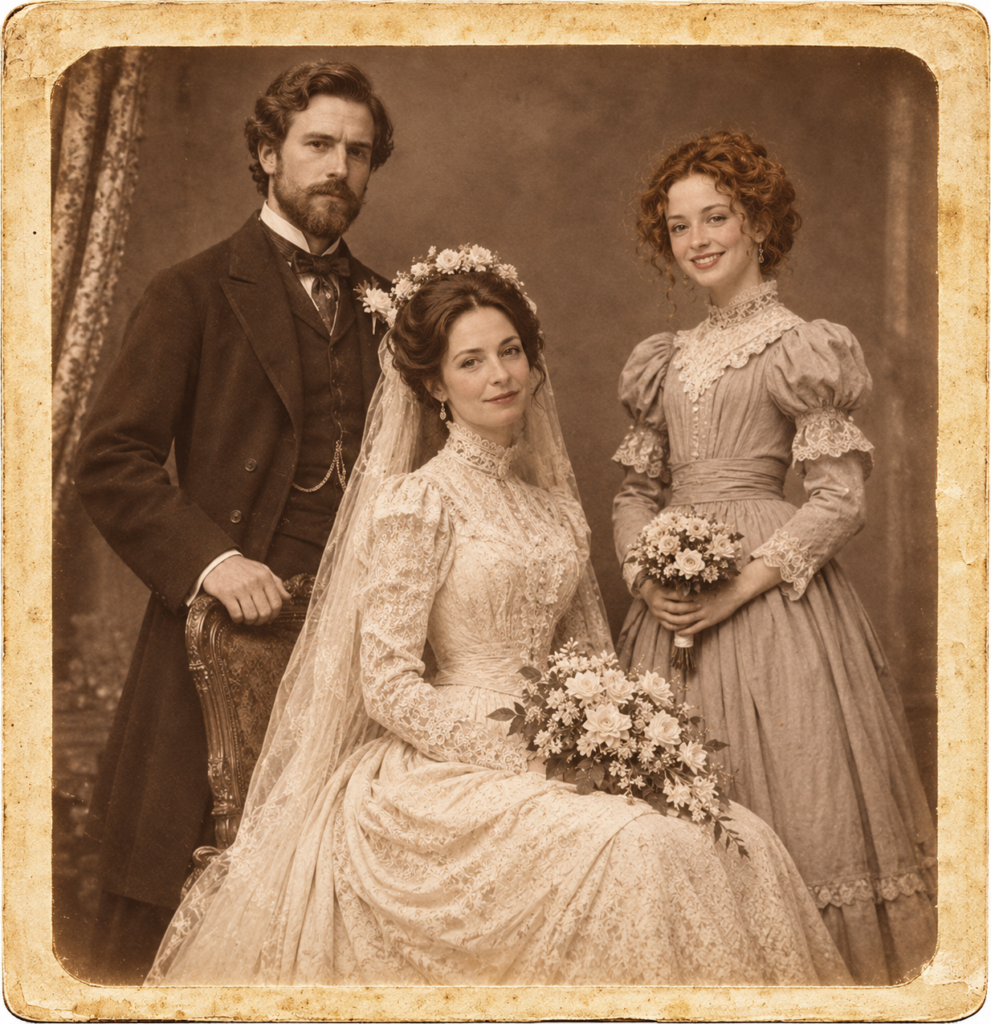
It was a modest family wedding in Faversham. I wore an ivory silk gown with lace and a veil, and Bella was my principal bridesmaid. She wore a pale lilac dress and seemed to consider the occasion almost as important as I did.
When she saw me dressed for the ceremony, she looked me up and down and announced:
“You look much nicer than you usually do.”
I laughed, and my mother immediately told me not to do so too much in case I disturbed my hair.
The service was a happy one. My father gave me away, my mother watched with evident pleasure, and Bella stood beside us looking very solemn and important.
I remember Edward’s expression when he first saw me. He had always been composed, but there was such affection in his face that I found myself smiling.
We were married, and I became Mrs Edward Alexander Hartford.
A few days later we went to a photographer in Faversham to have a formal wedding portrait taken. We dressed again in our wedding clothes, and Edward insisted that Bella should be included.
“I don’t think a wedding photograph would be complete without you,” he told her.
The photographer arranged me seated, with Edward standing beside me and Bella at the other side. She whispered that she did not think she could look so serious for very long.
“Only for a moment,” Edward replied.
“I shall look like a governess,” she muttered.
Edward was obliged to turn away to conceal his laughter.
The photograph has remained one of my most treasured possessions.
Our honeymoon – January 1878
We spent our honeymoon on the Isle of Wight, staying at Ventnor for about a week.
It was January, and although the weather was not always kind, we enjoyed the change of scenery and the opportunity to explore together. Edward was particularly interested in the geology of the island, and I discovered that he could become almost as enthusiastic about a curious rock formation as he could about an ancient tablet.
We visited Alum Bay and admired the coloured sands, and went to see the Needles. We also visited Carisbrooke Castle.
I remember how much I enjoyed simply being with Edward without the usual interruptions of family life. We walked, talked, read and explored. There was no particular schedule to observe, and we were free to spend our days as we pleased.
We has collected a small souvenir of the coloured sands at Alum Bay. It was not a valuable object, but it reminded us of our first journey together as husband and wife.
Finding our home in Canterbury – Spring 1878
After our return, we rented a modest house in Canterbury while we considered where we should settle permanently.
We were both pleased to be in the city. I had always liked Canterbury, and Edward found much to interest him in its history and architecture.
During one of his walks through the streets, he noticed a house in Blackfriars Street which was available for purchase. He mentioned it to me that evening, and we arranged to view it together.
It was comfortable rather than grand, with a sitting room, dining room, two bedrooms and a small garden. Upstairs there was a study which Edward immediately took a particular interest in.
The room had a window overlooking the city, with a lovely view towards Canterbury Cathedral.
Edward stood beside me as we looked out.
“What do you think?” he asked.
I looked towards the Cathedral and then around the room.
“Oh, Edward. I think I could be very happy here.”
He smiled.
“I rather thought you might say that.”
We both felt that the house would suit us. It was not imposing, but it had character, and the study seemed almost made for Edward.
The purchase took some months to complete, as the necessary legal arrangements had to be made, but by late spring or early summer we were able to move in.
I soon came to love Blackfriars Street. It was our first real home together, and we made it our own in every sense.
Edward’s study gradually filled with books, papers, maps and drawings. He had a remarkable ability to put something down in a perfectly safe place and then spend half an hour searching for it.
I once asked him how he ever managed to find anything.
“I have a system,” he replied.
“Does it work?”
“Most of the time.”
“Then why are you looking for something?”
He laughed.
Bella visited frequently, and before long the spare bedroom had become almost hers. She was always welcome, and Edward seemed to enjoy having her about.
Our evenings were often spent together in the sitting room, with Edward reading or working on his correspondence and myself occupied with books or notes of my own. We talked a great deal, and I discovered that marriage had not diminished my independence in any way. If anything, Edward encouraged me to pursue my interests more enthusiastically.
He also enjoyed selecting our wines. Saint-Émilion became our usual claret at dinner, while Château Margaux was reserved for special occasions. I developed a particular fondness for sherry in the evening, which Edward was always happy to provide.
The death of Grandmama Frances – July 1878
In July 1878, my grandmother, Frances Mary Louisa Fairfax Kingsley, died at the age of seventy-nine.
I had never found Grandmama an easy person to know. She held very definite opinions about duty, propriety and the way in which people ought to conduct themselves. Her ideas were those of her generation, and she had little patience with anyone who appeared to question established expectations.
I respected her as my grandmother, but I cannot honestly say that we had been particularly close.
Her death affected me, though perhaps not in the way I had expected. I was sorry that she had died, and I recognised that she had been an important figure in our family. But I did not experience the profound grief which I thought I ought to feel.
I mentioned this to Edward after the funeral.
“I feel rather guilty,” I told him. “I know I should be more distressed.”
He looked at me thoughtfully.
“Why should you feel guilty?”
“She was my grandmother.”
“That is true, but it does not mean you must pretend to feel something you do not.”
“I did respect her.”
“Of course you did. But respect and affection are not always the same thing.”
I was relieved by his understanding.
“You would have found it difficult to be anyone other than yourself, Jemima,” he said.
I smiled at that, for he knew me well enough to understand that I could not easily pretend to be what others expected.
At the gathering after the funeral, my Aunt Catherine spoke to me privately. She told me that she and Philip Redmond intended to marry after the customary period of mourning.
I had known of their affection for one another for many years. I remembered the occasions when Philip had visited us at Broadstairs, and I had long suspected that their attachment was much deeper than Grandmama had ever wished to acknowledge.
Catherine explained that after her father’s death she had felt unable to leave her mother. Grandmama had depended upon her, and had once said to her, “Don’t leave me, Catherine.”
Philip had understood. He had waited, without pressure or reproach, leaving the decision entirely in Catherine’s hands.
“He has waited a very long time, Jemima,” she said. “I think he can manage another three months.”
I told her how pleased I was for them both.
In November, after the period of mourning, Catherine and Philip were married. Edward and I were witnesses, and it was a quiet, happy occasion.
At the wedding breakfast, Catherine spoke to me again about the years she had waited.
“I could not have left Mother when she needed me,” she explained. “Philip understood that. He never made me feel that I was choosing between them.”
I was glad that they had at last been able to marry. Their happiness seemed all the more precious because it had been so patiently achieved.
1879 – A year of changing fortunes
The early months of 1879 brought an unexpected change to my own life. I discovered that I was expecting a child.
Neither Edward nor I had anticipated it quite so soon, but we were both pleased by the news. We began, quietly, to imagine what our family might become.
Sadly, the pregnancy did not continue. I suffered a miscarriage, and although I recovered physically, the loss was a private sorrow for us both.
We told no one. I did not even confide in my father, who was a doctor. It was something Edward and I kept between ourselves.
He was very attentive during that time, and I was grateful for his kindness. We did not speak of it constantly, but I knew that he shared my disappointment.
Later in the year, Amelia gave birth to her fourth child, a little girl named Lily Jane. I was genuinely delighted for her, and I was very fond of the children. Yet I could not help thinking privately of the child Edward and I might have had.
Bella, who was visiting us one afternoon, looked at me with an expression of great seriousness.
“Jemima, is that all Amelia does, have babies?”
I looked at her in astonishment.
“Bella! What a thing to say!”
“Well, she has an awful lot of them.”
Edward, who had overheard the exchange, laughed so heartily that Bella looked rather pleased with herself.
It was one of those moments which reminded me that, even in the midst of life’s disappointments, there was still plenty of room for laughter.
Archaeology and the beginning of new interests – 1879
Edward’s work continued to occupy much of his time. When he was not travelling, he spent long hours in his study, reading, writing and corresponding with other scholars.
He was an independent archaeologist and had considerable freedom to choose the work he undertook. His particular interest remained the ancient civilisations of Mesopotamia and the cuneiform tablets which had revealed so much about their history.
He sometimes invited me to accompany him on visits to archaeological sites, and I was always pleased when circumstances allowed me to do so.
During the summer of 1879, we visited a Roman villa excavation near Wingham in Kent. Edward had been invited by an antiquarian acquaintance who was overseeing the work.
I was fascinated by the exposed foundations and the fragments of pottery and painted plaster which had been recovered.
Edward explained that the position in which an object was found could be just as important as the object itself. A piece of pottery found in one room might tell us something quite different from a similar piece discovered elsewhere.
I began to appreciate that archaeology was not simply a matter of collecting interesting objects. It was about understanding the lives of the people who had used them.
On one occasion I noticed a small object lying in a shallow tray with several other finds. It was a little bronze hairpin, slightly bent, with a modest decorative head.
“Do you suppose it belonged to the lady of the house?” I asked.
“Possibly,” Edward replied. “But it might equally have belonged to one of the servants, or perhaps a visitor.”
“How extraordinary. Someone wore this, perhaps every day, and then one day it was lost. And here we are, finding it nearly eighteen hundred years later.”
“You seem to have become rather attached to our little hairpin.”
“I think I am more interested in its owner.”
Edward smiled.
“And that, Jemima, is perhaps not such a bad way of looking at archaeology.”
I made a note of it in my notebook. I was interested not so much in the value of the object as in the unknown person to whom it had once belonged.
I did not then realise how often I would find myself thinking about that little hairpin in later years.
The importance of an object’s history – 1880
In the spring of 1880, Edward took me to visit a private collection belonging to an antiquarian acquaintance in Canterbury.
The collection included Roman and Anglo-Saxon objects, pottery, glass, coins and various pieces of metalwork. I found it most interesting, although I was surprised to discover that some of the objects had little information attached to them.
I asked Edward whether this made it difficult to understand their significance.
“Very much so,” he replied. “An object without a reliable account of where it was found, or the circumstances in which it came to light, can tell us only so much.”
I considered this for a moment.
“It is rather like receiving a letter without an address. We may read the words, but we cannot know where it came from or to whom it was intended.”
Edward looked at me with evident approval.
“That is an excellent comparison.”
Our host laughed and agreed that it was a very sensible way of describing the problem.
I began to understand that the history of an object was not always contained in the object itself. One had to establish where it had come from, who had handled it and what had happened to it before it entered a collection.
Later that year, I brought Edward a small newspaper cutting which reported the discovery of a Roman burial during building work somewhere in Kent.
The account was brief and rather unsatisfactory. It mentioned that objects had been found, but gave little information about the precise location, the people who had discovered them or what had happened to the objects afterwards.
“What would you want to know?” Edward asked when I showed him the report.
I considered the question.
“I should like to know exactly where the burial was found. I should want to know who was carrying out the building work, whether anyone had recorded the objects, and where they had gone afterwards.”
“Good. And how might you find out?”
“Perhaps there were other newspaper reports. Or correspondence about the building work. Someone must have known more than this account tells us.”
Edward smiled.
“You have identified several useful lines of enquiry.”
We looked for further references, but the information remained incomplete. There was no certainty about what had happened to all the objects, and we could not establish the full circumstances of the discovery.
I found this frustrating, but Edward reminded me that it was not unusual.
“Sometimes the evidence is incomplete, Jemima. We must be willing to accept that, even when we should prefer a more satisfying answer.”
I began to understand the importance of patience, of comparing one account with another, and of not accepting the first explanation simply because it appeared in print.
Edward never set out to teach me these things. He simply encouraged my questions and took my interest seriously.
I was beginning to discover that the methods he used in archaeology could be applied to many other subjects. An object had a history, and so did a person. The challenge was to find the evidence which allowed us to reconstruct it.
The proposed expedition – Early 1881
By the beginning of 1881, Edward had begun to speak increasingly often of another expedition to Mesopotamia.
There was a possibility of undertaking further work at a site which had already attracted considerable scholarly attention, and Edward was eager to take advantage of the opportunity.
His study was soon covered with maps, letters and lists of arrangements. He was in correspondence with several acquaintances, and there was much to be settled before the expedition could begin.
I was as excited as he was, for this time I was intending to accompany him.
I had always enjoyed hearing about his travels, and I was delighted at the prospect of seeing something of the country for myself. We began discussing the journey together, and I made lists of the things I thought we might need.
Edward was particularly concerned about the amount of luggage I proposed taking.
“Jemima, we are not establishing a library in Mesopotamia.”
“I should have thought that a few books would be useful.”
“A few, certainly. But you appear to have selected enough to occupy the greater part of our luggage.”
“Then perhaps you should be grateful that I have not yet considered my clothes.”
He laughed and returned to his packing list.
We spoke of the places we hoped to visit and the work he intended to undertake. Edward was particularly pleased that I should be joining him. He had spent much of his life travelling alone or with colleagues, and the prospect of sharing such an expedition with his wife gave him considerable pleasure.
I was looking forward to it enormously.
Unfortunately, circumstances were soon to change.
Amelia was expecting her fifth child, but this pregnancy was proving much more difficult than her previous ones. She was often unwell and increasingly obliged to remain in bed. Arthur was naturally concerned, and it became apparent that she would need more help than usual as the time of her confinement approached.
I visited The Elms more frequently and became increasingly worried about her.
One afternoon Arthur spoke to me privately.
“She is not herself, Jemima. I know she is in good hands, but I think it would reassure her to have you here more often.”
I promised that I would come whenever I could.
When I returned home, Edward immediately realised that I was troubled.
“You are thinking of staying,” he said.
“I don’t know yet. I don’t want to abandon our plans, Edward. I have looked forward to this journey as much as you have.”
“I know you have.”
“But Amelia is not well. I don’t think I could leave her, particularly when the time comes.”
He was silent for a moment.
“No, I don’t think you could. And I should not wish you to feel that you ought to.”
“But you wanted me to come.”
“Very much.”
“And I wanted to go.”
“I know that too.”
Neither of us spoke for a little while.
At last Edward said, “I had been looking forward to showing you Mesopotamia, Jemima.”
“And I had been looking forward to seeing it with you.”
“There will be another opportunity.”
“Yes,” I said. “There will.”
He smiled, but neither of us was quite able to take comfort from that assurance.
We agreed that I would remain in England. It was a real disappointment to us both. We had planned the journey together, and I had imagined all the things we should see and do. Edward did not reproach me, nor did he ever suggest that I should have acted differently. But I knew how much he had wanted me beside him.
We continued to make preparations for his departure, although the lists which had once been for two now had to be revised.
I was sad to see him go without me, but neither of us imagined that this would be the last journey he would make.
August 1881 – Violet Elizabeth
As the summer advanced, Amelia’s confinement approached. I spent much of my time at The Elms, and although I was anxious about her, I was relieved that Arthur had arranged whatever assistance was needed.
In August, Amelia gave birth to a little girl, whom they named Violet Elizabeth.
The birth was not without difficulty, but both mother and child survived, and I was profoundly thankful.
Amelia’s recovery was slow, however, and she needed considerable rest and care. I remained with her for much of the following weeks.
I was glad that I had stayed in England, though I could not help thinking of Edward and wondering how his expedition was progressing.
His letters were a great comfort. He wrote of the journey, of the people he had met and of the work they were undertaking. He included small observations which he knew would amuse me, as well as more detailed accounts of the discoveries.
In one letter he described an uncomfortable journey during which he had spent several hours in the company of a gentleman who had mistaken his archaeological interests for a passion for collecting curiosities.
“Had I known,” Edward wrote, “that I was to be required to explain the difference between an ancient tablet and a particularly unattractive piece of pottery, I might have chosen a different travelling companion.”
I laughed when I read it, and made a mental note to tease him about it when he returned.
I had no reason to suppose that anything was amiss. Edward was doing what he had always loved, and I expected him to return to me when his work was finished.
September 1881 – The news
The first weeks after Violet’s birth passed in a confused succession of visits, nursing, household arrangements and anxious enquiries about Amelia’s recovery.
I divided my days between The Elms and our own home in Canterbury. Edward’s letters were my greatest pleasure, and I read them whenever I had a quiet moment.
I was expecting another letter when the news came.
It was an ordinary morning in Canterbury. I had returned from The Elms and was in the sitting room when the servant announced that a gentleman wished to see me. He had travelled some distance and had brought a letter addressed to me.
I assumed there had been some difficulty with the expedition, or perhaps a change in Edward’s arrangements.
The gentleman who entered was a stranger to me. He was dressed in dark travelling clothes and carried a small leather case. He seemed uncomfortable, and I noticed that he did not sit down immediately.
“Mrs Hartford?” he asked.
“Yes.”
He gave his name and explained that he had been associated with the expedition.
“I am very sorry to have to bring you such distressing news.”
I cannot remember precisely what he said next. I remember only certain words, and the terrible effort it took to understand them.
There had been an accident at the excavation.
Edward had been killed.
For a moment I could not make sense of what I was hearing. I looked at the gentleman, waiting for him to correct himself, to explain that there had been some mistake, that Edward was injured perhaps, or that he was being brought home.
But there was no mistake.
He told me that Edward had been working at the site when part of the excavation gave way. There had been an unexpected collapse, and although those nearby had done what they could, Edward had suffered fatal injuries.
I asked whether he had died immediately.
The gentleman answered that he believed he had, although I cannot now recall his exact words.
I remember asking when it had happened. I remember asking whether Edward had suffered. I remember that the gentleman tried to answer as gently as he could.
And I remember thinking, with an absurd clarity, that Edward had promised to write.
He explained that arrangements were being made for Edward’s remains to be brought back to England, though this would take some time.
When he had gone, I remained in the sitting room. The house was quiet. On the table lay the last letter I had received from Edward, and beside it the map we had used when planning the expedition.
I could not bring myself to touch either.
Bertie happened to be in Canterbury at the time, and came to me as soon as he heard. My father and mother also came from Faversham, and Bella was also with me that day.
I tried to explain what had happened, but the words would not come.
“Edward is dead, Bella,” I managed at last.
She stared at me.
“No,” she said. “No, Jemima.”
She came and put her arms around me, and it was then that I began to cry.
Only a few weeks earlier we had been planning the journey together. I had expected him to return with stories to tell, discoveries to describe and perhaps some small object which he would insist was of particular interest, even if I could not immediately see why.
Now there would be no more letters, no more conversations, no more journeys together.
And there would be no return.
The days that followed
I have often wondered how I managed the days immediately following the news of Edward’s death. They remain in my memory, but not in any very clear order. There were people coming and going, letters to be answered, arrangements to be made and questions to which I could scarcely bring myself to listen.
My father was deeply distressed. He had grown very fond of Edward, and I think he felt his loss almost as a member of his own family.
My mother took charge of the practical matters which I seemed quite incapable of considering. She made certain that I ate something, persuaded me to rest, and quietly dealt with the callers who came to offer their condolences.
Bertie was a great comfort to me. He was close at hand, and I was grateful for his practical help and quiet companionship.
Bella stayed with me that day and was unusually quiet. She had been accustomed to Edward’s visits, his jokes and his patience with her endless questions.
“Will he really not come home, Jemima?” she asked at last.
I took her hand.
“No, darling. I’m afraid he won’t.”
She looked down at our hands.
“But he was always coming back.”
There was nothing I could say to that.
“He loved you very much, Bella,” I said.
“I know,” she replied, and began to cry.
The gentleman who had brought the news had explained that Edward’s companions were gathering his personal belongings and making arrangements for his remains to be returned to England.
I was told that Edward had not suffered for long. I found some comfort in that, although no account of his final moments could make his death easier to bear.
I went into his study only once during those first few days. His papers were still spread across the desk, and there were books open beside the maps he had been using for the expedition. A pencil lay where he had left it. His spectacles were beside a letter which he had evidently been reading before he went away.
I stood for a long time looking at them.
I could almost hear him moving about the room, searching for something he had put down moments before, or calling to me to ask whether I had seen a particular paper.
I did not alter anything. I could not bear to put away his things, and I left the room much as he had left it.
My father visited frequently. He did not attempt to persuade me that time would make everything right, nor did he offer the familiar assurances that I was young and might one day make another life for myself. I was grateful to him for that. I did not want to think about another life. I wanted the one I had been living with Edward.
Amelia was very distressed when I was finally able to visit her. She was still recovering, and I could see that she felt guilty that I had remained in England because of her.
“Jemima, if only you had gone with him,” she said.
I took her hand.
“Amelia, you mustn’t think that. I stayed because I wanted to stay. You needed me, and I would have made the same decision again.”
“But you had been looking forward to it so much.”
“I know. And Edward was disappointed too. But neither of us had any idea what was going to happen.”
I had no wish for her to carry the burden of believing that my decision had somehow caused Edward’s death. It had not. The accident was a terrible misfortune, and nothing I might have done differently could alter that.
Violet was sleeping in her cradle nearby. I looked at her tiny face and thought how strange it was that, within the same family, one life should have begun just as another had ended.
I was glad that Amelia and her little daughter were safe. But I could not pretend that my own sorrow was diminished by these things.
October 1881 – Edward comes home
It was not until October that Edward came home.
The journey from Mesopotamia had been long and difficult, and there had been delays in making the necessary arrangements for his remains to be returned to England. I was grateful to those who had taken such care of him, and to the men who had undertaken the arrangements, but the waiting seemed almost unbearable. Each passing week brought the knowledge that he was still so far away, and that I could do nothing to hasten his return.
At last, word came that the ship carrying his coffin had reached the Port of London. My father, Bertie and I travelled to London to receive him. I scarcely remember the journey. I know that my father tried to talk to me, and that Bertie remained close beside me, but my thoughts were elsewhere. I had imagined Edward’s return so many times, but never in this way.
At the port, arrangements had been made for the coffin to be brought ashore. There were officials to speak to, papers to be completed and practical matters to be settled. I remember very little of these details. My father dealt with most of them, while Bertie stayed with me. I was conscious only of the coffin itself, and of the terrible finality of seeing his name upon it.
I had thought that when Edward came home I might somehow feel that the waiting was over. Instead, the sight of his coffin made his death more real than it had ever seemed before. Until then, some small part of me had continued to imagine him returning, perhaps walking through the door of our house in Blackfriars Street, tired from his travels but smiling as he always did.
That could never happen now.
We made the arrangements for his coffin to be taken by rail to Canterbury. My father insisted that I should not have to concern myself with the practical details, and I was too exhausted to argue. I remember standing beside him and Bertie as we prepared to leave the port, feeling that I had somehow travelled a very long way only to arrive at the beginning of another journey.
Edward was home, but I could not yet bring myself to think of what that meant.
His funeral would take place on the first of November in Canterbury Cathedral, which had been such a familiar presence in our daily lives.
1 November 1881 – Edward’s funeral
The first of November was a cold, grey day. It was All Hallows’ Day, and I remember thinking that the Cathedral seemed particularly solemn beneath the November sky.
Edward’s funeral service was held there, in the place which had become such a familiar part of our life in Canterbury. I had wanted him to be laid to rest in the city we had chosen together, and I was grateful that this had been possible.
My father and mother accompanied me, as did Bertie and Bella. Amelia was still not sufficiently recovered to be come to the funeral although she had sent a message expressing her sorrow and her regret that she could not be with us. Arthur remained with her and the children.
A number of Edward’s friends and professional acquaintances also attended. Some had known him through his archaeological work, others through his scholarly associations. I was touched by the number who had come, and by the affection with which they spoke of him. It was comforting to discover how widely he had been respected, not merely for his knowledge, but for his generosity and good humour.
The service itself remains rather indistinct in my memory. I remember the great height of the Cathedral, the sound of the prayers and hymns, and the feeling that I was somehow watching events from a distance. I heard the words, but they seemed to belong to another person.
Bella sat beside me throughout. She was very quiet, and I could feel her hand resting in mine. She had lost someone who had been much more than a brother-in-law to her. Edward had taken a genuine interest in her, listened to her opinions and encouraged her curiosity. He had never made her feel that she was merely a child to be indulged.
After the service, Edward was taken to Canterbury City Cemetery, where he was laid to rest. I remember standing beside his grave with my family around me. My father held my arm, and my mother stood close on the other side. Bertie was behind us, and Bella remained beside me.
I had thought that seeing him brought home would allow me to accept that he was gone. But standing there, I found that I could scarcely comprehend it. The man who had once walked beside me through the streets of Canterbury, who had shared my hopes and plans, who had filled our house with books and conversation, was now beyond my reach.
I wanted to remember him as he had been: smiling across the dinner table, laughing at one of Bella’s remarks, or leaning over his desk to show me something he had discovered in a book. I did not want my last memory of him to be one of sorrow.
When we returned to Blackfriars Street, the house seemed unbearably quiet. My father and mother stayed with me for a while, and Bertie promised to come again the following day. Bella, who had been reluctant to leave, eventually went with them, though not before asking whether she might return soon.
“Of course you may,” I told her. “You must come whenever you wish.”
She kissed me and said, “I shall miss him, Jemima.”
“So shall I, darling. Every day.”
When they had all gone, I found myself alone in the house for the first time since Edward’s return.
I went upstairs to his study and sat at his desk. His maps were still there, and the papers relating to the expedition. I could see the route we had once intended to travel together, marked in his familiar hand.
I did not remove them.
For a long time I sat quietly, thinking of the life we had shared. We had been married for less than four years, and yet those years had contained more happiness than I could ever have expected. I had been fortunate enough to know a marriage in which I was loved and respected, in which my opinions mattered, and in which I had never been asked to become someone other than myself.
I knew that I must learn to live without him, but I could not yet imagine what such a life might be.
For the present, I had only the memories, and I held on to them.
Edward’s will – November 1881
A few days after the funeral, I received a letter from the solicitors who had acted for Edward in his personal and financial affairs. They requested that I attend their offices to discuss his estate and the provisions he had made in his will.
I had known, of course, that Edward was comfortably provided for. His parents had left him a considerable inheritance, and he had always been in a position to pursue his archaeological interests without having to concern himself with earning a living. But he had never been one to speak much about money, and I had never thought it necessary to enquire into the precise extent of his affairs.
I went to the solicitors’ offices accompanied by my father. I was grateful for his presence, as I found the prospect of discussing such matters rather daunting.
The senior partner received us with considerable courtesy and expressed his condolences before explaining that Edward’s affairs were in good order.
He had evidently taken care to arrange them some time before his death.
The solicitor began by explaining that Edward had left me the house in Blackfriars Street, together with its contents and personal possessions. There were also a number of bequests to friends and institutions with which he had been associated, including provision for some of his archaeological interests.
Then he turned to the financial arrangements.
It was here that I began to understand how much Edward had actually possessed. His investments and other assets were considerably greater than I had imagined, and he had made provision for me to receive an income sufficient to maintain the house and live comfortably for the rest of my life.
I listened in some astonishment.
“I had no idea,” I said at last, “that his affairs were on quite such a scale.”
The solicitor smiled faintly.
“Mr Hartford was a man of considerable means, Mrs Hartford. He was also a very careful gentleman. He had made certain that you would be well provided for.”
I asked whether there was anything further I needed to know, and he explained the arrangements for the administration of the estate. He assured me that everything would be dealt with properly and that I need not concern myself unduly with the legal details.
My father, who had been listening attentively, asked a few practical questions on my behalf. I was grateful to him, for my thoughts were elsewhere.
On the journey home, I was unusually quiet.
“You mustn’t feel overwhelmed by it all, Jemima,” my father said. “Edward has clearly taken great care to make certain that you will be secure.”
“I know, Papa. I am very grateful. I simply wish he had told me more about it.”
“Perhaps he did not think it necessary to trouble you with such matters.”
I thought about that. Edward had never been secretive, but neither had he been inclined to discuss his wealth. It had simply been part of the circumstances of his life, and he had never allowed it to determine how he treated other people.
I realised that he had probably made these arrangements with the same quiet thoroughness with which he approached everything else.
When I returned to Blackfriars Street, I went upstairs and stood for a while in his study. I thought of the plans we had made together, and of the future he had so carefully provided for me, without either of us ever imagining that I should have to live it alone.
The house was still ours, although I was now the only one who lived in it.
I was thankful that Edward had left me secure, and I knew that his generosity would make it possible for me to continue living independently. But I would gladly have surrendered every penny of it to have him walk through the door again.
I had married Edward for love, not for his fortune. And it was his companionship, his kindness and the happiness we had shared that I missed beyond measure.
His will had provided for my future, but it could not tell me what to do with it.
That, I would have to discover for myself.