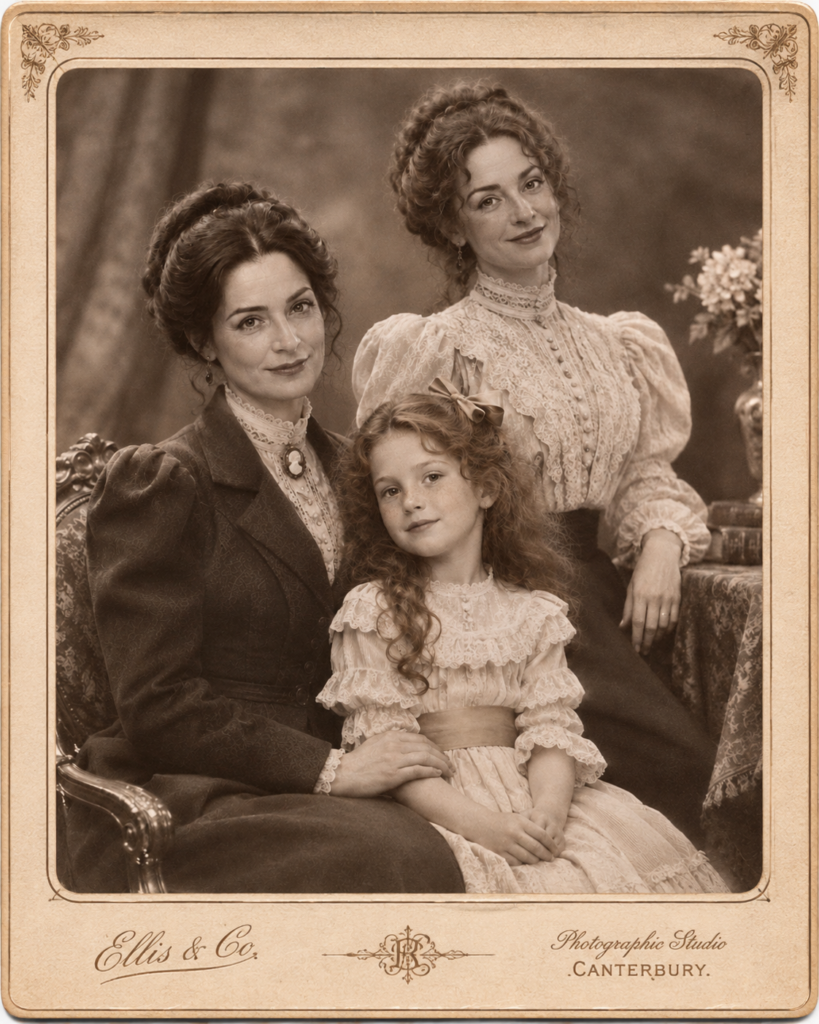
Written in 1912
A few words before we begin
It is now more than ten years since I last set down an account of my life and work. When I ended the previous part of these memoirs, I had little idea how greatly the arrival of a child would alter the arrangements of our household, or how much I should come to value the part I was to play in her upbringing.
I think it best to begin where I left off: with Bella”s news in November 1901.
November 1901
When Bella first told me of her condition, I confess that I was taken aback. Not because I doubted her ability to make her own decisions, for she had never been a person to arrange her life according to the expectations of others, but because I could see at once the practical difficulties which would follow. She was thirty-six, established in her profession, and had no intention of marrying the child”s father. She was happy about the prospect of becoming a mother; I was less immediately concerned with happiness than with the arrangements which would be required to make that happiness possible.
I wondered how she proposed to manage her theatrical engagements, what society would make of her decision, and, most importantly, how the child would be regarded. I had no wish to lecture my sister, and I knew that she would not have welcomed a lecture had I attempted one. Nevertheless, I could not help thinking of the disadvantages which might be placed in the path of a child whose parents were not married. Bella, as it turned out, had given more thought to these matters than I had supposed, although she had not yet considered every practical detail.
She was, I think, more anxious about my reaction than about anyone else’s. She had expected surprise, and perhaps disapproval, but she was determined that the news should not be treated as a misfortune. She had not planned to become pregnant, but now that it had happened she was delighted. She spoke of the child with an affection which was already unmistakable.
“You are very quiet, Jemima,” she said at last. “I had prepared myself for a great many questions, but not for silence.”
“I am trying to decide which questions ought to be asked first,” I replied. “There are practical matters, of course, but I do not want you to think that I regard the child as a problem to be solved.”
Bella reached across the table and took my hand. “I knew you would understand. I am not asking you to approve of every decision I have made. I am asking you to stand beside me.”
“Then that is what I shall do,” I told her. “We may disagree about the details, but you will not have to face them alone.”
I asked, eventually, what she intended to do about the father.
Bella hesitated before answering. He was the Honourable Theodore Vane Blackwood, known to her as Theo, a gentleman somewhat older than herself, unmarried, and employed in the Foreign Office. His work had taken him abroad on several occasions and was likely to do so again. He wished to marry her. Bella had refused.
I was surprised by this, though perhaps I ought not to have been. Bella had never been indifferent to affection, but she had always guarded her independence. She did not wish to marry merely because a child was expected, nor did she wish to give up her profession or place her future in the hands of a husband. Theo, she told me, had accepted her decision, although he had not ceased to hope that she might change her mind. He intended to remain part of the child’s life. The baby would know who her father was, and would know that he loved her.
I asked whether Bella was certain that this arrangement would endure. She replied that she could not answer for the whole of the future, but she knew Theo well enough to believe that he meant what he said. He had not tried to compel her, and she would not pretend to accept a marriage she did not want. It was not, she said, a question of denying the child a father. It was a question of allowing the child to have both parents without requiring them to live in a manner which neither of them considered right for themselves.
I still had reservations. I had spent too many years reading accounts of women and children whose circumstances had been made difficult by the decisions of men to dismiss the matter lightly. Yet I also knew that Bella was not entering this arrangement blindly. She was determined to bring up her child without shame, and I understood that my first duty was to help her rather than to make her defend herself.
She proposed to leave the stage when her condition became apparent, remain at home for the birth, and return to work when she was able. What she had not yet settled was how she would manage the child when theatrical engagements required her to be away.
“But when you return to the stage,” I said. “you cannot take a baby with you from town to town.”
“No, but I need not decide the whole of my future this evening,” Bella said. “I shall have you, so we shall find a way.”
“You speak as though arrangements can be made as easily as casting a new play.”
“Sometimes they can,” she replied, smiling. “And sometimes the people involved are more accommodating than one expects.”
There was, in truth, no question that she should stay. Our house was not large, and it would require some rearrangement, but we had room enough. Bella would use the bedroom she had always occupied when staying with me, and the baby would share it with her. My own bedroom and the upstairs study would remain as they were; there was no separate nursery, nor any possibility of accommodating a resident nurse. I had never before considered the precise requirements of a baby, and discovered that there were far more of them than I had imagined.
Early 1902 – Preparing for the baby
During the early months of 1902, Bella gave up her theatrical work and spent much of her time at home. She occasionally travelled to London, where I understood she met Theo, though she did not make a practice of explaining every detail of their conversations. I did not ask. Their relationship was theirs to manage, and I was content to know that he was taking an interest in the coming child.
We began with the practical business of preparing the room. A cot was acquired, together with the various linens and small articles which other women assured us were indispensable. I was inclined to make a list, and Bella declared that I was treating the arrival of a baby as though I were preparing an exhibition for the Cantium Museum. She was not entirely wrong. I wanted to know what was required, what was useful, and what could safely be dispensed with. We found a suitable place for the cot beside Bella’s bed and arranged space for the baby’s clothes and other necessities. Bella was rather better than I at judging what would be convenient, while I concerned myself with making certain that nothing essential had been overlooked.
“You have made a list,” Bella observed, looking over my shoulder.
“Several lists,” I admitted. “One for the things we require, one for those we may borrow, and one for what other people insist we require.”
“The third will be the longest.”
“I fear you are right. I have already been told that a baby cannot possibly sleep without a particular kind of blanket.”
“Then we shall have to discover whether the baby agrees.” Bella folded the paper and put it aside. “I should like a room that feels welcoming, Jemima, not one that looks as though a committee has furnished it.”
I had discovered that there was no shortage of advice. Every woman who had ever had a child seemed to possess some essential piece of information which she felt obliged to impart. Some of it was useful; some contradicted the advice given by the previous visitor. Bella listened with admirable patience, although I could see that she was already looking forward to the day when she might make her own decisions without an audience.
As June approached, she became increasingly impatient with the restrictions imposed upon her. She was not unmindful of the importance of resting, but inactivity did not come naturally to her. I encouraged her to take things quietly, and she reminded me more than once that she was not an invalid. I knew this perfectly well, but it did not prevent me from worrying.
June 1902 – Beatrice’s arrival
The birth took place in June 1902, with the assistance of a qualified medical attendant and a midwife. Bella’s confinement had been tiring, and although she was exhausted, she had borne the experience with considerable courage. Both mother and daughter were well, and there was a great sense of relief that everything had passed safely. I had remained close by, waiting anxiously for news, and was at last admitted to see them.
“Would you like to hold her?” Bella asked.
I hesitated, suddenly conscious of the smallness of the child and the weight of the responsibility. “I am not certain I know how.”
“You have held babies before.”
“Not one who belongs to us in quite this way.”
Bella smiled, tired but radiant. “Then you must learn. She will have plenty of time to teach you.”
When she placed the child in my arms, I understood that I had been given something more than the privilege of being an aunt. I had thought myself quite prepared to love the child, but I had not anticipated the extraordinary sensation of being entrusted with her.
I looked down at the tiny baby. She had a fine covering of soft auburn hair, already suggesting her mother”s colouring, and I thought her quite beautiful.
Bella had chosen name for a daughter long before the birth. She was to be Beatrice Theodora Kingsley.
“Why Kingsley?” I asked. “You have spent so many years making your own way that I wondered whether you would choose Mead.”
“Because she is a Kingsley, Jemima. Whatever else she may become.”
“You have never been particularly concerned with family names.”
“No, but perhaps I have grown older. And besides, you have spent all these years finding out who our ancestors were. It seems a pity not to give the child something of them.”
“And Theodora?”
Bella glanced towards the sleeping child. “That is for Theo. I want her to know that he is part of her life, too.”
I thought this a generous way of looking at the matter. Bella had become more reconciled to her own family background than she had been as a young woman. She no longer felt the need to prove her independence by rejecting everything which had gone before. She had chosen her own life, but she wanted her daughter to inherit the affection and traditions which were worth keeping.
For convenience, we soon shortened the name. Bella called her Bea. I found myself calling her Little Bee, a name which seemed to suit the small, busy creature who was already beginning to make her presence felt.
Bella took to motherhood with a seriousness which surprised nobody who knew her well. She was affectionate, attentive and determined to learn what her daughter needed. I had wondered whether she would find the constant demands of an infant frustrating, but she seemed to accept them as naturally as she accepted the demands of the stage. She did not regard the child as an interruption to her life, but as a new and important part of it.
July 1902 – Theo meets his daughter
Theo came to Canterbury in July to see his daughter. He stayed at a nearby hotel, and I made myself scarce for a while so that Bella and he could spend some time together privately. When I returned, Theo had already left. Bella was sitting with Beatrice in her arms, looking thoughtful but not unhappy.
“Was it a pleasant visit?” I asked.
“Yes, very much so,” she replied. “He was quite taken with her. He said she had my hair, although I pointed out that she has very little of it at present.”
I laughed. “And what did he say to that?”
“That he would have to wait until there was more of it before making a proper comparison.” Bella smiled. “He seemed reluctant to put her down. He looked at her for the longest time before he left.”
She told me that Theo had brought a small gift for Beatrice, and that they had also discussed her future maintenance. He had made it clear that he wished to contribute towards his daughter”s upbringing. I thought it right that he should do so, and was pleased that he had raised the matter himself.
Bella was reluctant to accept. She told me that she had no intention of taking money from him, and that she was perfectly capable of earning her own living.
“I told him I had no intention of accepting his charity,” she said.
“It isn”t charity, Bella.”
“It feels rather like it.”
“Then think of it as his contribution towards his daughter’s upbringing. You are perfectly capable of earning your own living, but that does not absolve him of his responsibilities.”
She looked at me with an expression which suggested that she was considering whether I had become unnecessarily severe.
“You sound remarkably like one of your magistrates.”
“I have occasionally found them useful.”
I reminded her of conversations we had had in earlier years, when she had been indignant about men who abandoned their children and left the mother to bear the whole burden. On more than one occasion she had been particularly scathing about a father who had refused to contribute and had only been brought to account after the matter reached the courts. She replied that those women had been poor, and that she was not. I pointed out that the principle was the same. A father’s responsibility did not depend upon the mother”s need.
Bella was silent for a time. At last she said that she would accept Theo’s offer, provided the money was for Beatrice and not for herself. She did not want it to become a means by which he could influence her decisions or claim a right to direct the child’s upbringing. I thought this a reasonable condition, and she later told me that he had arranged for a modest sum to be set aside and invested for Beatrice’s future, in addition to making provision towards her ordinary expenses. The details were dealt with privately, and I did not enquire further.
It seemed to me that this was a sensible arrangement. Bella remained independent, Theo acknowledged his responsibilities, and Beatrice would have some provision of her own when she was older. More importantly, she would grow up knowing that her father was not a secret or a shameful subject. He was part of her life, even when his duties took him elsewhere.
Autumn and winter 1902 – A new routine
In the autumn of that year Bella was offered a short theatrical engagement in Canterbury. It was an excellent arrangement. She could live at home, and I could look after Beatrice while she was at the theatre. The engagement included the usual seasonal entertainments and some lighter performances. Bella was well suited to such work, and the opportunity allowed her to return gradually to the stage without being separated from her daughter for long periods.
By then Beatrice had settled into a routine. She was still very young, and much of the day was governed by feeding and sleeping. When she was awake, she watched everything with an intensity which I found quite remarkable. She would follow movement across the room with her eyes, and seemed particularly interested in the sound of voices. I became accustomed to speaking to her while I went about my work, although I cannot claim that my explanations of the Cantium’s latest acquisitions were of much assistance to her.
The weather was cold and often damp, so we spent more time indoors than I might otherwise have wished. Beatrice slept for long periods, and I was able to continue with my research while keeping an ear open for any disturbance from her. I discovered that I could recognise the difference between an ordinary murmur and a cry which required immediate attention. This was a new branch of knowledge, and one which no amount of reading had prepared me for.
Some mornings I went to the Cantium, leaving Bella with her daughter. I was careful not to make myself so indispensable that Bella had no opportunity to enjoy her own child. It was important that she should have time with Beatrice without feeling that she was merely taking over from me. We managed the arrangement between us without difficulty, though there were occasions when I returned to find Bella and the baby asleep together in the sitting room.
Theo visited again shortly before Christmas. He brought a small present for Beatrice, and spent some time with her. He was attentive without being overbearing, and Bella seemed comfortable with his presence. His work meant that he could not always be in England, but he made an effort to visit when he was able.
In time, a pattern developed: he would generally come at Christmas and around Beatrice”s birthday, and sometimes on other occasions when his duties permitted. He remembered her, took an interest in her progress and brought gifts, but more than this, he made it clear that he loved her. Beatrice would never have occasion to think of him as a stranger.
Spring 1903 – Bella returns to the stage
Early in 1903 Bella was offered an engagement which would take her away from Canterbury for several weeks in March and April. We considered the matter carefully. It would be a test for both of us: whether Bella could bear to be away from her daughter, and whether I could manage the daily care of a child without her. We agreed that it was worth attempting, provided the arrangement could be altered if either of us found it too difficult.
I found that I enjoyed having Beatrice to myself. She was still small enough for her needs to be fairly simple, and fortunately she slept well. The perambulator, which had been standing in the hallway for some weeks, was finally brought into regular use. I remember our first proper outing together. The morning was bright but cool, and I wrapped her carefully before setting off. I had imagined that taking a baby out would be a complicated undertaking, and it was certainly necessary to remember a number of things, but once we were on our way I found the experience delightful. Canterbury looked different when seen at the slow pace required by a perambulator. I noticed gardens, doorways and small details which I might otherwise have passed without thought.
When Bella returned, I could see that she had missed her daughter more than she had expected. She was delighted to be home, and for a few days I deliberately spent more time at the Cantium so that she could have Beatrice to herself. Bella had learned something from the experience. She did not intend to give up her profession, but she became more selective about the length and location of her engagements. She would accept work which allowed her to return to Canterbury regularly, but she no longer wished to be away for long stretches. She decided to take no further engagement until after Beatrice”s first birthday.
June 1903 – Beatrices first birthday
On the second of June 1903, Beatrice reached her first year. We marked the occasion quietly at home. She was by then a striking little girl, with naturally curly auburn hair, warm copper-red in the light, and expressive features which were unmistakably her mother”s. Her eyes were lively and observant. She had not yet acquired Bella”s ability to command a room, but I could see the beginnings of it.
Bella took her to visit our sister Amelia and the children, and she also saw our niece Charlotte Emily Brockenhurst and her two young children. It was good for Beatrice to be among other children, and she seemed fascinated by them. Theo came for his customary visit and brought her a doll. She regarded it with great seriousness, as though she understood that it was an object of some importance, and then promptly tried to put its foot in her mouth.
The birthday was a happy occasion, but it also marked a change in the way I thought about my own responsibilities. Until then I had regarded my care of Beatrice as something temporary and practical, a service I could offer Bella while she pursued her work. I now understood that I had become attached to the daily rhythm of her life. I looked forward to her waking, to the small sounds she made when she was content, and to the new expressions which appeared on her face. I was not her mother, nor did I wish to take Bella”s place. But I had become something more than an aunt who occasionally lent a hand.
1903 – Influences and inheritance
I would spend much of the day in my study, leaving the sitting room to Bella and her daughter, and in the evening we would dine together and sit by the fire. Our conversations ranged widely, as they always had, but increasingly we found ourselves considering the kind of woman Beatrice might become.
We spoke of the people who had influenced our own lives. I mentioned Uncle Samuel, who had first encouraged my curiosity and shown me that the world contained far more than the limits of one”s immediate experience. I spoke of Edward, who had taken that curiosity and given it a direction I could never have found alone. But I also spoke of my grandmother Frances, and of the difficulty I had experienced as a child in understanding her manner towards me. I did not need to repeat the history I have already set down in the previous part of these memoirs. It was enough to say that the knowledge I had gained about her own family and upbringing had altered my understanding of her. I had once interpreted her reserve as a personal dislike; later I came to see how much of it belonged to the conventions and experiences of her generation.
Bella listened, and then asked me whether I had ever considered how much of our lives had been shaped by people we had never met. The question brought me back to the story of Jemimah Fairfax, my grandmother’s elder sister, whose life in Calcutta had continued to occupy my thoughts since I first encountered the diaries and letters in 1884, which revealed a story that our family had not known about since then.
I had been unable to discover much more about Jemimah through ordinary research. The surviving papers had provided glimpses of her life, her friendship with Madhav and the circumstances which led her to leave her family in 1809 – but they did not answer every question. I knew that she had loved him, and that the family had opposed their marriage, but I could not know precisely what she had felt, what arguments had passed between them, or how she had reached the decision to leave. The records gave me the outline of events, but not the private thoughts which lay behind them.
I told Bella that I still found myself wondering what Jemimah had endured, and what courage or desperation had been required for her to choose a life so far removed from the one intended for her.
“Why don’t you make it up?” Bella asked.
I was horrified.
“Make it up?”
“Yes. You know what happened, more or less. You know the people and the circumstances. Why not imagine the rest?”
“That is not how I work,” I replied. “I cannot simply invent what I do not know.”
Bella pointed out that I had spent years trying to understand people whose lives could no longer be questioned. I had often drawn conclusions from incomplete evidence, and had considered what might have happened when the documents did not provide an answer. What, she asked, was so very different about allowing myself to imagine a scene, provided I did not pretend that it was a record of fact.
I told her that there was a considerable difference between a reasonable inference and an invented conversation.
“Of course there is,” she said. “But you need not tell people that the conversations are real. You can tell them that it is a story.”
I could not dismiss the suggestion as easily as I might have wished. Bella had spent her working life inhabiting the minds and words of other people. She understood the importance of motive, gesture, silence and the small exchanges which reveal character. I had often been interested in what a person had done, and why the evidence suggested they had done it. Bella was asking me to consider how that person might have spoken, what they might have feared, and what they might have wanted but been unable to say.
The idea remained with me. I did not immediately begin writing, but I found myself thinking about Jemimah in a different way. Instead of asking only what the documents could prove, I began to ask what kind of young woman she might have been, what she would have noticed, what she might have found beautiful or frightening, and how she would have understood the world around her.
1904 – My first historical novel
By the beginning of 1904 I had decided to attempt a story. I was conscious that I was taking a considerable liberty with the past, and I determined that I would not alter the facts which the surviving papers established. Where the documents were silent, I would use imagination, but I would try to make the imagined events consistent with the known circumstances and with the world in which Jemimah had lived.
My first efforts were not encouraging. I began with conversations, thinking that dialogue would be the easiest way to discover the characters. It was not. My early attempts sounded stiff and unnatural. I found myself making people speak as though they were giving evidence before a committee. Bella, had she read those first pages, would doubtless have told me that nobody in ordinary life speaks in paragraphs of carefully arranged explanation.
I tried again, and again. I read passages aloud, altered them, and sometimes abandoned whole pages. Gradually I began to hear a difference between the language I used in my own research and the language which might belong to a young woman living nearly a century earlier. I had to remember that Jemimah did not know what I knew. She could not anticipate the consequences of her decisions, nor could she explain herself with the benefit of a hundred years of hindsight.
Research remained essential. I knew the broad setting of the story, but I wanted to understand Calcutta in the early nineteenth century as more than a name on a map. I read what I could about the East India Company, the city’s growth, its streets and riverfront, its houses and markets, and the different communities who lived and worked there. I looked at maps and contemporary descriptions, and tried to form a picture of the daily life which would have surrounded Jemimah. I wanted to understand the climate, the monsoon, the arrangements of a household, the practicalities of travel, and the customs which would have been familiar to the people she encountered.
I was particularly anxious not to make the Indian characters mere figures in the background of an English woman’s story. Madhav had to be a person in his own right, with a family, a history, a way of understanding the world and interests which did not exist merely to serve Jemimah’s. This required me to read beyond the accounts written by English visitors and officials. I was aware that my knowledge could never be complete, but I hoped that careful research and a willingness to recognise what I did not know would prevent me from treating the setting as a decorative stage.
All this work took place alongside my responsibilities at home. Bella continued to accept only engagements which were reasonably convenient, and she arranged her professional life with Beatrice in mind. There were mornings when I had the house and my work to myself, and others when I put aside my papers because Beatrice required attention. I learned to write in shorter periods, and to leave a sentence unfinished without allowing it to trouble me unduly.
June 1904 – Beatrice’s second birthday
Beatrice’s second birthday, in June 1904, was a cheerful occasion. Theo came to Canterbury and stayed for several days. He was able to spend more time with Bella and his daughter than he had on some earlier visits, and the three of them went for walks through the city and out into the surrounding countryside. I was pleased to see how naturally they were together. Beatrice knew him as her father, and although she was still too young to understand the demands of his work, she recognised him and was happy in his company. He took a genuine interest in her, and she was beginning to respond to him with the confidence she showed towards those she knew well.
Autumn 1904 – A first manuscript
During the summer I became increasingly absorbed in Jemimah and Madhav’s story. My usual piles of newspapers, notes and genealogical papers were less conspicuous than they had been, and Bella eventually remarked upon the change.
“You have not been investigating a mystery for weeks,” she said one morning. “I am beginning to wonder what you are doing in there.”
I admitted that I had been writing.
“Writing what?”
I told her that I had been working on Jemimah and Madhav’s story, and that I believed I had reached a complete draft.
Bella looked astonished.
“You are a dark horse! I had no idea you were doing that.”
I asked whether she would care to read it. I was more nervous than I cared to admit. I had become so accustomed to testing my conclusions against documents that I found it difficult to judge whether the story worked as a story. Had I used enough imagination? Had I made the characters convincing? Had I allowed myself too much freedom, or not enough?
Bella took the manuscript away and read it over several days. She made no comment while she was reading, which I found increasingly alarming. I began to imagine that she disliked it and was merely trying to discover a kind way of telling me so. I considered asking her what she thought, but decided that this would only make matters worse.
One morning she came into my study with tears in her eyes.
“Whatever is the matter, Bella?” I asked. “Is Beatrice unwell?”
“Jemimah has just left Calcutta with Madhav,” she said.
For a moment I did not understand.
“What do you mean?”
“Your story. I have just finished it. Jemimah has left Calcutta with Madhav.”
All I could say was, “Oh.”
She wiped her eyes and told me that it was a beautiful story. She had not expected me to write in that way, and she thought I ought to publish it.
I was deeply moved, though I was also uncertain. Writing a story for oneself was one thing; offering it to the public was quite another. I had no experience of publishers, printers or the arrangements by which a manuscript became a book. Bella, however, had contacts through her theatrical work. She said that when she next went to London she would make enquiries.
Christmas 1904
Christmas 1904 was a particularly happy one. Theo joined us for much of the day, before travelling to New York for an extended period. He was affectionate towards Beatrice, who was now old enough to enjoy the excitement of presents and visitors, and Bella seemed content. I remember thinking that our family arrangements, which had seemed so uncertain when she first told me of her pregnancy, had settled into a pattern which suited us all.
Early 1905 – A new arrangement
At the beginning of 1905 Bella accepted an engagement which required her to spend a considerable part of each week in London. The theatres were keen to have her, and it seemed that her absence from the stage had not diminished her reputation. If anything, she was in greater demand than before. She was careful, however, to arrange her work so that she could return to Canterbury as often as possible.
I was not sorry to have more time with Beatrice. She was nearly three, curious about almost everything, and generally good-tempered. She could be reasoned with far more easily than I had expected of a child of her age, although I soon learned that reasoning did not always produce the result I wanted. She had a habit of considering a request very carefully before deciding whether she agreed with it.
We went on several outings together during the late winter and early spring. On fine days I took her to Whitstable and Seasalter, wrapping her warmly against the wind. She enjoyed the journey and the sea, and I remember her rosy cheeks and the seriousness with which she watched the waves. She was not yet old enough to understand the history of the places, but she was interested in what she could see: boats, birds, shells, people carrying baskets, and the changing colour of the water.
Other afternoons we sat by the fire and I read to her. I discovered that she preferred stories with something happening in them, and that she was quite prepared to interrupt me if she thought a character had behaved foolishly. I was obliged to accept that a child of three might have a perfectly reasonable objection to the conduct of a person in a book.
Bella came home whenever she could. On one of her visits in late March she told me that, following several enquiries, she had found a publisher willing to consider my manuscript. She had sent it to them, and their initial response had been encouraging. They were interested in the possibility of producing the book and had suggested that illustrations might be included. I was astonished. Bella explained that loving a story and persuading a publisher to take a chance on an unknown author were two very different matters. She had been fortunate to find someone prepared to give my work serious consideration.
There followed a period of correspondence and practical arrangements, details of which I shall spare the reader. I had to consider corrections, proofs and the proposed illustrations. It was a strange experience to see my own words in printed form. I had spent so many years handling other people’s papers that the thought of a book bearing my name seemed almost impertinent.
Summer 1905 – Publication
 In the summer of 1905, Jemimah and Madhav: Part One – Where the River Leads was published. A box containing copies arrived at the house, and I confess that I stood looking at it for some time before I opened it. The volume seemed both familiar and unfamiliar. It contained the story I had written, but it had become an object in the world, something which other people might read without knowing anything of the years I had spent thinking about Jemimah.
I gave Bella one of the first copies. She was delighted, and asked me to write a dedication in it. I wrote:
To Bella,
For all that you have done for me – helping me to bring my imagination to life.
Your loving sister,
Jemima
She seemed more pleased with that inscription than with the book itself. I knew that without her suggestion I might never have attempted the story. She had not supplied the words or the research, but she had helped me to understand that imagination was not necessarily the enemy of historical truth. It could be a means of approaching the parts of a life which the records had left beyond our reach.
Bella took the summer off, and we spent a number of happy days with Beatrice by the sea. We went to the coast whenever the weather permitted, and I enjoyed seeing her discover the pleasures of sand, water and open space. She collected shells, made elaborate arrangements with pebbles, and regarded the sea as something which ought to answer questions if one asked it often enough. We returned home tired and usually carrying more sand than we had intended.
I also returned to the Cantium for several mornings each week. There had been donations to catalogue and display, and I had missed the regular contact with the collections. I found satisfaction in returning to familiar work, although I now had another occupation to consider.
1905 – The story of Penang
I had assumed that, having completed the first part of Jemimah’s story, I would naturally proceed to the second. I had long known the broad course of events which followed her departure from Calcutta. I had read the relevant letters and diaries in 1884, and had made notes at the time. My intention was to write the next part largely in the form of correspondence between Jemimah and her sister Georgiana, as the original story had come to me in that way.
I soon discovered that this would be much more difficult than I had imagined. I did not possess the original diaries and letters. I had been allowed to examine them in 1884, and I had made notes, but the papers themselves had remained with Charlotte Appleby. More than twenty years had passed. My notes preserved the principal events and some details of the correspondence, but they were not sufficient to reconstruct the texture of Jemimah’s daily life.
The second part would take place in Penang. I knew what happened in Calcutta: the consequent scandal, her mother’s gradual breakdown, her sister Frances’s return to London for her schooling, and the family’s later return to Somerset, where her mother was admitted to a private asylum and subsequently died. But I knew very little about the ordinary life Jemimah and her husband would have made in Penang. What did their house look like? How did they arrange their days? What would she have seen from her windows? What were the customs and social relationships which shaped her life there? I could not fill those pages with a succession of major events. I needed to understand the ordinary days between them.
It would require a considerable amount of research, and I was not prepared to undertake it hastily. I made some preliminary attempts at the letters, but I was dissatisfied with them. I could not make them sound like the correspondence I remembered, and I was conscious that I was reconstructing from memory and notes rather than working from the original documents. I therefore put the second part aside, intending to return to it when I had gathered more information.
1905–1906 – A different kind of story
Having discovered the pleasure of writing a novel, however, I found that I was reluctant to put aside my new occupation altogether. Although I had placed my attempts at the second part of Jemimah and Madhav: Where the River Leads in a drawer, I had not abandoned the idea of continuing the story. I simply could not yet find a satisfactory way forward.
I did not wish to give up writing while I waited for inspiration to return. The experience of creating characters, imagining conversations and bringing a story to life had given me a satisfaction I had not anticipated. I found myself wanting to try again, perhaps with a subject that might prove more straightforward.
I remembered then a small pamphlet which I had acquired during my early years at the Cantium. It concerned the life of a young Kentish man named John Kirby, known as Jack, whose criminal career had eventually brought him before the courts and led to his imprisonment and subsequent transportation. (He had turned out to be my great-great-great uncle.) I had kept a copy of the pamphlet among my papers for the Kirby family history research.
Unlike the Fairfax papers, the pamphlet offered a reasonably clear narrative. It described Kirby’s early life, his involvement in crime, the people with whom he associated, his arrest and trial, and the eventual consequences of his actions. There were incidents, characters and events around which a story might readily be constructed. I found myself thinking that here, at last, was a subject which would not require me to spend quite so much time wondering what had happened between one surviving letter and the next.
I took my copy of the pamphlet from its file and read it again. Although I had examined it years before, I now approached it with a different purpose. I was no longer simply interested in the historical account of a criminal life. I began to imagine the boy behind the printed pages: the circumstances of his childhood, the influences which had shaped him, the decisions he had made and the moments at which his life might have taken a different course. And so I began to write a version of Jack’s life, which I called Jack: The Life and Fate of a Kentish Thief.
I worked on it through the end of 1905 and into 1906, but when I had completed a first draft and read it from beginning to end I was very unhappy with the result. It seemed to me that I had taken the incidents from the pamphlet and placed invented conversations around them without discovering the deeper story. The dialogue felt contrived, and the characters did not seem to live beyond the events recorded in the original account. I had been so concerned with giving the narrative movement that I had not given sufficient attention to the people who were supposed to inhabit it.
I put the manuscript in a drawer beside the beginnings of the Penang story. I was reluctant to abandon it, but I recognised that I needed a rest from both.
I returned instead to my Victorian mystery investigations, which I had neglected for some months. I found it a relief to work again with documents, newspapers and evidence. I did not give up on the manuscripts; I simply left them until I could approach them with a clearer mind.
1906 – Beatrice grows
Meanwhile, Beatrice was growing up. By her fourth birthday in June 1906 she had become an attractive, confident little girl, with her mother’s long curly auburn hair and a presence which was increasingly her own. She was lively without being constantly troublesome, and she had begun to show a strong preference for doing things for herself.
Bella continued to accept theatrical engagements from time to time, and I often had Beatrice by myself. We had our own routines, and I grew accustomed to having a small companion in the house.
I shall not attempt to record every stage of her childhood. There were the ordinary illnesses, the small triumphs, the toys which became indispensable and then were forgotten, and the games whose rules seemed to change whenever I thought I had understood them. There were afternoons when she wanted to be read to and others when she preferred to make up stories of her own. She liked to accompany me on walks and was particularly interested in the buildings of Canterbury. She noticed doors, windows, carvings and signs, and asked why some houses were older than others. I tried to answer without turning every outing into a lecture.
One afternoon, when we were passing an old building, she asked whether people had always lived in houses like that. I explained that buildings changed over time, and that the house might have looked different when it was first built. She wanted to know how I could tell. I explained that historians examined the materials, the shape of the windows, old maps and written records. She considered this and then asked whether a house could lie about its age. I told her that buildings did not usually lie, but that people could misunderstand them. She seemed satisfied with this distinction.
1907 – A governess for Beatrice
By 1907 Bella had begun to think seriously about Beatrice’s education. She raised the matter with me one evening, having decided that the time had come for some more regular instruction. She wanted Beatrice to learn properly, but was equally determined that her childhood should not be consumed by lessons. There was no room in our house for a resident governess: the bedrooms were already occupied, while the upstairs study was needed for my work. A daily governess was the practical solution.
“I think she is ready for lessons each morning,” Bella said. “But I don’t want her shut away with books all day.”
“A few hours in the morning would be quite sufficient at first,” I replied. “She needs time to play, to read what she chooses, and to be outdoors.”
“I should like to find someone who suits her,” Bella continued. “I shall certainly want your opinion, Jemima. You have more experience of these things than I have, and I know you will tell me honestly what you think. But I feel I must make the final choice myself.”
“Of course,” I said. “I shall gladly help you consider the candidates, and I will tell you what I think. But the decision is yours.”
Bella smiled. “I knew you would understand. You may help me with the references, if you like, but I should enjoy conducting the interviews myself.”
“I should expect nothing less.”
Bella made enquiries and interviewed several women before choosing Miss Eleanor Whitcombe who was prepared to come from nine until about twelve each morning. The lessons took place in the dining room, or occasionally in my study if I was not using it. At first the work was necessarily simple. Beatrice was five, and there was little purpose in keeping her at a desk for long periods.
She learned to read more confidently, practised her letters and numbers, and began the first steps in arithmetic. There were stories, songs, drawing and simple lessons about the world around her. As she grew older, French, geography, history and music were added, together with more sustained reading and written exercises.
Miss Whitcombe provided a regular foundation, but Bella believed that education could not be confined to books and exercises. The afternoons remained open for walks, reading, visits and the ordinary pleasures of childhood.
Beatrice had her own opinion of the arrangement. At first she was interested in the novelty of having a teacher come to the house, but she was less enthusiastic about the prospect of sitting still every morning. She soon discovered that Miss Whitcombe was kind but not easily distracted, and that the appearance of a particularly interesting object outside the window did not necessarily bring a lesson to an end. Nevertheless, they developed a good understanding. Beatrice liked being praised for work well done, and she enjoyed the sense of achievement which came from mastering something she had previously found difficult.
The arrangement gave me more freedom in the mornings. I could go to the Cantium or attend to research without feeling that I must remain within call at every moment. I remained closely involved in Beatrice’s life, but Bella had made the arrangements and continued to oversee them. She was able to accept theatrical work with greater confidence, knowing that her daughter’s mornings were settled.
1908–1910 – Questions about the past
As Beatrice grew older, she became increasingly interested in the people whose stories I investigated. She knew that my work involved old newspapers, certificates, photographs and other documents, and she sometimes asked what I had discovered. I would tell her a little, choosing matters which I thought she could understand. I soon found that a child’s questions were not always the questions I expected.
“May I see the photographs?” she asked one afternoon, drawing a chair beside my desk.
“You may look at these, provided you do not move the labels.”
“I shall be careful. Who is this lady?”
“Her name was recorded in the family papers, but very little else is known about her.”
Beatrice studied the portrait. “Was she happy?”
“I cannot tell from a photograph.”
“Then how do you find out?”
“Sometimes we find letters or diaries. Sometimes we discover what happened to them. And sometimes we must admit that we do not know.”
“I think I would like to know,” she said. “It seems sad that she should be forgotten.”
“Why did people have so many children?” she asked once, after I had been speaking of a family in which several generations seemed to have produced a great number of sons and daughters.
I explained that families had different circumstances and expectations, and that children were often an important part of family and working life. She wanted to know whether the mothers had chosen to have so many. I tried to explain that women did not always have the same choices as they did now. She looked troubled by this, and asked why not.
On another occasion she asked why girls could not do the same things as boys. I explained that many people believed that boys and girls should be prepared for different kinds of lives, and that opportunities for women had been more limited. She thought this unfair. I told her that I agreed there were many unfair restrictions, and that some women had spent their lives trying to change them. She asked whether I had been allowed to do everything I wanted. I said that I had not, but that I had been fortunate in having people who encouraged my curiosity and in finding work which I could pursue.
She also asked about a woman in one of my cases who had been married twice.
“Why did that lady have two husbands?”
I explained that her first husband had died and that she had married again. Beatrice considered this, then asked why anyone would object to it. I told her that some people had strong ideas about marriage and propriety, but that a widow was generally free to marry again. She seemed to think this was a perfectly sensible arrangement.
There were more difficult questions. “Why did that man leave his family?” she asked after hearing about a case in which a father had disappeared. I explained that I could not always know why people behaved as they did. Sometimes the records showed what had happened but not the reasons. She found this unsatisfactory. “But you must try to find out,” she said. I told her that I did, though I could not promise always to succeed.
Perhaps the question which most affected me was one she asked while looking at a newspaper cutting. “How do you know what happened if nobody is alive to tell you?”
I explained that we had to use what people had left behind: letters, diaries, official records, newspapers, photographs and the memories of others. We compared one account with another, looked for inconsistencies, and tried to distinguish what we knew from what we merely suspected. She listened carefully and then asked whether people could leave things out because they did not want anyone to know. I told her that they certainly could, and that this was one reason why we had to be cautious.
“Could someone write something that was not true?” she asked.
“Certainly. A person may be mistaken, or may wish to conceal something.”
“Then why do you believe the papers?”
“I do not believe them simply because they are papers. I compare one account with another, and I look for evidence that can be checked.”
“Like when two people tell you different things?”
“Very much like that.”
“And what if neither of them is telling the truth?”
“Then we must be prepared to say that the truth has not yet been discovered.”
Her questions made me realise that teaching a child about history was rather different from researching it for oneself. I had been accustomed to reconstructing lives by collecting names, dates, relationships and explanations. Beatrice wanted to know what it had felt like to live those lives. She was interested in whether a little girl who had lived in a particular house had owned a doll, whether she had been allowed to play outside, whether she had had brothers and sisters, and whether she had been happy.
I found that I was beginning to look at my material differently. A census return might tell me how many people lived in a house and what work they did, but it could not tell me whether the children played together, whether the mother was tired, or whether the youngest child was frightened of the dark. A newspaper report might record a tragedy, but it could not always show the ordinary life which had preceded it. Beatrice reminded me that behind every name in a record there had been a person who had woken in the morning, eaten meals, worried about money, loved someone, quarrelled, laughed and hoped for something.
I allowed her to help me occasionally. She enjoyed sorting photographs, matching names when I had already identified the people, and noticing details in newspaper cuttings. Once she pointed out that two photographs I had placed together could not show the same woman, because the shape of the ears was different. I had overlooked the distinction. I was delighted, though I had to resist the temptation to make every afternoon a genealogy lesson. She was still a child, and I wanted her to have the freedom to be one.
There were times when Bella accused me of turning Beatrice into a little antiquarian. I denied it, although I could not entirely defend myself. If Beatrice asked a question, I found it difficult not to pursue the answer. Bella reminded me that there was a difference between encouraging curiosity and requiring a child to spend every spare moment in the company of old papers. She was right, and I tried to remember it.
By this time we had settled into a way of life which allowed each of us a measure of independence, though it required some thought and occasional adjustment. Bella continued her theatrical work, and I remained occupied with my own researches and writing. Beatrice had become accustomed to the comings and goings that were part of our household, and accepted them without much question. She knew that Theo could not always be with her, but she never doubted his affection. His visits were occasions she looked forward to, and she was always pleased when a letter or a small parcel arrived from him.
Bella and I had learned to manage our responsibilities between us. There were times when her engagements required me to take a larger share of Beatrice’s daily care, but I never regarded this as a burden. Indeed, our household had acquired its own character, and I think we were all the happier for the affection and understanding which held it together.
1911 – Edward’s family
In 1911, when Beatrice was nearly nine, she began to ask me questions about Edward. His photograph had always stood on the mantelpiece in my study. She knew that he had been my husband and that he had died when she was not yet born. She had seen the wedding photograph many times, but until then she had not shown much interest in the man himself. Perhaps Bella had discouraged her from asking too much, fearing that the subject might distress me. I cannot say. I had never told her not to ask.
One afternoon, while she was with me in the study, she looked at the photograph and asked what I had discovered about Edward’s family. What had his parents been like? Had he had brothers and sisters? Where had they lived? What sort of house had he grown up in?
“I know a little about his work,” I said, “but I am afraid I have never made a proper investigation into his family.”
“But you investigate everybody else’s families,” she replied.
I had to smile. “That is true. It seems I have neglected my own.”
I was astonished, not because the questions were unusual, but because I realised that I had never properly asked them myself. I had known Edward as my husband, my companion and a scholar whose interests had enriched my own life. I knew the circumstances of his work and the events of our marriage. Yet I had not undertaken the kind of investigation into his family which I would have considered essential had he been the subject of one of my cases.
Beatrice’s questions exposed an omission which I could no longer ignore. I told her that I did not yet know the answers, but that I ought to find them. She asked whether we could look together. I said that we could, and so began a new piece of research which I had somehow postponed for thirty years.
I began with the papers Edward had left behind. I had kept them in my possession since his death, carefully preserved in a couple of boxes, but seldom examined beyond those which concerned his archaeological interests and our own affairs. There were letters, receipts, old accounts and legal documents relating to his father’s estate. Beatrice sat beside me at the desk, taking a lively interest in each discovery, and occasionally asking questions which sent me back to examine a document more closely.
The first person we needed to understand was Edward’s father, Alexander James Hartford. From the papers I gathered that he had been a prosperous merchant in Cirencester, continuing a family business established by his own father, Thomas William Hartford. The earliest references suggested that the family fortune had begun in the wool trade. Thomas had been a woolstapler, buying and selling wool, and had gradually acquired commercial premises and property. Alexander had expanded the business into corn and other agricultural produce, including cheese, with trading connections extending towards Gloucester and Bristol.
This was the first surprise. I had known that Edward was comfortably provided for, but I had never understood the origins or extent of his inheritance. He had not been a man to discuss money, and I had assumed that his means came from a respectable but relatively modest family business. The papers showed that the Hartfords had been considerably more prosperous than I had imagined.
As we followed the names backwards, a family began to emerge. Thomas had married Anne Margaret Pritchard in 1792, and they had three sons: George William, Henry Thomas and Alexander James. Each had established a separate branch of the family. George remained in Gloucestershire, Henry moved to Bristol, and Alexander stayed in Cirencester.
The name Pritchard gave me pause. It was the same surname I had chosen for a family in my novel, Jemimah and Madhav: Where the River Leads, written in 1905. I had selected it without any knowledge of Edward’s ancestry. Then I came across the name Cecilia Louisa Ellwood, Edward’s mother, and was struck by a second coincidence. Jane Ellwood had been another of the characters in my book. It seemed extraordinary that I should have used two names which, quite independently, belonged to my husband’s family. There was no connection between the fictional characters and the people I was now discovering, but I could not help smiling at the coincidence.
Beatrice was particularly interested in the children. We found that Edward had been the third son of Alexander and Cecilia. Their first child, Edward James, had died in infancy, as had their second, James Alexander. My Edward had therefore been named after the brother who had gone before him. He had been their only surviving child. I felt a pang of sadness at this, thinking of the quiet household in which he had grown up, without brothers or sisters of his own.
We learned, too, that his father had married his mother in 1835, when he was about thirty and she only seventeen. She came from an educated Gloucestershire family, her father having been a clergyman. The difference in their ages surprised me, although it would not have been considered especially remarkable in their generation.
It was the Bristol branch which provided our next discovery. Among the children of Henry and Mary Hartford was a son, Edmund Charles, born in 1832. At first he was simply another name in the family tree. A few references in the surviving papers suggested that he had become involved in public affairs, and I decided to investigate him further.
I turned to the newspapers and reference books, and gradually discovered that Edmund had become Sir Edmund Charles Hartford, a Liberal politician and advocate of reform in the treatment and education of pauper children. His name appeared in connection with the movement to improve conditions in workhouses and to place suitable orphaned and deserted children with private families.
I stopped reading. I knew the subject well. In several of my own investigations I had encountered the debates surrounding pauper children, the difficulties of their education and the growing movement towards boarding-out. I had followed the arguments and the changes in policy, but had been more concerned with the circumstances of the children than with the parliamentary figures who had supported reform.
I looked again at the name on the page. This was the man whose work I had read about over a number of years. And he was Edward’s first cousin.
“Beatrice,” I said, “I believe we have found someone rather interesting. This Sir Edmund Hartford is your Uncle Edward’s cousin.”
She looked from the newspaper to the family papers spread across the desk.
“Then he was Uncle Edward’s cousin all the time?”
“Indeed he was. And I have been reading about his work for years without knowing that.”
I found myself eager to learn more about him, not merely because of his public reputation, but because he might remember Edward and perhaps have knowledge of the family which the papers had not preserved. I decided that I should write to him, explaining who I was and how I had discovered our connection. I could hardly have imagined, when Beatrice first asked her questions, that our afternoon’s research would lead us to a member of the family whose work I had followed for so long.
A reply arrived some weeks later. Sir Edmund expressed considerable pleasure at hearing from the widow of his cousin, and apologised for the delay in answering, explaining that he had been occupied with family matters. He was interested to learn that I had been investigating the Hartford family and particularly amused that I had encountered his name through my own historical researches.
He remembered Edward, although naturally his recollections belonged to a much earlier time. He described him as a quiet and rather serious boy, devoted to his mother and inclined to spend long periods with books. He recalled visiting the family home in Cirencester and remembered my father-in-law, Alexander, as a reserved but kindly man. His own father, Henry, had remained in friendly correspondence with Alexander after moving to Bristol, and Edmund believed that some of their letters might still be among the family papers.
He also told me something of his own life: of his marriage to Margaret Vaughan, who had died six years earlier, and of their three children, Charles, Margaret and Arthur, all now grown with families of their own. His letter was not formal in tone. There was a warmth in it which I had not expected from a man whose public reputation had always seemed to belong to a rather different world.
He regretted that he had lost touch with Edward and wished that they had maintained their acquaintance in later life. He asked me to write again, and offered to look through his own papers for anything that might be of interest.
I was touched by his kindness. Until then, Edward’s family had existed for me largely as names, dates and entries in documents. Now, through Sir Edmund’s recollections, I had begun to glimpse something of the people behind them. Beatrice was delighted that our investigation had resulted in a reply, and declared that we must certainly write again.
“We have only just begun,” I told her. “There may be much more to discover.”
1912 – Choosing a school
By the time Beatrice approached her tenth birthday, Bella began to consider what should follow the years of lessons at home. Miss Whitcombe had given Beatrice a sound foundation, and she had become a confident reader with a lively interest in the world. Bella felt that she would benefit from a wider education and the company of other girls. She raised the possibility of a private boarding school with me, asking what I thought and whether I knew of suitable establishments.
I was aware that the decision would not be an easy one. Beatrice had been part of our daily lives for ten years, and I had become accustomed to hearing her voice in the house and seeing her come into my study with some question or discovery. Yet I knew that the purpose of bringing up a child was not to keep her permanently beside one. At some point she must be allowed to move beyond the protection of home. I told Bella that I thought the idea worth exploring, but that the choice must be hers, with Beatrice’s feelings carefully considered.
Bella began making enquiries in the spring. She asked me to help her compare the prospectuses and to look carefully at the curriculum, fees and boarding arrangements. She wanted a school which took academic work seriously, but which did not neglect music, drawing, literature and the other subjects which might give a girl a rounded education. She was concerned above all that Beatrice should be happy and treated kindly. We were both determined that she should not be sent somewhere merely because its name carried social distinction.
Bella decided that the school should be within reasonable travelling distance of Canterbury. There was no need to send Beatrice to London or farther away when good opportunities might be found nearer home. After considering the replies, she became particularly interested in St Margaret’s School for Girls, situated in a substantial country house near Wingham. It appeared to offer the kind of education she wanted: a serious academic foundation, a reasonable range of accomplishments, and an environment which was neither excessively grand nor unduly severe.
In May, Bella and I went to visit the school. We met the headmistress, examined the classrooms and dormitories, and walked through the grounds. The house had been adapted for its purpose, but it retained something of its former domestic character. There were gardens and open space, and the school seemed large enough to offer companionship without being so enormous that a new pupil might easily become lost in it. The headmistress was a composed and capable woman, firm in manner but not unkind. I asked questions about the curriculum, the daily routine, discipline and the arrangements for girls who were homesick. Bella asked rather more direct questions about the food, the comfort of the bedrooms and how the staff dealt with a child who was unhappy.
The headmistress answered us both with patience. We left with a favourable impression, but Bella was clear that no decision would be made until Beatrice had seen the school for herself.
Bella arranged a second visit and took Beatrice with us. Beatrice was excited by the journey, although I noticed that she became quieter as we approached the house. The headmistress showed her the classrooms and introduced her to some of the girls. Beatrice looked carefully at the dormitory and asked which bed might be hers. She wanted to know whether she would be allowed to keep books beside her bed, whether there was a garden where she could sit, and whether the girls were permitted to write letters home whenever they wished. The headmistress answered her questions seriously, which I thought a good sign.
“Would you be frightened on your first night?” I asked her quietly, while Bella spoke with the headmistress.
“Perhaps a little,” she said. “But I should not like you to think I am afraid of going.”
“I would never think less of you for being afraid.”
“I know. I am looking forward to the library. And I should like to find out whether the girls are as interesting as they look.”
“That is a very good reason for going to school,” I told her.
“Will you still write to me about your cases?”
“If you wish me to.”
“I do. I might have an idea.”
On the journey home Bella asked what she had thought of the school. Beatrice did not answer immediately. She said that she liked the garden and the library, but that she was not sure about sharing a bedroom with so many girls. She also wanted to know whether the food was as good as it looked. Bella laughed and told her that these were important considerations. Then she asked whether Beatrice thought she might be happy there. Beatrice said that she thought she might, although she would miss us.
Bella did not press her for an immediate answer. She considered what Beatrice had said, made further enquiries about the school and then decided that it was the right place for her daughter. She told me that she had listened carefully to my advice, but that she must be able to stand behind the decision herself. I thought that entirely right. We settled the arrangements and confirmed Beatrice’s place for the autumn term.
2 June 1912 – Beatrice’s tenth birthday
Beatrice’s tenth birthday fell on the second of June 1912. I found it difficult to believe that ten years had passed since I first held her. We marked the day at home, with just Bella, Beatrice and me. There were presents, a birthday cake and the usual bustle which accompanies a family celebration. Beatrice was delighted with her gifts, but she was also conscious that the beginning of the school term was approaching. She spoke of the girls she had met and wondered whether she would make friends quickly.
I felt a mixture of pride and apprehension. She was no longer the baby who had rearranged our household, nor the small child who had asked whether buildings could lie about their age. She was becoming a thoughtful, independent girl. I was pleased that she was ready for a wider world, but I could not pretend that I would find the change easy.
September 1912 – A new beginning
September arrived sooner than I expected. We had spent much of the summer preparing her clothes and other necessities, labelling what needed to be labelled and making certain that she had everything required. Bella was more practical about the business than I was. She had a way of making each task seem manageable, whereas I found myself thinking about the empty room and the altered shape of our days.
On the morning of her departure, Beatrice was excited and a little subdued. She had packed her books and small possessions, and she had chosen a few things which would remind her of home. We travelled with her to St Margaret’s and helped her settle into the room. The other girls were beginning to arrive, and there was the usual confusion of trunks, instructions and introductions. I tried not to make too much of the moment. I did not want Beatrice to feel that her departure was a tragedy.
Bella was affectionate and cheerful, though I knew she too was feeling the separation. We reminded Beatrice that she could write to us, that she would come home for the holidays, and that we would visit. She listened patiently, perhaps thinking that we were repeating what she already knew. When the time came for us to leave, she gave us both a hug and went back towards the other girls.
I remember looking back once. She was standing with a group of pupils, her auburn hair catching the light, and she seemed at once very small and remarkably self-possessed. I had to remind myself that the purpose of all our care had been to prepare her for precisely this moment.
Autumn 1912 – A quieter house
Bella began a three-month theatrical tour shortly afterwards, and would be away until Christmas. The house therefore became quieter than it had been for many years. I continued with my work at the Cantium and my investigations, but I found that my days had changed. I missed the small interruptions, the questions and the sound of Beatrice moving about the house. I had thought that I would enjoy the uninterrupted time, and in some respects I did. Yet I discovered that a household can be too quiet.
I wrote to Beatrice regularly, and she wrote back. Her letters were full of news about her lessons, her companions and the small incidents of school life. She described the teachers, the food, the games and the girls with whom she was becoming friendly. She did not complain, though there were hints that she sometimes missed home. I tried not to ask too many questions in my replies. I wanted her to feel that she could tell me what she wished, rather than provide a report for my inspection.
December 1912 – Returning to Jack Kirby
As the year drew towards its close, I found myself returning to the two manuscripts which had remained in my desk. I had not forgotten Jemimah and Madhav, nor had I ceased to think about Jack Kirby. The first part of Jemimah’s story had taught me that I could write beyond the limits of documentary evidence, but the second part still required research I had not yet undertaken. Jack’s story presented a different difficulty. I had to find a way of making the people live, rather than merely arranging the incidents recorded in the pamphlet.
In December I took the Jack Kirby manuscript out of its drawer and read it again. I had kept away from it long enough to see some of its faults more clearly. I made substantial revisions, reconsidered the structure and worked to give the characters more convincing lives. I was not entirely satisfied, but I felt that I had at last found a way forward.
I asked Bella to read a few chapters. I was curious to know what she would make of my attempt to turn the bare account of Jack’s life into a story, and I valued her judgement, particularly where character and dialogue were concerned. She read the pages while I busied myself with some correspondence, occasionally pausing to turn back to an earlier passage. When she had finished, she put the papers down.
“Well?” I asked.
“I think you are beginning to find your way,” she said. “Jack is becoming a person, rather than merely a name attached to a list of offences.”
“You think so?”
“Yes. I can begin to imagine him. And I want to know what happens next, which is surely a good sign.”
“I am not certain that I have got the writing right.”
“Then keep at it, Jemima. You cannot expect to get everything right at the first attempt.”
Her encouragement stayed with me as I returned to the manuscript. I did not take it as proof that the work was finished, but it gave me confidence to continue revising it.
I eventually completed the revised version and sent it to the same publisher who had produced Jemimah and Madhav.
But, even as I did so, I had reservations. Was it good enough? Had I improved it sufficiently? Would the publisher accept it?
I had learned that finishing a manuscript did not necessarily mean that one had finished with it. I could only send it away and wait.