A few words before we begin
I ended the last part of my memoirs in 1911 by mentioning that I had sent my novel about Jack the Kentish thief to the publishing house. Although I had not been entirely satisfied with it, I was anxious to hear what they thought, and whether they felt it was worthy of publication.
The years covered in these pages brought considerable changes, both within my own family and in the wider world. I do not intend this to be a complete account of every event in our family history, but rather a record of those occurrences which, for one reason or another, made the greatest impression upon me. There have, of course, been many marriages among my nieces and nephews, and the arrival of a growing number of great-nieces and great-nephews. I have continued to record these carefully in our family tree, along with the dates and other details, so that the information is preserved for those who may wish to consult it. It gives me considerable pleasure to see the family continuing to grow, even as some of the older generation pass from us.
Early 1913
The letter from the publishers arrived early in the year. They had considered my manuscript and, although they were not yet prepared to accept it for publication, they were willing to give me an opportunity to revise it.
“Mrs Hartford,
I had hoped what you had sent me was to be the manuscript for Part Two of Jemimah and Madhav’s story. Sales of Part One are very encouraging, and readers are clamouring to hear what happened next.
Stories about criminals from the late 1700s are becoming less of an interest for our readers. However, if you could improve the dramatisation – it still reads like historical research in some places – we would be willing to publish it, at least to satisfy your readers.
Yours sincerely,
Edwin Fortescue”
I was not particularly disappointed by this response, nor was I surprised. I had rather expected something along these lines, for I had myself begun to feel that the manuscript contained too much historical explanation and not quite enough storytelling. I had spent so much time working with what was written in the original pamphlet that I had sometimes allowed his description of incidents to take over the lives of the people themselves.
But at least it was not an outright objection. The letter was more an encouragement to persevere, and I was pleased that the publishers were prepared to consider the work again if I could improve it.
I therefore returned to the manuscript and worked through it once more. Beatrice was still at her private school, and with Bella frequently away performing, I had plenty of uninterrupted time in which to concentrate. I tried to bring the characters more fully to life, giving them conversations and allowing events to unfold rather than simply recording what had happened. It was not always easy, but gradually I felt the story was taking a better shape.
 Eventually, I reached the point where I felt I could do no more without beginning the whole work again. I sent the revised copy back to the publishers, who accepted it. An illustrator was engaged, and JACK – The Life and Times of a Kentish Thief was finally published in August 1913.
Once again, copies were sent to me in Canterbury, and I placed them on the shelf alongside those of Jemimah and Madhav – Where the River Leads. Although I was pleased to see the work in print, I was not entirely satisfied with my writing. I still wondered whether I had done justice to Jack’s story, and how and when I was going to find the time to begin Part Two of Jemimah’s.
Beatrice, on the other hand, was extremely delighted with the book, as she was home for the holidays when it arrived. When the time came to pack her trunk for the autumn term, she asked if she might take several copies back to school to show her teachers and friends. I gave them to her, although I wondered what her schoolfellows would make of a book about a young thief whose life had ended aboard a convict ship on the voyage to Australia.
Once Beatrice had returned to school, things quietened down considerably, as they always did after she had been staying with me. She was a lively girl and kept me on my toes, particularly when Bella was away on the stage. I enjoyed her visits enormously, but I also appreciated the opportunity to return to my own work when the house was quiet again.
As for Part Two of Jemimah’s story, I had still not found a way to begin. As I explained previously, I had made notes about the correspondence between Jemimah in Penang and Georgiana, first in Calcutta and later in England, but I did not have copies of the original letters. To reconstruct their contents from my notes, and to undertake the necessary research into Penang in the early nineteenth century, would be a considerable undertaking. I had always intended to return to it, but other work and family commitments had repeatedly intervened.
Late 1913
In November 1913, I received the sad news that my Aunt Catherine’s husband, Philip, had died. I knew that he had not been particularly well, but I had not expected his death so soon. I worked out his age and, to my surprise, found that he had been seventy-four. Although I had not seen him for some years, I still remembered him as the young man who used to appear at Broadstairs whenever we were there for our summer holidays.
Philip and Catherine had married in 1878, following the death of Grandmamma Frances, and had enjoyed more than thirty-five years together. They had married later in life and had no children, but I had always thought theirs a particularly devoted marriage. Philip had waited a long time for Catherine, and I hoped that their years together had made up, in some measure, for the time they had spent apart.
I was able to attend the funeral, which took place not long afterwards. Catherine was inconsolable. A couple of her friends supported her as she came into the church and accompanied her to the graveside. I had never seen her quite so distressed.
When I had an opportunity to speak with her afterwards, I invited her to come and spend some time with me in Canterbury. She accepted, and I hoped that a change of surroundings and some company might help her, although I knew she would need time to adjust to life without Philip.
Early 1914
Sadly, she never came. Within six weeks of Philip’s death, Catherine had died too. I was deeply saddened, although perhaps not entirely surprised. They had been together for a long time, and I found it difficult to imagine one of them continuing without the other.
I had sometimes thought that Catherine had sacrificed a great deal of her own happiness through her devotion to Grandmamma Frances, but she and Philip had eventually enjoyed a long and loving marriage. I was glad that they had been given those years together.
1914–1918 – The War
For many years my memoirs had concerned family events, my own work and the discoveries that came from my researches. After the summer of 1914, it became impossible to write of our lives without writing of the war. The declaration of war on 4 August altered the circumstances of almost everyone I knew, and its effects were to be felt long after the fighting had ended.
The news came as a shock. In the weeks before it, the newspapers had been full of the crisis over Irish Home Rule. There was so much discussion of the possibility of civil conflict in Ireland, and of the divisions that might be brought into the country, that the danger in Europe seemed at first to belong to another and more distant world. We had followed the reports of the assassination at Sarajevo and the growing tension between the powers, but I do not believe that many of us understood what was about to happen, or imagined that a conflict would involve so many nations and last for so long.
I remember Bella being with me when the first reports became impossible to ignore. She had been reading the newspaper while I attended to some letters.
At last she lowered it and said, “Do you think it will really come to war?”
I could offer no reassuring answer. “I hope not,” I said. “But I fear events are moving beyond the power of anyone here to stop them.”
Neither of us spoke for a little while. We had lived through political alarms before, and perhaps that made it harder to understand that this time the danger was of quite another order.
At first, people spoke of the war as though it might be over by Christmas. It is easy, looking back, to criticise such confidence, but none of us had lived through a war on that scale. We had no experience by which to measure what was beginning. The newspapers brought reports of mobilisation, troop movements and battles, but at home we still had our ordinary duties to perform. There were meals to prepare, letters to answer, accounts to settle and children to educate. It took time for the war to enter every part of daily life. When it did, it did so thoroughly.
When I mentioned this expectation to Arthur, my brother-in-law, he said, “They cannot keep an army in the field through the winter. It will be settled before then.”
I remember wishing I could share his certainty. I did not argue with him. None of us knew enough to understand how wrong that confidence might prove to be.
A different world
Beatrice’s school, St Margaret’s at Wingham, remained open throughout the war, although its arrangements changed. She wrote to tell me that part of the playing field had been dug up for vegetables. What she called “allotment fever” had taken hold, and she and the other girls spent a good deal of their recreation tending potatoes and rhubarb. I was amused to discover that she enjoyed this more than some of her lessons. She described the pride with which they watched the first shoots appear and the disappointment when a crop did not do as well as they had hoped. It was a small thing, but it gave the girls a practical task at a time when so much seemed beyond their control.
Other schools were less fortunate. Boys’ schools in particular found themselves short of young masters as men volunteered or were called into service. Some institutions relied upon older teachers who had retired, while others employed women to take classes which had previously been taught only by men. It was a considerable change, though one which the circumstances made necessary. I found myself wondering whether some of those who had long argued that women were unsuited to certain kinds of work would revise their opinions when they saw how much depended upon the women who stepped in.
I briefly considered offering my services at one of the schools near Canterbury. I had spent much of my life reading and teaching myself, and I had a reasonable knowledge of history, but I had never been trained as a schoolteacher. I made enquiries, then lost my courage before I had taken the matter any further. I sometimes wonder what I might have made of it. Perhaps I was sensible to recognise my limitations; perhaps I was simply too accustomed to working alone.
Bella’s work in the theatre continued, and in some respects flourished. The theatre offered people an escape from the relentless news of the war. It could provide laughter, music and a few hours in which the audience was not obliged to think about casualty lists or the uncertainty of the next telegram. Bella was often engaged in London and other towns, and she took her work seriously. I sometimes wondered whether people who criticised the theatre understood how valuable such entertainment could be at a time of anxiety. Bella was not merely amusing people; she was helping them to spend an evening in which they could remember that life contained more than sorrow.
I sometimes wondered whether Bella had considered going to France to entertain the troops. She had spent so much of her life on the stage, and I knew how much she enjoyed her work, but I also knew that she was not indifferent to the suffering of others. It seemed to me that bringing a little laughter, music or drama to men who had endured so much might have been a worthwhile contribution, and one for which her particular talents were well suited.
In the early years of the war, opportunities for women performers to travel with concert parties were limited, and it was not until later that they became more readily available. I do not know whether Bella ever seriously considered joining one of these companies, or whether her responsibilities at home and her work in London made it impractical. She certainly continued to support charitable performances and other wartime efforts. But I sometimes thought that, had circumstances been different, she might have welcomed the opportunity to take her performances beyond the London stage and bring a little pleasure to those who needed it most.
It was one of the things the war taught me: that service did not always take the form we first imagined. Some women nursed the wounded, others worked in factories or offices, while others used the skills they already possessed. There was more than one way to be of use, and perhaps we were sometimes too ready to overlook the value of those contributions which did not resemble traditional service.
As for the young men in our family, the pressure to enlist was considerable. “Your Country Needs You” appeared on posters, in newspapers and in conversation. Some men volunteered from conviction, some from a sense of duty, and others because they feared what their neighbours might think if they remained at home. There were different reasons, and I would not pretend to know what passed through every man’s mind. Many of my nephews were already in their thirties, but some nevertheless felt that they ought to go. I could not easily tell them that they were wrong. I could only hope that they would return.
When one of the younger men spoke of volunteering, I asked whether he had thought carefully about it.
“I have thought of little else,” he answered. “If I am fit to go, I cannot see how I can stay behind.”
I wanted to remind him that there were other duties, and that a wife, children or parents might have equal claims upon him. But I knew that such arguments would not necessarily reach a young man who believed his honour was at stake.
“Only take care,” I said at last. It was a poor thing to say, but it was all I could manage.
Edward Thomas Page
The first of our young men to be lost was Edward Thomas Page, Amelia’s youngest son. He had been named partly in memory of my dear Edward, and I had always felt a particular affection for him. He had trained as a lawyer and was working in his father’s firm. He was thirty-one, older than many of the first volunteers, and had a young wife and child. He might have believed that his responsibilities at home gave him reason to remain, but he felt that he must do his duty.
Edward had married Jennie in 1912, and their son, also named Edward, was born in 1913. Their marriage was still very young when he enlisted. I remember thinking that he had only just begun his life as a husband and father. It is difficult to explain the feeling of seeing a young family established and then knowing that the husband and father has gone away to a war from which he may not return. We all knew that such things were happening, but it seemed impossible that they should happen to us.
The telegram came to Amelia and Arthur in the autumn of 1914. Edward had been killed in action at Ypres on 31 October. I cannot now recall every word of the message, but I remember the effect it had upon the family. There was a terrible finality in the brief official language. A life that had been full of plans and ordinary concerns was reduced to a few lines delivered to a house.
Jennie was left a widow with a son not yet a year old. I wrote to her as soon as I could. I knew something of what it meant to lose a husband while still young, and I knew that there were no words which could make the loss less complete. I did not attempt to offer comfort by telling her that time would heal everything. Such statements may be made with good intentions, but they can sound very empty to someone whose future has been altered in a moment. I told her that I was thinking of her, that I would help in any way I could, and that she need never feel she was troubling me by writing.
I began the letter several times before I was satisfied with it. At first I wrote the usual words of sympathy, then crossed them out. They seemed too small for what had happened. In the end I told her simply that I was thinking of her and little Edward, and that if she wished for company, help with the child, or merely someone to whom she could write without ceremony, I was there. I did not want her to feel that she must answer at once, or that she had to make herself brave for the sake of other people.
I thought often of the little boy. He would grow up with his father’s photograph and with stories told by his mother and the family. He might learn to recognise Edward’s face, his manner and perhaps some of his habits, but he would not remember being held by him. I had spent so much of my working life looking at family records that I knew how easily a father could become a name in a register, a date in a family Bible, or a photograph on a mantelpiece. I hoped that Edward’s son would have more than those things. I hoped that the family would speak of his father often enough for him to feel that he belonged to his life, even though he had lost him so young.
Arthur John Page
In the summer of 1915 my brother-in-law, Arthur John Page, Amelia’s husband, died. His death was not directly connected with the war. He had not been well, and although I had thought he was recovering, his health failed. Edward’s death the previous year had naturally affected him deeply. I cannot say that it caused his own death, and it would be wrong to suggest that it did, but the grief and anxiety of that time cannot have made his convalescence easier.
Arthur had been a steady presence in Amelia’s life and in the wider family. He had built his professional life and raised a large family with her. His death left Amelia with many memories and many responsibilities. She had children and grandchildren around her, and her household had never been a small one, but the loss of a husband is not made simple by the number of people who remain. I thought of her often, and wished that the family might be spared further sorrow.
George Kingsley
The next young man we lost was George Kingsley, the youngest son of my brother Bertie and his wife Alice. George was twenty-eight. He had married Clara early in 1916, knowing very well that he might be sent overseas and might not return. I understood that they had decided not to postpone their marriage merely because the future was uncertain. They wanted to begin their life together while they could.
Clara spoke to me afterwards about the weeks before their marriage. She said that neither of them had been under any illusion about the danger, but that they had not wished to spend what time they had in discussing what might happen.
“We wanted to be married,” she told me, “and we wanted to begin our life together. It seemed wrong to put everything off because we were afraid.”
I could understand that, though I could only imagine how difficult it must have been to hold on to such hope when George was sent to France.
George was wounded on 1 July 1916, the first day of the Battle of the Somme. Clara was informed that he had been taken to a field hospital behind the lines. At first she believed he might be brought back to a hospital in England. She waited for further news, as so many wives and mothers were doing, trying to understand the meaning of each message and hoping that the next would be more reassuring.
A second message came later in July. George had died of his wounds on 21 July and had been buried in France. He and Clara had no child at the time of his death. Later that summer she discovered that she was expecting, and in 1917 their daughter was born. She was named Georgia after her father. The poor child would grow up without knowing him, though she would have a name, photographs and the memories of those who had loved him.
Clara told me that for a time she kept the first message beside her, reading it again and again as though some further meaning might be found in its few words. When the second message arrived, there was no longer room for hope.
“I thought they would bring him home,” she said to me later. “I kept thinking that if he could be moved, he might come back to England.”
I had no answer. There are moments when sympathy is not improved by speaking.
I thought of Clara often. She had married with the knowledge that George might be killed, but knowing a danger exists is not the same as living through it. A person may try to prepare herself, yet when the news comes the mind still refuses to accept it. Her daughter would be a consolation to her, but no child can replace the father who should have been there to see her grow.
Alice Kingsley
George’s death was especially hard for his mother, Alice. He was her youngest son and had always been close to her. I had seen how she took pleasure in his visits and how readily she spoke of him. After the news arrived, something in her seemed to withdraw. She tried to continue with ordinary family life, but those of us who knew her could see that she was no longer the same.
Bertie wrote to me that he could not persuade Alice to take an interest in anything beyond the smallest necessities of the day. When I saw him, he tried to speak of ordinary matters, but his attention kept returning to her.
“I do not know how to reach her,” he said. “She is here, but I cannot seem to get through to her.”
I wished I could tell him that time would make things easier, but I had seen enough of grief to know that no such promise could be made.
Bertie did what he could to support her. The family tried to keep her occupied and included, but her grief deepened and her health deteriorated. Eventually arrangements were made for her to receive care in a private sanatorium. She died in early 1918. I remember the sadness of it, and the helplessness of watching someone suffer in a way that affection alone could not cure.
I would not say that George’s death directly caused Alice’s, for there were other matters of health and circumstance which we could not fully understand. But the loss of her youngest son had changed her profoundly. Bertie had now lost a son and a wife within a short period. I could only imagine how empty the house must have seemed to him.
These losses made the war very different from the reports in the newspapers. I had read casualty figures before, and I had followed the progress of battles, but the figures did not tell me what it meant for Amelia to lose Edward, for Clara to become a widow, for Alice to lose her youngest child, or for Bertie to go on living after the family he had known had been so altered. I knew that every name in a casualty list belonged to a life, and that every life was joined to others.
Beatrice wants to help
By the beginning of 1918 Beatrice had become determined to do something useful for the wounded. She was not yet sixteen, and when she announced that she wanted to train as a nurse I told her that she was too young. She was not easily discouraged. She had seen the reports and photographs in the newspapers, and she knew that wounded men were returning from the front. She wanted to help them, not merely read about them.
She eventually managed to obtain an auxiliary position at Dane John House, a convalescent home in Canterbury, by giving her age as twenty-one, although she was still only fifteen. I was not pleased to discover that she had done this, but I understood her determination. At first she was excited by the prospect of being useful. She took the work seriously and wanted to prove that she was capable of it.
It soon became clear that the work was beyond her. The soldiers who came back from the front had suffered injuries and experiences which were difficult even for adults to witness. Beatrice was confronted with pain, disfigurement, distress and the effects of the war upon men who were often much younger than her cousins. She came home in tears, and before long she was having nightmares. She tried to conceal how much it affected her, but I could see that she was becoming exhausted.
I spoke to her about it and eventually persuaded her that she must leave the convalescent home. She was very upset and told me that she felt she had failed. I tried to explain that there was no shame in discovering that a particular kind of work was not suited to her. Courage did not mean forcing oneself to continue in circumstances which were doing harm. There were other ways in which she could help.
“I thought I could bear it,” she said, sitting opposite me with her hands clasped tightly together. “I wanted to do something that mattered. Those men have been through so much, and I could not even stay in the room.”
I told her that she had not understood beforehand what the work would involve, and that there was no disgrace in discovering it was too much.
“But they need help,” she replied.
“Indeed they do,” I said, “and there are other ways in which you can give it.” I was relieved when she agreed to try the supply depot.
I found out about the War Hospital Supply Depot in St Margaret’s Street, where women were making bandages and surgical dressings. Beatrice went there instead. She was much happier. The work was practical and necessary, and she could see that what she made would be used. She came home tired, but no longer distressed. I was proud of her for having the courage to change direction. I hope she learned that giving up one task in order to do another well is not a failure.
The end of the war
When the Armistice was announced on 11 November 1918, there was relief and rejoicing, but it was not the uncomplicated happiness that people had once imagined would accompany the end of the war. Bells rang, crowds gathered and people embraced one another in the streets. Yet there were empty places in many households, and for some families the end of fighting did not bring the return of the person they had been waiting for.
Bella was with me that afternoon. The streets were full of people, and from the open window we could hear bells and shouting.
“It is over,” she said, though her voice held little triumph.
“The fighting, at least,” I replied.
She looked at me and nodded. We both thought of those who would not be coming home. There was rejoicing outside, but inside the house we spoke quietly.
I remember the mixture of feelings. We were grateful that the killing might stop, but we were also conscious of those who would never come home. The word “peace” seemed almost too simple for what followed. It could not restore Edward to Jennie and her little boy, or George to Clara and Georgina. It could not return Alice’s son to her, or undo what had happened to the men who had survived but carried their injuries and memories with them.
1919 – Learning to live differently
We all tried to return to ordinary life, but it was not possible to resume exactly where we had left off. The post-war years brought both improvements and new difficulties. There were shortages and practical inconveniences, and many people had to make do with less. Families had to adjust to the absence of those who had died, and to the altered temperaments of those who had returned. Men who had been away for years came home to find that their wives had managed households, earned money and made decisions without them. Some welcomed the change; others found it difficult.
Women had taken on work in factories, offices, transport and public services. They had managed farms and businesses, kept schools going and undertaken duties which would previously have been thought unsuitable for them. Some returned to domestic life when men came home, either because they wished to or because their employment was no longer available. Others wanted to continue working. It was not always easy for them to do so, and I heard of many disagreements within families about what should happen next.
I found myself thinking of the women I had known in my own family. My grandmother Frances would have found much of this bewildering. My mother had lived in a world where a woman’s responsibilities were generally understood to lie within the family, and where the possibility of earning one’s own living was often treated as a necessity rather than an ambition. Yet I had also known women who had quietly made their own decisions, even when those decisions were not approved.
I remember saying to Bella that the war had made it impossible to pretend that women were incapable of managing affairs beyond the home.
“They knew it before the war,” she replied. “It is the rest of the world that has been slow to catch up.”
I laughed, for Bella had never been patient with those who underestimated women. Yet I thought she was right. The difficulty would be persuading people not to forget what they had learned once the emergency had passed.
The war had not created women’s abilities; it had made it harder for society to ignore them. I did not suppose that all the old restrictions would disappear at once. Indeed, some seemed to return as soon as the emergency passed. But it was no longer possible to pretend that women were incapable of work which they had performed for four years.
I was particularly pleased when women were at last given the opportunity to vote in parliamentary elections. It seemed to me that something for which so many women had worked and argued for years was finally beginning to come within reach. I was old enough to remember a time when a woman’s opinion on matters of public importance was often dismissed, or considered of little consequence. I had never believed that women were less capable than men of forming sound judgements, and I could not see why they should be denied a voice in choosing those who governed the country.
The right was not yet extended to all women, and it was not on the same terms as that enjoyed by men, but I regarded it as a significant beginning. I found myself thinking of the younger women in our family, and of Beatrice in particular. They would grow up in a world in which a woman’s voice was beginning to carry greater weight. I hoped they would use that opportunity wisely, and never take for granted what earlier generations had been denied.
The world outside our family was changing too. Motor cars were becoming more familiar, and the telephone, where one had access to it, made communication quicker. Electric lighting was spreading, though it was by no means universal. The cinema was attracting audiences, and people were beginning to speak of moving pictures as an ordinary form of entertainment. I could not help comparing these developments with my childhood, when a message from a distant relative might take several days to arrive and an evening’s entertainment might consist of reading aloud or playing music.
I was interested in these changes, though not always convinced that every new invention improved life. A motor car could be useful, but it could also make a dreadful noise and frighten a horse. The cinema was an extraordinary invention, but I sometimes missed the intimacy of a small theatre. I suppose every generation finds some things to admire and others to complain about. I was determined not to become one of those older people who dismiss everything new simply because it is unfamiliar.
Beatrice in London
Beatrice wanted to continue working after the war. Bella had been appearing in London more frequently and had decided to take rooms there. Through her theatrical connections she found Beatrice a position with a theatrical agent. The work was mainly administrative, but it brought her into contact with actors, performers and the business behind the stage. Beatrice enjoyed it. She was quick to learn and liked being among people who were making their own way in the world.
For much of the time she lived with Bella in London, although they came to Canterbury to see me whenever they could. When they stayed with me, the arrangements were rather cramped. Two grown women sharing a room meant that I had to be more organised than I had been when Beatrice was a child, but we managed perfectly well. Their visits brought a welcome liveliness to the house.
Bella herself had changed in some respects. She was still the same determined woman who had chosen the stage, but she had become more assured in her position and more comfortable with the life she had made. She was often busy, and I sometimes thought that the theatre had become not merely her profession but the centre around which everything else was arranged. She and Beatrice were close, though they were not always of one mind. They could disagree vigorously and be laughing together a few minutes later.
Violet Elizabeth Page
In the summer of 1919 I heard from Amelia that her daughter Violet Elizabeth had been appointed headmistress of a private girls’ school. I was delighted for her. I had known for years that Violet wanted to teach, and I remembered how much difficulty she had encountered when she first told her mother of her intention.
Amelia had not been pleased. She had imagined a different future for her daughter, and teaching had not seemed to her a sufficiently advantageous or desirable ambition. Violet had come to me for advice, and I had encouraged her to consider what she wanted carefully and not abandon it merely because her mother disapproved. I had not wished to set mother against daughter, but I could see that Violet’s interest was genuine.
She undertook her training in 1878 and began her career as an assistant mistress at St Anne’s School for Girls in Canterbury in 1902. She worked hard, gained experience and eventually became headmistress. I do not know whether Amelia ever entirely accepted that her daughter’s life would be centred upon the school rather than marriage and children. She asked Violet often enough when she intended to marry. But whenever I saw Violet, she seemed content with her work and with the girls in her care. She had responsibility, independence and a purpose which she had chosen for herself.
I thought of how different her prospects might have been had she given up at the first objection. It pleased me that she had persisted, and I was glad that Amelia had at least come to take pride in her daughter’s position, even if it was not the future she would originally have selected for her.
I had become more sympathetic to Amelia’s point of view as I grew older. She had raised a large family and had known the demands and satisfactions of a life very different from mine. She had not always understood why Violet wanted something else, just as I had not always understood the choices Amelia made. We had been brought up in the same household, yet our lives had taken different courses. It was perhaps too easy to assume that the path which suited one of us ought to suit the others.
1920 – Hon. Theodore Vane Blackwood
In January 1920 Bella sent me a message which distressed us all. Beatrice’s father, the Honourable Theodore Vane Blackwood, had died suddenly in London.
Theo had been part of Bella and Beatrice’s lives for many years. He and Bella had never married, but they had remained close. He was a gentleman of aristocratic family and had served in the Foreign Office, with periods of diplomatic work abroad. His career had taken him away from England for long stretches, and I believe this had helped to shape the arrangement between him and Bella. He was not a man who could always be present, but he had never ceased to be interested in her or in their daughter.
He had never stayed at my house. When he came to Canterbury he preferred to take a room at a hotel nearby, and from there he would visit Bella and Beatrice. There was no awkwardness about this arrangement. I knew him well enough to understand that he was considerate of my position, and I had no wish to interfere in a relationship which Bella had managed in her own way for many years.
Theo had never married. I understood that he had hoped Bella might eventually agree to marry him, but she had never made that commitment. She cared for him, and he for her, but Bella had chosen to retain her independence and her career. I do not believe she had ever wanted to make a promise simply because it was expected of her. She was not a woman who would deliberately involve herself with a married man, and Theo’s unmarried state meant that their relationship was not burdened by that particular complication. They had found an arrangement which suited them, even if it did not fit the usual description of a family.
He had always remembered Beatrice’s birthday and brought her presents. She knew who he was and had never been led to believe otherwise. He was not a stranger who appeared occasionally with a gift; he was her father, and she had grown up understanding that he loved her, even though he and Bella did not share a home. I think this was important to Beatrice. She had the affection of both parents, though their lives were arranged differently from those of most families she knew.
His death affected Bella more than she first allowed me to see. She was accustomed to managing her feelings privately, and I did not press her. Beatrice was also deeply upset. She was nearly eighteen and old enough to understand that she had lost a father, but young enough for the loss to alter her sense of the future. Theo had left her a substantial sum in trust. This gave her financial security and meant that she was no longer obliged to continue working for her living, although she chose to remain with the theatrical agent for a time.
When I saw her, she was holding one of Theo’s letters.
“I knew this day would come,” she said, “but knowing it does not make it easier.”
I sat beside her and did not try to offer comfort too quickly.
After a while she said, “He was always there in his own way. I shall miss that.”
I told her that she need not speak of him as though she had to make his place in her life smaller now that he was gone. She gave me a grateful look, and we sat together for some time.
I was pleased that he had made proper provision for her. He had been a devoted father in the ways available to him, and the legacy was a practical expression of that care. It would give Beatrice choices which might otherwise have been difficult for a young woman of her age.
Beatrice’s new appearance
The Beatrice who began to emerge after her father’s death was rather different from the girl I had known at school, as she now began to enjoy the social life of London. Bella told me of parties, dances and late evenings. Beatrice also became very much of the new generation. She wore her hair bobbed and favoured the loose dresses which were coming into fashion. When I first saw her in this new style, I almost failed to recognise her.
“Well, Aunt Jemima, what do you think?” she asked, turning her head so that I could see the new cut from every angle.
“I think you look very different,” I replied.
“That is not quite an answer,” she said.
“Then I shall say that it suits you, although I shall need a little time to become accustomed to it.”
She laughed and told me that I would soon see that everyone was wearing it. I reminded her that this was not always a convincing argument, but I was secretly pleased by her delight.
She was strikingly pretty, as Bella had been at her age, and she carried her appearance with a confidence that I found both amusing and rather admirable. Bella sometimes teased her, though I suspected that she was a little envious of the ease with which Beatrice adopted the fashions of the day. Beatrice danced whenever she could, and Bella reported that she had become particularly fond of the Charleston. I did not always understand the attraction of the music, but I was glad to see her enjoying herself after the difficult years of the war.
I was conscious that the freedoms Beatrice took for granted had not been available to me when I was her age. I did not resent this. It would have been a poor sort of affection to wish the next generation to encounter the same restrictions merely because I had known them. I sometimes found her ways startling, but I tried to remember that my own elders had doubtless found some of my choices startling too.
The Blackwood family
It was Bella who eventually asked me whether I would undertake a family history of the Blackwoods. She had been thinking about Theo’s family and felt that Beatrice ought to know more of her father’s ancestry. Beatrice had also shown curiosity, but she did not wish to give the impression that she had been secretly investigating Theo while he was alive. Bella therefore made the request herself, which suited everyone.
I was interested. The Blackwoods belonged to a world quite different from the families I had usually investigated. They were an old Scottish family, with a country estate and a title which had passed through several generations. Theo’s father was an earl, and Theo himself, as a younger son, had been entitled to use the style of the Honourable. The family had produced men who served in Parliament, the diplomatic service and other positions of public responsibility. Theo’s own Foreign Office career was therefore very much in keeping with the family’s traditions.
I began with the information Bella could provide, then turned to the usual sources: family papers, published accounts, registers, newspaper notices and the records of births, marriages and deaths. Aristocratic families were often easier to trace in some respects because their marriages, inheritances and public appointments had been recorded, but that did not mean every family story was reliable. A published pedigree might be useful, but I had learned never to accept one without looking for supporting evidence.
One discovery particularly interested me. Among the earlier generations I found a marriage which had brought the Blackwoods a rather distinguished connection with the royal family. A woman who had married into the family was descended from a younger branch of the House of Hanover, and through her Beatrice could claim a distant relationship to the family of Queen Victoria. It was not a close connection, and certainly nothing which would have given the Blackwoods any special standing at court, but it was an interesting addition to their history. I could imagine that it had been a source of some family pride, even if it was not something they were inclined to advertise.
When I mentioned the connection to Bella, she raised her eyebrows.
“You mean Beatrice has royal relations?” she asked. “
Very distant ones,” I said. “I should not advise her to write to the King on the strength of it.”
Bella laughed. “No, I think she will manage without an introduction at court.”
I was glad that she saw the amusing side of the discovery. It was an interesting footnote to Beatrice’s ancestry, not a reason for anyone to think more highly of themselves.
The more I examined the papers, the more I appreciated that a family name, however distinguished, did not tell the whole story. There were men who had served in public life, women whose marriages connected one family to another, and branches which had become less prominent over time. The records gave me dates and relationships, but they could not tell me what it had felt like to live within those households. I found myself wondering what Theo had known of his own ancestors, and whether he had ever been as curious about them as Beatrice had become.
I was careful not to turn the work into an attempt to explain Theo himself. A family tree can show where a person came from; it cannot tell us everything about the person he became. I hoped that Beatrice would find the account interesting, and perhaps it would give her a clearer sense of the paternal family to which she belonged. I also thought it might help her understand that she had inherited more than money from her father. She had a history on that side of her family too, whether she chose to make much of it or not.
February 1921 – Beatrice’s engagement
In the early part of 1921 we had another surprise. Beatrice announced that she was engaged to Harry Fox-Browne, who was twenty-three. She was not yet nineteen.
I confess that I had expected Bella to be alarmed by the news. Bella had always been protective of Beatrice’s independence, and I wondered whether she would think her daughter too young to marry. But she was delighted. She had met Harry and approved of him, and she believed that he and Beatrice were well suited.
When I next saw Beatrice, she was eager to tell me about Harry herself.
“I hope you will like him, Aunt Jemima,” she said. “Bella does, and that is half the battle.” She had taken to calling her mother, Bella in recent years.
I told her that I should like to make up my own mind.
“He is very kind,” she said, “and he makes me laugh. I think I shall be happy with him.”
I asked whether she was quite sure she wished to marry so young.
She looked at me steadily and said, “I know I am young, but I do know my own mind.”
I could hardly take exception to that, having spent much of my own life insisting upon the same right.
Harry came from a family which had made its money comparatively recently. There was nothing ancient about the source of the Fox-Browne fortune, but it was substantial, and Harry himself seemed to me a pleasant young man. He was comfortably provided for and would be able to give Beatrice a secure home. Beatrice, for her part, had the inheritance from Theo, so she would not be entering marriage without resources of her own.
I was glad of that. I had lived long enough to know that affection was important, but that a woman benefited from having some financial independence. Beatrice’s circumstances were fortunate in this respect. She had her own money, and Harry had no need to regard it as the means by which she would be maintained. I hoped that this would give them both a sound beginning.
I was also pleased that Bella did not see the marriage as a threat to her daughter’s freedom. She had made her own choices and allowed Beatrice to make hers. The two were not necessarily the same, and Bella seemed to understand that. I think she was proud that Beatrice had found someone she wished to marry, rather than feeling obliged to do so.
July 1921 – The wedding
The wedding took place in London in July 1921. It was a grand occasion, with a good many guests and all the arrangements one might expect when families of considerable means came together. Beatrice looked beautiful. Her auburn hair, which she had inherited from Bella, although short, was dressed elegantly, and her wedding gown suited her perfectly. I watched her and found it difficult to reconcile the young bride with the lively child who had once demanded that I take her for walks and invent amusements during school holidays.
Bella was happy, though I could see that the day moved her. She had brought Beatrice up with the help of others, and had made her own arrangements with Theo, but now her daughter was beginning a household of her own. I think she felt both pride and the natural sadness of seeing a child leave one stage of life for another.
Before the wedding, Bella and I had a quiet moment together.
“It seems impossible that she is grown,” she said. “I can still see her as the little girl who used to follow me about.”
I reminded her that Beatrice had always been determined to keep up with her mother.
“Yes,” Bella replied, “and now she is determined to go her own way.”
There was pride in her voice, though I knew there was sadness too.
I was touched when Beatrice told me that she hoped I would always be part of her life, whatever changed. I assured her that she need not fear losing me merely because she had married. I had never considered her a temporary responsibility. She was Bella’s daughter, but she had become one of the closest people in my life, and I loved her as dearly as if she had been my own.
September 1921 – Charlotte Appleby’s bequest
Later that year I received a letter from a solicitor informing me that Miss Charlotte Appleby had died and had left me a bequest. It was not money, but something of far greater interest to me: the diaries of Georgiana Fairfax and the letters written by my great-aunt Jemimah.
I had last seen these papers during my visit to Charlotte in 1884, when I was investigating the family of my grandmother Frances. Charlotte had been kind enough to let me examine the material, and I had made notes from it. I had never forgotten the visit, although I had long since accepted that I might not see the original documents again.
In her will she explained that she remembered my visit and my interest in the family, and that she believed I was the person best suited to care for the papers. She asked only that they should not be destroyed and that, when the time came, I should pass them to another custodian who would value and preserve them.
Her letter was enclosed with the solicitor’s communication.
“Dear Mrs Hartford,
You may perhaps remember your visit to me some years ago, when you were seeking to learn more of your grandmother’s family and, in particular, of her sister Jemimah and the gentleman, Madhav Basu, whose name was so closely connected with hers.
I have often thought of that visit, and of your interest in the family and its history. I have therefore decided that, upon my death, certain papers which have been in my keeping should pass to you.
They include Georgiana’s diaries and the letters written by Jemimah. I have kept them carefully, knowing that they contain something of the lives of people who might otherwise be forgotten.
I have no children of my own to whom I might leave them, and I can think of no one better suited to their care than yourself.
I ask only that they should not be destroyed, and that, when the time comes, you will pass them on to another custodian who will value them and preserve them for those who may wish to know their history.
I hope you will accept them in the spirit in which they are given.
With kind regards,
Charlotte Appleby”
I was deeply touched. I remembered Charlotte as a woman of considerable kindness and discernment, and I was moved that she had remembered my visit after so many years. I had gone to her house as a young woman seeking information about a family connection. I could not have imagined then that she would one day entrust me with the very papers I had examined.
The diaries and correspondence arrived a little later, securely wrapped in a box. I opened it with some trepidation. The volumes were older than when I had last seen them, and the spines had begun to crack. The letters had been kept carefully, but they were still fragile and needed gentle handling. I lifted one of the diaries and recognised the handwriting. It was a strange sensation to touch the original pages after so many years, knowing that they had once been held by Georgiana and had passed through the hands of her descendants before coming to me.
I sat for some time looking at the papers before I began to read them. I thought of Charlotte, who had preserved them when she might easily have allowed them to disappear into the belongings of a family with no direct heir. I thought of Georgiana, whose words had survived because somebody had understood their importance. And I thought of Jemimah, whose letters had been written in a place and at a time that were now far removed from my own life.
The bequest gave me more than the pleasure of possessing old family papers. It allowed me to return to a piece of work I had wanted to complete for nearly twenty years.
Part Two of Jemimah and Madhav
When I wrote Part One of Jemimah and Madhav: Where the River Leads in 1905, I had relied upon the notes I had made when reading Georgiana’s diaries, my research about life in Calcutta in the early nineteenth century and my imagination. It had been a work of fiction, though one grounded in what I could establish about the family and the period. I had tried to imagine the people behind the names and to give shape to a story which had been only partly preserved.
Part Two was to be different. I had intended it to follow the correspondence between Jemimah, writing from Penang, and Georgiana, who was first in Calcutta and later returned to England. The letters would provide the structure of the work, allowing the reader to follow the sisters’ lives through their own words. I had made notes when I first examined the papers, but notes were not enough. I could remember the subjects and some of the details, but I could not recreate the tone of a letter from a summary. Nor could I be certain that I had retained every small observation which might prove important.
Penang in the early years of the nineteenth century was not a place I knew at all. I would need to set the letters against the events and conditions of the time. This was why I had postponed the undertaking partly because of the scale of the work and partly because I did not wish to produce an account which was less satisfactory than the material deserved.
Now I had the letters themselves. I could read them in sequence, compare them with Georgiana’s diaries and follow the changes in the sisters’ circumstances. I began by making a new chronology, then transcribed the letters carefully and noted the places where further research was needed. The work absorbed me. I found that I was no longer trying to reconstruct the words from memory; I could listen, as it were, to the voices on the page.
I did not need to alter the letters very much. Their language was of their own time, and I wanted to preserve that wherever possible. I corrected a few obvious slips in transcription and supplied explanations where a modern reader might not understand a reference, but I resisted the temptation to smooth away every unfamiliar expression. The letters had their own rhythm. Sometimes they were concerned with important family matters; at other times they were full of ordinary observations about weather, visitors, household arrangements and the small incidents of daily life. It was often these ordinary details which made them most valuable.
I still had to research Penang and the wider setting. The original letters did not explain everything, and I was careful not to assume that a place or custom had remained unchanged simply because its name was familiar. I read what I could find, consulted maps and accounts of the period, and compared the dates in the correspondence with other records. But the letters gave me a foundation I had never possessed before. They told me what Jemimah herself had noticed and what she had chosen to tell her sister. I could now place those observations in their historical setting without having to invent the substance of the correspondence.
In this second part I was less a novelist than an editor and recorder. That is not to say that no judgement was required. I had to decide what to include, how to arrange the letters and where an explanation was necessary. But I no longer needed to imagine the sisters’ voices. They were there already, and I had only to take care not to drown them out.
There were moments when I felt almost as though I were in correspondence with them myself. I would read a letter written more than a century earlier and find that a small domestic concern had not changed at all. A sister worried about another’s health; someone described a visitor; a family disagreement was mentioned in passing and then returned to several letters later. The great events of history were present in the background, but the people writing did not know how later generations would regard their lives. They were simply living them.
I thought often of Charlotte while I worked. Without her care, the letters might have been lost, or at least separated from the diaries which helped to explain them. She had not asked me to make a great work of them. She had asked only that they should be preserved and passed on. Yet by giving them to me she had made it possible for their story to be told more fully.
1922 – The book is completed
Early in 1922 I sent the completed manuscript to Mr Fortescue. We had corresponded about the work for some time, and he was pleased to receive it. He had been the person who encouraged the publication of Part One, and he told me that he was approaching retirement. He was glad that he might see the story completed before he left the publishing house.
He arranged for illustrations and discussed the presentation with me. I was quite firm that the cover and illustrations should resemble those of Part One, although that book had appeared in 1905 and the fashion in publishing had changed. I wanted the two volumes to be recognised as a pair. They belonged together, even though the second had been written in a different manner and after the passage of many years.
In one of our letters Mr Fortescue wrote that he hoped the book would please those who had waited so long for its continuation. I replied that I hoped so too, though I was more concerned that the letters should be presented faithfully than that the book should meet every passing fashion. When we discussed the cover, I told him that I wanted the two volumes to look like companions. “
Then we shall make them so,” he replied. I was grateful that he understood what the pairing meant to me.
I knew that some readers might think the design old-fashioned, but I did not mind. I had no wish to make the second volume look like an entirely new undertaking. It was the continuation of a story begun long before, and I wanted that relationship to be clear.
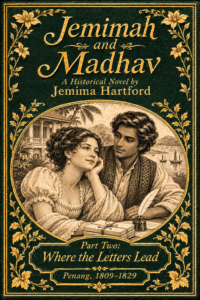 Part Two of Jemimah and Madhav – Where the Letters Lead was published in the late summer of 1922. When the copies arrived, I placed one beside the first volume and spent some time looking at them together. I felt a satisfaction which was different from the pleasure of seeing Jack in print. This time I believed that I had completed something I had intended to do for many years, and that I had done justice to the material entrusted to me.
I was conscious of the curious route by which the two volumes had come into being. My interest in the Fairfax family had begun with Grandmamma Frances, whose opinions caused me considerable distress when I was young. I had set out to understand something of her family, without any particular idea of where the enquiry might lead. In time, it brought me to the story of her sister Jemimah and Madhav, and eventually to the two books which I had now completed.
I cannot say that this work has removed every difficult memory of my childhood, or that I have fully understood my grandmother Frances. But I have come to see her as a woman whose life was marked by so much sadness that I didn’t know about when I was young. Her years in Calcutta, the loss of her beloved sister Jemimah, and her eventual return to England alone must have left their mark upon her. Nor did she ever again see her two other sisters. I cannot know how much these experiences shaped the woman she became, but I can no longer look upon her simply as the stern and disapproving grandmother I remember. There was a life before my own, with its own affections, disappointments and sorrows, and I wish I had understood that sooner.
It has also led me more kindly about the different paths taken by those closest to me. Bertie followed his own professional course and built a family, while Amelia devoted much of her life to her children and her household. When I was younger, I sometimes measured their choices against my own, perhaps without realising that I was doing so. I had been fortunate to find work which interested me and to enjoy a degree of independence, but that did not make their lives any less worthwhile. Each of them had known happiness and disappointment, responsibilities and satisfactions which I could not fully understand. Their lives were their own, and I have come to respect that.
When I consider my own life, I know that I have had my share of sorrow. I lost Edward, and there have been many occasions when I have wished for his companionship and the opportunity to share some discovery or piece of news with him. I have known uncertainty, and I have not always made the wisest decisions. Yet I have also been fortunate. I have been able to work, investigate, write and follow the questions which interested me. I have had Bella’s companionship, and the great happiness of watching Beatrice grow from a child into a young woman. These are things for which I am deeply grateful.
Nor do I look upon the world around me without hope. The war showed us how much suffering could be brought into ordinary lives by events beyond their control, and peace has not restored everything that was lost. But change has also brought opportunities which I welcome. Women have begun to claim a greater place in public life, and the younger generation seem less willing to accept restrictions simply because they have always existed. I hope that the girls growing up now will have greater freedom to choose their own futures, and that they will make good use of it.
I have no wish to pretend that I understand everything about the modern world, or that all its changes are improvements. But I am glad to have lived long enough to see some of them, and I hope I shall remain curious about those still to come.
April 1923 – A new arrival
As I write these pages, I have just received the news that Beatrice has had a daughter, and that they have named her Constance Jemima Fox-Browne. I have not yet had the pleasure of seeing the baby, but I feel as though I have been waiting for her arrival with the same impatience I once felt when Beatrice was expected.
The news that Beatrice had given birth to a daughter reached me with the greatest pleasure. Bella was delighted, of course, and I could well imagine the excitement in their household. I was told that the baby had a fine crop of auburn hair, just like her mother and grandmother. I could not help smiling at the thought that this particular family characteristic had been passed on once again. I had known Beatrice since the day she was born, and had watched her grow from the little girl who once followed me about with endless questions into a young woman with a family of her own.
When Beatrice told me that she had given the baby the name Constance Jemima, I was deeply touched. She said that she wanted to acknowledge all I had done for her, particularly during the years when she had been growing up and Bella’s work had taken her away from home. I could hardly find words to express how much the gesture meant to me.
“You must know how much that means to me,” I told her.
“I wanted you to know,” she replied. “You have been part of my life from the beginning, and I wanted something of you to be part of hers.”
I could not think of a suitable answer. I had not expected such a gift, and I was moved beyond what I could easily express.
I thought, too, of my own name, and of Grandmamma Frances, after whom I had been named. I had not always found it easy to live with the expectations which seemed to accompany that inheritance. I hoped that little Constance would grow up feeling that her name was a gift of affection, rather than an obligation. She must be free to become entirely herself.
I have not yet had the pleasure of meeting her, but I am looking forward very much to seeing her, and to welcoming another generation into our family.
There are many things I cannot know about the life that lies ahead of her. The world into which she has been born is very different from the one in which I began my own life, and it will doubtless change again before she is grown. I hope she will find happiness, and that she will be allowed the freedom to discover what sort of person she wishes to become.
For now, I am simply grateful that she is here.