Written in 1978
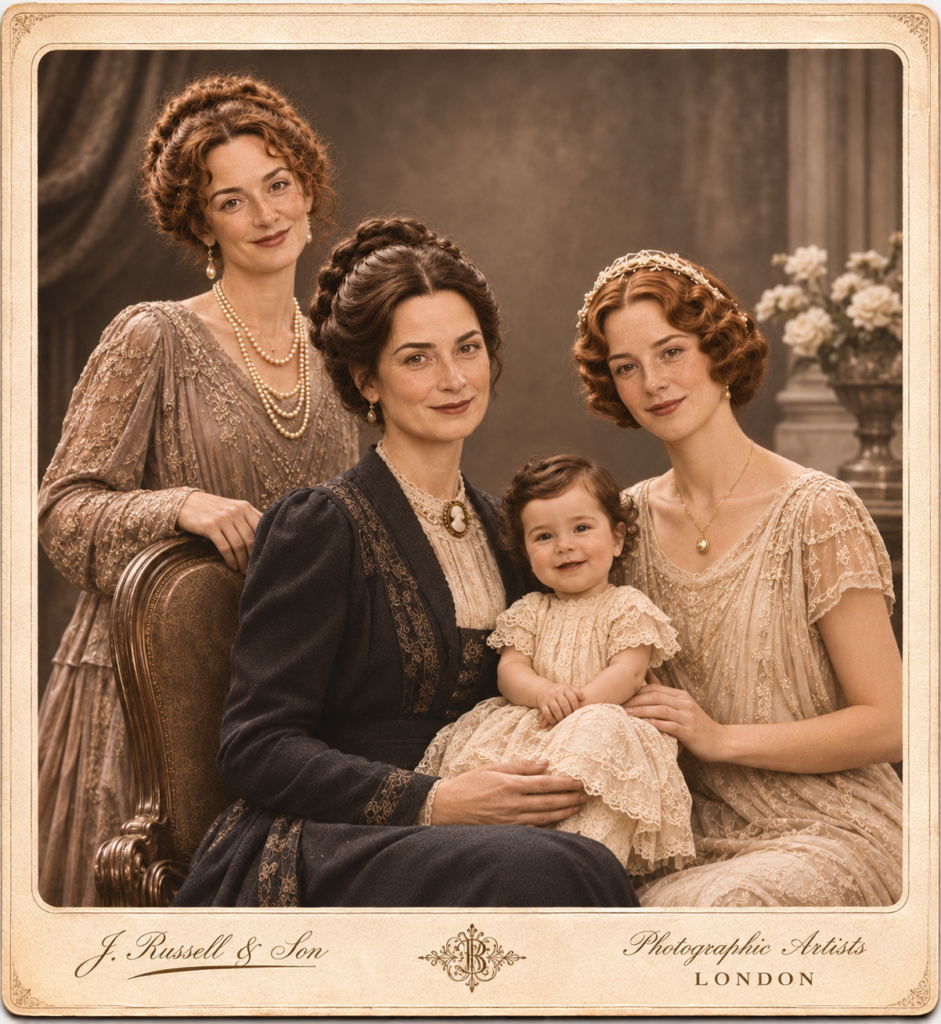
A few words before I begin
My great-great-aunt Jemima Hartford completed the fifth and final part of her memoirs in 1923, and although she had brought her account of her earlier life to a natural conclusion, she had no intention of bringing her investigations to an end. There were still people to remember, family histories to trace, questions to answer and mysteries to pursue. For Jemima, the past was never quite finished, and I doubt that she imagined that those five volumes would ever be the last word on her life or her work.
It is only recently that I have come into possession of the papers and personal effects which she left behind. I have begun to discover the extent of the material she accumulated during her lifetime, and the many different strands of her work. There will be time enough to examine these more fully, and to tell how they came into my hands and what I have found among them. For the present, however, I have decided to begin with the years immediately following the completion of her memoirs. I want first to tell the story of Jemima’s final years, and of the people who were closest to her during that time, before turning back to explore the earlier periods of her life and the records which illuminate them.
In putting together this account, I have drawn on several sources. There are Jemima’s own papers and correspondence, photographs and other records, as well as the recollections passed down through the family. My grandmother Beatrice remembered her aunt particularly well, and my mother, Connie, retained a number of memories from her childhood visits to Canterbury. Although she was still quite young when Jemima died, she remembered the house, the atmosphere of those visits and some of the conversations she had with her great-aunt. Some of these are quite small incidents, but I have come to think that such details often tell us more about a person than a list of dates and achievements.
I never knew Jemima, of course. She died eighteen years before I was born. Yet she has always seemed a remarkably present figure in our family, partly because so much of her work survived, but also because Bella, Beatrice and Connie continued to speak of her. Through them, I have come to know something of the woman behind the memoirs: her curiosity, her habits, her affection for her family and her determination to follow a question wherever the evidence might lead. I have tried to bring together what they remembered with what the surviving documents can tell us, while remembering that recollection and documentary fact are not always quite the same thing.
This is not an attempt to repeat Jemima’s memoirs or to write another account of her investigations. It is the story of what happened to her and to those closest to her during the years after she completed them, and of how her work came to be carried forward by the family. It is also the beginning of the story of what she left behind: not simply her papers and the records of her investigations, but the curiosity and interest in the past which, in different ways, continued through the generations that followed.
Jemima after her memoirs
When Jemima completed the final part of her memoirs in 1923, she was sixty-eight years old. It might have been natural to suppose that she would now turn her attention to other things, or perhaps begin to take life a little more easily. But that was never really her way. Her memoirs had brought one undertaking to a conclusion; they had not brought her working life to an end.
She continued to live in the house in Blackfriars Street in Canterbury, and her historical and genealogical investigations remained central to her daily life. She was still curious about the past, still interested in the lives of people whose stories had been only briefly recorded in newspapers or official documents, and still determined to establish what had actually happened whenever the surviving evidence allowed her to do so.
Her particular interest remained the nineteenth century. She concentrated on cases and family histories relating to the Victorian period, generally choosing subjects which had occurred before 1900. The arrival of a new century had not diminished her interest in the old one. Indeed, she seemed to find an inexhaustible supply of questions in the newspapers, registers and family records she had been collecting for so many years.
Her work was not confined to reading and making notes. She followed up references, compared accounts in different newspapers, traced the people mentioned in reports and attempted to establish what had happened to them afterwards. A brief newspaper paragraph might lead her into months of research. A name in an inquest report could become the starting point for a family history, while a seemingly insignificant detail in a letter or certificate might provide the clue which connected one part of a story to another.
She was particularly interested in the difference between what had been reported and what could actually be established. Newspaper accounts were useful, but she knew they were not always complete or accurate. Witnesses might remember events differently, official records might contain errors, and a coroner’s verdict did not necessarily answer every question raised by a case. She had learned to be cautious about accepting the first explanation offered, and she was not easily satisfied by a conclusion which the evidence did not support.
Over the years, this approach had produced a considerable body of material. Her working papers included notebooks, handwritten transcripts, newspaper cuttings, correspondence, family trees, photographs and copies of official records. She kept notes of possible leads and references which she intended to pursue, as well as accounts of investigations which she considered complete. Some of her work was carefully arranged; other material had accumulated gradually as one enquiry led to another. There were also cases which she had been unable to resolve, despite considerable effort.
Her study in the house in Blackfriars Street had become the centre of this activity, shaped by her own interests and the work of more than half a century. Its shelves held books and reference works, while her desk and surrounding cupboards contained the papers and correspondence of her investigations. It was a working room, and one in which she was entirely at home.
Although she had once been closely involved with the Cantium Museum, she no longer undertook regular work there. She still visited from time to time, however, and remained interested in its collections and activities. If someone needed advice or assistance with a historical or genealogical question, she was usually happy to help. The museum had been an important part of her earlier life, but by this time her private research occupied most of her attention.
She did not, however, work in complete isolation. She maintained correspondence with people who shared her interests, and she was always willing to exchange information or discuss a problem with another researcher. Her reputation as someone who could follow a difficult trail of evidence had grown over the years. She was not necessarily concerned with having her name attached to every discovery; the satisfaction lay in finding an answer, or at least in bringing a little more clarity to a story which had previously been obscure.
One of her later investigations, concerned the case of Harriet Moseley, whose name appeared in an account of an inquest held in Bury in 1847. The newspaper report raised troubling questions about the death of an illegitimate child and the circumstances of its burial. Jemima was particularly struck by the way in which the coroner’s summing-up had moved beyond the evidence and become a judgement on the young woman’s character. She wanted to discover more about Harriet herself: who she had been, what had happened to her before the inquest, and whether it was possible to trace her later life.
It was the sort of case which had always interested Jemima. The newspaper had preserved a small fragment of a person’s life, but it had also presented that person through the opinions and assumptions of others. Jemima wanted to look beyond the report and find the woman behind it. She made enquiries, followed possible family connections and considered whether a woman of the same name found in later records might be the person concerned. She had not reached a definite conclusion by the time of her death.
There were many such investigations in her papers. Some had been brought to a satisfactory conclusion; others remained incomplete, not because she had lost interest, but because the evidence had run out or there had not been enough time to follow every possible lead. She was still finding new subjects to explore, and still adding to the collection which had grown around her work.
But Jemima’s life was not confined to her study. For all the time she devoted to research, she remained closely attached to her family and took a keen interest in the lives of those who were still around her. As she grew older, however, the family circle she had known since childhood became steadily smaller. The deaths of her two older siblings were among the most personal losses of these years.
The first came in 1927, when her brother, Dr Thomas Bertram Kingsley, known to his sisters as Bertie, died at the age of seventy-six. He had been an important figure in Jemima’s life, not simply because he was her elder brother, but because he belonged to that earlier world of family gatherings, childhood memories and shared experiences which had shaped them both. As the years passed, their lives had followed different paths, but the family connection had remained.
Four years later, in 1931, Jemima lost her sister Amelia Page, who died at the age of seventy-eight. Amelia had been the other surviving member of that older generation of siblings. With Amelia’s death, Jemima was the last surviving member of her own generation of the older family, apart from Bella, whose life had followed a very different path. The loss of her brother and sister meant that she was now the only one left who could remember their shared childhood and the family home in quite the same way.
These deaths must have brought home to Jemima how much of the family world into which she had been born had disappeared. She had already experienced the losses of younger members of the family in the Great War, and now the two people who had shared her earliest years were gone too. She continued with her work and her daily life, but the family circle was becoming smaller, and she was increasingly the keeper of memories which no one else could recall in quite the same way.
Bella and the theatre
Bella continued to act throughout the 1920s and 1930s, although she became more selective about the engagements she accepted. She had spent almost all her adult life on the stage, performing under the professional name Bella Mead, and the theatre remained an important part of her identity. It had given her an independence and a life of her own, quite apart from her roles as Jemima’s sister and Beatrice’s mother. Even as she grew older, she had no particular desire to give it up.
Her work consisted of individual engagements rather than a permanent association with one theatrical company. She might spend several weeks in a production and then have a period at home before accepting another part. As she approached sixty, she was increasingly offered roles suited to a more mature actress, and she was happy to take them when the play appealed to her.
In 1924, for example, she appeared in The House on the Hill, a drawing-room comedy, playing Lady Margaret Ashcombe, a well-connected society widow whose sharp observations and dry humour provided much of the entertainment. It was the sort of part that allowed Bella to make an impression without needing to dominate every scene.
Five years later, she took the role of Maria in Twelfth Night. It was a different kind of performance, and one which gave her the opportunity to return to Shakespeare. She enjoyed the language and the liveliness of the character, and it reminded her of the range of work she had undertaken during her earlier career.
By 1935, she was appearing in The Winter Garden, a contemporary family drama, in the role of an older woman whose experience gave her a particular understanding of the younger members of the family. It was a quieter part, but one which suited her well. She was no longer playing the ingénues or romantic leads of her youth, but she had acquired a presence and confidence which could make even a relatively small role memorable.
Bella’s theatrical life was not entirely separate from her family life. After Beatrice married Harry Fox-Browne in 1921, Bella divided her time between London, where she could spend time with her daughter and granddaughter, and Canterbury, where she shared the house in Blackfriars Street with Jemima. Her engagements sometimes took her further afield, but Canterbury remained her home, and the sisters continued to enjoy one another’s company.
After Beatrice married Harry Fox-Browne, Bella divided her time between London, where her daughter lived, and the house in Blackfriars Street, where she and Jemima continued to share their lives. The sisters had remained close throughout their adulthood. Their circumstances were not always the same, and Bella’s theatrical work often took her away, but the affection between them was constant.
The house in Blackfriars Street had been Bella’s home too for more than fifty years. She had first gone to live with Jemima in 1883, when she decided to pursue a professional career on the stage and left the family home. From then onwards, she had lived with her sister on and off, returning between engagements and spending longer periods in Canterbury when her work allowed. She knew the house as intimately as Jemima did. It was not simply the place where her sister lived and worked; it was where the two women had shared so much of their adult lives.
Beatrice, Harry and Connie
Bella’s daughter, Beatrice Theodora Kingsley, had married Harry Fox-Browne in 1921. They were comfortably well off, and Harry had a good position in the City. They made their home in Kensington, where he was able to provide a spacious and comfortable house for his wife and family.
Their daughter, Constance Jemima Fox-Browne, was born in 1923. Jemima announced her birth at the end of her own memoirs, and the baby’s second name had been chosen in her honour. She was affectionately known as Connie.
Beatrice and Harry had hoped to have more than one child, but Connie remained their only daughter. She was Jemima’s great-niece, and she is my mother.
My mother’s memories of Jemima are necessarily those of a child. She was only fourteen when her great-aunt died, and she did not know the full extent of Jemima’s research or the importance it would later have for the family. What she remembered was the woman herself: her appearance, her manner, the house and the conversations they had.
My mother has told me about her visits to Canterbury on many occasions. Sometimes she and Beatrice would travel down from London for the day, particularly when Bella was staying with Jemima. The house was not large enough to accommodate the whole family comfortably for an extended visit, so these were usually short stays. On other occasions Jemima travelled to London and stayed with Beatrice and Harry. Their Kensington home was very different from the house in Blackfriars Street, but Jemima seems to have been equally at ease in both.
One of my mother’s earliest memories concerns the photographs in Jemima’s house. She was puzzled by the solemn expressions of the people in the older portraits and asked why nobody ever smiled. Jemima explained that early photographic exposures could take some time, and that it was difficult to remain perfectly still while smiling. Connie apparently wondered why they did not simply take another photograph.
It is a small recollection, but I like it. It shows the difference between the world in which Jemima had grown up and the one in which my mother was beginning to live. It also suggests that Jemima was quite willing to explain things to a curious child without making her feel foolish for asking.
Another memory, from when my mother was a little older, has stayed with me. She once asked Jemima about a photograph of a young woman whose identity she did not recognise. Jemima explained that she had never met the woman herself, but had been able to reconstruct much of her life from family records and correspondence.
My mother asked how she could know so much about someone she had never met.
Jemima replied:
“People leave more behind than they realise, Connie. A letter, a photograph, a name in a register. Sometimes, if you are patient, you can put together a surprising amount of someone’s life.”
It is a remark which seems to me to sum up much of Jemima’s approach to her work. She believed that people left traces of themselves behind, often without knowing that those traces might one day help someone understand who they had been. She was patient enough to follow them.
I have often wondered whether my mother understood the full significance of that conversation at the time. Probably not. She was a child, and the words may simply have seemed an interesting answer to an interesting question. But she remembered them, and in telling me about them she has passed them on to another generation.
Jemima’s final months
Jemima died in 1937, aged eighty-two. She had remained remarkably active, and there was no long period of retirement or decline in which she gradually withdrew from the life she had made for herself.
She continued her research until shortly before her death. Even in her eighties, she was still interested in new questions and still capable of being absorbed by a case. She also kept up her habit of taking an afternoon stroll around Canterbury. It was part of her daily routine, and she seems to have continued it until the week before she died.
Then she caught a bad cold. It became progressively worse, developed into pneumonia, and she died at home with Bella beside her.
I find it difficult to write about her death without feeling that something important has been lost, even though I never knew her. She had lived through so many changes, from the middle of the nineteenth century into the modern world. She had seen the arrival of new inventions, the transformation of society, two generations of family life and the terrible upheaval of the Great War. Yet she had retained her curiosity and her determination to understand the lives of other people.
She had also outlived her husband by more than fifty years. Edward Alexander Hartford had died in 1881, after only three years of marriage. Jemima had built a long and independent life after his death, but she had never forgotten him.
The funeral
Jemima’s funeral was held at St Peter’s Church in Canterbury. She was buried in Canterbury City Cemetery beside Edward.
Bella was there, as were Beatrice, Harry and my mother, Connie. Other relatives and friends came to pay their respects. It must have been a sad occasion, but I imagine there was also a sense of gratitude for the long and interesting life she had lived.
For Bella, the loss was especially great. She had shared a home with Jemima for so much of her adult life. Their relationship had been more than that of sisters who met occasionally or exchanged family news. They had been companions, confidantes and, in many respects, each other’s family home.
I have sometimes wondered what they said to one another in those last days, but I have no record of their conversations. I would rather not invent words for them. It is enough to know that Bella was with her sister when she died.
Bella and the house in Blackfriars Street
Bella inherited the house in Blackfriars Street, together with Jemima’s belongings and papers. It was a natural arrangement. The sisters had shared the house for much of their lives, and Bella knew it intimately. She was not taking possession of an unfamiliar property; she was continuing to live in the home she had known for more than half a century.
She did not make many changes. She remained in the bedroom she had always used, the same room she had shared with Beatrice when her daughter was a child. She moved a few chairs in the sitting room, but otherwise the familiar arrangement of the house remained much as it had been.
After a few months, Bella began to deal with Jemima’s bedroom and wardrobe. In doing so, she came across something which surprised her: Edward’s wedding suit and some of the working clothes he had worn on the archaeological excavation where he and Jemima had first met.
She knew that Jemima had dealt with Edward’s belongings shortly after his death. The clothes she had kept were therefore not an accidental survival of a wardrobe which had never been cleared. Jemima had chosen to retain them, and had kept them for all the years that followed.
Bella must have understood immediately why her sister had done so. Edward had been Jemima’s husband for only three years, but the love she had felt for him had remained part of her life long after his death. That did not mean she had spent the rest of her life mourning him or that she had been unable to make a life of her own. She had done both: she had built a full and purposeful life, and she had never stopped loving the man she had married.
I think Bella would have recognised the significance of those clothes without needing to ask anyone about them. She had known Jemima all her life. She would have understood that keeping them was a private expression of affection, not an inability to let go.
The study was a different matter. Bella did not feel any need to make substantial changes to the rest of the house, and she left Jemima’s working room largely alone. It was full of books, papers, correspondence and the accumulated material of more than fifty years of research. Bella knew that Jemima had spent much of her life working there, but she did not attempt to examine everything or decide immediately what should be done with it.
From time to time she might straighten something on the desk, move an object or tidy a small area, but she had not yet got round to tackling the room properly. It was not that she wished to turn it into a memorial to Jemima. She simply did not know where to begin, and there was no immediate reason why she should. She knew that the papers mattered and that most of them ought to be preserved, but she needed time to think about what to do.
In the years that followed, she would have time to think about them. For now, she had to adjust to a life without her sister.
The work that remained
Jemima’s death marked the end of a remarkable life, but it did not bring all her work to an end. She had left behind the results of decades of investigation: family histories, newspaper reports, correspondence, photographs, notes and unfinished questions. Some cases had reached conclusions; others remained incomplete. There were people whose lives she had reconstructed in extraordinary detail, and others whose identities she had never been able to establish.
Bella understood that this material was important, even if she did not yet know what to do with all of it. She kept it safe, and that decision would prove to be one of the most important things she did.
The house continued to be a family home. It was not a museum, nor was it frozen in the moment of Jemima’s death. Life went on there, as it had always done. But her work remained, quietly occupying the study, waiting for someone to take an interest in it again.
I have sometimes thought about the different ways in which the women of our family have contributed to the preservation of these stories. Jemima spent her life finding them. Bella understood their importance and kept them safe. My grandmother Beatrice would later protect what had been left to her, and my mother grew up alongside it all without knowing quite what it contained.
It is a curious inheritance. Not simply a house or a collection of papers, but the work of a woman who believed that no life should be dismissed as unimportant and that even the smallest surviving detail might help to recover a forgotten story.
Jemima had finished writing her memoirs in 1923, but she had never finished investigating. Her questions remained, and in time they would become questions for another generation.