Written in 1979
A few words before we begin
The years covered in this part of my family’s history were years of change and new beginnings. The war had brought uncertainty and disruption to everyone’s lives, but even during those difficult years, life continued. People married, made homes, formed new friendships and looked towards a future that they could only begin to imagine.
This account draws on the family recollections passed down to me, together with photographs, letters and other documents that have survived. Some events are recorded clearly, while others have had to be pieced together from the evidence available and from what I know of the people concerned. I have tried, wherever possible, to distinguish between what is known and what I have had to reconstruct.
There are also family papers whose significance was not understood at the time. They remained among the possessions kept in the house in Blackfriars Street, waiting, as it turned out, for another generation to discover them.
1944 – A marriage in wartime
By the beginning of 1944, Connie and Adam had been together for some time. Their friendship, which had begun when Connie first started working at Canterbury West station, had gradually developed into a close and affectionate relationship. They had got to know one another through their daily routines, through conversations after work and through the time they spent together away from the station. What had begun as an acquaintance had become something much more important to both of them.
It was not until one evening, when they were all together in the house in Blackfriars Street, that Connie and Adam told Beatrice what they had decided.
Connie began rather hesitantly, although it was clear that she and Adam had discussed what they wanted to say. They had been thinking seriously about their future, she explained, and had come to the conclusion that they wished to marry.
Beatrice looked from her daughter to Adam. She had known, of course, that their friendship had grown into something deeper, and she liked Adam. He was considerate towards Connie, steady in his work and had always shown respect for the family. Even so, hearing them speak of marriage made the prospect seem suddenly very real.
“Have you both thought this through?” she asked.
“We have, Mother,” Connie replied. “We know it isn’t an easy time, but we don’t want to keep putting our lives on hold. We want to be together, and we want to make a home.”
Adam assured Beatrice that he understood the responsibility he was taking on. He had a secure position with the railway, and although wartime life brought many uncertainties, he and Connie were not making the decision lightly.
Beatrice was pleased for them, but her thoughts inevitably turned to Harry. She had imagined that he would be there when Connie married, that he would have the opportunity to give his daughter away and share in such an important day. The thought that he might still be a prisoner in Germany when the wedding took place was painful.
“I only wish your father could be here,” she said.
“So do I,” Connie answered. “But we don’t know how long the war will last, and we cannot ask everyone to wait for a future that may be a long way off.”
Adam said quietly that he wished Harry could be there too. He would have liked to meet him properly and have his approval. But he hoped that, when Harry eventually came home, he would understand why they had chosen not to wait.
Beatrice did not want her own sadness to stand in the way of their happiness. She knew that Connie and Adam had thought carefully about this, and she could see how much they meant to one another.
“Then I hope you will both be very happy,” she said at last. “Your father would want that for you, too.”
It was not quite the conversation Beatrice might have imagined having with her daughter, and there was a sadness in knowing that Harry would miss the wedding. But she accepted their decision, and from that evening the practical arrangements could begin.
There was little prospect of a grand wedding in wartime, and they had no wish for one. Rationing and the restrictions of the time meant that clothing, food and the reception all had to be considered carefully. They decided on a modest ceremony in Canterbury, with only close family and a few friends present. It would not be quite the wedding Connie might once have imagined, but it would be their day, and that mattered more than anything else.
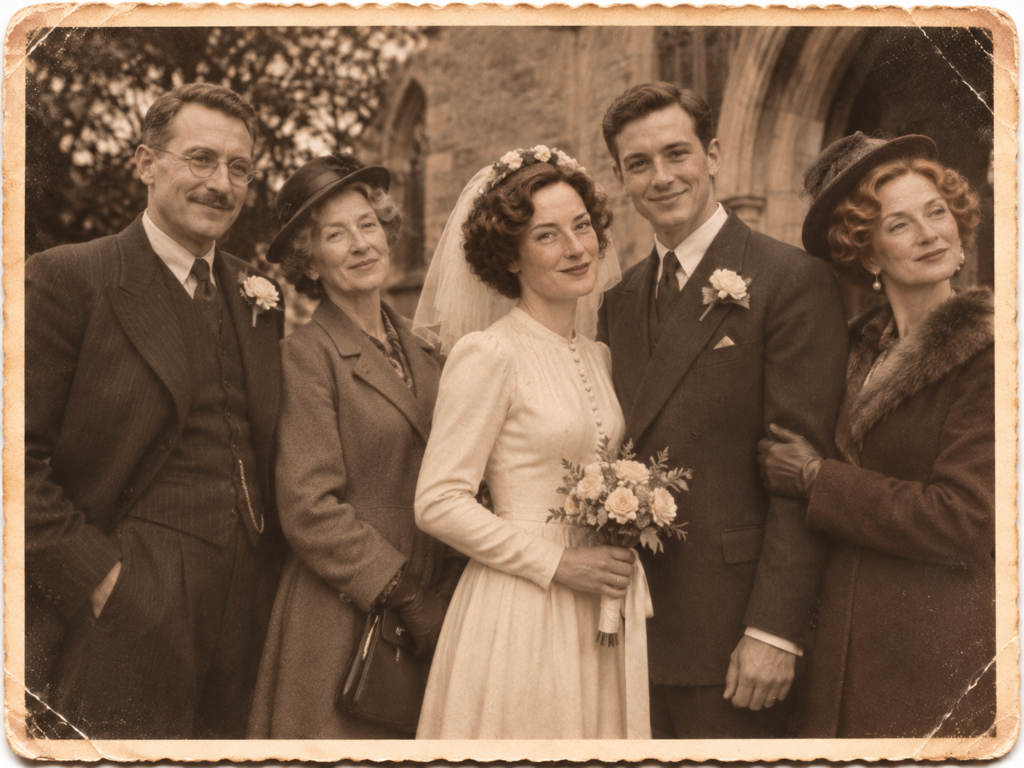
Connie’s wedding dress was to be simple, but she was determined that it should still look like a proper bridal gown. Beatrice mentioned that she had a long, soft ivory dress which she thought might be suitable for alteration. She offered it to Connie, saying that if she would like to use it, they could see what might be done to turn it into a wedding dress. Connie was touched by the offer and readily agreed. Together they considered how it might be adapted, eventually settling on a fitted bodice, a modest neckline and long sleeves. The skirt would fall simply from the waist, without elaborate trimming or a train. It was an elegant design, but one that made sensible use of what was already available. A short veil, borrowed for the occasion, and a small bouquet of flowers would complete the outfit.
It was not the elaborate wedding dress Connie might have chosen in more prosperous times, but she was delighted with it. There was something particularly special about wearing a dress that had once belonged to her mother, and Beatrice was pleased to have been able to contribute to her daughter’s wedding in this way.
The wedding breakfast required similar thought. Food was still rationed, and even a small gathering meant planning carefully and making the best use of what was available. Beatrice would have wanted to provide something for the family, but there was no question of a lavish meal. A simple celebration, with a modest selection of food and perhaps a little cake, was enough. The Slomans would be there, and the occasion would bring the two families together in a way that had not happened before.
The ceremony itself took place on Saturday 29 April 1944. It was a small affair, attended by their closest family and friends. The absence of Harry was the one sadness that could not be put aside. Connie was conscious of it throughout the day, and Beatrice must have felt it particularly strongly. Yet there was happiness too. Connie and Adam were beginning a new chapter, and those who gathered around them were pleased to see them married.
Afterwards, the practical business of establishing their married life had to be considered. They were to remain in the house in Blackfriars Street, where Connie had lived since leaving London. It made sense financially and practically, particularly while the war continued and housing was difficult to find. Beatrice was happy for them to stay, and Adam was welcomed into the household.
There were some adjustments to the rooms and furniture. Connie remained in her own room, which had been hers since her arrival into Bella’s household in 1940. It was familiar to her, and there was no reason to change everything simply because she was now married. A better bed and a few alterations made it suitable for the two of them. The larger bedroom, which had once belonged to Jemima and had later been used by Beatrice, remained Beatrice’s.
Living together in this way was not unusual in the circumstances. The house was large enough to accommodate them, and the arrangement allowed the family to share expenses and support one another. Adam’s work at the railway kept him occupied, while Connie continued with her own responsibilities. They had the companionship of one another, but they also had to fit their married life around the routines of a household in which Beatrice remained an important presence.
They had also discussed the question of children. They both wanted a family eventually, but they decided that while the war continued they would wait. The future was too uncertain. Adam’s work was essential, Harry remained a prisoner, and the possibility of further danger and disruption was never far away. They felt that it would be better to wait until peace had returned and they could offer a child a more settled beginning.
It was not a decision made without affection or longing for a family of their own. Rather, it reflected the practical outlook they had developed during the war. They had seen how easily ordinary lives could be disrupted, and they wanted to give their future children the security that circumstances had denied so many others.
For Connie and Adam, 1944 was therefore a year of beginnings, but not yet of complete freedom. They were married, they had a home together, and they could look forward to a future. Beyond Canterbury, however, the war continued, and Harry was still somewhere in Germany, waiting for the day when he too could come home.
1944 – A new household
After their marriage, Connie and Adam began the process of settling into life together in the house in Blackfriars Street. In one sense, very little had changed. Connie was still living in the home she had shared with Beatrice, and Adam was already familiar with the family and its ways. Yet marriage inevitably brought a change in their circumstances, and all three had to become accustomed to a slightly different household.
For Connie, the adjustment was perhaps the most noticeable. She was still very much at home with her mother, but she now had a husband with whom to share the ordinary details of everyday life. They had their own room and their own routines, although much of their time was still spent together with Beatrice. It was a new balance, and one they found quite naturally.
Adam, too, had to settle into a home that had its own history and established habits. He had been welcomed into the family long before the wedding, but living there as Connie’s husband was rather different from being a regular visitor. He was considerate of Beatrice and quickly became part of the household, while she made every effort to ensure that he felt comfortable there.
For Beatrice, there was a change in the familiar companionship she had enjoyed with Connie. Her daughter was still there, and they continued to share much of their daily life, but Connie now had a husband and a marriage of her own. Beatrice was pleased to see her settled and happy, and she understood that the two young people needed time and space together. At the same time, she was glad not to be living alone.
Practical matters also required a little adjustment. Adam’s work at Canterbury West meant that his hours did not always fit neatly into the ordinary pattern of family life. Meals and household arrangements had to take account of his shifts, and there were occasions when he came home while the rest of the household was already settling down for the evening. These were small things, but they were part of learning to live together.
There was no difficulty between them. They were fond of one another, and each was thoughtful of the others. Gradually, the house acquired a new rhythm, with Connie and Adam establishing their married life while Beatrice continued to share the home with them.
It was not the arrangement any of them might originally have imagined, but wartime circumstances had brought the family together in Canterbury, and there was comfort in being able to remain together. For the time being, it suited them all.
1944 – Working on the railway
Although their home life had changed, both Connie and Adam continued with their work at Canterbury West railway station. Connie remained in the ticket office, where she had been employed since before their marriage, while Adam continued his duties as a signalman. In different ways, they were both part of the railway’s wartime workforce, helping to keep an essential service operating under difficult conditions.
Connie’s work brought her into contact with a constant stream of people. The railway was carrying military personnel, people travelling for work, those visiting relatives and ordinary passengers whose journeys were often affected by wartime restrictions and changes to services. There were fewer opportunities for leisurely travel, and the station could be busy at unpredictable times. Connie had to be efficient and patient, dealing with enquiries as well as issuing tickets, often to people who were tired, anxious or in a hurry.
Adam’s work was rather different. As a signalman, he had considerable responsibility for the safe movement of trains along his section of the line. His shifts required concentration and alertness, and wartime conditions sometimes made an already demanding job more complicated. Military movements, altered timetables and occasional disruption meant that he had to be ready to respond to circumstances that could change at short notice.
There were, no doubt, a number of occasions when Adam had to deal with unusual or difficult situations. One incident illustrates the sort of responsibility he carried. Following an air raid which had disrupted services elsewhere along the line, a train was held while information was obtained about the condition of the track ahead. Adam could not allow it to proceed until he had received confirmation that the route was safe. It meant a delay for the passengers and crew, but there was no room for impatience when safety was involved. Only when the necessary assurance had been received could the train continue.
For Connie and Adam, working on the same railway meant that their working lives were never entirely separate from one another. They understood the demands of the job and the uncertainty that wartime disruption could bring. Their hours did not always coincide, and there were times when one was at work while the other was at home, but they shared an understanding of the responsibilities they had undertaken.
The railway was not simply where they earned their living. It was part of the community in which they lived, and their work gave them both a sense of purpose at a time when so much else remained uncertain.
1945 – The last months of war
The opening months of 1945 brought a growing sense that the war in Europe might finally be approaching its end. News from the Continent was increasingly encouraging, as Allied forces advanced through France and into Germany, while the Soviet armies moved westwards from the east. After so many years of uncertainty and sacrifice, people began to allow themselves to hope that peace might not be too far away.
Life in Canterbury, however, continued much as it had during the previous year. Rationing remained part of everyday existence, and shortages and restrictions had not suddenly disappeared. Connie and Adam carried on with their work at Canterbury West, where the railway continued to play an important part in the movement of people and supplies. Their working lives were still governed by shifts and responsibilities, and the ordinary routines of the household continued around them.
For Beatrice, these developments brought mixed feelings. She was relieved by the progress being made by the Allies and hopeful that the fighting would soon be over, but she knew that Harry was still a prisoner of war. The end of the war in Europe would bring the possibility of his return, although she had no way of knowing exactly when that might happen or what condition he would be in after so many years away.
Connie and Adam shared her hopes. They had begun their married life while the war was still being fought, and the prospect of peace meant that they could at last look forward to a more settled future. Yet for all three of them, the most important thing was still Harry’s safe return.
As the weeks passed, the news from Europe became more dramatic. The German armies were being pushed back on every front, and the prospect of victory grew ever closer. For Beatrice, each new report brought her a little nearer to the moment she had been waiting for since Harry’s capture in 1940.
8 May 1945 – VE Day
On Tuesday, 8 May 1945, the announcement that the war in Europe was over brought an enormous sense of relief throughout the country. After almost six years of conflict, the news that Germany had surrendered was greeted with celebrations in towns and cities across Britain. In Canterbury, too, people came out into the streets to share the moment. Flags and bunting appeared, people gathered to talk and congratulate one another, and there was a feeling of happiness that had been absent for so long.
For Connie and Adam, it was a day they had scarcely dared to imagine when they married the previous spring. They had begun their life together in the middle of a war, never knowing how long it would last or what the future might bring. Now, at last, there was the prospect of peace. They could look forward to a time when railway services might return to something closer to normal and when ordinary life would no longer be governed by wartime restrictions and uncertainty.
Beatrice was equally relieved, but her thoughts were inevitably with Harry. The end of the war in Europe meant that the reason for his captivity had come to an end, and she could now hope that he would soon be released. Yet there was still no immediate news of his whereabouts or of when he might return. The fighting had stopped, but the process of bringing prisoners of war home would take time.
She had waited nearly five years for this moment. Now that peace had come, she wanted only one thing: to have her husband home again.
For the family, VE Day was therefore both a celebration and the beginning of another period of waiting. They could be thankful that the war in Europe was over, but they knew that the next important news they received would be about Harry.
12 May 1945 – News of Harry
Only a few days after VE Day, the news Beatrice had been waiting so long for finally arrived. A telegram was delivered to the house in Blackfriars Street, confirming that Harry had been liberated and was safely back in Britain.
The message was brief, but its meaning was enormous. After nearly five years of uncertainty, Beatrice at last knew that her husband was alive and free. Harry had been captured during the retreat to Dunkirk in May 1940, and for much of the intervening time she had known very little about his circumstances. Even when news of his imprisonment had reached her, there had always been the anxiety of not knowing what he was enduring or whether he was well.
Connie and Adam were with her when the telegram arrived, and they shared her relief. For Connie, the news meant that her father, whom she had last seen when she was still a teenager, would finally be coming home. She was now a married woman, and so much had happened in his absence that she could scarcely imagine what it would be like to see him again.
There was still some waiting to be done. Harry had been brought back to Britain, but former prisoners were being processed and arrangements made for their return to their families. Beatrice did not yet know exactly when he would arrive, only that it would not be long.
After all the years of waiting, the prospect of seeing him again was almost difficult to take in. The war had separated them for far too long, and now, at last, Beatrice could begin to look forward to having her husband home.
16 May 1945 – Harry comes home
On Wednesday, 16 May 1945, Harry finally returned to his family. Nearly five years had passed since Beatrice had last seen her husband, and although she had known for four days that he was safely back in Britain, nothing could quite prepare her for the moment when he walked through the door of the house in Blackfriars Street. At last, the long wait was over.
When Harry arrived, the first moments were almost too much for either of them. Beatrice went straight to him, and they held one another for a long time. There were tears, and very little need for words. So much had happened during the years they had been separated, but for that moment all that mattered was that they were together again.
Harry was thinner than Beatrice remembered him, and there was a noticeable change in his appearance. The years of imprisonment had taken their toll, although he was not seriously ill or incapacitated. He was tired from his journey and from everything he had endured, but he was home, and that was what mattered most.
Connie’s reunion with her father was different, but no less moving. The last time Harry had seen her, she had been a girl of seventeen. Now she was twenty-two, a married woman with a home and a life of her own. He looked at her with a mixture of pride and amazement, taking in the changes that five years had brought. Connie, in turn, was delighted to have him back, although she knew that it would take time for them both to become accustomed to the fact that so much of her adult life had taken place without him.
Harry had missed her wedding the previous year. It was a sadness he could not entirely put aside, and he told her how much he wished he could have been there. Connie reassured him that they had thought of him throughout the day and that she had always hoped he would eventually be able to share in their happiness. There would be time now for him to get to know the man she had married.
Adam had been waiting with them, and this was his first proper meeting with his father-in-law. He greeted Harry warmly, conscious that this was an important moment for all of them. Harry, for his part, was glad to meet the man who had become his daughter’s husband. He had heard about Adam in Beatrice’s letters, but meeting him in person was quite different. He could see that Connie was happy, and that mattered greatly to him. The two men had much to learn about one another, but there was no awkwardness or hostility between them.
That first evening was naturally taken up with the simple pleasure of being together. There was much to talk about, although Harry was tired and did not attempt to recount everything that had happened to him. Beatrice and Connie wanted to hear about his journey home and how he was feeling, while Harry was equally interested in what had happened in Canterbury during his absence. He wanted to know about Connie’s work, her marriage and the family life he had missed.
For the first time in nearly five years, they could sit together without the knowledge that Harry was thousands of miles away, behind barbed wire and under guard. He was home, and they could begin to find their way back to being a family together.
It would take time, of course. Harry had to become accustomed to freedom and to the changes in the people he loved, while Beatrice and Connie had to make room for the man who had been absent for so long. But there was no doubt that his return was a moment of enormous happiness for them all.
Harry and Connie
In the days following Harry’s return, he and Connie began to rediscover their relationship. They had always been close, and although nearly five years of separation could not simply be undone, the affection between them remained unchanged. Yet Harry was conscious that he was getting to know a rather different Connie from the girl he had last seen in 1940.
He was particularly interested in how she had met Adam and how their friendship had developed into something more. Connie told him about their early conversations at the station, the gradual growth of their affection and their decision to marry in the spring of 1944. Harry listened with great interest, wanting to know all the details he had missed.
The wedding was naturally a subject of particular interest. Connie showed him photographs of the day and told him about the arrangements, the dress Beatrice had offered her and the small gathering that had celebrated their marriage. Harry looked carefully at the pictures, trying to imagine the occasion and the people who had been there. He was sorry not to have been present, but he was pleased to see how happy Connie had been. He could also see how much Adam meant to her.
There was, perhaps, a little sadness in realising just how much of his daughter’s young life had passed without him. He had missed her growing up, her first years of work and the beginning of her relationship with Adam. But he did not dwell on what could not be changed. Instead, he was determined to take an interest in the life she now shared with her husband and to become part of it.
For Connie, having her father home meant that she could once again share the ordinary things of life with him. She could tell him about her work, talk over family matters and enjoy his company without the uncertainty that had accompanied every letter and every piece of news during the war. She no longer had to imagine what it might be like to see him again.
In some ways, they had to learn a little about one another afresh. Harry had to become accustomed to the fact that his daughter was now a married woman, while Connie had to get used to having her father around after so many years of making her own decisions without him. But these adjustments came naturally. Their relationship had not been lost; it simply had to find its place in the life they now shared.
Harry was very proud of Connie, and she was delighted to have him home. The years apart could never be recovered, but they had the opportunity to make new memories together, and both were grateful for that.
Harry and Adam
Harry’s return also gave him the opportunity to get to know Adam properly. He had heard about him in Beatrice’s letters and from Connie’s accounts of her life in Canterbury, but until now he had never had the chance to meet the young man who had become his son-in-law.
Harry was interested in Adam’s work on the railway, and they soon found plenty to talk about. Adam explained his duties as a signalman at Canterbury West, while Harry, who had served in the Royal Corps of Signals, was familiar with the importance of reliable communications and careful procedures. Although their work had been very different, there were points of common understanding between them. Harry was interested in the responsibility Adam carried, particularly during the difficult wartime years, and listened with appreciation as he described some of the demands of the job.
He also wanted to know about Adam’s family. Adam told him about Stephen and Janina, their Polish background and the life they had made in Canterbury. Harry had known something of this from Connie, but hearing about it directly from Adam gave him a better understanding of the family into which his daughter had married. He was particularly interested in the story of Adam’s parents and their arrival in England, and in the traditions they had maintained in their home.
As the days passed, the two men became more comfortable in one another’s company. There was no need to force a relationship or to pretend that they had known each other for years. They simply began to talk, sometimes about work and family, sometimes about more ordinary things. Harry was pleased to see that Adam treated Connie with affection and consideration, and Adam was glad to have the opportunity to know the father whose absence had been such a large part of Connie’s life.
Harry had missed his daughter’s wedding, but he had not lost his place in her family. Adam understood that, and Harry in turn recognised that Connie and Adam had built a happy life together while he was away. There was room for all of them, and his return brought the family together in a new way.
Harry talks of his years in captivity
It was some time after his return that Harry began to talk more freely about his experiences as a prisoner of war. At first, he had been content to answer occasional questions, but gradually, as he became more settled, he began to tell Beatrice, Connie and Adam about what had happened to him. He did not always tell the story in one sitting. Sometimes a particular question brought back a memory, and at other times he would talk about an event that had remained especially clear in his mind.
His story began in France in May 1940. Harry had gone overseas with the British Expeditionary Force the previous month, serving with the 44th (Home Counties) Division’s Signals unit. As the German advance forced the British forces into retreat towards the coast, the situation became increasingly desperate. The withdrawal towards Dunkirk was marked by confusion, exhaustion and the constant threat of attack. Harry was eventually captured, and with that his life as a serving officer came to an abrupt end.
Like thousands of other British servicemen taken prisoner during the campaign, he faced the uncertainty of being moved away from the battlefield and into German captivity. He had little idea at first where he would be taken or how long he would remain a prisoner. His immediate concerns were practical: food, shelter, keeping warm and finding out what had happened to other men from his unit.
Harry was eventually sent to Oflag VII-B at Eichstätt in Bavaria, where he spent the next three years. The camp held British officers, and although the prisoners were subject to strict rules and regular inspections, they developed their own routines and activities. There were opportunities for reading, discussion, lectures and other occupations, all of which helped to give some structure to days that might otherwise have seemed endlessly repetitive.
For Harry, as for many of the other officers, the possibility of escape was never far from his thoughts. The men knew that an escape would be difficult and dangerous, but they also understood that remaining behind the wire indefinitely was not something they were prepared simply to accept. Plans were discussed, carefully organised and kept secret from the guards.
In the early summer of 1943, Harry became involved in one of the most remarkable escape attempts of the war. A tunnel had been constructed at Eichstätt, and on the night of 3–4 June, sixty-five British officers made their way out of the camp. Harry was among them.
The escape was a considerable achievement, but getting out of the camp was only the beginning. The men dispersed in small groups, hoping to make their way across Germany and eventually reach neutral territory. Harry’s intention was to get towards Switzerland. He knew that the journey would be extremely difficult, with the constant danger of being recognised or stopped, but for a brief time he had the hope that he might regain his freedom.
His escape did not succeed. He was eventually recaptured and, like the other men who had taken part, returned to German custody. The consequences of the escape were severe, and the prisoners were subsequently transferred to Oflag IV-C at Colditz Castle in Saxony.
Colditz was a very different place from Eichstätt. It was an old castle, used as a special prisoner-of-war camp for officers regarded by the Germans as particularly troublesome or likely to attempt escape. Its reputation was already considerable, and Harry found himself among men who had made repeated efforts to get away from captivity. The atmosphere was more closely controlled, and the prisoners were watched carefully, but the determination to find a way out had not disappeared.
Harry remained at Colditz until the spring of 1945. By then, the war was moving towards its conclusion, and the sound of fighting was drawing ever nearer. The prisoners knew that the German position was deteriorating, although they could not be certain what would happen to them as the Allied armies advanced.
On 16 April 1945, American forces reached Colditz and the prisoners were liberated. After almost five years in captivity, Harry was free at last.
Following his return to Britain, Harry was taken through the Army’s reception arrangements, which included a medical examination and the necessary administrative formalities. He was considered fit to return home on leave, although the years of imprisonment had left him thinner and less physically robust than before. At last, he was able to make his way back to Beatrice and Connie.
When he eventually finished telling his family about those years, he did not present himself as a hero. He spoke of the men he had known, the friendships that had helped them endure, the frustrations of captivity and the repeated disappointment of failed escape attempts. He also spoke of the uncertainty of never knowing how long imprisonment would last.
Harry was home, and although those years would always remain part of him, he could now speak about them among the people he loved.
September 1945 – Returning to Kensington
By the late summer of 1945, Harry was beginning to feel more like himself again. The months spent in captivity had inevitably taken their toll, and although he had returned home in reasonable health, he needed time to regain his strength and become accustomed to ordinary civilian life. The summer in Canterbury had given him that opportunity. He had been able to spend time with Beatrice, become reacquainted with Connie and get to know Adam properly, without the immediate demands of returning to work or making major decisions.
As the weeks passed, Harry and Beatrice began to talk about returning to their home in Kensington. They were both were ready to resume their life in London. Harry particularly wanted to see the house again and to discover what condition it was in after such a long absence. Beatrice, too, was looking forward to returning, although she had become very fond of the life they had shared with Connie in Canterbury.
There were practical arrangements to make before they could leave. The Kensington house had been closed for much of the war, and it needed to be aired, cleaned and made ready for their return. The move was not especially complicated, but after so many years of living together, it marked another change in the family’s circumstances.
Connie and Adam were to remain in the house in Blackfriars Street. It had become their home, and there was no reason for them to move simply because Beatrice and Harry were returning to London. Beatrice retained legal ownership of the Canterbury house, but she regarded it as Connie and Adam’s home and had no intention of reserving it for her own use. She and Harry were comfortably established in Kensington, and they were pleased that Connie should have such a lovely home of her own.
The departure in September was naturally a little emotional. Beatrice had shared the difficult years of the war with Connie, and leaving her daughter in Canterbury meant that their daily companionship would come to an end. But Connie was now happily married, and Beatrice knew that she and Adam were settled and able to manage their own household. She was not leaving Connie alone, and the distance between Canterbury and London was easily manageable.
There was also the question of Harry’s return to work. Before the war, he had been employed in banking in the City, and he was keen to resume his former occupation when he felt sufficiently recovered. The Government had made provision for returning servicemen through the Reinstatement in Civil Employment Act of 1944, which gave eligible men the right to apply to their former employers to be taken back into their previous employment. In Harry’s case, however, there was no need for any difficulty. The bank was pleased to have him back and welcomed his return after his long absence. It was reassuring for Harry to know that his former position was still open to him and that he could return to a familiar working environment as he began to rebuild his civilian life.
When Beatrice and Harry returned to Kensington, they were beginning another chapter of their lives. Their home was familiar, but they were not quite the same people who had left it in 1940. The war had changed them both, and their family had grown in ways neither could have anticipated. Nevertheless, they were together again, and after everything that had happened, that was enough.
1946 – Making a home in Canterbury
With Beatrice and Harry settled back in Kensington, Connie and Adam were able to establish their own household in Blackfriars Street. There was no great need to make substantial changes. They could gradually arrange things to suit themselves, making the house their own in the ordinary way that any newly married couple would. But they did move into the larger bedroom, that once had been Jemima’s room, and which during the war Beatrice had used as her own.
Their working lives continued much as before. Connie remained at the ticket office at Canterbury West, while Adam carried on as a signalman. The railway was still an important part of their everyday lives, although the gradual return to peacetime brought changes to services and a slow easing of some of the wartime pressures. They were both accustomed to working hard, and their familiar routines provided a reassuring structure as the country adjusted to life after the war.
Beatrice and Harry remained close to them, of course, and visits between London and Canterbury were an ordinary part of family life. But the two households were now separate, and Connie and Adam were free to make their own decisions about the running of their home.
They also remained close to Stephen and Janina. As Adam’s parents, they were naturally an important part of their lives, and the young couple continued to share family occasions and ordinary visits with them. The Polish traditions in which Adam had been brought up remained part of his daily life, and Connie had become increasingly familiar with them too.
The years immediately after the war were not without their difficulties. Rationing and shortages continued, and the return to ordinary life was slower than many people had hoped. Nevertheless, there was a growing sense that they could now make plans without the constant uncertainty of wartime. Connie and Adam had a home of their own, secure employment and the company of both sides of their family. They were ready to look ahead.
1946 – Helping others to begin again
The end of the war brought a new concern into the lives of the Sloman family. For many Poles who had served with the Allied forces, peace did not mean that they could simply return home. Poland had emerged from the war under a very different political order, and for those who had fought alongside the British and other Western Allies, the prospect of returning was often difficult, and sometimes impossible to contemplate.
Stephen and Janina understood something of what it meant to leave one’s country and build a life elsewhere. They had come to England in 1912, long before the present troubles, and had gradually made a home for themselves. Stephen had worked his way up through the railway, learned a new language and adapted to a different society. They had never forgotten Poland, however, and the events of the war had made their attachment to their birthplace all the stronger.
When the Polish Resettlement Corps was established in 1946, it became clear that many Polish servicemen would be making a new life in Britain. Some had spent years away from their families; others had lost contact with relatives or had no home to which they could safely return. Men who had been soldiers now had to find civilian work, accommodation and a place in a country whose language and customs were unfamiliar to many of them.
Stephen and Janina wanted to help, but it soon became a family undertaking rather than something that belonged to them alone. Adam was naturally involved. Although born in England, he had grown up in a Polish household, speaking the language and understanding the traditions. He could communicate with newcomers in a way that made them feel less isolated, and he was able to help them navigate the unfamiliar world in which they now found themselves.
Connie became equally involved. She had no Polish ancestry of her own, but by this time Poland and its people were very much part of her family life. She understood how important this work was to Adam and his parents, and she felt strongly that people who had given so much during the war should not be left to face the difficulties of starting again without support. She brought her own practical abilities to the effort, helping to make arrangements, welcoming people and ensuring that those who came into contact with the family were made to feel at home.
The house in Blackfriars Street was often a natural meeting place. There might be someone needing advice, a person looking for help with accommodation or employment, or simply someone who wanted to spend an hour among people who understood something of what they had been through. Stephen and Janina could offer the reassurance of their own experience, Adam could help with language and communication, and Connie was just as ready to lend a hand. It was not a formal service, but a great deal could be achieved through kindness, introductions and practical assistance.
For Connie, the work brought a deeper understanding of the history that had shaped Adam’s family. She had known that Stephen and Janina had left Poland because of political difficulties, but meeting people whose lives had been disrupted by the more recent war made that experience seem much closer. These were not simply people from another country. They were husbands, wives, parents and children trying to find their place again after years of uncertainty.
The work continued over several years. The Polish Resettlement Corps was eventually wound up in 1949, but the need for friendship and mutual support did not end with it. Some of those who had arrived found work and settled permanently in Britain; others were reunited with their families, while many continued to maintain close links with the Polish community.
For Stephen and Janina, helping these newcomers was a way of keeping their own connection with Poland alive. For Adam, it was an expression of the Polish heritage in which he had been brought up. And for Connie, it had become something she cared about in its own right. By then, she was not simply helping her husband’s family with their concerns. She had become part of the effort herself, and the work had become something they shared.
1946 – A New Chapter: Connie’s Pregnancy
By 1946, Connie and Adam had settled comfortably into their married life. The house in Blackfriars Street was now very much their home, and although they were both still working, they had found a rhythm to their days. They enjoyed their independence, but family remained an important part of their lives. Stephen and Janina were frequent visitors, and Connie and Adam continued to help them with the Polish families and former servicemen who were trying to make a new life in Britain.
There was, however, another change approaching. During the course of the year, Connie discovered that she was expecting a baby.
The news brought a mixture of excitement and apprehension. They had talked about having children once the war was over, and now that the prospect had become real, both began to think about the responsibilities that lay ahead. Adam was delighted at the thought of becoming a father, while Connie, although equally happy, was conscious that her life was about to change in ways she could not yet fully imagine.
Beatrice was naturally pleased when she heard the news.Having been through the experience of motherhood herself, she knew how much it could alter one’s outlook on life. She was delighted at the thought of becoming a grandmother, though she was careful not to overwhelm Connie with advice. Connie was a grown woman with a home and a husband of her own, and Beatrice understood that she and Adam would find their own way.
Stephen and Janina were equally delighted. For them, a grandchild meant the continuation of their family in a country that had become their home, while still keeping alive the Polish traditions they had brought with them. They were particularly pleased at the thought of Adam becoming a father, and Janina was already looking forward to helping with the baby.
As the pregnancy progressed, Connie and Adam began making preparations. There was the practical business of arranging the baby’s room, gathering clothes and making sure that everything would be ready. Nothing was particularly extravagant. The post-war years were still marked by shortages and rationing, and like other young couples they had to make use of what was available. But they had the advantage of a comfortable home and a family who were ready to help.
Connie’s involvement with the Polish community continued, although naturally her pregnancy became an increasingly important part of her daily life. Adam remained closely involved too, as did Stephen and Janina. The work they had begun together was not something Connie simply stepped away from, but there were now other matters to think about, and a new arrival for whom they were all preparing.
For Connie and Adam, 1946 was therefore a year of beginnings. They were building their life together, finding their place within the wider family and looking forward to the arrival of their first child.
1947 – Daniel arrives
On 6 April 1947, Connie and Adam’s first child was born. They named him Daniel Harry Sloman.
His arrival brought an entirely new happiness into the house in Blackfriars Street. Connie and Adam were now parents, and the familiar routines of their married life were transformed by the needs of a small baby. There were sleepless nights, new responsibilities and all the adjustments that come with a first child, but they took to their new roles with enthusiasm.
The choice of his names carried something of the family’s history. Daniel was the name of Adam’s grandfather, a man Adam himself had never known, but whose name had been kept alive within the family. Harry was chosen in honour of Connie’s father, my grandfather. In this way, their son’s name brought together two generations and both sides of the family.
Beatrice was delighted to become a grandmother. She had watched Connie grow from a little girl into a young woman, and now she was able to share in this new stage of her daughter’s life. She was affectionate towards Daniel and enjoyed visiting Canterbury to see him, while allowing Connie and Adam the space to discover parenthood for themselves.
For Stephen and Janina, Daniel’s birth was especially meaningful. He was their first grandchild, and they were overjoyed to welcome him. Janina was particularly pleased to have a baby in the family again, and there were opportunities to pass on little things from her own childhood and Polish upbringing. Adam was happy that his son would grow up knowing something of that heritage, just as he had done.
The arrival of Daniel also brought the wider family closer together. The two sets of grandparents had their own ways of doing things, but there was a shared delight in the new baby, and plenty of affection to go around. Connie and Adam were fortunate to have family nearby who were willing to help, and they soon found that the demands of parenthood were easier to manage with that support.
Their lives had changed, but not in a way that diminished the things they had already built. They continued with their work and their involvement with the Polish community, although family life now naturally took up more of their attention. The house in Blackfriars Street had become a home for three, and the next generation of the family had begun.
1950 – Lucas Arrives
On Friday, 6 October 1950, Connie and Adam’s second son was born. They named him Lucas Stephen Sloman.
Daniel was now three and a half years old, and the arrival of his baby brother marked another change in the household. He was no longer the only child, although at first he was probably too young to understand quite what that would mean. Connie and Adam were delighted to have another son, and the house soon adjusted to the presence of a new baby.
As with Daniel, the choice of names carried a particular family meaning. Lucas came from Adam’s Polish middle name, Łucasz, while Stephen was chosen in honour of Adam’s father. It was a way of keeping that part of the family’s history alive, and of recognising the importance of Stephen and Janina in their lives.
Stephen and Janina were thrilled to have a second grandson. They had watched Adam become a father and were now able to enjoy seeing the family grow. Beatrice and Harry were equally pleased, and Daniel and Lucas soon had the affection of four grandparents who were delighted to be part of their childhood.
For Connie and Adam, life was now busier than ever. Two small children brought their own demands, and there was always something to be done. But they had the support of their families, and the house in Blackfriars Street continued to provide a secure and happy home.
The family had grown again, and there was still more change to come.
1950-1954 – The growing family
The years following Lucas’s birth were busy ones for Connie and Adam. With two young boys in the house, there was always something happening, and Daniel and Lucas were soon developing their own little routines and interests. Daniel, as the elder brother, was beginning to take an interest in looking after Lucas, although the two would no doubt have their share of disagreements as they grew older.
Beatrice and Harry remained an important part of their lives, but the family visits gradually changed. Harry was still affected by the years he had spent in captivity, and although he had returned to his work in the City and resumed much of his former life, he tired more easily than he once had. It therefore became more convenient for Connie and Adam to take the boys to Kensington rather than expect Beatrice and Harry to travel down to Canterbury so frequently.
The visits were occasions the children looked forward to. Daniel and Lucas enjoyed being with their grandparents, and Beatrice was delighted to have them in her home. Harry enjoyed their company too, although he was sometimes content to sit quietly with them rather than join in all their activities. The boys were growing up knowing both their grandparents’ homes, and the journey to Kensington became a familiar part of family life.
In Canterbury, Connie and Adam continued to make a happy home for their sons. The boys were close enough in age to share much of their childhood, and as they grew they naturally became companions as well as brothers. The house in Blackfriars Street had adapted to the needs of a young family, and Connie and Adam were now well established in their roles as parents.
Stephen and Janina were, of course, delighted with their grandsons. Polish remained part of family life, and the boys grew up hearing the language and encountering the customs that had been important to their father’s upbringing. Connie was equally keen that they should understand this part of their background. Her involvement with the Polish community had never been simply a passing interest, and the friendships made through that work continued to be part of their family circle.
By the end of 1954, the boys were no longer babies, and Connie and Adam had settled into family life with two children. But there was to be one more addition, and the beginning of 1955 would bring another very special change to the house in Blackfriars Street.
1955 – My arrival
The beginning of 1955 brought another addition to the family. My parents, Connie and Adam, had their third child – a daughter. That daughter was me, and my arrival completed the little household in the house in Blackfriars Street.
My parents named me Alexandra Jane, but I was soon known as Sasha. It was Stephen and Janina who first used the name, choosing the familiar Polish diminutive of Alexandra. It was a name that belonged naturally in their household, and it stayed with me throughout my childhood and beyond. In time, Sasha became the name by which almost everyone knew me.
The arrival of another child meant that the bedrooms in the house in Blackfriars Street had to be arranged once more. Daniel and Lucas shared Bella’s old bedroom, while I was given the room that had once been Jemima’s study and which my mother had used during the war. It became my little room as I grew up, although I knew very little about the woman whose papers were still stored in boxes on top of the cupboard.
Those boxes remained there for many years. Nobody seemed to think it necessary to disturb them, and I grew up scarcely aware of what they contained. It was only much later that I began to understand their importance, and to discover the remarkable story of the woman who had once worked in that room.
There was another coincidence about my arrival which I could not possibly have known as a child. I was born on 1 January 1955, exactly one hundred years after Jemima Hartford’s birth on 1 January 1855. I did not discover this until much later, when I began to examine the family papers and piece together the history they contained.
At the time, of course, I was simply the new baby in a busy and affectionate household. I had no idea that the papers above my cupboard would one day lead me back to the woman whose birthday I shared, or that her story would become such an important part of my own.