Written in 1978
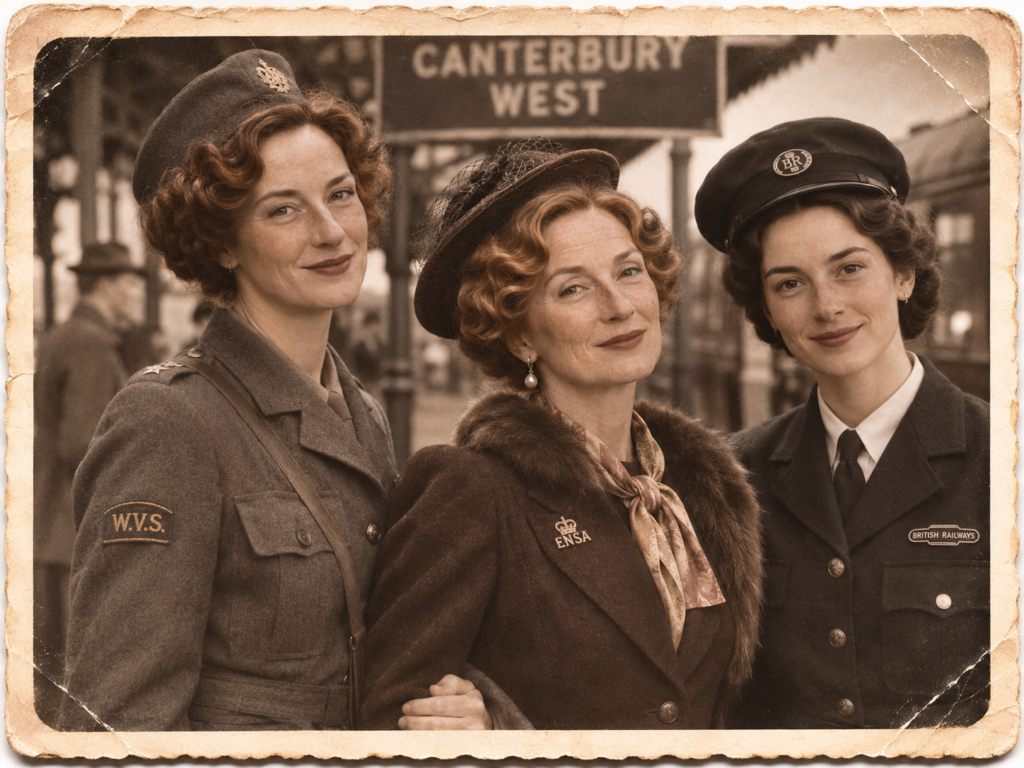
A few words before we begin
The death of my great-great-aunt Jemima Hartford in 1937 marked the end of an important chapter in our family’s history. She had lived through a period of extraordinary change, from the middle of the nineteenth century into the modern world, and had left behind a remarkable record of her life and work.
But the family story did not end with Jemima. Her younger sister, Bella Mead, had been part of her life for more than seventy years, and the two women had shared a home in Canterbury for much of that time. She was also still very much an actress, and the theatre remained an important part of her life. The years that followed would bring changes neither sister could have anticipated.
In writing this part, I have drawn on family recollections, letters, photographs and the documents which have survived. Some events are remembered particularly clearly, while others have had to be pieced together from official records and the wider historical background. I have tried to distinguish between what we know from the family’s own papers and what can reasonably be understood from the circumstances of the time. There are still gaps in our knowledge, particularly concerning the earlier lives of some of the people who enter this story, and I do not want to pretend that every question has been answered.
The war itself provides the setting for much of what follows, but this is not intended to be a general history of the Second World War. My interest is in how it affected one family: how people adapted to unfamiliar circumstances, how they found useful work, how they coped with separation and uncertainty, and how they tried to maintain some sense of ordinary life when so much around them was changing.
The years covered here are among the most eventful in our family history. They are years of separation and reunion, of danger and uncertainty, but also of new beginnings. Above all, they show how the lives of three generations of women were shaped by a war which reached into every corner of their world.
(1937–1939) Bella’s life after Jemima
When Jemima died in 1937, Bella was seventy-two years old. Although she had lost the sister with whom she had shared so much of her adult life, she was not a woman inclined to withdraw from the world. The house in Blackfriars Street had been her home for many years, and she continued to live there much as she had before. There were familiar routines to maintain, friends to see and, perhaps most importantly, the theatre remained a part of her life.
She had never thought of herself as having retired. Although she was no longer working as frequently as she had in her younger days, she still relished the opportunity to perform. The anticipation of a new production, the rehearsals, the familiar bustle backstage and the companionship of fellow actors remained pleasures she was reluctant to surrender. The theatre had been part of her life for more than fifty years, and it was still where she felt most at home.
The years immediately following Jemima’s death were therefore not without their pleasures. Bella continued to accept occasional engagements, travelling when necessary and returning to Canterbury between productions. She was no longer obliged to take every part offered to her, and this gave her a freedom she had not always enjoyed earlier in her career. She could choose work which interested her, rather than simply accepting whatever might be available.
She also continued to see Beatrice and Connie in London. Beatrice was now well established in her marriage to Harry Fox-Browne, and the family had settled comfortably into their life in Kensington. Bella enjoyed being part of their household when she was in London, and her visits gave her the opportunity to spend time with her daughter and granddaughter away from the routines of Canterbury.
For Connie, the house in Blackfriars Street in Canterbury was a place of particular interest. She had visited it as a child and remembered her great-aunt Jemima, although perhaps not always understanding why she spent so much time among her books and papers. Bella was a rather different presence: lively, sociable and accustomed to the company of people from many walks of life. Her theatrical career had given her a store of stories and experiences which a young girl could find fascinating. She could talk about the places she had visited, the actors she had worked with and the curious incidents which seemed to occur whenever a company of players travelled together.
Bella took a particular interest in Connie as she grew older. The little girl who had once visited Canterbury with her mother was now developing interests and opinions of her own. Bella enjoyed her company and was always ready to encourage her curiosity and independence. Having made an unconventional life for herself, she was perhaps less inclined than Beatrice to worry about the conventions and expectations which accompanied growing up.
For Bella the loss of Jemima had inevitably altered the character of the household. There was no longer the familiar sound of her sister moving about the house, nor the sight of her at work in the study. Bella had left much of Jemima’s working room undisturbed, and the books and papers remained reminders of the life which had been lived there. But she did not spend her days dwelling on the past. She had her own interests and, for the time being, there was still work to be done.
Her days were not filled with work alone. Bella had known Canterbury for most of her adult life, and she had a circle of friends and acquaintances with whom she could keep in touch. She enjoyed conversation, a visit to a friend or an invitation to take tea, and she remained interested in the life of the city. The theatre gave her a wider circle beyond Canterbury, but she valued the familiar people and places to which she returned. In the years after Jemima’s death, she had to adjust to being the only sister in the house, yet she did not allow that loss to define the whole of her life.
During 1938, however, it became increasingly difficult to ignore the unsettled political situation in Europe. News from Germany was frequently troubling, and the crisis over Czechoslovakia brought the possibility of another European war much closer to home. The Munich Agreement in September 1938 temporarily eased the immediate tension, but it did little to reassure those who had begun to fear that the peace established after the Great War might not last.
Like many people, Bella followed the news in the newspapers and listened to discussions about the situation on the wireless. She had lived through the war and remembered its effects on the family. Although she had not experienced the fighting herself, she had seen the consequences of the war in the lives of those she loved. The deaths of family members, the changes in the lives of those who returned and the long period of uncertainty which followed had left their mark. She had no desire to see another generation subjected to the same experience.
There was also a growing awareness that, if war came, it might be very different from the last one. Aircraft could now carry bombs over considerable distances, and the possibility of attacks on towns and cities was discussed openly. Civil authorities had begun making preparations, and the government was encouraging people to take precautions against air raids and the possible use of poison gas.
Canterbury was not exempt from these preparations. Following the Munich crisis, local authorities had accelerated their arrangements for air raid precautions. Gas masks were distributed, public trenches were dug for use as shelters, and plans were made for the organisation of rescue, first-aid and fire services. These preparations were not always immediately visible in everyday life, but they were a reminder that the possibility of war was being taken seriously.
By the beginning of 1939, the arrangements were becoming more organised. Air raid wardens’ posts were being established around the city, and plans were made for control centres and emergency services. There were exercises to test how these arrangements might work in practice. In August, a large civil defence exercise was held across Kent and the surrounding counties, involving a simulated blackout and imaginary incidents caused by bombing. It was a striking indication of how far preparations had advanced, even before war had actually been declared.
The distribution of gas masks, the talk of shelters and the preparations for a blackout were all part of the growing public awareness that the country might soon be at war. Yet life continued. Shops remained open, trains ran, theatres presented their programmes and people made plans for the autumn as they always had.
By the summer of 1939, the situation in Europe had deteriorated further. Germany’s occupation of the remainder of Czechoslovakia in March had made it increasingly clear that the assurances given the previous year had not brought lasting peace. The news was followed closely, and the possibility of war was now discussed with much greater seriousness.
The final weeks of August were particularly tense. When Germany and the Soviet Union signed their non-aggression pact on 23 August, it was widely regarded as another ominous development. People began to make practical preparations, and the civil defence arrangements which had been planned over the previous months were brought closer to readiness.
On 3 September 1939, Britain declared war on Germany.
For Bella, as for millions of others, the announcement marked the end of any hope that the crisis might be resolved without another major conflict. The familiar world of the previous few years was about to change. Theatres would have to adapt, journeys would become more difficult, and everyday life would increasingly be governed by restrictions and precautions which had previously seemed unimaginable. She could not yet know how profoundly the war would affect her family.
(1939) Harry, Beatrice and Connie
There were, of course, conversations in all families about what might happen, and in London, Harry was particularly conscious of the situation. He was forty-one in 1939 and already serving as a Captain in the 44th (Home Counties) Divisional Signals, Royal Corps of Signals, a Territorial Army unit based at Stamford Brook Lodge, Ravenscourt Park, in West London. His military service was part of his established life, involving regular training and duties alongside his civilian occupation. He understood that, should war come, his responsibilities would become considerably more demanding.
When the Territorial Army was mobilised on 3 September 1939, Harry was called up for full-time service with his unit. The change must have been considerable for Beatrice and Connie. Until then, his military commitments had been balanced with his family and professional life. Now he was required to leave home and prepare for active service.
The 44th (Home Counties) Division was among the Territorial Army formations selected for overseas service. Its Signals unit was responsible for maintaining communications between divisional headquarters and the various formations under its command. This was an essential part of military organisation, and the work became particularly important as units moved and operations developed. Harry’s responsibilities would have involved the arrangements for telephone and wireless communications, as well as the coordination of the men and equipment needed to keep those links functioning.
During the autumn and winter of 1939–40, the division prepared for service overseas. In April 1940, it crossed to France as part of the British Expeditionary Force. Harry was therefore among the British officers sent to the Continent before the German offensive began in May.
The division became caught up in the rapid retreat which followed the German advance through Belgium and northern France. As the British forces withdrew towards the Channel coast, the work of the Signals units became increasingly difficult and important. Communications had to be maintained while headquarters and formations were moving, often under considerable pressure. By the end of May, the 44th Division was involved in the fighting and withdrawal towards the Dunkirk perimeter.
For Beatrice and Connie, the months following his departure must have been difficult. They had little control over where he was sent or what he might be experiencing, and news from France was often limited. Beatrice would have followed the newspaper reports and listened to the wireless, trying to understand what was happening and whether Harry’s unit was involved.
Then, following the fighting and evacuation from Dunkirk, the news they had dreaded arrived. Beatrice received a telegram from the War Office informing her that Harry had been reported missing on active service. There was no further explanation, and she and Connie could only wait for more definite news. Several weeks later, a second telegram confirmed that he had been captured by the Germans and was a prisoner of war. Although this brought the immense relief of knowing that he was alive, it told them very little about his circumstances or where he was being held. It would be some time before Beatrice received a letter from him.
With Harry away, Beatrice and Connie had to find a way of carrying on without him. There was little they could do to influence what was happening in France, and they could not allow the uncertainty surrounding his fate to bring their everyday lives to a standstill. Beatrice had to manage the household and make decisions for herself and Connie, while Connie was approaching the age when she would have to think seriously about her future. At home, life was increasingly governed by the practical requirements of wartime. Even before the first air raids, Londoners had been preparing for the possibility of attack. Beatrice had collected the family’s gas masks and made sure that they knew where to go when an air-raid warning sounded.
The blackout altered the familiar streets of Kensington. Shop windows and houses disappeared into darkness, and people made their way along the pavements with torches carefully shielded. Cars travelled with restricted headlights, and even familiar journeys became more difficult. The first weeks brought a great deal of uncertainty, but also a curious sense of unreality. War had been declared, yet London had not immediately become a battlefield.
For Beatrice, the blackout meant checking the windows each evening and making sure that no light showed through a curtain or around a door. A careless chink could attract the attention of an air-raid warden, and the restrictions made even simple errands less straightforward. Connie had to become accustomed to carrying a torch and watching her footing on streets that she had known well in daylight. The ordinary independence of going out after school or meeting a friend now involved a little more planning.
There were practical matters to attend to, too. Rationing began in January 1940, initially covering bacon, ham, butter and sugar, and the family had to register with local shops and learn to manage the new restrictions. It was another reminder that the war was not something happening only to the men overseas. It was already changing the lives of those at home.
Connie’s school life continued, although the atmosphere around it had changed. Lessons and examinations still mattered, and Beatrice tried to preserve as much normal routine as she could. Yet conversations about the war, interruptions caused by alerts and the uncertainty about Harry were never far away. Connie was old enough to understand why her mother worried, but young enough still to want the ordinary pleasures and freedoms of adolescence. Beatrice did her best to allow her daughter a measure of both.
(1940) The London Blitz and the move to Canterbury
The first letter from Harry was a great relief to Beatrice. It arrived in August 1940, several months after the telegram confirming that he was a prisoner of war. It was necessarily a short letter, and there was little he could tell her about his circumstances. He reassured her that he was well and asked her not to worry unduly. He was thinking of her and Connie, and hoped they were both keeping safe. Most importantly, he gave her the address of the prisoner-of-war camp in Germany where he was being held, so that she could write to him.
Beatrice read the letter more than once. The knowledge that Harry was alive had been a comfort, but hearing from him in his own words was something quite different. There was now a way of maintaining contact, even if the journey of a letter in either direction might take many weeks. She wrote back as soon as she could, telling him about life in Kensington and reassuring him that she and Connie were managing. She was careful not to burden him with too much of their anxieties. From then on, correspondence became an important part of their lives, and Beatrice kept his letters and postcards together.
Meanwhile, the situation in London was becoming increasingly difficult. The German bombing campaign, which had begun in September, brought a new and frightening routine. Air-raid sirens interrupted the day and night, and families learnt to recognise the warning signals and make their way to whatever shelter they had available. For many people, the nights were broken by the sound of aircraft, anti-aircraft guns and explosions. Sleep became irregular, and the following morning often brought news of damage somewhere in the neighbourhood.
Beatrice and Connie had to adapt to this new existence. The blackout, which had seemed strange and rather unreal when it was first introduced, now became part of the ordinary pattern of life. They had to be ready to take shelter, keep essential belongings close at hand and make decisions about what was safe and what was not. Connie was old enough to understand the danger, although Beatrice would naturally have tried to shield her from the worst of her own fears.
Their Kensington home was fortunate not to suffer a direct hit, but the bombing did not leave it entirely untouched. On one occasion, an explosion nearby caused damage to the house, breaking windows and disturbing plasterwork. It was unsettling to see the familiar rooms affected in this way, and the practical difficulties of obtaining repairs during wartime meant that the damage could not necessarily be put right at once. Nevertheless, the house remained standing and was still their home.
As the raids continued, Beatrice began to think more seriously about whether London was the right place for Connie. She had already spent months managing without Harry, and the responsibility for their safety rested entirely with her. Connie was approaching adulthood, and Beatrice wanted her to have the opportunity to continue with her life without the constant disruption and danger of the air raids.
Bella, meanwhile, was following events in London with considerable concern. She had always been close to Beatrice, and although she was living in Canterbury, she was well aware of what the family was experiencing. She urged her daughter and granddaughter to come and stay with her in the house in Blackfriars Street. There was room for them, she said, and they would be safer away from the bombing. It was an invitation made out of affection, but it also offered a practical solution to a situation which was becoming increasingly difficult.
Beatrice did not make the decision lightly. Leaving London meant putting aside, at least temporarily, the life she and Harry had established there. Their home contained their furniture, books, photographs and all the accumulated possessions of a family. Yet there seemed little point in keeping Connie in the city simply because it was familiar. Harry was in Germany and could not advise her; she had to make the decision herself.
Before leaving, Beatrice wrote to Harry at the address he had supplied, explaining that she and Connie were going to Canterbury to stay with Bella. She gave him the address of the house in Blackfriars Street so that he could write to them there. It was important to her that he should know where they were going and that their correspondence should continue without interruption. She could not know how long they would be away, but she wanted him to be able to reach them.
They decided to leave most of their possessions behind. The Kensington house was locked, and arrangements were made for someone to keep an eye on it and deal with any post or urgent matters. They took clothes, personal belongings and the things they considered essential, leaving the furniture and the greater part of the household contents in place. They expected to return when the danger had passed. Neither Beatrice nor Connie imagined that their stay in Canterbury would last for the remainder of the war.
The journey to Canterbury marked the beginning of a new phase in their lives. They were leaving behind the familiar streets of Kensington and the home they had shared with Harry, but they were going to Bella, whose house had been part of their family history for as long as Connie could remember. They would be together, at least, and there was now a way for Harry to remain in contact with them.
(1940) Making room in Blackfriars Street
When Bella learned that Beatrice and Connie had decided to leave London and come to Canterbury, she was relieved. Now that they had accepted her invitation, she was determined to make them comfortable.
There was quite a lot to arrange. The house in Blackfriars street had been organised around Bella’s own needs since Jemima’s death, and the rooms were not immediately ready to accommodate two more people. Bella began by considering how best to arrange the bedrooms. She would continue to use her usual room, Beatrice could have the bedroom which had formerly belonged to Jemima, and Connie would need a room of her own.
This meant Connie would need to sleep in Jemima’s old study. It had remained largely undisturbed since her death, and Bella had never quite known where to begin with its contents. The books still occupied the shelves, while papers and working materials filled the desk drawers. Bella understood how important the room had been to her sister, but she had neither the inclination nor the knowledge to sort through a lifetime’s research. Until now, there had been no pressing reason to do so.
Now, however, the room had to be made usable. Bella approached the task practically. She kept Jemima’s books on the shelves, but gathered the papers together, carefully wrapped them and placed them in boxes. These she stored at the top of the cupboard, intending to return to them when she had more time. She did not read through them or attempt to catalogue them; her immediate concern was simply to keep everything safe.
Jemima’s desk also had to be moved. Bella was reluctant to dispose of it, and found a place for it in the sitting room, where it could continue to be used. Bella arranged for a bed to be brought into the room for Connie, so that it was properly furnished and comfortable enough for what she expected would be a temporary stay. It would still contain reminders of Jemima, particularly the books on the shelves, but it was no longer the working room it had been for more than fifty years.
There were other preparations to make too: linen brought out, cupboards cleared and space found for the clothes and belongings Beatrice and Connie would bring with them. Bella knew they were travelling with relatively little, but she wanted them to feel that they had a proper home waiting for them.
When Beatrice and Connie finally arrived, Bella was delighted to see them. Their arrival brought a new liveliness to the house, and she was glad that they would no longer be facing the dangers of London alone. Beatrice was grateful for the welcome and for the work her mother had done to accommodate them. Connie, who knew the house from earlier visits, now found herself living there. It was a considerable change, but at least they were all together.
The house gradually settled into its new routine. Bella had her daughter and granddaughter with her, and the three women shared the ordinary business of meals, shopping and household responsibilities. The arrangements were not those any of them would have chosen in peacetime, but they had the comfort of being together.
(1941) Finding their feet in Canterbury
As 1941 began, Beatrice and Connie were settling into their new life in Canterbury. What had initially seemed like a temporary escape from London was becoming a more settled arrangement. They still hoped to return to Kensington when circumstances permitted, but with Harry in Germany and the bombing continuing, there was little prospect of that happening soon.
Bella was pleased to have them with her. Although she had been accustomed to living quietly, she enjoyed the company of her daughter and granddaughter, and the house acquired a rather different atmosphere. Beatrice helped with the household and took an interest in local affairs, while Connie was beginning to think about what she might do with herself now that her familiar life in London had been interrupted.
For Beatrice, the opportunity to do something useful beyond the household was particularly welcome. She became involved with the Women’s Voluntary Service, which had an important part to play in supporting communities during wartime. The work offered many ways of helping people affected by the conflict, from assisting with local arrangements to supporting those who had been displaced by bombing and other wartime emergencies. Beatrice was glad to contribute where she could. She had no wish to sit at home worrying about Harry, and the WVS gave her a sense of purpose and the opportunity to meet other women who were also doing their best to keep things going.
Beatrice was accustomed to organising a household and looking after other people, and those abilities were useful in a wider setting. The work also gave her a circle of acquaintances beyond the family and helped her feel that she was doing something constructive while Harry remained away.
Connie, meanwhile, was approaching her eighteenth birthday and needed to consider her own future. Before the war, she might have expected to continue her education or to take some time deciding what kind of work interested her. But the circumstances of 1941 were different. Young women were increasingly taking on jobs which had previously been done by men, many of whom had joined the armed forces. Connie felt that she ought to make herself useful, and Beatrice encouraged her to find employment.
Through the local Employment Exchange, Connie heard of a vacancy at Canterbury West railway station. The railways were under considerable pressure, carrying not only ordinary passengers but also service personnel, supplies and people travelling for wartime reasons. With many male employees away on military service, women were being recruited to fill a variety of positions. The vacancy was for a booking clerk, and Connie was interested in the prospect of working at the station.
The decision to take paid employment was an important step. Connie had not expected her working life to begin in quite this way, and she was conscious that the job might shape her future more than she had first imagined. Beatrice wanted her to have a useful occupation, but she also wanted her daughter to have the chance to learn and gain confidence. The railway offered both a regular wage and the opportunity to acquire skills which would remain valuable after the war.
The station was also conveniently close to Bella’s house in Blackfriars Street, only a short walk away. This made it an ideal place to work, allowing her to get to and from her job easily without having to depend on public transport.
It was a considerable step for her. She had travelled by train many times, of course, but working in a railway station was quite different from being a passenger. At first there was a great deal to take in: the layout of the booking office, the different ticket types, the fares for familiar and less familiar destinations, and the timetables which she would need to consult quickly. She had to learn not only how to issue a ticket but how to understand what a passenger was asking for, particularly when someone knew only the name of a town or had to make several connections. She was shown the routine by more experienced staff and gradually became familiar with the work.
She found the work demanding at first, but she was quick to learn. There was a satisfaction in becoming familiar with the routines and discovering that she could manage the responsibilities entrusted to her. The station was a busy and sometimes confusing place, particularly when troop movements and other wartime traffic disrupted the usual pattern of passenger services. Connie soon realised that a booking clerk needed patience as well as accuracy. People were often in a hurry, sometimes anxious, and occasionally uncertain about where they were supposed to be going. She had to learn to deal with them calmly, even when the station was crowded and the timetable had changed yet again.
Some passengers were straightforward, but others arrived in a state of confusion or anxiety. Servicemen might be travelling at short notice, carrying orders which gave them little time to spare; civilians could be trying to reach relatives or find an alternative route after a service had been altered. Connie learned that accuracy mattered, but so did patience. She began to recognise regular travellers and to understand that a calm answer could be as useful as a correctly issued ticket. By the end of her first months, the booking office no longer seemed an intimidating place. She was beginning to feel that she belonged there.
The station master was a man named Stephen Sloman. He had been at Canterbury West for many years and was well acquainted with the demands of running a station, particularly during difficult times. He was helpful to the younger members of staff and understood that those who had joined the railway during the war needed time to learn their duties. Connie found him approachable, and his quiet manner made it easier for her to ask questions when she was unsure of something.
Stephen had a son, Adam, who was about two or three years older than Connie. He also worked for the railway, as a signalman. Connie first encountered him when he came to the station to see his father. Their meetings were initially brief and unremarkable: a greeting, a few words exchanged while he waited, perhaps a passing conversation about the day’s work. There was no particular reason for Connie to take notice of him at first, beyond the fact that he was another young person working on the railway.
For Connie, the station gradually became more than simply a place of work. She was learning a great deal about the town and the people who passed through it, and she was beginning to develop an independent life of her own. She had arrived in Canterbury as a young woman displaced from London by the war. Now she was earning her living, making acquaintances and finding her place in a community which was becoming increasingly familiar.
The war remained an ever-present part of their lives. Beatrice continued her voluntary work, Connie went to the station each day, and Bella maintained her household and her connection with the theatre. Letters from Harry were a continuing source of comfort, although the delays and restrictions of prisoner-of-war correspondence meant that news from him was never as frequent as they would have wished.
None of them could know how long this arrangement would last. They still thought of Canterbury as a place of refuge until the family could be together again, but the months were passing, and the lives they were building there were becoming more firmly established.
(1941) The Sloman family
As the weeks passed, Connie and Adam became better acquainted. Their conversations at the station gradually became longer and more relaxed, and they began to look forward to seeing one another. Sometimes they found themselves talking after their immediate work was finished, or exchanged a few words when Adam came through the station. They discovered that they had quite a lot in common, not least the experience of being young people trying to establish themselves in an uncertain wartime world.
It was through these conversations that Connie began to learn more about Adam’s family. She had noticed Stephen’s accent and, curious about it, eventually asked Adam where his parents came from. He told her that his father had been born in Poland, and that his original name had been Stefan Slomanski. His mother, Janina, was Polish too. Adam himself had been born in England and had grown up in a household where Polish was still spoken, although English was the language he used in his everyday life.
Adam explained that his parents had come to England in 1912. His father had been involved in Polish nationalist circles at a time when Poland was still partitioned between neighbouring powers and the Polish population had no independent state of its own. He had not been a prominent political figure, but he sympathised with those who wanted Poland to regain its independence and had taken part in modest activities in support of that cause. The upheavals of 1905 and the repression of political and nationalist activity in the years that followed had made life increasingly uncertain for people with such sympathies. Eventually, his father decided that it was safer to leave.
Connie found this difficult to imagine. She knew that Poland had a complicated history, but had never thought much about what it meant for an ordinary family to leave their home and begin again in another country. Adam told her that his father had arrived in England with very little, and that his first work had been as a railway porter. He had gradually learned the language and the railway business, taking on greater responsibilities as opportunities arose. By the time Adam was old enough to understand his father’s working life, Stephen had become an established railwayman. He had eventually risen to become the station master at Canterbury West.
The family name had changed too. His father had gradually adopted the shorter form Sloman, which was easier for English people to pronounce and remember. He had become a British citizen some years before Adam was born, and by then the family was well established in Canterbury. Although Stephen and Janina had retained their Polish language and customs within the home, their life in England had become their permanent home.
Connie was interested in the story, and it gave her a new understanding of the man she knew as the station master. His quiet authority and his familiarity with the railway had been built up over many years, beginning with a very different life in another country. She also began to understand why Adam sometimes seemed to belong to two worlds: he was English by birth and upbringing, but his family background was unmistakably Polish.
It was not long before Connie met Adam’s mother properly. Janina occasionally came to the station, sometimes to see her husband and sometimes to bring him something he had forgotten. She was a warm and composed woman, and Connie found her easy to talk to. Her English was good, although she spoke with a stronger accent than Stephen.
On one occasion Janina stayed for a little while rather than simply delivering something and leaving. She asked Connie about her work and how she was finding Canterbury. Her manner was friendly but observant, and Connie had the impression that she was interested in the young woman who had become a regular presence in her son’s conversations. Connie was conscious that she knew very little Polish, and that there were words and expressions exchanged between mother and son which she could not follow. It did not make her feel excluded so much as curious about the family life Adam had grown up with.
Janina was pleased that Adam had made a friend at work. She had watched her son grow up in England and knew that, although he was comfortable in his surroundings, he had not entirely escaped the feeling of being different from some of the other young people he knew. Connie’s interest in his family and her willingness to listen seemed to please her.
For Connie, these encounters opened up a new world. Until then, her knowledge of Poland had been little more than the occasional mention in newspapers or on the wireless. Now she was beginning to understand something of the personal histories behind the political events. The Slomans had come to England long before the present war, but the circumstances which had brought them here had not been forgotten within the family.
As Connie and Adam became better acquainted, their conversations extended beyond the railway. They talked about their work, their families and the uncertainty of the times in which they were living. Neither of them knew what the future would bring, and both had grown used to making plans only a little way ahead. For the moment, they were simply enjoying one another’s company.
Their friendship was still at an early stage, but it had become something Connie looked forward to. The station, which had initially been just a place where she went to work each day, was also where she had begun to make a new friend. In the unsettled circumstances of wartime Canterbury, that was no small thing.
(1942) Canterbury under attack
By the beginning of 1942, Beatrice and Connie had become accustomed to their life in Canterbury. Harry remained a prisoner of war in Germany. His letters continued to arrive, although the intervals between them could be frustratingly long. Beatrice had developed the habit of reading each one carefully and keeping it safely with the others. They were a reminder that, despite the distance, Harry remained part of their daily lives.
Connie’s work at Canterbury West had by now become an established part of her routine. She was no longer the inexperienced young woman who had first arrived at the booking office. She knew the timetables, understood the ticketing arrangements and had become more confident in dealing with passengers. The station remained busy, and the demands of wartime travel meant that she had to be ready for alterations and unexpected questions. She had learned to keep her composure when the booking office became crowded and to seek help when a journey or ticketing problem was beyond her experience.
Adam’s work as a signalman continued to demand concentration and reliability. The safe movement of trains depended on the proper operation of the signalling system, and his responsibilities could not simply be put aside when the railway became busy. His work was less visible to passengers than Connie’s, but it was essential to keeping services moving. The railway remained one of the country’s important wartime services, and skilled staff such as Adam were needed at their posts.
The two young people were now seeing rather more of one another. Their friendship had developed through the ordinary opportunities provided by working at the same station, and they were beginning to spend time together outside their duties. Sometimes they walked part of the way home together, or stopped to talk when their working hours allowed. Connie enjoyed Adam’s company, and she was increasingly interested in his family and the stories he told her about his parents’ earlier life.
The war, however, was becoming an increasingly immediate presence in Canterbury. The city had experienced occasional air raids since 1940, but there had been nothing to prepare its inhabitants for the scale of what was to come. In the spring of 1942, German attacks on historic English cities became more frequent. Canterbury, with its cathedral and ancient buildings, was among the places targeted.
The most devastating attack came during the night of 1 June. In the early hours, German aircraft dropped high-explosive and incendiary bombs across the city. The damage was extensive, particularly around St George’s Street and the eastern end of the High Street. Buildings were destroyed, fires broke out and many people lost their homes. Forty-three people were killed, and a large part of the historic centre was left in ruins.
For those living in Canterbury, the raid was a terrible shock. The sound of the bombing, the fires and the following morning’s scenes of destruction made it impossible to regard the war as something happening elsewhere. The cathedral had survived, thanks in part to the efforts of its fire-watchers, but much of the surrounding city had suffered badly.
Bella, Beatrice and Connie were fortunate that the house in Blackfriars Street escaped serious damage. They had experienced the raid at close quarters, and the noise and explosions were frightening, but their home remained standing. The following day, like many other residents, they saw something of the destruction as they went about their necessary business. Familiar streets and buildings had been transformed, and the loss of so much of the old city was deeply unsettling.
The family had an Anderson shelter in the garden, where they went when air raid warnings sounded and there was sufficient time to reach it. They would sit close together inside, listening to the sounds of the raid and waiting for the all-clear. The shelter was hardly comfortable, particularly on cold or wet nights, but it offered some reassurance. Bella, who had lived through the First World War and remembered its anxieties and losses, would perhaps have tried to remain composed, particularly for the sake of Beatrice and Connie. She knew that fear was unavoidable, but that panic would only make a frightening situation harder to bear. Beatrice’s first concern was for Connie, while Connie herself was old enough to recognise the danger and to feel the strain of waiting. When the warning was over, the fact that their own house was still standing brought relief, but it could not lessen the shock of what had happened elsewhere in the city.
For Connie, the experience brought home the vulnerability of the town in which she had begun to make a new life. She had left London partly to escape the bombing, only to find that Canterbury too could be attacked. Nevertheless, she and her family were now established there, and there was no question of returning to Kensington while the danger continued.
The following days brought a different kind of work for the people of Canterbury. Streets had to be cleared, damaged buildings made safe and temporary arrangements found for those whose homes had been destroyed. Even where a family had not suffered direct damage, the effects of the raid could be seen in disrupted journeys, closed premises and the absence of familiar buildings. Connie’s route through the city was no longer quite the same, and she became more conscious of how closely ordinary life depended on the work of those trying to restore it.
The railway had its own difficulties during this period. The movement of trains had to continue despite the danger of air raids, and railway employees were expected to carry on with their duties whenever it was safe to do so. For Adam, this meant working under the same conditions of uncertainty as everyone else, while remaining responsible for the safe passage of trains. Signalmen could not simply abandon their posts whenever an air-raid warning sounded; the railway depended on a carefully coordinated system, and the safety of passengers and railway staff had to be considered.
There was a further major attack on Canterbury on 31 October 1942. This time the raid took place during the day and brought another period of danger and destruction to the city. Thirty-three people were killed and many more injured. The attacks of June and October had changed Canterbury profoundly, and the damage remained visible in the streets and buildings for a long time afterwards.
Connie and Adam’s friendship had begun to extend beyond the station. When their hours allowed, they sometimes walked together for part of the way home, talking about the day’s work or the news. Adam was not given to grand declarations, and Connie appreciated his steadiness and his quiet humour. He listened when she spoke about Beatrice and Bella, and she in turn was interested in the stories of his parents and the life they had made in England. Their companionship grew out of these ordinary conversations rather than any sudden change in their circumstances.
There was no formal courtship at first. They were both busy with work and neither had much money or freedom to make elaborate arrangements. A walk together, a conversation after a shift or an occasional visit with the Sloman family was enough. Connie liked Adam’s unassuming manner and the fact that he took his responsibilities seriously without making a show of it. Adam, for his part, seemed to appreciate that Connie was interested in his family and did not treat his Polish background as something strange.
Their friendship became a steady and welcome part of their lives. It had grown steadily through the months they had known one another, and the shared experience of living and working in wartime Canterbury had brought them together. They were still young, and neither could be certain what the future would hold, but they had begun to look beyond the immediate demands of their work and the uncertainty of the war.
For Bella, the presence of her daughter and granddaughter had brought companionship and a renewed sense of family life. She remained interested in the theatre, although the circumstances of wartime made ordinary theatrical engagements more difficult. She was also aware that the world was changing rapidly, and that the younger generation was having to make its own way through circumstances very different from those she had known.
The years in Canterbury were no longer simply an interruption to the family’s life in London. They had become a chapter in their own right, shaped by the war, by the people they had come to know and by the relationships that were beginning to develop. Connie, who had arrived as a young woman seeking refuge from the bombing, was now establishing a life of her own.
(1943) Bella and ENSA
By 1943, Bella had reached an age when many people would have been content to withdraw from public life. She was seventy-eight, and although she had continued to take an interest in the theatre, her opportunities to perform had become fewer. The war had changed the theatrical world, as it had changed so many other aspects of life, and ordinary productions and engagements were no longer as easy to arrange as they had once been.
Yet Bella had never thought of herself as retired. The stage had been part of her life for more than sixty years, and she still enjoyed the experience of performing. In late 1941, when the opportunity arose to join the Entertainments National Service Association, better known as ENSA, she had welcomed it enthusiastically. The organisation provided entertainment for members of the armed forces, and its performers travelled to camps, hospitals and other military establishments, bringing music, comedy and drama to people whose lives had been transformed by the war. For Bella, it offered a chance to return to the work she loved and to make a contribution in her own way.
Bella was attracted by the idea that she could still be useful. She knew that entertaining an audience was not simply a matter of passing the time. For men and women serving far from home, or recovering from illness and injury, a performance could offer a welcome escape from the pressures of military life. She had spent much of her own life trying to bring pleasure to audiences, and this seemed a particularly worthwhile way of continuing to do so.
Beatrice and Connie were initially concerned about the demands such work might make upon her. Travelling was tiring, accommodation was not always comfortable, and performances could take place in circumstances very different from those of a conventional theatre. Bella, however, was not easily discouraged. She had spent decades adapting to the practical difficulties of theatrical life, and she was determined not to allow her age to prevent her from accepting an opportunity she genuinely wanted.
Her engagements took her away from Canterbury for periods at a time. Much of the work was within Britain, although there were occasional journeys further afield. The performances were often informal, and the conditions could be challenging. A makeshift stage, a hall or a temporary entertainment space might have to serve as a theatre, and audiences were not always able to attend at a convenient hour. Bella nevertheless enjoyed the variety and the company of other performers. She was once again part of the theatrical world, and she relished the feeling that her experience was being put to good use.
One engagement that Bella later described to her family was at a service establishment where the performance had to be arranged in a large communal room rather than a proper theatre. The stage was makeshift, the lighting was plain and the audience had come straight from their duties. At first the men were tired and subdued, but as the programme went on they began to respond, laughing at the comic turns and applauding the songs and sketches. Bella found that she could still hold an audience, even in such unpromising surroundings. The warmth of their reception mattered to her more than the lack of theatrical comforts.
When she returned to Canterbury between engagements, she brought stories of the places she had visited and the people she had met. Beatrice and Connie were pleased to see her looking so animated, and although they worried about the strain of the travelling, they understood how much the work meant to her. Bella had always been independent, and it would have been difficult for her to accept that she should simply remain at home because she was getting older.
She did not always describe every detail of the places she had visited, but she liked to tell them about the audiences. Some had been noisy and full of high spirits; others, particularly in hospitals, had been quieter and more subdued. Bella learned to judge the mood of a room and adapt her performance accordingly. She sometimes said that the response of an audience was the best measure of whether an evening had been worthwhile. Beatrice and Connie could see that the work gave her genuine satisfaction, and that she was not simply keeping herself occupied.
Her work with ENSA also brought her into contact with a very different generation of performers and audiences from those she had known in her earlier career. The young men and women serving in the armed forces were often far removed in age and experience from the audiences she had entertained before the war. Yet Bella’s ability to communicate with people had never depended upon their age. She understood the importance of humour, warmth and a little diversion, and she was able to bring these qualities to her performances.
For Connie, seeing her grandmother continue to life in this way was a reminder of the character she had inherited from the earlier generation of women in the family. Bella had never allowed other people’s expectations to determine the course of her life. She had made her own choices about her career and her independence, and even in her late seventies she remained unwilling to give up something which gave her pleasure and purpose.
In August 1943, Bella was away from Canterbury on another ENSA engagement. She had been travelling regularly during the summer, performing for servicemen at camps and military hospitals, and although the journeys were tiring, she continued to enjoy the work. She was particularly pleased to find that audiences responded warmly to her performances. Some of the men were far from home and had little opportunity for entertainment, and Bella understood how much a familiar face, a little laughter and an hour away from the routine of military life could mean to them.
Her engagement that summer was in Aldershot, where she was performing for servicemen at one of the military establishments. Before leaving, she had told Beatrice about the arrangements and when she expected to return. There had been nothing to suggest that she was unwell or finding the work too demanding. She remained enthusiastic about her performances and had every intention of coming home to Canterbury when the engagement was over.
It was therefore a great shock when news reached Beatrice that her mother had died suddenly while away from home. Although Bella was seventy-eight, she had remained active and enthusiastic about her work, and Beatrice had no reason to think that this engagement would be any different from the many that had gone before.
Beatrice was naturally distressed. Although she had sometimes worried about the amount of travelling her mother was undertaking, she had come to accept that Bella would continue working for as long as she felt able. It had been part of her life for so many years that the idea of her giving it up had never seemed likely. Connie was equally upset. Bella had been a lively and affectionate presence in her life, and the thought that she would no longer return from an engagement with stories of the people she had met and the places she had visited was difficult to comprehend.
Beatrice had to make arrangements to deal with her mother’s belongings and bring them back to Canterbury. It was a sad and rather lonely business, made more difficult by the wartime restrictions on travel and the practical complications of arranging things at a distance. The theatrical friends and colleagues who had been with Bella during her final engagement were able to give Beatrice some comfort by telling her how much her mother had enjoyed the work and how warmly she had been received.
Bella’s death brought to an end a life which had been unusually independent for a woman of her generation. She had begun her theatrical career as a young woman, made a name for herself as Bella Mead and continued to perform through the changing fashions and circumstances of more than sixty years. Even in her late seventies, she had found a new purpose in entertaining those serving their country. She had remained true to herself until the end.
For Beatrice, the loss was particularly profound. She had been close to her mother all her life, and the years they had spent together in Canterbury had brought them into daily companionship once more. Connie, too, had lost someone who had been an important presence throughout her childhood and adolescence. Bella had been more than a grandmother to her; she had been a source of affection, encouragement and lively conversation.
Bella’s death also brought a change in the family’s circumstances. Beatrice inherited the house in Blackfriars Street and its contents, and she and Connie now had to consider their future without Bella. The house, which had provided a refuge during the war, became Beatrice’s responsibility. The life they had built there over the previous years would continue, but it would be different without her mother.
The two women were now the only members of their immediate household there. Harry was still a prisoner of war in Germany, and there was no certainty about when he might return. Connie was growing into adulthood, with her work at Canterbury West and her friendship with Adam Sloman becoming increasingly important parts of her life. Beatrice, meanwhile, faced the responsibility of looking after the house and deciding what the future would hold.
The war was not yet over, and the family still had difficult years ahead. But Bella’s life had come to an end, and with it another chapter in the history of the house in Blackfriars Street.
Furthermore, Jemima’s books and papers remained exactly where Bella had put them when she prepared the study for Connie. The books still stood on the shelves, while the carefully wrapped papers remained in their boxes at the top of the cupboard. Although Bella had always intended to return to them when she had more time, that opportunity had never come. Beatrice and Connie had not examined them, and for the time being they remained part of the contents of the house, preserved but untouched. Neither of them could have imagined how important those forgotten papers would one day become.