Written in 1995
A few words before we begin
When I look back over the past eighteen years, I sometimes find it difficult to believe how much has changed, and how much of it can be traced to a discovery I made in the summer of 1977.
I was twenty-two years old. I had recently inherited the house in Blackfriars Street following the death of my grandmother, Beatrice, and was beginning to settle into a life of my own in Canterbury. I had a teaching post at Queen’s School, a home that I had known all my life, and the prospect of making it entirely my own.
I knew very little about Jemima Hartford, the woman who had owned the house before Beatrice. I knew that she had lived there many years earlier, and that quite a number of her books remained in the small room which had become my bedroom. They were simply part of the familiar surroundings of the house. I had never given them much thought, still less imagined that they might have any particular significance.
1977 – Making the house my own
When the house in Blackfriars Street became mine, I felt that it was time to make some changes. Until then, I had simply been living in the family home, first with Mum and Dad and then, after they moved to London, on my own. Although I had always known the house as my home, it had never really been mine to arrange as I pleased.
Now it was different. I was its owner, and I could decide what to do with it.
I had no intention of undertaking a complete modernisation. The house had already benefited from considerable improvements during the 1960s, when Mum and Dad, with Grannie Bea’s agreement, had updated the kitchen and installed a proper bathroom and indoor lavatory. Those improvements had made a great difference to everyday life, and there was no immediate need to disturb them. The bathroom, in particular, would eventually need attention, but I knew that any further work would have to wait. I was not particularly well off, and I would have to do things gradually, as time and money allowed.
My attention therefore turned first to the upstairs rooms. I wanted to make them more comfortable and give them something of my own character, while retaining the older furniture that I had grown up with. There were pieces I was fond of, and I saw no reason to get rid of perfectly good furniture simply because it was old. I could introduce a few new things alongside them, change the decoration and make the rooms feel fresher without losing their familiar character.
The room that interested me most was the small bedroom I had occupied for so many years. I had decided that it should become my study. It was a lovely room to work in, not least because of its view of the Cathedral. I had always liked looking out across the rooftops towards its towers, and I thought it would make a pleasant place in which to read, write and prepare my lessons.
There was an old desk in the sitting room which I had always rather liked, so it seemed appropriate to put the desk back there, where I could use it for my own work. I had no idea whether it had originally stood in that particular room, but it looked very much at home there. I arranged the room around it, adding a comfortable chair, a reading lamp and shelves for my own books.
There was still plenty to do. I intended to redecorate the other bedrooms in time, but the large wardrobe in my old room was next on my list. It was an old piece, but a useful one, and I thought it would look much better with a fresh coat of paint. Before I could do that, however, I needed to empty it.
I knew there were several boxes stored at the top of the cupboard. They had been there for as long as I could remember, and I had never given them much thought. As far as I knew, nobody had taken them down or looked inside for many years. Now, with the cupboard to be cleared, I finally had a reason to see what they contained.
1977 – The discovery of Jemima’s papers
The boxes were not particularly attractive. They were old, some of them rather battered, and had clearly been stored away for a considerable time. I brought them down one by one and began opening them, initially more out of curiosity than with any particular expectation.
Inside were bundles of papers, notebooks and folders, some tied with ribbon or string, others placed in cardboard files. It was immediately apparent that this was not simply a collection of old family papers. There was far too much material, and it had evidently been gathered and kept for a purpose.
At the top of the box was a file containing five substantial manuscripts. Each was clearly marked as a different part of a memoir. The name on the file was Jemima Hartford. I was intrigued. I knew so little about the woman who had once lived in the house, and here, quite unexpectedly, was what appeared to be her own account of her life. I took the file downstairs, made myself comfortable and began to read.
I had intended to look through just a few pages, but it soon became clear that I was not going to put the manuscripts down again in a hurry. Jemima had written about her childhood, her family and the people she had known. I began to get a picture of a life lived in a world very different from my own, and yet there were familiar places and family names which immediately caught my attention.
I found myself drawn into her story. By the time I put the papers aside, I was no longer simply curious about the contents of the boxes. I wanted to know much more about Jemima Hartford.
I read the five memoirs over the next few days. I had originally intended to dip into them when I had a spare moment, but they soon took precedence over almost everything else. There was something compelling about reading an account of someone’s life written in her own hand, particularly when that person had once lived in the very house in which I was sitting.
Until then, Jemima had been little more than a name to me. I knew she had been a member of the family and had once owned the house, but I had never really considered what sort of person she might have been. Now, through her own words, I was beginning to discover her.
Her memoirs covered an extraordinary span of time. She wrote about her childhood in Kent, her family and her marriage to Edward, and then about the life she had built after his death. There were accounts of her work at the Cantium Museum, her relationship with Bella and the part she had played in Beatrice’s upbringing. The later memoirs took me through the years before and during the First World War and into a world that was already beginning to feel very different from the one in which she had grown up.
I was particularly struck by how much of the family history I had never known. People whose names I recognised from family conversations became real individuals, with their own circumstances, ambitions and difficulties. Places that were familiar to me acquired a different significance when I realised how closely they were connected with the lives of those who had come before us.
I also found myself admiring Jemima as a writer. Her style was clear and thoughtful, and she had a way of describing people and events which made me want to know more. Having studied English Literature, I was naturally interested in the writing itself, but I was equally fascinated by the life it revealed. She was observant, independent-minded and clearly possessed of considerable determination. I began to understand that there was much more to her than I had ever imagined.
By the time I finished the five memoirs, my curiosity had extended well beyond Jemima’s personal story. I wanted to know more about the people she had written about, and particularly about the work she had undertaken during her lifetime. The memoirs made occasional references to investigations, old cases and the many documents she had consulted, but they were not intended to be a record of all that work.
Having finished the memoirs, I returned to the box in which I had found them. The file had been lying on top of the other papers, and I was now curious to see what else had been stored beneath it.
What I found was a remarkably well-organised collection. There were individual files for the various investigations Jemima had undertaken, each containing the relevant newspaper reports, notes, correspondence, family trees and other supporting material. Her Victorian Mysteries were kept separately from the Curious Cases she had discussed with Bella, and there were also files relating to the different family lines and their history.
It was clear that Jemima had taken considerable care to preserve and organise her research. I was looking at the accumulated work of many years, arranged in a way that made it possible to follow each investigation from its beginnings through to whatever conclusions she had reached.
There were two further boxes containing more of the same kind of material. I had clearly underestimated the extent of the collection, but I was beginning to appreciate how much thought Jemima had put into preserving it.
1977-1978 – Exploring Jemima’s Victorian Mysteries
Having read the five memoirs, I was naturally curious about the other papers I had found. The memoirs had mentioned some of Jemima’s investigations, but they had given me only a glimpse of the work she had undertaken. I wanted to know more about the cases themselves and began taking out some of the individual files to see what they contained.
I found it fascinating that a brief newspaper report could lead to such extensive enquiries. Some cases concerned events which had attracted considerable attention at the time, while others seemed to have begun with quite ordinary incidents. Yet Jemima had pursued them with the same patience and determination, following up names, tracing family connections and looking for explanations which were not always apparent from the original accounts.
I did not, however, have the time to devote myself to the papers as much as I might have liked. I was still relatively new to teaching at Queen’s School, and it took up a considerable amount of my time, both during the school day and at home. Much of my lesson preparation and marking had to be done in the evenings and at weekends. I spent time planning what I would teach, finding suitable material, preparing exercises and reading through my pupils’ essays and written work. I was still learning my profession and wanted to do it well. It was demanding, but I enjoyed the work, and gradually became more confident in the classroom.
Teaching inevitably took priority. The house, too, was still a work in progress. I fitted the decorating around my school commitments, tackling the larger jobs at weekends and doing what I could in the evenings. I was determined to make the house comfortable and attractive, but I had to be realistic about how much I could manage and afford at any one time.
I was pleased to have the study as a comfortable place to read and work, and I began to use the desk for my own papers, and the shelves gradually filled with my books. The boxes containing Jemima’s research remained close at hand, and whenever I had a free evening or a quiet weekend, I would take out another file and read through it.
Sometimes a particular case would hold my attention for several days; at other times I would put one aside and return to it weeks later. I was not trying to work through the collection in any particular order. I was simply following my curiosity, discovering the range of Jemima’s interests and beginning to understand something of the methods she had used.
There was plenty of time, or so I thought, and I was enjoying discovering what she had left behind.
1978-1980 – Beginning my own family chronicle
As I became more familiar with Jemima’s papers, I found myself thinking increasingly about the generations that had followed her. Her memoirs had brought the family story up to the years of the 1920s, but there was much that had happened since then. I began to wonder whether I ought to record some of it myself.
I had grown up hearing stories about the family, and although I had not always paid much attention to them at the time, I now found myself wanting to know more. There were people and events which I remembered from my own childhood, but there were also earlier years about which I knew very little. I could ask Mum about her memories, and there were still family members who could tell me things I had never thought to ask them before.
I also had photographs, letters and other family documents to draw upon. Some of these were among Jemima’s papers, while others had been kept by Mum and Dad or by other members of the family. I began to realise that, between the documents and the recollections of those who had lived through the events, there was enough material to put together a further account of our family history.
I did not originally envisage it as a major undertaking. I simply wanted to continue the story that Jemima had begun, recording what had happened to the family during the years after her own memoirs ended. The work took longer than I had expected. I had to distinguish between what I remembered, what I had been told and what I could establish from documents. I also wanted to retain the personal character of the account, rather than turn it into a straightforward family tree or a list of dates and events.
Writing about people I had known, or whose lives had been described to me by those closest to them, was quite different from reading Jemima’s account of the nineteenth century. I was no longer simply discovering the past; I was trying to preserve the memories and experiences of my own family for those who might come after us.
I was fortunate that Mum was able to help me with much of this. She could tell me about her own childhood and her memories of the older members of the family, while other relatives were able to fill in details about people and events which I had never known. I also consulted family photographs, letters and official records wherever I could. Some details were easy to establish; others required more careful checking, and occasionally I had to accept that a particular question could not be answered with certainty.
Once I had begun writing, I found that there was considerably more to the family story than I had first imagined. I had originally thought of it as a relatively straightforward continuation of Jemima’s memoirs, but as I began to gather information and talk to members of the family, I realised that there were several distinct periods to cover, each with its own stories and circumstances.
The first two parts took shape during 1978. Part I covered Jemima’s final years, from 1923 until her death in 1937, while Part II dealt with the years from 1937 to 1943, including the wartime experiences of Bella and the family. I continued with the story in 1979, writing Part III, which covered the years from 1944 to 1955 and brought the family history up to my own birth. Part IV followed in 1980, taking the account through my childhood and early adult life to the death of Beatrice in 1977.
I did not write these parts in one continuous stretch. They developed over time, and I often returned to earlier passages when new information came to light or when I felt that something needed further explanation. I wanted to be as accurate as I could, particularly when writing about people whose lives I had not witnessed myself. It was important to distinguish between what I knew from my own memories, what I had learned from relatives and what could be supported by documentary evidence.
Although I had studied English, writing a family history presented rather different challenges. I wanted the account to be readable and to have something of the character of a memoir, but I also wanted it to be faithful to the people and events it described. I was not writing a novel, and I did not want to fill gaps in the record simply because a more complete story might be easier to read.
By the time I had completed the fourth part in 1980, I had produced a substantial account of the family across several generations. It was still a private undertaking, written primarily for my own interest and for the family, but I was pleased to have continued the story that Jemima had begun in her own memoirs.
Looking back, I can see that this work taught me a great deal. It made me more attentive to the value of family documents and personal recollections, and it encouraged me to look beyond the information immediately available. I was beginning to understand that the past could rarely be reconstructed from a single source. It required patience, comparison and a willingness to question what one thought one already knew.
1980-1989 – Editing and publishing Jemima’s work
By the beginning of the 1980s, I had become much more familiar with Jemima’s papers. I had read a considerable number of her investigations, and my own work on the family chronicle had given me greater confidence in handling historical documents and comparing different sources. I was beginning to look at the archive in a rather different way.
I had always enjoyed reading the cases, but I was now becoming increasingly interested in how Jemima had put them together. Her files contained not only her conclusions but also the original newspaper reports, notes and other evidence on which she had based her investigations. It was possible to follow her reasoning and see how she had pursued a particular line of enquiry. I found this aspect of her work almost as interesting as the mysteries themselves.
I began to wonder whether some of these investigations might be worth making available to a wider readership. They were fascinating accounts of Victorian lives and events, and many of the cases had a wider historical interest beyond the immediate mystery. Jemima had done much of the difficult work already, and it seemed a pity that it should remain known only to those who might one day happen to look through her papers.
I did not rush into the idea. Before anything could be published, I needed to understand the material thoroughly and consider what would be involved in preparing it for modern readers. Jemima’s handwritten notes and original accounts needed to be transcribed where necessary, names and dates checked, and newspaper references identified. Some passages required explanation, particularly where they referred to people, places or customs which might no longer be familiar. I also wanted to make sure that any uncertainty in the original investigations remained clear, rather than presenting a tentative conclusion as an established fact.
One thing mattered to me from the beginning: I did not want to rewrite Jemima’s work in my own voice. Her investigations belonged to her, and I wanted readers to be able to recognise her approach and her way of thinking. My task was to make the material accessible without losing its original character. Where I added information or discovered something that Jemima could not have known, I would make that distinction clear.
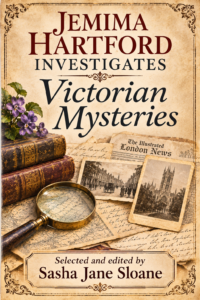 I began by selecting a group of investigations which I thought would make a suitable first volume of Jemima Hartford Investigates Victorian Mysteries. This was a considerable undertaking. I had to decide which cases were sufficiently complete, which needed additional checking and which would be most interesting to readers. I worked through them carefully, transcribing the original material, checking references and preparing explanatory notes. I was still teaching at Queen’s School, so much of this work was done in the evenings and at weekends. It took several years, but eventually the first volume was ready and was published in 1983.
Seeing Jemima’s work in print was a very special moment for me. Until then, the investigations had been something I had discovered in the privacy of my own home. Now they were available to other people, who could read them and appreciate the care and determination that had gone into them. I felt a great sense of satisfaction, not only because I had brought the work to publication, but because I had helped to preserve something that might otherwise have remained forgotten.
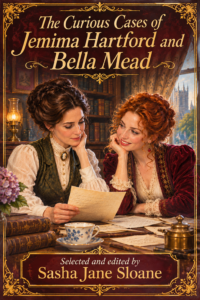 After completing the first volume, I turned my attention to the Curious Cases that Jemima had discussed with Bella. These were rather different from the formal investigations. They had a more personal and conversational quality, and their appeal lay partly in the relationship between the two sisters and the way they approached the stories together. I felt that they deserved to be preserved in their own right, rather than treated simply as another group of research files.
Preparing this collection required a slightly different approach. I wanted to retain the character of the original material and, above all, the distinctive voices of Jemima and Bella. Their exchanges and observations were part of what made these cases so enjoyable, and I was careful not to lose that quality through editing. There were fewer cases in this collection, but each needed attention, and I spent much of 1985 and 1986 preparing them for publication. The first volume of The Curious Cases of Jemima Hartford and Bella Mead appeared in 1987.
I then returned to the larger collection of Victorian mysteries. By this time I had developed a much clearer idea of how to approach the work, and the experience of preparing the earlier volumes had made the process more straightforward. There were still difficult decisions to make, particularly where investigations were incomplete or where Jemima had expressed uncertainty about her conclusions. I wanted the second volume to reflect the same care and honesty as the first.
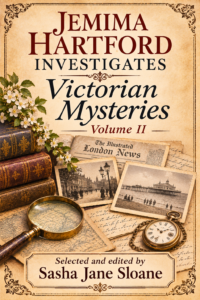 The second volume of Jemima Hartford Investigates was published in 1989. By then, I had brought a substantial part of Jemima’s work to a wider readership, and I felt that I had fulfilled something of a responsibility towards the woman whose papers had changed the course of my life.
Throughout these years, my teaching continued to occupy much of my time. The editorial work was something I fitted around my other commitments, often taking place in the evenings and at weekends. It was demanding, but I found it immensely rewarding.
More than anything, the experience had taught me how to work with historical evidence. I had learned to question sources, compare accounts, follow family connections and distinguish between what could be established and what remained uncertain. I had also gained confidence in presenting historical material in a way that other people could understand and enjoy.
I had begun by wanting to preserve Jemima’s work. By the end of the 1980s, I was beginning to realise that the skills I had acquired might allow me to do something more. I was no longer simply following in her footsteps as an editor. I was beginning to wonder what I might discover if I followed some of those paths for myself.
1990-1994 – Finding my own way
By the beginning of the 1990s, I had already brought a considerable amount of Jemima’s work to publication. Three volumes had appeared, and I had spent several years studying her papers, checking her sources and preparing her investigations for a modern readership. Although there was still material in the archive which I had not fully explored, I felt that I had done much to preserve her work and make it accessible to others. More importantly, the experience had given me a thorough grounding in historical research and a confidence which I might not otherwise have acquired.
I had learned how to follow a line of enquiry, compare different sources and distinguish between what could be established and what remained uncertain. I had become familiar with census returns, parish registers, newspaper archives and the many other records which can help to reconstruct a person’s life. I had also learned that the first explanation is not necessarily the right one, and that a seemingly insignificant detail can sometimes lead to a quite different understanding of a family or an event.
It was natural, therefore, that I should begin to turn some of this experience towards my own family history. I had written our family chronicle in the late 1970s, but that had been largely concerned with recording the memories and experiences of people I had known, or of whom I had heard from other members of the family. I now wanted to investigate some of the earlier generations more thoroughly, using the documentary evidence available to me.
I decided to begin with Mum’s family, the Fox-Brownes. I had known my grandparents, Harry and Beatrice, as a relatively wealthy couple. Grandpa Harry had enjoyed a successful career in the City, and they had lived comfortably, with all the advantages that came with their social position. I had never really questioned how the family had acquired its wealth or how they had come to occupy the position they did. It was simply the world in which I had known them.
As I worked backwards through the records, however, I discovered that the family’s history was rather different from what I had imagined. Harry’s father, my great-grandfather, had been born William Edward Fox, into a family of agricultural labourers in rural Essex. His background had been modest, and his prospects in the countryside would have been limited. It was his move to London, at a time when industrial expansion was creating new opportunities, which had changed the direction of his life.
William had found work in engineering, learned the trade and eventually established a successful manufacturing business. It was not an extraordinary or glamorous enterprise, but it was a sound and profitable one, and he built it into a substantial concern. Through his own ability and hard work, he created a fortune which transformed the circumstances of his family.
I also discovered something rather amusing about the family name. William had married Clara Browne, and the name by which their descendants were known, Fox-Browne, had been created by bringing their two surnames together. It was not an ancient family name, as I had perhaps unconsciously assumed, but a comparatively recent invention. I could not help feeling that there had been something rather deliberate about the choice. Fox-Browne sounded considerably grander than either name on its own, and perhaps that was precisely the intention. Having established themselves financially, my great-grandparents had evidently been keen to establish a name and social identity to go with their new circumstances.
By the time their son Harry was born in 1898, William’s business was already becoming successful. During the years that followed, the family became increasingly prosperous and socially established. By the time Harry married Beatrice in 1921, the Fox-Brownes were wealthy and well connected, and the splendid wedding which had become part of our family history was a reflection of that position.
I began to understand, too, how much of Harry’s own success had depended upon what his father had achieved. Harry had made a career for himself in the City and earned a good living, but he had begun adult life from a position of considerable advantage. His father had provided him with a comfortable home, a good education and an established place in London society. The connections and financial security which William had created gave Harry opportunities that would have been unimaginable to the family from which William himself had come.
The more I discovered, the more striking I found the contrast between the two generations. The Fox-Brownes were not born into wealth; they had made it. Within a relatively short time, a family of agricultural labourers had become a prosperous and socially established London family. I had known the later generation, but my research had revealed the determination and enterprise of the people who had made that life possible.
This was exactly the sort of discovery which has drawn me to historical research. I had started with people whose lives I thought I understood, only to find that there was a much larger story behind them. The records had allowed me to see my own family in a new light, and I found the process every bit as absorbing as working through one of Jemima’s investigations.
There was, of course, another side of my family history which I wanted to explore. Dad’s family had come from Poland, and I had always been interested in the story of Dziadek and Babcia, their departure from their homeland and the life they had made in England. I knew something of their experiences, but I had never undertaken the sort of research into their earlier family background that I was now doing with the Fox-Brownes.
I thought increasingly about tracing the Sloman (or rather the Slomanski) family further back and learning more about the places and people from whom we had come. But I found myself putting it off. During these years I lost both my paternal grandparents, Stefan in 1991 and Janina in 1993. Their deaths made me more conscious of how much of their history had been carried in their own memories. There were questions I wished I had asked and stories I would have liked to hear again. I knew that I wanted to investigate this side of the family, but it was something I found difficult to approach immediately after losing them.
Meanwhile, my teaching at Queen’s School continued to occupy an important place in my life. I had become an established member of staff, and although the work remained demanding, I enjoyed the contact with my pupils and the variety that each school year brought. I had no intention of giving it up. Research and writing were still things I fitted around my professional responsibilities and my life in the house in Blackfriars Street.
The study had gradually become the centre of my historical work. Jemima’s papers were still there, alongside the files and notes relating to my own family enquiries. I continued to return to her investigations, sometimes to check a reference or reconsider a particular case, and there were still projects I hoped to pursue. But I was no longer working solely on material she had left behind. I had begun to find my own interests and to follow my own questions, and that was an important change.
Looking back, I think these years marked the point at which I began to see myself not simply as the person responsible for preserving Jemima’s work, but as a researcher in my own right. I had learned a great deal from her, and her influence remained important to me, but I was beginning to discover that there were stories beyond the archive which I wanted to investigate and perhaps one day write about.
I had no particular plan for what might come next. There were further family histories to explore, more of Jemima’s papers to examine and ideas which I had not yet had time to develop. I was content with the life I had made in Canterbury, balancing my teaching with my interests and enjoying the independence I had worked towards.
But in 1994, an unexpected discovery of a very different kind was about to change the direction of my life. I found that I was pregnant.
1994 – A new chapter
To explain how I came to be in that situation, I should go back a few years, to the time when I first met Richard Bennett.
My interest in older buildings had developed partly as a result of the work I had been doing on the house itself. Although it had been modernised in various ways over the years, I was keen to preserve its original Georgian character. I wanted to make it comfortable for modern living without losing the features which gave it its particular charm. I had gradually become more aware of the importance of its original proportions, woodwork, fireplaces and other details, but there were occasions when I was unsure how best to approach certain alterations. I decided that some professional advice would be useful.
Someone recommended an architect called Richard Bennett, who had his own practice in Canterbury and specialised in the restoration and adaptation of older properties. He came to look at the house and discuss some of the improvements I was considering. We talked at some length about its architectural features and the changes which had been made over the years. I found him knowledgeable and enthusiastic, and it soon became apparent that we shared an interest in historic buildings and the importance of preserving them.
Our first meeting was entirely professional, but we continued to see one another after the initial work had been discussed. Richard was an interesting man, well educated and widely read, with a particular appreciation of art and architecture. He was older than I was, at forty-nine,, and had been a bachelor for most of his adult life. He also had a comfortable home of his own and enjoyed the independence that came with it.
We discovered that we had plenty to talk about beyond the house. We both enjoyed visiting historic buildings, exhibitions and places of architectural interest, and our conversations often ranged over history, art and literature. What had begun as a professional acquaintance gradually became a friendship, and in time something rather closer.
By then I was well established in my own life and had no particular wish to change it. I was fond of Richard and enjoyed his company, but I had no desire to give up the house in Blackfriars Street or to reorganise my life around another person. Richard felt much the same way. He had lived independently for many years, and were perfectly happy to retain our own homes and spend time together as we pleased.
Richard became a regular visitor to Blackfriars Street, and I spent time at his home too. We shared meals, went out together and occasionally spent weekends away. He was a thoughtful and affectionate companion, and I came to value his presence in my life enormously. We had found an arrangement which suited us both, and neither of us felt any need to change it at that time. By 1994, Richard and I had been together for several years. Our relationship was affectionate and secure, and although we continued to maintain separate homes, he was very much part of my everyday life.
When I discovered that I was pregnant, I was naturally surprised. At thirty-nine, I had not expected to become a mother, and it was not something I had been planning. Richard and I had a settled relationship, but we had never discussed marriage or starting a family. We had both been content with the life we had made, and the possibility of a child had not really entered our conversations.
My first reaction was to take some time to think. It was a considerable change, and I knew that having a child would affect almost every aspect of my life. I had my home, my teaching career and my historical work, all of which mattered a great deal to me. I was also very conscious that I would be bringing up a child largely in my own household. But the more I thought about it, the clearer I became that I wanted to have the baby. The surprise gradually gave way to a feeling of happiness and anticipation.
I talked to Richard, of course. He was as surprised as I was, but his reaction was warm and supportive. We discussed what it would mean for both of us, and I was reassured by the fact that he was entirely committed to being involved in the child’s life. He did not expect me to change my arrangements or give up my independence, and I did not feel that I needed to do either. We had never felt that we had to marry in order to make our relationship secure, and the arrival of a child did not alter that.
Telling Mum and Dad was rather more difficult. I knew that they would be surprised, and I was not entirely sure how they would react. They had been brought up with rather more conventional expectations about marriage and family life, and I suspected that they would have concerns about the practicalities as well as the circumstances.
Mum was particularly anxious at first. She wanted to know whether Richard intended to take responsibility, how we would manage, and whether I had properly considered what it would mean to bring up a child without being married. I understood her worries, even if I did not share all her assumptions. I tried to reassure her that Richard was fully involved and that we had discussed the future carefully. I was not proposing to bring up a child without a father; I simply did not see marriage as a necessary condition for becoming a family.
I also reminded her of Bella’s story, which I had come to know so well through Jemima’s memoirs. Bella had chosen not to marry Theodore Vane Blackwood, but Beatrice had grown up knowing her father and having him in her life. She had been loved and cared for, despite the circumstances of her birth. I was not suggesting that our situations were identical. The world had changed considerably since Bella’s time, and I had choices which would have been much harder for her. But her story had helped me understand that marriage and parenthood were not necessarily inseparable.
Dad was quieter about the matter, although I knew he shared some of Mum’s concerns. He wanted to be certain that Richard understood the responsibilities involved and that I would not be left to manage everything alone. Once he had spoken with Richard and seen for himself how seriously he regarded the situation, he became more comfortable with the idea.
Mum took a little longer to settle, but she gradually came to accept that I had made my decision thoughtfully and that I was happy with it. I think she was still apprehensive, as any mother might be when her daughter is embarking on something so important, but she did not try to dissuade me. In time, her concern gave way to the practical questions of what we would need to prepare and how she could help.
Once the initial conversations were behind us, there was plenty to think about. I had to make practical arrangements for the baby, not least deciding which room would become the nursery. I had always intended to keep the study as my own working space, and I was reluctant to give it up. Fortunately, there were other bedrooms in the house, and I was able to prepare one of them for the new arrival.
It was strange, in a way, to find myself making plans for a baby in a house which had been part of my life for so long. I had grown up there, and the rooms had gradually taken on different purposes as the family changed. Now, for the first time in many years, the house was preparing to welcome another generation.
I also had to consider my work at Queen’s School. I intended to take maternity leave and return to teaching afterwards, and I began discussing the arrangements with the school. I was fortunate to have supportive colleagues, and although I knew that returning to work would require some careful planning, I did not want to abandon a career which I enjoyed. My historical research would have to fit around the demands of motherhood, as it had always fitted around my teaching.
Richard was involved in the preparations and helped with the practical matters. We discussed what the baby would need and how we would manage once he or she arrived. We were both aware that our lives were going to change, but neither of us felt that we had to abandon the arrangements which had suited us until then. Richard would continue to have his own home, while the baby and I would make our home in Blackfriars Street. We would work out the details as we went along.
Mum was becoming increasingly enthusiastic as the months passed. Her initial anxieties had not disappeared entirely, but the prospect of becoming a grandmother was beginning to take over. She was interested in what I had bought for the baby, offered advice when I wanted it and occasionally reminded me of things I had not yet thought about. Dad was more reserved, but I knew he was looking forward to the arrival too. Both of them made it clear that they would be there if I needed help.
As the time approached, I found myself looking forward to meeting the baby with a mixture of excitement and apprehension. I had spent much of my adult life making decisions for myself, and now I was preparing for a responsibility unlike any I had known before. I was very happy, but I was also aware that there would be much to learn.
Jamie Richard Sloman was born on 12 November 1994 in the Kent and Canterbury Hospital. Richard was with me, and Mum and Dad were among the first to visit. I remember feeling an extraordinary sense of wonder when I first held him. After all the planning and anticipation, there he was: a real little person, entirely new to the world and already the centre of ours.
Mum stayed close by during those first days and was a great comfort to me. She had brought up three children of her own and was able to offer the sort of practical help and reassurance that no book could provide. Dad visited too, and Richard was there regularly. I was fortunate to have their support, and gradually began to find my feet as a mother.
Jamie’s arrival marked the beginning of a new chapter in my life. I was thirty-nine years old, and although I had spent many years making a home and a career for myself, motherhood brought responsibilities and experiences I had never known before. The house in Blackfriars Street was now Jamie’s home too, and another generation of the family had begun its life here.