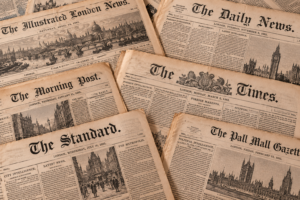
 Victorian newspapers are an invaluable resource for investigating the mysteries of the nineteenth century. They preserve details of crimes, family relationships, marriages, financial difficulties, personal disputes and courtroom proceedings that might otherwise have been lost. Yet newspapers are more than historical records: they are also stories shaped by the attitudes, interests and commercial pressures of their time. To use them effectively, we must consider not only what they tell us, but how and why they reported it.
Victorian crime reporting could be remarkably graphic and intimate. Accounts of murder, suspicious deaths and violent assaults might describe injuries, bloodstains, medical examinations and the discovery of bodies in disturbing detail. Inquests and trials provided lengthy testimony from witnesses, doctors and relatives, which newspapers often reproduced almost verbatim. Sensational illustrations added another dimension, depicting crime scenes, victims and accused persons for readers who had never visited the places concerned. Publications such as the Illustrated Police News, founded in 1864, capitalised on the public’s fascination with shocking events. Such reporting served several purposes: it informed readers, offered moral lessons about crime and respectability, and sold newspapers. There was no single moment when graphic reporting ended; rather, conventions of taste, privacy and editorial restraint evolved gradually, and sensational crime journalism continues today in different forms.
Newspapers could also reveal extraordinary details of private lives. Alleged affairs, marital disputes, family quarrels, financial motives and questions of character frequently emerged during legal proceedings. A criminal investigation could therefore become a much wider story involving relationships, inheritance, reputation or social scandal. For genealogical research, these apparently incidental details can be especially valuable, helping to establish connections between people and suggesting new avenues of investigation.
The circulation of news was equally important. During the nineteenth century, steam-powered printing, cheaper paper, the removal of newspaper taxes, expanding railway networks and the electric telegraph transformed the newspaper industry. News could travel farther and faster, while growing networks of editors, correspondents and news agencies supplied material to publications throughout Britain. Newspapers frequently copied reports from other papers, sometimes with acknowledgement and sometimes without it. This practice, often called scissors-and-paste journalism, allowed provincial newspapers to report distant trials and sensational crimes without sending their own reporters. Organised syndication and news agencies subsequently made the sharing of material more systematic. Copying never entirely stopped; it evolved into the networks of shared news content familiar today.
This has an important consequence for historical research: ten newspapers repeating the same allegation do not necessarily provide ten independent sources of evidence. They may all derive from one original report. Comparing wording, publication dates, omissions and the sequence of testimony can help identify copied accounts, although the earliest surviving report is not necessarily the original.
Nor should a newspaper report automatically be treated as the truth. Headlines, editorial choices and contemporary prejudices could influence how victims, suspects and witnesses were portrayed. Rumours and allegations might be repeated before a trial had concluded, while important qualifications or contradictory evidence received less attention. A report can accurately record an accusation without establishing that it was true.
The Victorian Mysteries project therefore approaches newspapers as both evidence and objects of investigation. By comparing accounts, tracing allegations to their sources, following cases through inquests and trials, and examining what happened afterwards, we can distinguish documented facts from speculation and uncover details overlooked by conventional records.
Ultimately, the newspapers offer two intertwined stories: the mystery itself, and the story the press constructed around it. Understanding both can bring us closer to the people behind the headlines and reveal how Victorian society understood crime, family, morality and justice.