Written in 1980
A few words before we begin
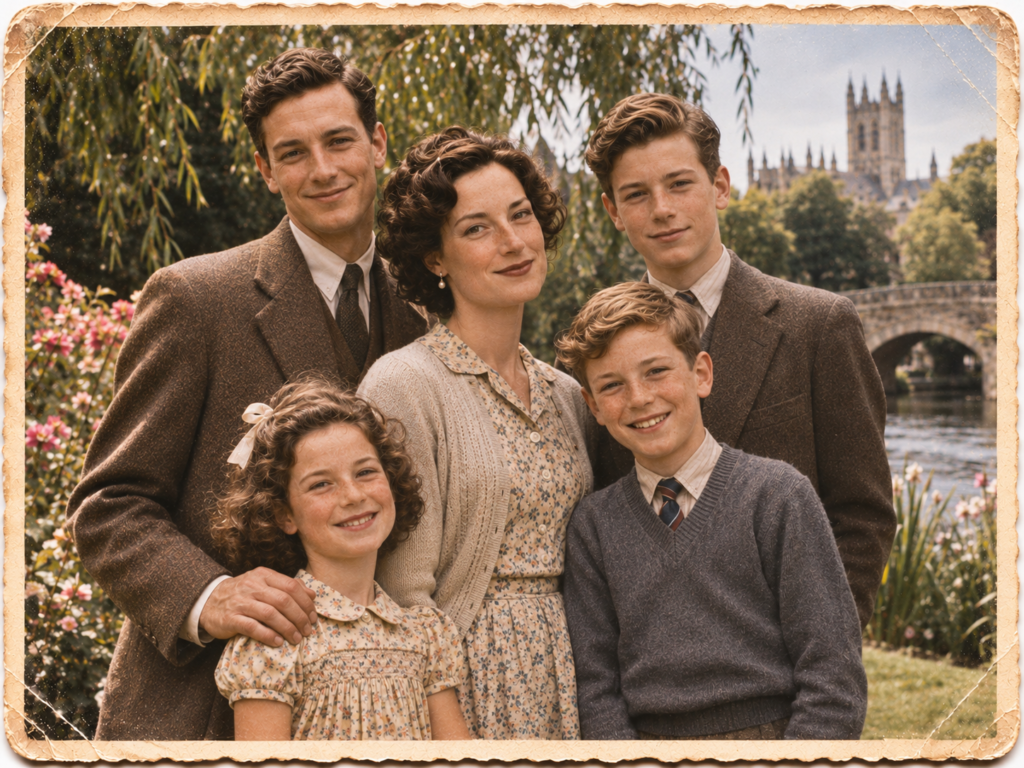
These pages are rather more personal than those which have gone before. They tell the story of my own childhood and young adulthood, from my earliest memories in the house in Blackfriars Street to the time when I found myself living there alone, with the responsibility for making a home of my own.
I grew up surrounded by family stories, although I cannot claim that I paid much attention to them at the time. I knew something of the lives of my grandparents and of the generations who had come before them. I knew that the house had once belonged to my great-great-aunt Jemima, and that she had been a remarkable woman in her own way. But as a child, I was much more concerned with my brothers, my friends, school and the ordinary adventures of growing up.
My childhood was a happy one, shaped by the affection of my family and by the different influences of the people around me. I was fortunate to know my grandparents well, and to grow up with both the English and Polish sides of my family as part of everyday life. As I grew older, my interests naturally widened. School, university, friendships and eventually my work as a teacher took me beyond Canterbury, although the house in Blackfriars Street remained the place I thought of as home.
Early memories
My earliest memories are of the house in Blackfriars Street, Canterbury, where I spent almost all my childhood. By the time I was old enough to remember things clearly, it was already a well-established family home. My parents, Connie and Adam Sloman, had made it their own, although it still belonged to my grandmother, Beatrice, who lived in Kensington.
It was a comfortable house, but never an especially grand one. There was enough room for all of us, although I suspect my parents sometimes wondered how they had managed to fit three growing children into it. My brothers, Daniel and Lucas, were considerably older than me, and by the time I was old enough to take much notice of them, they had already developed their own interests and their own ideas about how the world worked.
Daniel, or Dan as we called him, was the eldest and, in many ways, the most like our father. He was practical, dependable and liked things to be properly organised. He was the sort of boy who wanted to know how something worked and was usually more interested in doing something useful than in talking about it. Lucas was rather different. He was fascinated by aircraft, and could spend hours looking at pictures of them or making model aeroplanes. He had a much more adventurous imagination, and I think even as a boy he was already dreaming of a life that would take him beyond Canterbury.
I was the little sister, which had its advantages and disadvantages. I was often included in things because I was there, but I was also sometimes reminded that I was too young to understand. I admired my brothers enormously, although I don’t suppose they always appreciated having me following them about. They were good to me, on the whole, and I never felt that I was an unwelcome addition to their lives. But I did learn quite early that if I wanted to join in, I sometimes had to make myself useful or find a way of keeping up.
I was not a particularly quiet child, although I could happily occupy myself for long periods with a book or some small interest of my own. I liked company and conversation, and enjoyed being with other children, but I was equally content to sit and watch what was going on around me. Looking back, I can see that I had something of both sides of my family in me. I could be thoughtful and reserved, but I was also sociable and enjoyed a good deal of laughter. At the time, of course, I gave very little thought to where these qualities might have come from.
Our household had its own familiar routines. Dad worked on the railways, and Mum, who had returned to the booking office at Canterbury West after we were older, fitted her work around the family. She had always enjoyed the railway, and I think she was pleased to have a little part of her former working life back. She did not work full-time, but she liked keeping in touch with her colleagues and the familiar business of the station.
When I was still quite small, Janina helped Mum by looking after me on the day she went to work. This was never treated as a formal arrangement. Janina was my grandmother, and having me with her was simply part of family life. I loved being with her, and although I was not aware of it at the time, those days helped me become familiar with the Polish language and the customs that were part of my father’s family.
The house itself was full of things that had belonged to earlier generations. I knew that it had once been the home of my great-great-aunt Jemima, and that she had been an unusual and rather scholarly woman. I had heard that she collected information, read old newspapers and spent a great deal of time writing. There were still some of her books in the house.
My room had once been Jemima’s study. It was not a large room, but it was mine, and I liked it. The room was not large, but it was mine, and I liked it. The bookshelves and old furniture had become so familiar that I scarcely noticed them.
As a child, I was much more interested in the ordinary business of growing up. I wanted to know what my brothers were doing, what my friends were talking about, and what was happening beyond the familiar streets of Canterbury. The house in Blackfriars Street was the centre of my world, but I was already beginning to look outwards from it.
It would be many years before I understood how much of my family’s past had been gathered into that house, and how little I really knew about the people whose lives had helped shape my own.
1960 – The Death of Grandpa Harry
I was five years old when my grandfather Harry died. I was still very young, and although I have some memories of that time, I cannot pretend to remember everything clearly. Some of what I know has come from Mum and Grannie Bea in later years. But I do remember the sadness that surrounded us, and the sense that something important had happened which I was not quite old enough to understand.
Grandpa Harry had been home from the war for fifteen years, but he had never entirely regained his former strength. He was not an invalid, and he continued to lead a full life, but the years of captivity had taken their toll. As a child, I knew only that he sometimes tired more easily than other grown-ups. I did not understand why, and I certainly had no idea of what he had endured during the war.
I remember being told that he was very ill, and then that he had died. I am not sure that I understood what death meant at first. I knew that people were sad, and that Grannie Bea was particularly upset, but the idea that I would never see Grandpa again was difficult to grasp. I may have asked when he was coming home, or whether I would see him soon. Children do not always understand the finality of things, and I suspect I was no different.
We travelled to London for his funeral. I remember the journey and the unfamiliar atmosphere of the occasion more than any particular detail of the service. The grown-ups were quieter than usual, and I was aware that I was expected to behave sensibly and stay close to Mum and Dad. I knew that something serious was happening, although I could not have explained exactly what it was.
I remember Grannie Bea looking very sad. I had always associated her with the warmth of her home in Kensington and the pleasure of our visits, and it was strange to see her so unhappy. I was probably more conscious of her sadness than of my own loss. At five, I did not have the experience to understand what it meant to lose a husband after so many years together. I only knew that someone I loved was no longer there, and that the people around me were grieving.
It was my first real encounter with death. I had not previously thought very much about it, and I certainly had not understood that it meant the permanent absence of someone. I cannot say that I grasped all of that at the time. My understanding came gradually, as I grew older and began to realise that Grandpa Harry would never again sit with us, join in our family conversations or welcome us into the Kensington house.
For Grannie Bea, his death meant the beginning of a very different chapter of her life. She remained in the Kensington house, which was now hers, and continued to live independently. She was still our grandmother, still part of our family, and we continued to visit her. But the house had changed, just as our family had changed, and I think I became more aware of her as a person in her own right as I grew older.
I did not understand grief in 1960. I only knew that Grandpa Harry was gone and that the adults I loved were sad. It was many years before I could appreciate what his death had meant to Grannie Bea, or how much of their shared life had been shaped by the years before I was born.
By the time I was old enough to appreciate the different personalities in our family, I had become very attached to my three surviving grandparents. They were quite different people, and each gave me something different.
Grannie Bea
My grandmother Beatrice, whom I always called Grannie Bea, was a rather different sort of person from my other grandparents. She had been brought up in a world that was more formal than the one in which I grew up, and she retained something of that background in her manner. She was always well turned out, took care over her appearance and had a certain elegance about her. But she was also warm and affectionate, and I never doubted that she loved having me with her.
I visited her in Kensington during school holidays, sometimes with Mum and sometimes for a few days on my own as I grew older. I came to know her house very well: its rooms, its familiar furniture and the particular atmosphere of a home that had been hers for many years. After Grandpa Harry died, she continued to live there, and although she must sometimes have felt his absence keenly, she did not become a recluse. She had her own routines and interests, and she liked to have family around her.
When I was little, I enjoyed the treats that went with a visit to London. Grannie Bea might take me shopping, or we would go out for lunch, and I always felt that a visit to her was a little different from ordinary life in Canterbury. She was interested in what I was doing at school and what I thought about things, although I suspect she sometimes found my opinions rather more forthright than she expected.
She also told me stories about her own mother, Bella, and about her great-aunt Jemima. I was particularly entertained by tales of Bella’s life in the theatre. The idea that my great-grandmother had been an actress seemed exciting, and I liked hearing about the people she had met and the places she had visited. Jemima’s story was less immediately appealing to me. I understood that she had been clever and had spent a great deal of time researching and writing, but I had little sense of what her work involved. At that age, old newspapers and family documents were not exactly my idea of an interesting afternoon.
Dziadek and Babcia
My paternal grandparents, Stephen and Janina, were much more closely woven into the everyday fabric of my childhood. I called them Dziadek (Grandpa) and Babcia (Grannie), as was natural in our family, and those names became as familiar to me as Mum and Dad. They lived in Canterbury, and I saw them frequently. Their Polish background was something I grew up with rather than something I had to discover later.
Dziadek was a quiet, practical man, and I think Dad inherited much of his nature. He was not given to grand speeches, but he was dependable and thoughtful, and he liked things to be done properly. I knew that he and Babcia had come to England from Poland many years before, and that their early life here had not always been easy. But to me they were simply my grandparents, and their home was a familiar and welcoming place.
Babcia was perhaps the more expressive of the two. She was affectionate and had a way of making me feel that I was always welcome, whether I had been expected or had simply appeared. She was also a wonderful source of Polish food and family traditions. I loved being in her kitchen, where there was nearly always something being prepared, and where conversations moved easily between Polish and English.
Dad had spoken Polish to us from the time we were small, as he did with Dan and Lucas. He would often address us in Polish, but my brothers generally answered him in English. They understood much of what was said, but neither showed the same enthusiasm for speaking it. I was different. I liked the sound of the language and enjoyed trying out new words and expressions. Babcia encouraged me whenever she could, and I soon became quite happy chatting away with her and Dziadek in Polish.
I particularly enjoyed those conversations because they were not lessons. I was simply talking to my grandparents about what I had been doing, asking questions, or listening to their stories. If I made a mistake, Babcia would gently correct me, and then we would carry on. Gradually I became more confident, and Polish became a natural part of my relationship with them.
As I grew older, I wanted to learn more than just how to speak the language. I attended a Polish Saturday school alongside my regular studies, which helped me with reading and writing. It also gave me the opportunity to meet other children from Polish families and to understand more about the culture and history that lay behind the language. By the time I was in my late teens, I could hold a conversation comfortably and was reasonably fluent.
I think Dad was quietly pleased that I had taken such an interest, and Babcia was certainly delighted. Dan and Lucas could still understand Polish, but by then they were much more accustomed to using English. I suppose each of us had found our own way of relating to that part of our family background.
Looking back, I can see how fortunate I was. Grannie Bea gave me a connection with the earlier generations of our family and with a world that was very different from my own. Dziadek and Babcia gave me a strong sense of family, continuity and belonging, as well as a language and cultural inheritance that became an important part of my identity. They were all different, but each of them helped shape the person I became.
Early 1960s – Modernising the Canterbury house
As the 1960s began, the house in Blackfriars Street was becoming rather more suited to the needs of a modern family. It had served us well, but much of its plumbing and domestic equipment belonged to an earlier age. Mum and Dad wanted to make it more comfortable, particularly as we children were growing up and the demands on the household were changing.
Mum had received a legacy from her father, and with Grannie Bea’s agreement she decided to use some of the money to improve the house. The outside lavatory at the rear was one of the things Mum and Dad were particularly keen to replace. They decided to build a small extension at the back of the house, providing space for a proper bathroom with a bath, washbasin and indoor lavatory, together with improved plumbing and a reliable supply of hot water. I imagine that, to Mum and Dad, having a bathroom inside the house must have seemed a considerable improvement, although to us children it soon became simply part of everyday life.
The kitchen was updated, with new fittings and equipment that made everyday tasks a little easier. Gradually, some of the older furniture was replaced, and the house began to feel more comfortable and modern.
We also acquired a telephone, which seemed quite an exciting development at the time. It was something we had to get used to having, and I remember the novelty of being able to speak to people without leaving the house. Later came a television, which changed the evenings in a way that I suspect most families of that generation will remember. There was suddenly something around which we could all gather, although deciding what to watch was not always straightforward.
The work was mostly concentrated downstairs. Upstairs, the bedrooms remained much as they had been, apart from fresh paintwork and wallpaper here and there. The old doors, cupboards and other familiar features stayed in place, and the rooms retained something of the house’s earlier character.
My own bedroom was still the small room that had once been Jemima’s study. I had grown used to its proportions and its old fittings, and it seemed entirely ordinary to me. The room was simply where I slept, read and kept my belongings.
Looking back, I realise that the improvements made the house more comfortable without changing its essential character. It was still the same family home, with the same familiar rooms and routines. The downstairs rooms were gradually brought into the modern world, while upstairs much of the past remained undisturbed.
1962 – 1971 – Daniel and Lucas: Two different paths
My two brothers were very different in temperament, and as they grew older it became clear that they would follow quite different paths in life.
Dan, being the eldest, was the first to leave school. He was fifteen in 1962 and, perhaps inevitably, followed Dad into the railway. He had always been practical, with a good understanding of how things worked, and he seemed to take naturally to railway life. He began in a junior station position, learning the everyday work and gradually acquiring a much broader knowledge of railway operations.
He was not content, however, simply to follow Dad’s example. Dad was happy in his work and took considerable pride in doing it well, without any particular desire to climb the career ladder. Dan was rather more ambitious. He wanted to learn, to take on greater responsibility and to see how far he could progress. He trained as a signalman and, as he gained experience, began to look towards more senior positions.
In 1967, when he was twenty, Dan married Jenny Coleman. They were still very young, but they were sure of one another, and I remember being delighted at having a sister-in-law. The following year they had a little boy, making me an aunt at thirteen. I thought this was a very important development, although I suspect I was more interested in having a baby nephew to fuss over than in the responsibilities of motherhood. They subsequent went on to have two more boys.
As his experience grew, Dan became increasingly interested in the more responsible positions within railway operations. By the end of the decade, he had qualified as a signalman and was offered the opportunity to take up a senior position at Ashford. It was an important step in his career, and he and Jenny decided to move there with their three sons. It meant leaving Canterbury, but the move made sense for them. It offered Dan the prospect of further advancement, and he was never one to let a good opportunity pass him by. I missed having him nearby, but I understood that he was making a life of his own.
Lucas, three years younger than Dan, had quite different interests. From an early age he was fascinated by aircraft. He spent hours making model aeroplanes, particularly the kits that came in the Airfix boxes, and he was always reading aviation magazines or looking at pictures of different machines. While Dan was interested in railways, Lucas’s imagination was already taking him further afield.
When he was eighteen, in 1968, he joined the Royal Air Force. He was not interested in becoming a pilot; it was the aircraft themselves, and the engineering that kept them flying, that appealed to him. He trained as an aircraft technician, learning the skills needed to service and maintain the machines he had admired for so long. It suited him very well, and he was able to develop his technical abilities and gain further qualifications as his career progressed.
After his initial training, Lucas was posted to Malta. It was a considerable change from Canterbury, and for him it opened the door to a life that was quite unlike anything he had known before. He took to the island, its climate and its people, and it was there that he met Michelina Vella.
They married in 1971. Michelina was Maltese, and through her Lucas became part of a much wider family and a different way of life. He was happy there, and although he remained in the RAF and continued to make progress in his technical career, I think Malta gradually became more than simply the place where he happened to be stationed. It began to feel like home.
As the years passed, Lucas’s life became increasingly centred on the island. He came back to England from time to time, but visits to Canterbury were less frequent. We missed him, of course, but there was never any suggestion that he was unhappy or that he ought to return. He had found his own place in the world, just as Dan had found his own direction in Kent.
When the British military presence in Malta came to an end in 1979, Lucas and Michelina faced a decision about their future. By then, he had acquired valuable technical experience and qualifications, and he was able to use them to find civilian employment in Malta. They decided to remain there rather than return to England. It was a natural choice for them: Michelina was at home among her own family, and Lucas had come to think of Malta as his home too.
Looking back, I can see how different their lives became from the one Dad had known. Both my brothers had begun their working lives in practical occupations, but they had opportunities to develop their skills, gain qualifications and move into positions that might not have seemed possible to the previous generation. Dan built his career within the railway, while Lucas found his future in aviation and eventually made his home overseas.
I was fond of both my brothers, but by the time I was growing up they were increasingly occupied with their own lives. I remained the one who was still at home in Canterbury, and perhaps that was one reason why I became so attached to the house in Blackfriars Street. It was the place to which we all still belonged, even as our lives took us in different directions.
1966-1976 – My education
In 1966, when I was eleven, I sat the 11-plus examination as children throughout Kent did at that age. The results determined which type of secondary school I would attend, and I was fortunate enough to gain a place at Canterbury Grammar School for Girls. I was pleased, of course, although at that age I was probably more excited by the prospect of a new school, new friends and a different routine than by any great understanding of what a good education might mean for my future.
I enjoyed school and was generally a conscientious pupil. I was fortunate in that I found most subjects interesting, although, as I grew older, I began to discover that I had particular strengths and preferences. English became one of my favourite subjects. I enjoyed reading, discussing books and learning how writers used language to create character, atmosphere and meaning. I also developed an interest in history of art, and gradually became more aware of the different ways in which people expressed themselves and understood the world around them.
My knowledge of Polish was another part of my education. I had grown up hearing the language spoken at home and had learned to converse with Dad and my grandparents. The Saturday school had also played its part in helping me become comfortable with the language. At grammar school, I was able to develop my knowledge further, particularly in reading and writing. It was something I valued, not simply as a school subject, but because it connected me to Dad’s family and to a part of my background that was different from that of many of my friends.
As I approached the end of my school years, I began to think seriously about university. I decided that I wanted to read English Literature, and applied for a place at King’s College London. I was delighted when I received a conditional offer, although I knew that everything depended on my A-level results.
I sat my examinations in the summer of 1973 and, when the results were published in August, I was pleased to discover that I had achieved the necessary grades to secure my place at King’s. So in the autumn I left Canterbury for London. I was eighteen, and although I was excited by the prospect of university life, it was also the first time I had spent an extended period away from the familiar surroundings of home.
University opened up a much wider world. I met people from different backgrounds, encountered ideas and opinions that were new to me, and found myself studying literature in a much more demanding and independent way than I had experienced at school. We were expected not simply to read books and remember what we had been taught, but to question, compare and form our own interpretations. I particularly enjoyed exploring the historical and social circumstances in which works had been written, and considering how much an author’s experiences and the world around them might influence their writing.
I also made friendships that became an important part of my life during those years. Like most students, I had my share of social occasions, outings and the ordinary business of making my way as a young adult. I had a boyfriend for a time; we enjoyed one another’s company, but as we grew older it became apparent that we wanted rather different things from life. There was no great falling-out; the relationship simply came to an end, as some young relationships do.
Although I was making a life of my own in London, I never lost my connection with Canterbury or with the family. During term time, I particularly enjoyed visiting Grannie Bea in Kensington. It was easy enough to make the journey across London, and I often called in to see her. By then I was old enough to appreciate her company in a rather different way from when I had been a little girl. Our conversations were longer, and I became more interested in the stories she told about her own life, about Bella and about Jemima. I still knew relatively little about Jemima’s work, but I was beginning to understand that there was much more to her than I had realised. When the university holidays came, I returned to Canterbury and the familiar comforts of the house in Blackfriars Street.
By my final year, I had begun to think seriously about what I wanted to do next. I knew that I wanted to return to Canterbury, and teaching English seemed a natural way to use what I had been studying. I began making enquiries about posts in the area and was fortunate enough to be offered a position teaching English at Queen’s School, an independent girls’ school in Canterbury, subject to completing my degree.
1976 – A new beginning
I graduated in the summer of 1976, and returned to Canterbury I had the summer ahead of me before taking up my appointment in September. It was a pleasant time of readjustment, settling back into familiar surroundings and preparing for the next stage of my life. The house in Blackfriars Street was once again my home, and I was looking forward to beginning my working life.
I had the summer ahead of me before starting my new teaching post in September. It gave me time to unpack properly, get myself organised and enjoy a few weeks without the demands of lectures, reading lists and examinations. I was also looking forward to having a little more independence. I was still living with Mum and Dad, of course, but I was no longer a schoolgirl or a university student. I had a degree, a job to go to and the beginnings of a working life of my own.
I was excited by my new job at Queen’s School, Canterbury where I would be teaching English, but also a little apprehensive. It was one thing to study literature at university and quite another to teach it to a classroom of pupils. I knew my subject, but I was soon to discover that knowing something and being able to explain it clearly to others were two rather different skills.
When September came, I began my first term. There was a great deal to learn, not all of it to do with English. I had to become familiar with the school’s routines, prepare lessons, mark work and learn how to manage a classroom. I soon discovered that teaching required patience, organisation and a good deal of energy. Some lessons went better than others, and I occasionally found myself wondering whether I had explained something as clearly as I might have done. But I enjoyed the work, and gradually became more confident.
I particularly liked the opportunity to encourage girls to enjoy reading and to think for themselves. I had always loved literature, and I wanted my pupils to discover that books were not simply things to be studied for examinations, but could open up different worlds and ways of looking at life. I was perhaps a little idealistic in those early days, but I think that was probably no bad thing.
Life at home also settled into a new pattern. Mum and Dad were still very much part of my everyday life, and I enjoyed having them around, but I was increasingly occupied with my own work and friendships. I was beginning to find my place as an adult member of the family rather than simply the youngest child.
Looking back, the summer and autumn of 1976 were a time of quiet beginnings. I had returned to the town where I had grown up, started a career that I hoped would suit me, and was gradually establishing a life of my own. I had no reason to suppose that anything much would change. But, as it happened, the family was soon to face a change that would affect all of us, and particularly my future in the house in Blackfriars Street.
Winter 1976 – A Change in the Family
By the winter of 1976, Grannie Bea was beginning to find life on her own in Kensington more difficult. She had lived independently since Grandpa Harry’s death sixteen years earlier, and had always been determined to manage her own affairs. But she was now in her mid-seventies, and her health and energy were gradually declining. She tired more easily, found some of the everyday tasks around the house increasingly burdensome, and was going out less often than she had done in the past.
Mum had always been close to her, and she was becoming increasingly concerned about her living alone. Although Grannie Bea had managed perfectly well for many years, Mum felt that the time had come for the family to be closer at hand. She and Dad discussed the situation and decided that the best solution would be for them to move to Kensington and live with her.
It was a considerable change for them both. They had spent most of their married life in Canterbury, and Dad had worked on the railway there for many years. But he understood how much Mum wanted to be near her mother, and he was quite willing to make the move. He approached British Rail and arranged a transfer to a signal box in the London area, allowing him to continue in the work he knew so well.
The arrangements took some time, but by the beginning of 1977 they had moved into Grannie Bea’s house in Kensington. I knew they would miss Canterbury, particularly Dad, who had spent so much of his working life there, but they settled into their new circumstances. Mum was much happier knowing that she was there to help her mother, and Dad took everything in his usual quiet and practical way.
Of course, Mum and Dad were not leaving all their family behind in Canterbury. Dziadek and Babcia were still living there, although they were getting older themselves. They were managing well enough on their own, and with me remaining in Canterbury there was still someone close by. Dad knew that he would miss seeing his parents as regularly, but they understood the reasons for the move, and he and Mum intended to visit whenever they could.
For me, it meant that I was now living alone in the house in Blackfriars Street.
It was during this period that Grannie Bea began to think more seriously about the future of her two houses. She had always been fond of the house in Blackfriars Street, and she knew how much it meant to me. She also understood that Dan and Lucas had established their own lives elsewhere, while Mum and Dad were now living with her in Kensington. She wanted to make sure that both properties remained within the family, and that each went to someone for whom it would be a meaningful home.
She therefore decided that Mum should inherit the Kensington house, while the house in Blackfriars Street would pass to me. She discussed her wishes with Mum and Dad, who both understood and supported her decision. It was entirely Grannie Bea’s choice, and she had given it careful thought.
She also spoke to me about it herself. I was touched that she wanted me to have the house, although at the time I don’t think I fully appreciated what such a responsibility would mean. I had grown up there and had always thought of it as home. The idea that one day it would legally belong to me seemed a natural continuation of things rather than a particularly dramatic change.
By then, Grannie Bea was becoming increasingly frail, and we were all aware that her time with us might be limited. But she remained very much herself, and I was glad that she had been able to make her wishes known while she could still discuss them with us. It was a comfort to know that the future of the two houses had been settled, and that the family understood what she wanted.
1977 – The End of an Era
By the summer of 1977, Grannie Bea had become increasingly frail. Although she had enjoyed having Mum and Dad with her in Kensington, and their presence had made life easier and more comfortable, her health continued to decline. We all knew that she was getting towards the end of her life, even though it was difficult to imagine the family without her.
She died that summer, and with her passing another important chapter of our family history came to an end. She had been a familiar and affectionate presence throughout my childhood, and although I had become an adult and was beginning to make my own way in the world, I still thought of her as someone who would always be there. I missed her enormously.
For Mum, her death meant losing her mother, and for Dad it meant losing someone he had known and cared for over many years. They had moved to Kensington to look after her, and I was glad that she had not been alone during her final months. I think it was a comfort to Mum in particular that she had been able to spend that time with her mother.
Her wishes concerning the two houses were carried out. Mum inherited the Kensington house, where she and Dad continued to live, while the house in Blackfriars Street passed to me.
I was only twenty-two, and although I had begun my teaching career and was enjoying my independence, I had not really thought of myself as the owner of a family home. I had grown up in those rooms, and they were full of memories of Mum and Dad, my brothers, my grandparents and the many family occasions we had shared there. Now the responsibility for the house rested with me.
Looking back, I think 1977 really did mark the end of an era. Grandpa Harry had been gone for seventeen years, and now Grannie Bea had gone too. The older generation who had been such a constant part of my childhood was gradually disappearing.
I had a career and the freedom to shape my future. I felt very fortunate, but I also understood that I had inherited something more than bricks and mortar. The house represented the continuity of our family, and I wanted to look after it.
At the time, I thought of that responsibility simply in terms of keeping the house in good order and preserving it as a home. I had no idea that it contained anything that would change my understanding of our family history, or that one day I would find myself looking much more closely at the lives of those who had lived there before me.
But that belongs to the next part of my story.