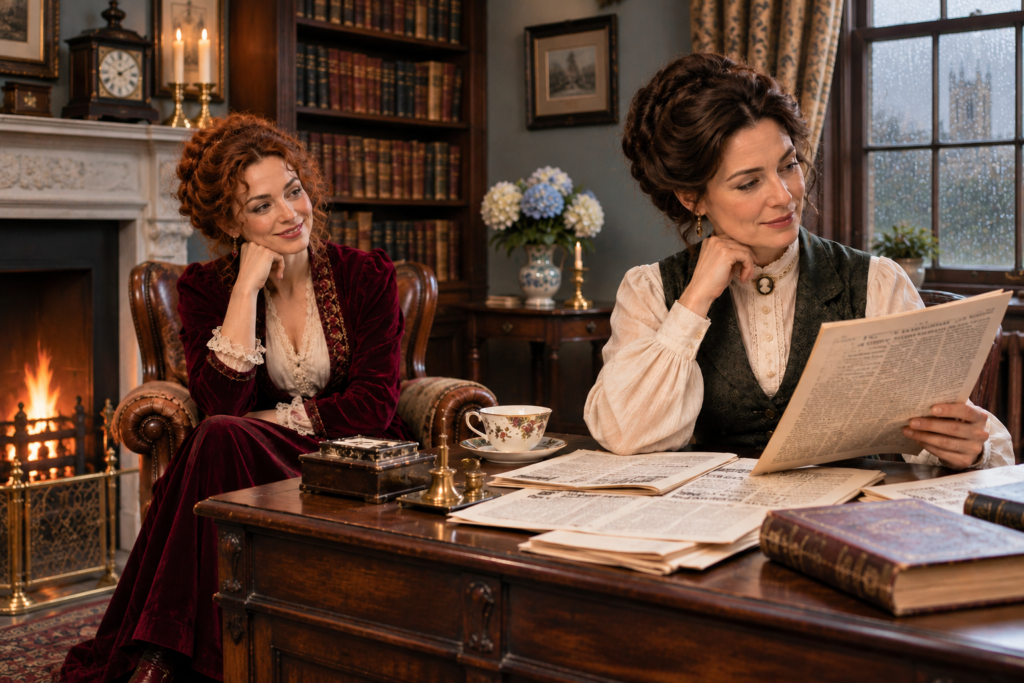
The rain had been falling steadily over Canterbury since luncheon, and by mid-afternoon the streets were decidedly uninviting. In Jemima’s study the fire was burning brightly so the room offered a comfortable refuge from the November weather.
Jemima was seated at her writing desk, surrounded by newspaper cuttings, handwritten notes and several extracts from parish registers. She had been examining the same small collection of documents for much of the afternoon, occasionally making a note before returning to the newspaper cutting that lay before her.
Bella was settled in an armchair near the fire with a cup of tea.
“You appear to be having a disagreement with that document, Jemima.”
“I am having a disagreement with an entire family, Bella.”
“How unfortunate. Which family has incurred your displeasure?”
“The Fullers. William, Maria and their children, or at least the children I believe they had. I cannot persuade them to remain in one place long enough for me to establish who they were.”
Bella laughed.
“Surely you have managed to discover something?”
“Something, certainly. Enough, unfortunately, to make the absence of everything else rather irritating.”
Jemima pushed a newspaper cutting towards her sister.
“This is where it began. The Whitstable Times, January 1867. An account of an inquest into the death of a little girl named Emma Fuller, aged fifteen months.”
Bella picked up the cutting and began to read.
“Oh, how dreadful!”
“Indeed. Emma died after eating mistletoe berries, which her elder sister had given her.”
“Her sister?”
“Margaret. She was six years old.”
Bella looked up in surprise.
“Six! And she was looking after a baby?”
“That was precisely what caught my attention. Their mother had left the two children together, entrusting Margaret with the care of her infant sister. The newspaper says that Margaret had occasionally been called upon to act as nurse to the baby.”
Bella read further.
“She took the little one outside?”
“Yes. Her mother had instructed her not to go beyond the street door, but Margaret was tempted by the Christmas decorations in the shops. She found some mistletoe berries outside a greengrocer’s, mistaking them for white currants. Having tasted them herself and found them bitter, she gave some to Emma.”
Bella put down the cutting.
“Poor little thing. And poor Margaret! Imagine being six years old and having to live with that.”
“That was my thought too. The coroner appears to have taken a similar view. He remarked that the elder infant was hardly more to blame than the younger for what had happened.”
“Quite right. Margaret was little more than a baby herself.”
“The inquest returned a verdict of accidental poisoning. There is no indication in the newspaper reports I have found that the mother was prosecuted.”
Bella considered this for a moment.
“I suppose we should be careful not to judge her too harshly. We have no idea why she left the children together.”
“Quite so. We know that she was called Maria, but little else about her circumstances. Her husband, if the newspaper’s family references are correctly understood, was William. I have tried to discover more about them, but that is where my difficulties began.”
Jemima drew another piece of paper from the pile.
“I found what may be Emma’s burial. Emma Fuller, aged fifteen months, of Duke Street, St George’s East, buried on Boxing Day, 1866. The age and address correspond with the newspaper account.”
“And that is helpful.”
“Very. I also found a possible baptism, in December 1865, for an Emma Fuller, daughter of William and Maria Fuller. The father’s occupation was given as labourer, and the family abode was recorded as Gloucester Street.”
“Then surely you have your family?”
“I have a possible family, Bella. Not quite the same thing.”
Jemima smiled at her sister’s expression.
“The baptism and burial addresses differ. They may simply have moved house, which would be perfectly possible. But I cannot establish beyond reasonable doubt that the baptism belongs to the child in the newspaper.”
“And the census?”
“That is the difficulty. I have searched, and searched again. I cannot confidently identify the family in 1871.”
“Perhaps they had moved?”
“Almost certainly they may have done. East London families were often very mobile. A labouring family might change accommodation according to employment, rents or domestic circumstances. A move of even a short distance could take them into another parish or registration district.”
Bella shook her head.
“It sounds a very tiresome business.”
“It is rather more than tiresome. It is a lesson in the limitations of my profession.”
Jemima gathered the papers into a neater pile.
“You remember our investigation into the Henderson family? What a bewildering affair that proved to be! There were people appearing in different households, addresses that seemed to contradict one another, and relationships that were far from straightforward. Yet, despite all the confusion, there was always another record to pursue. Another possibility to examine. We could follow the trail, however circuitous it became.”
“And the Fullers?”
“The Fullers have left me with very little to follow.”
She turned towards the window. The rain was still falling, and the Cathedral tower was barely visible through the mist.
“East London presents particular difficulties. Births were not always registered. Marriages could be informal, or at least difficult to establish through the usual records. Names were sometimes written incorrectly, and the same family might appear under different spellings. Add to that the frequency with which people moved, and one can spend many hours following entirely the wrong household.”
Bella smiled.
“I should have thought that would make the work rather exciting.”
“It can do. But excitement is not always accompanied by progress.”
“Are you going to abandon them, then?”
Jemima hesitated.
“I think I must. I have given the case a fair amount of attention, and I have reached the point where further searching is unlikely to produce anything useful. I cannot identify William with confidence, I cannot trace Maria, and I have no idea what became of Margaret.”
“That seems a pity.”
“It is. I should have liked to know whether Margaret married, whether she had children of her own, and whether she remained in London. I wonder what sort of woman she became. But I shall probably never know.”
Bella was quiet for a moment.
“Do you think she remembered what happened?”
“I cannot imagine that she would have forgotten it. Whether she remembered it with distress throughout her life, or whether the family were able to help her understand that she was not responsible, I cannot say. I would hope that the adults around her recognised that she was a child who had suffered a terrible accident, rather than a child who had caused one.”
Bella nodded.
“And her mother?”
“Maria is perhaps the greatest unknown. We cannot tell whether she was working, shopping, or attending to some other domestic necessity that morning. We do not know whether she had any help available. We must not invent an explanation merely because we should like one.”
“Nor should we condemn her without knowing.”
“Precisely.”
Jemima lifted the newspaper cutting once more.
“There is another reason why I was drawn to this particular report. Although it appeared in the Whitstable Times, the events took place in London, but the circumstances seemed sufficiently familiar to deserve attention. A mother leaving a baby in the care of a very young child was something I wished to understand. The tragedy itself was accidental, but the arrangement raises questions about the expectations placed upon children in working families.”
Bella leaned forward.
“It makes one think, doesn’t it? We are inclined to suppose that childhood was much the same in every household, but it cannot have been.”
“Indeed. A child in a comfortable household might have a nursemaid, or at least an older relative to help. In a labouring household, the older children might be expected to assist with their younger brothers and sisters from a very early age. That does not necessarily mean their parents were indifferent. It means their circumstances were different.”
“And Margaret was only six.”
“Yes. That is what I keep returning to.”
Bella picked up the cutting again.
“Well, I am glad you found this little girl, even if you cannot find the rest of her family.”
Jemima looked at her with some surprise.
“That is a rather generous way of putting it.”
“But you have found out what happened to her. You have discovered her name, her age, where she lived and where she was buried. You have also found the account of the inquest. That is not nothing, Jemima.”
Jemima smiled.
“No. I suppose it is not.”
“And perhaps you will find the family one day.”
“Perhaps. But I shall not spend the next six months searching every William Fuller in the East End.”
Bella laughed.
“A sensible decision at last!”
Jemima gathered the papers together and placed them in a folder. On its front she wrote:
The Fuller Case – Closed.
She had sometimes thought that one of the most difficult lessons in historical investigation was learning to recognise when the evidence had been exhausted. Researchers were naturally inclined to believe that perseverance would eventually bring its reward. Often it did. But sometimes the records simply failed them.
The Henderson family had provided the sisters with a maze of contradictory clues, but at least there had been a maze to explore. The Fullers had provided Jemima with a few scattered stepping stones, and then nothing.
She could not manufacture the missing records, nor could she turn a possible baptism into an established fact simply because it suited the story.
Yet the little girl herself was not entirely lost. Emma Fuller had lived, briefly, in the East End of London. She had been loved by her family, had suffered a dreadful accident, and had been buried on Boxing Day in 1866. Her sister Margaret had been entrusted with a responsibility no six-year-old could reasonably have been expected to fulfil.
Jemima might never know what became of either of them.
And perhaps that, too, was a part of her work: not merely to discover the lives that the records had preserved, but to acknowledge those that they had almost entirely allowed to disappear.
She closed the folder and returned to her tea.
“Well,” said Bella, “what shall we investigate next?”
Jemima laughed.
“My dear Bella, I have several hundred newspapers waiting for me. I daresay one of them will oblige.”
And so, with the Fuller family reluctantly consigned to her closed cases, Jemima returned to the desk.