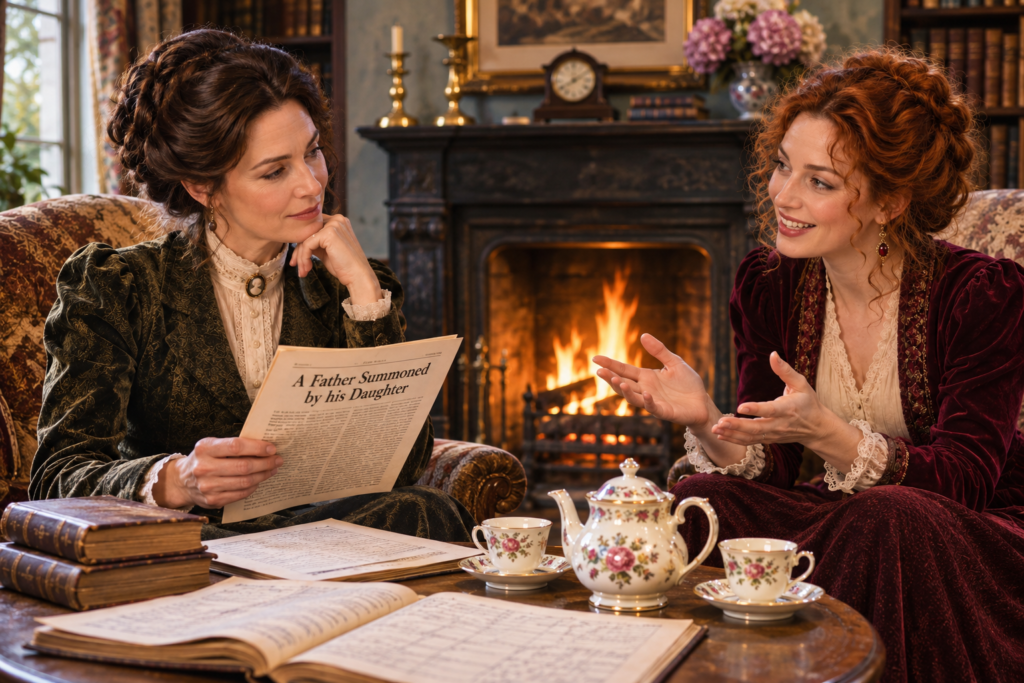
The newspaper cutting had been lying on Jemima Hartford’s desk for several days. It was not an especially long report, nor did it describe a particularly extraordinary crime. A man had broken a window, been summoned before the magistrates, admitted his guilt and been fined. By the standards of the Victorian press, it was a modest affair.
Yet Jemima had found herself returning to it repeatedly.
The report, published in the Whitstable Times on 17 October 1868, carried the intriguing heading A Father Summoned by his Daughter. The defendant was an elderly man named John Henderson, and the circumstances of the case had seemed, at first, reasonably straightforward.
John had been living with his daughter in Canterbury. He had come home intoxicated, broken a pane of glass at the back of her house and caused considerable distress. He was entirely dependent upon her for his living, yet had apparently been making her life difficult for some months. Worse, he had threatened her employment, the very means by which she earned her daily bread.
Jemima had initially imagined that a little genealogical investigation would establish the identity of the daughter and perhaps reveal something of the family’s circumstances. She had not anticipated quite how much time she would spend trying to disentangle the Henderson family.
Bella, who had been watching her sister consult yet another register, had begun to suspect that the case was becoming something of an obsession.
“You have been looking at that same family for days,” she remarked one afternoon. “Surely a broken window cannot require quite so much investigation?”
Jemima looked up from her papers.
“It is not the window, Bella. It is the people behind it.”
“Then I hope they are more interesting than their records suggest.”
“That,” said Jemima, “is precisely what I am trying to discover.”
—
Jemima turned the cutting towards her sister.
“Here is the original report. John Henderson, described as an aged man, was charged by his daughter with breaking a pane of glass at the back of her house in Notley Street, Canterbury. He admitted the offence. He also admitted being drunk, although he claimed that a small quantity of drink was enough to make him silly.”
Bella smiled faintly.
“A convenient explanation.”
“Perhaps. But there is more. His daughter told the magistrates that he had been a source of great annoyance for upwards of six months. He called her names and threatened to interfere with her employment.”
“And she was supporting him?”
“Entirely, according to the report. The magistrates were told that he was dependent upon her for his living.”
Bella considered this.
“So he was living under his daughter’s roof, relying upon her money, and making her life miserable.”
“That seems to have been the situation.”
“And when she complained, he suggested that she had encouraged boys to hoot at him?”
“Indeed. The police superintendent supported that assertion, although the daughter denied it. A constable also said it was perfectly true.”
Bella laughed.
“Well, at least the boys seem to have had a part in the proceedings.”
Jemima did not laugh quite so readily. She had been interested in the magistrates’ response. The chairman had expressed sympathy with the difficulties of such cases but had made it clear that provocation did not excuse the breaking of the window or the threatening behaviour. The daughter, he said, must be protected.
John was fined five shillings and costs, together with the damage, or faced seven days’ imprisonment. The money was subsequently paid.
“It is a small case,” Jemima observed, “but there is something rather uncomfortable about it. A daughter is keeping her elderly father, and he is threatening the very employment that enables her to do so.”
“Perhaps he thought that being her father gave him certain privileges.”
“Perhaps. But did it give him the right to make her life intolerable?”
Bella looked again at the newspaper.
“I wonder how old the daughter was.”
“That is one of the things I have not been able to establish with absolute certainty.”
—
Jemima had begun with the address. The house was at number 6 Notley Street, Canterbury, and the 1871 census had provided an interesting discovery.
There, in the household of John Berkley, a pipe maker, and his wife Frances, a midwife, was a young woman named Elizabeth Henderson, described as their stepdaughter. She was unmarried and employed as a teacher. A seventy-year-old John Henderson, a retired merchant born in Scotland, was also recorded as a visitor.
The coincidence seemed too strong to ignore.
“Then that is our John?” Bella asked.
“It is very likely. The age, the name, the Canterbury connection and the presence of Frances and Elizabeth all point in that direction. But I must be careful. The census was taken three years after the newspaper report, and it does not tell us precisely what happened in 1868.”
“And Frances?”
“I believe she was John’s daughter. We have her marriage to John Berkley in 1870, and her father’s name is given as John Henderson, an oil merchant.”
Bella leaned forward.
“So the old gentleman in the newspaper may have been Frances’s father, and Elizabeth’s grandfather.”
“That is the most convincing reconstruction I have been able to make.”
“And Elizabeth was living with her mother and stepfather?”
“Yes. She was a teacher, so she may well have been contributing to the household too. We cannot know precisely how the family divided its expenses, but it would be wrong to imagine that Frances was necessarily the only person supporting John.”
Bella studied the census notes.
“Then perhaps the newspaper’s daughter was Frances. Or perhaps Elizabeth?”
“That remains uncertain. The report does not name the complainant, and the relationships may have been described rather loosely. The magistrates may even have become a little muddled about which daughter was involved.”
“Which is rather inconvenient for anyone trying to investigate the matter fifty years later.”
“More than inconvenient,” Jemima replied. “It is one of the difficulties of historical research. We are dependent upon what someone thought worth recording at the time, and how accurately they recorded it.”
—
A few days later, the sisters walked together through Canterbury. Jemima had wanted to see Notley Street for herself, and Bella was happy to accompany her.
They found the street and stopped outside the address that had occupied so much of Jemima’s attention. The houses were modest terraces, standing close together, with the everyday appearance of a residential street.
Bella looked along the row.
“So this is where the unfortunate John Henderson was living?”
“Or at least where he was living by the time of the 1871 census. It is also the address associated with the household in the newspaper case.”
“And all our questions began with a broken window.”
“Quite.”
Bella looked at her sister.
“Have you discovered what happened to John before he arrived here?”
“Some of it. I have traced a possible family in London. In 1841, a John Henderson, an oil merchant born in Scotland, was living with his wife Frances and three children: John, Frances and Euphemia. I have found a baptism for Frances Nicholas Henderson in 1828 at St Luke, Finsbury. There is also a possible marriage for John Henderson and Frances Seymour at the same church in 1824.”
“And you are certain this is the same family?”
“No. It is a promising possibility, but not yet proved. The records are suggestive rather than conclusive.”
Jemima went on to explain how the family seemed to have scattered, how Frances’s mother had died in 1841, and how the older John appeared in later records with a woman named Sarah. A marriage in the early 1850s might connect them, while another record described John as a colours manufacturer rather than an oil merchant.
Bella listened with growing amusement.
“So he changed his occupation, possibly his wife, and eventually turned up in Canterbury?”
“When you put it like that, it sounds rather more dramatic than it is.”
“And what of Euphemia?”
“I believe she may have died in St Giles in 1863, aged thirty-two. I have not found a burial.”
“Then she has disappeared too?”
“Not disappeared. Merely become difficult to follow.”
Bella laughed.
“I think that is a rather polite way of describing it.”
Jemima smiled. “You may be right.”
They continued along the street, but Bella returned to the question that had first interested her.
“Whatever became of Euphemia, does it alter the story of the old man and his daughter?”
“No,” Jemima admitted. “Not really. It helps us understand the family, but it does not change what happened in that house.”
“Then perhaps you have been looking too far backwards.”
Jemima considered this. It was not an unreasonable observation.
—
That evening, the sisters settled beside the fire with tea. Jemima had gathered together the various notes she had made during her investigation: census entries, baptisms, marriages, possible deaths and the newspaper report itself.
Bella glanced at the pile.
“Tell me honestly. Have you enjoyed this case?”
“I have enjoyed parts of it.”
“That is not quite the same thing.”
“No,” Jemima conceded. “It has been a frustrating investigation. Every time I have thought I had established one connection, another record has raised a fresh question. Names are inconsistent, ages vary, occupations change, and people are sometimes described in ways that are not especially helpful to us.”
Bella picked up one of the notes.
“There is that business of Frances’s daughter being Elizabeth Henderson, while another record gives her a father named Anderson.”
Jemima nodded.
“That has been one of the more puzzling aspects. Elizabeth’s baptism records her father as John Anderson, a carpenter. Later, her marriage records give her father’s name differently. In 1891, when she married Thomas Foulds, the entry appears to name James Anderson, also a carpenter.”
“John or James?”
“John or James. Anderson or Henderson. We cannot be certain. I have considered whether Frances was unmarried when Elizabeth was born, and whether the later descriptions were attempts to make the circumstances more acceptable. But that is a theory, not a conclusion.”
Bella put down the paper.
“How very inconvenient of them not to have left us a proper explanation.”
“People rarely conduct their lives with the convenience of future genealogists in mind.”
“Perhaps they should.”
Jemima laughed.
She explained that she had searched for a marriage between Frances and an Anderson, without finding one. She had also found a possible James Anderson, a Scottish carpenter in London in 1851, but there was no proof that he was Elizabeth’s father.
“And so,” Bella said, “we have a John, possibly a James, an Anderson, perhaps a Henderson, and a daughter whose parentage is not quite clear.”
“When you put it like that, it sounds hopeless.”
“It sounds like a very curious case.”
“That is true.”
Jemima looked down at her papers. She had spent a considerable amount of time trying to make the various records agree, and she was beginning to accept that they might never do so entirely.
There was a temptation in family history to believe that if one searched long enough, every question would eventually find its answer. But the records did not always permit such satisfaction. Sometimes the evidence simply ran out.
—
Bella returned to the newspaper cutting.
“I still think the most interesting part is not the family tree. It is the question of why the daughter was expected to support him in the first place.”
Jemima looked up.
“An elderly parent without sufficient means would naturally have looked to his children for assistance. There was a strong expectation of family duty, although the practical circumstances varied enormously.”
“But what if the parent was difficult? What if he drank, quarrelled, and made the home miserable?”
“Then the duty became considerably more complicated.”
Bella thought for a moment.
“Would anyone have expected a son to put up with the same behaviour?”
“Possibly. But in this case, it was a daughter who was providing the support, and she was earning her own living. The newspaper makes a point of telling us that John threatened her employment.”
“Which seems particularly ungrateful.”
“It does. He was dependent upon her, yet apparently willing to jeopardise the means by which she supported him.”
Bella looked into the fire.
“Perhaps he believed that because she was his daughter, she had no choice.”
“That is quite possible. But being a parent does not necessarily entitle one to unlimited obedience or indulgence from one’s adult children.”
“And what of the granddaughter? Elizabeth was a teacher. Did she have an obligation to support her grandfather too?”
“We cannot tell how much she contributed, if anything. But she was part of the household, and it is quite possible that her earnings helped to maintain it. The newspaper does not give us that detail.”
Bella shook her head.
“It is a curious reversal, isn’t it? The older man, who might once have been expected to provide for his family, is now dependent upon the women in it. Yet he appears to have little regard for their comfort.”
“Perhaps that is the heart of the matter,” Jemima replied. “We often speak of the duties children owe their parents, but we do not always consider the responsibilities parents owe their children, even when those children are grown.”
Bella smiled.
“I think I should have liked to tell John Henderson that.”
“I suspect he would not have been particularly receptive.”
“Then I should have told him rather loudly.”
Jemima laughed, and the conversation drifted for a while.
—
Later, as Bella prepared to leave, she glanced once more at the newspaper cutting.
“So, after all this, what have we discovered?”
Jemima took a moment before answering.
“We have probably identified the elderly John Henderson as the father of Frances Berkley and the grandfather of Elizabeth Ann. We have found a household in Canterbury in which he was living with his daughter and granddaughter. We know that, in 1868, he was dependent upon a daughter who had brought a complaint against him after a period of difficult behaviour. We know that the magistrates considered her entitled to protection.”
“And we do not know which daughter brought the complaint.”
“No. Nor can we be certain of every detail of the family history. We may never establish the identity of Elizabeth’s father, or trace every member of the Henderson family to the end of their lives.”
Bella looked at the many pages on the desk.
“Then all those hours of searching have not given you all the answers.”
“No,” Jemima said. “But they have given us a little more understanding.”
She gathered the papers into a neat pile. The temptation to continue searching was still there. She could return to the registers, try another spelling, another parish, another census. There were always more possibilities, and the missing burial of Euphemia Henderson still niggled at her.
But she was beginning to recognise the point at which further research ceased to illuminate the original question.
“We must remember,” she said, “that the purpose of our work is not to account for every entry in every register. It is to understand, as far as the evidence permits, the lives behind them. Sometimes the records leave us with more questions than answers. That does not mean the investigation has been without value.”
Bella picked up her gloves.
“Then perhaps we should be satisfied with having discovered that a broken window can tell us quite a lot about family obligations.”
“Not quite everything,” Jemima replied.
“No. But enough to make a story.”
And with that, Bella left her sister to her papers.
Jemima looked once more at the small newspaper cutting. John Henderson had been an old man, dependent upon his daughter, and apparently difficult to live with. The magistrates had heard the complaint, imposed a fine and sent the family back to their lives.
The newspaper had recorded only a few lines. The census had supplied a household. The parish registers had offered fragments of a family history, some of which fitted together and some of which stubbornly refused to do so.
There would always be missing pieces.
But perhaps the most important question had never been whether every member of the Henderson family could be identified. It was whether an adult child, simply by virtue of being a daughter, was expected to sacrifice her peace, her livelihood and her independence to a parent who made those sacrifices difficult to bear.
On that question, the little report from 1868 had left them with rather more to think about than a broken pane of glass.