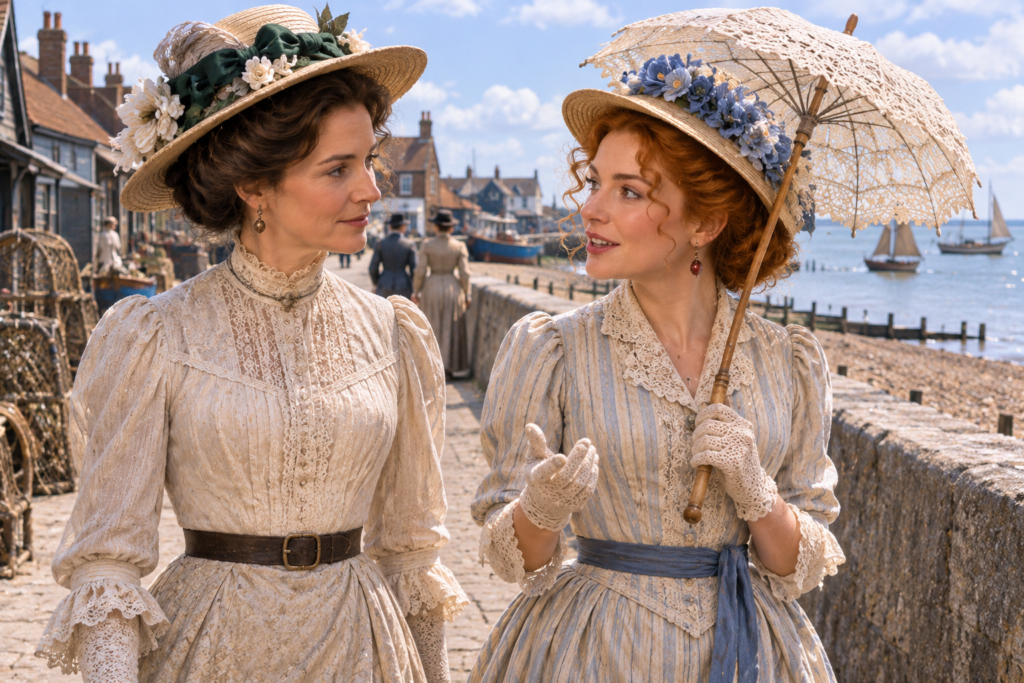
Jemima and Bella had decided to spend the afternoon at Whitstable. They had taken the train from Canterbury that morning, enjoyed a leisurely lunch and were now walking along the sea wall, taking advantage of the fine weather.
Bella, dressed in a light summer walking dress and carrying a small parasol, was enjoying the freedom of being away from the city.
“Do you know, Jemima, I think we ought to make a habit of these excursions. We spend far too much time indoors. You with your newspapers and family registers, and I with my rehearsals and theatrical engagements. One might almost forget that there is a world outside.”
Jemima smiled.
“I am perfectly aware of the world outside, Bella. I merely find that people leave rather more interesting traces of themselves in newspapers than they do on a summer afternoon promenade.”
“That, my dear sister, is precisely what I mean. You cannot resist turning even a pleasant walk into an opportunity for investigation.”
“Not at all. Today I have brought no newspaper cuttings, no family trees and no collection of certificates. I have only my notebook.”
Bella laughed.
“Only your notebook! Then I suppose we are safe.”
They walked on for a little while, listening to the waves breaking against the shore.
“I have been thinking about the little boy,” Jemima said eventually.
“Which little boy?”
“George Hatson. The child whose death I mentioned to you.”
“Ah, yes. The boy killed when the roof of his home fell in. I remember now. Three years old, wasn’t he?”
“Three years old. The account appeared in the Whitstable Times on Christmas Day, 1869.”
Bella shook her head.
“How dreadful. To think of a little child being put to bed one evening and never waking again.”
“It was a terrible accident. His father told the inquest that the child had been put to bed between five and six o’clock, in a room on the second floor. Shortly before ten, he was awakened by a noise. The roof had fallen in, and bricks and tiles had come down upon the child.”
“And his father found him?”
“Yes. He removed him as quickly as he could, but the child was already dead.”
Bella was silent for a moment.
“Did the father know that the roof was unsafe?”
“Apparently not. He told the inquest that he had no idea it was in such a state of repair as to be liable to fall. The surgeon confirmed that the injuries were consistent with the accident as described, and the jury returned a verdict of accidental death.”
“Well, I should hope they did not blame the poor father.”
“Neither should I. But it does leave us with a question.”
Bella glanced at her sister.
“Which is?”
“Who was responsible for the condition of the house?”
They had reached a point where the sea wall afforded a particularly good view of the harbour. Bella paused to look at a fishing boat making its way towards the shore.
“Surely the owner of the property?” she asked. “If a man lets a house to a family, he must surely be responsible for ensuring that it is safe.”
“One might reasonably expect that to be so. But the law is not quite as simple as that.”
Jemima took her notebook from her pocket, although she made no attempt to open it.
“I own the house in Canterbury, as you know. Edward purchased it for us, and I have always regarded its maintenance as part of my responsibility. I know what it costs to keep a house in good order. Roofs need attention, gutters become blocked, windows require repair and occasionally something more substantial must be done.”
“Yes, but you have the means to arrange such things.”
“Precisely. And that is where the difficulty arises. A family earning its living through agricultural labour may have very little left after paying rent, buying food and clothing their children. They may be perfectly aware that a house requires attention but have neither the money nor the authority to undertake substantial repairs.”
“Especially if the house belongs to somebody else.”
“Quite so.”
Bella looked towards the land beyond the harbour.
“Do we know whether the Hatson family rented their cottage?”
“No. The newspaper does not tell us. It describes the father as an agricultural labourer living near Whitstable, although technically in the parish of Blean. I have no information about the ownership of the property.”
“Then perhaps we should find out.”
“That is certainly one of the things I intend to do. If we can identify the family and locate their home, we may be able to establish something about the property and its owner.”
Bella considered this.
“But suppose the house was rented. Would the landlord not have been obliged to repair the roof?”
“Not necessarily. The obligations depended upon the arrangement between landlord and tenant. There was no universal rule requiring every landlord to undertake every repair. Some agreements placed particular responsibilities upon the owner; others did not. And the tenant might have been expected to undertake certain ordinary repairs.”
“How very convenient for the landlord.”
Jemima smiled at her sister’s indignation.
“Perhaps. But we must be fair. We do not know the terms of any agreement, and we do not know whether the owner was aware of the condition of the roof.”
“Still, surely somebody ought to have noticed?”
“That is what troubles me. A roof does not ordinarily collapse without some underlying weakness. There may have been damage, decay or a failure of the structure. The newspaper mentions that the wind was blowing very high, but it does not tell us whether the storm alone caused the collapse or merely exposed an existing weakness.”
Bella looked towards the houses along the shore.
“I suppose there must have been many cottages in a similar condition.”
“Indeed. The homes of agricultural labourers and other working people were often very modest. Some were old buildings, some poorly maintained, and some overcrowded. A family might be grateful to have a roof over its head, even if that roof was far from satisfactory.”
“But nobody could reasonably expect the roof to fall in on their children.”
“No. And that is the distinction I think we must remember. Being poor does not mean that a family should have to accept dangerous accommodation.”
They resumed their walk.
Bella was quiet for a few moments before speaking again.
“Do you think things are improving?”
“In some respects, yes. There is a growing recognition that the condition of people’s homes is a matter of public concern, not merely a private arrangement between landlord and tenant. Parliament has passed legislation giving local authorities greater powers to address insanitary housing and other dangers to public health.”
“Would that have helped the Hatson family?”
“Possibly, although I would not wish to suggest that the legislation could necessarily have prevented this particular tragedy. Its effectiveness depends upon local authorities having the means and determination to act.”
Bella shook her head.
“It seems to me that there is a great difference between passing a law and making certain that people benefit from it.”
“An observation with which I entirely agree.”
They had now reached a quieter stretch of the sea wall. The sun was beginning to lower, and the water had taken on a softer, silvery appearance.
Bella turned towards her sister.
“Do you know what I find most disturbing? The father must have gone to bed that night believing that his children were safe. He had put them to bed as any father would. He could hardly have imagined what was about to happen.”
Jemima nodded.
“Yes. And I think we must resist the temptation to judge him. The evidence given at the inquest suggests that he was as shocked as anybody. He could not have been expected to know what he had no reason to suspect.”
“Then perhaps it is the owner we ought to be looking for.”
“Perhaps. But first we need to know who the owner was, whether the property was rented and whether there had been any previous complaint about its condition.”
Bella smiled.
“I see that your notebook will not remain empty for very long.”
“I am afraid not.”
“And what of the family? Will you be looking for them?”
“Naturally. I should like to know what became of George’s parents and whether he had brothers and sisters. A tragedy of this kind does not end with the inquest. The family must have continued living with the consequences.”
“Perhaps they moved away.”
“Perhaps. Or perhaps they remained in the neighbourhood. We shall have to discover what the records tell us.”
Bella slipped her arm through her sister’s.
“Well, I hope you find something. But I should like to think that, wherever they went, the family found a safer home.”
“So should I, Bella.”
They walked on towards the harbour, where the fishing boats were beginning to return and the sound of voices carried across the water.
After a few moments Bella spoke again.
“Jemima?”
“Yes?”
“I think I shall be looking at the roofs of houses rather differently from now on.”
Jemima laughed.
“Then our afternoon has not been entirely wasted.”
“Not at all. And perhaps next time we come to Whitstable, we might investigate something a little less depressing.”
“I shall do my best.”
“Something involving a missing inheritance, perhaps?”
“That sounds considerably more like you, Bella.”
The sisters continued along the sea wall, their conversation turning to lighter matters as the afternoon drew towards its close.
But Jemima had already made a mental note of the name Hatson.
A little boy had died in a terrible accident, and a newspaper had devoted a few paragraphs to his passing. The inquest was over, the verdict recorded, and the matter apparently concluded.
Yet Jemima was not entirely satisfied.
There was still a family to discover, a home to locate and a question about responsibility that deserved rather more attention than a few lines in a newspaper.