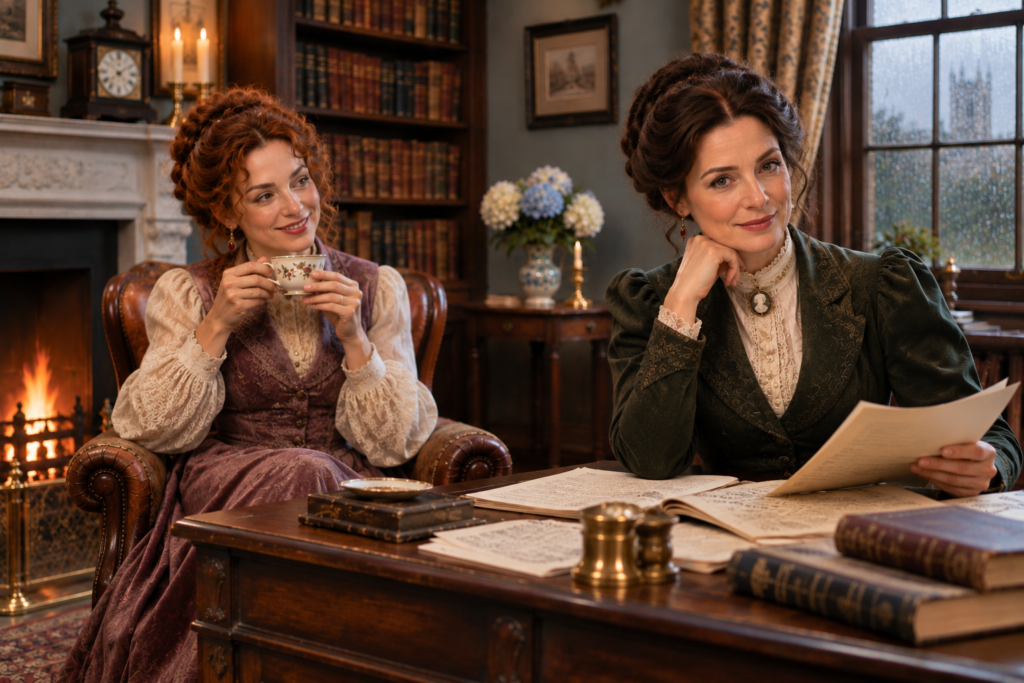
The afternoon was drawing in over Canterbury, and a pale autumn light fell across the papers spread over Jemima Hartford’s writing desk. Outside, the Cathedral bells had just struck four. Bella Mead, who had arrived earlier that afternoon, was sitting by the fire with a cup of tea, turning over a newspaper cutting that her sister had placed before her.
It was a small report, published in the Whitstable Times on 21 June 1873. At first glance, it seemed an unremarkable account of a maintenance hearing at the local magistrates’ court. Yet Jemima had spent several days following the people named in it, and the story had become considerably more complicated than the few lines of newspaper print suggested.
“Well,” Bella said, putting down the cutting, “I think I understand why you have been so absorbed in this. It is a sad business.”
“It is,” Jemima replied. “And rather more than a simple dispute about a maintenance payment. I believe we have uncovered something of the life of the young woman who brought the complaint, and of the little girl at the centre of it.”
She drew a sheet of paper towards her.
“Her name was Catherine Andrews. In 1873 she summoned a man named George Henry Jennings, asking that he be required to contribute towards the maintenance of her illegitimate child.”
Bella looked up.
“An unmarried mother, then. And the father denied responsibility?”
“He did indeed. But let me explain how the circumstances arose.”
Jemima read from her notes. George Jennings had been married to Jane Andrews, Catherine’s sister. Jane had become ill and died in June 1872. During her sister’s illness, Catherine had come to stay in the Jennings household. After Jane’s death she remained there. According to the evidence given at the hearing, Jennings had seduced Catherine about a month after his wife’s death.
“The child was born on 15 April 1873,” Jemima continued. “Catherine brought the proceedings in June, and Jennings denied that he was the father. He called no witnesses in his defence.”
“And what did the magistrates decide?”
“They ordered him to pay two shillings and sixpence each week from the date of the child’s birth. He was also required to contribute ten shillings towards the confinement expenses, together with fourteen shillings and sixpence in costs.”
Bella shook her head.
“Two shillings and sixpence a week. It sounds a very small sum to support a child.”
“It was not generous,” Jemima agreed. “But it was an enforceable contribution, and presumably better than Catherine might have received had she been left entirely to her own resources.”
“Still, I find it extraordinary that a man could deny his own child and leave the mother to establish her claim before a magistrate.”
“That was precisely the purpose of such proceedings,” Jemima replied. “The law provided a means by which a mother could seek maintenance from the alleged father. But she had to bring her case, provide evidence and persuade the court.”
“And meanwhile the child had already been born.”
“Indeed.”
Bella picked up the newspaper cutting again. “There is another aspect which troubles me. Catherine had been living in her sister’s home. Jane was dead, and Catherine had presumably been helping to care for her while she was ill. Then she found herself pregnant by her dead sister’s husband. It must have been a very difficult situation.”
“We cannot know exactly what passed between them,” Jemima said carefully. “The newspaper uses the word ‘seduced’, but it gives us very little about Catherine’s own account of the relationship beyond the evidence at the hearing. We must be careful not to imagine more than we know.”
Bella nodded, although her expression remained troubled.
“But we do know that Jennings denied the child was his.”
“Yes. And we know that the magistrates ordered him to pay.”
Jemima turned to another document.
“There was a difficulty when I first began looking for Catherine. I found the Andrews family in the census returns, but the children and their relationships were not immediately clear. In particular, there was a little boy named William in the household of Catherine’s married sister, Sarah Caroline, and her husband Alfred Holness. For a time I wondered whether he might have been Catherine’s child.”
“And was he?”
“No. I eventually established that William was Sarah Caroline’s son. His birth certificate names Sarah as his mother. It was an important distinction, because it meant that we were not confusing two different branches of the family.”
Bella smiled faintly. “I can imagine you becoming quite determined to settle that.”
“Quite determined,” Jemima admitted. “But once William was accounted for, I returned to the child named in the newspaper report. I suspected that she might be Lucy Emma Andrews, born in Canterbury in the second quarter of 1873.”
“And you found her?”
Jemima placed a further document on the desk.
“This is her birth certificate. It gives her date of birth as 15 April 1873, exactly as reported in the newspaper. Her mother’s name is Catherine Andrews, and the address is Broad Street, Saint Paul, Canterbury. There is no father’s name entered.”
Bella leaned forward to examine the certificate.
“So Lucy was the child.”
“Yes. The dates and details match, and the certificate names Catherine as her mother. We can now be certain of that connection.”
For a moment Bella said nothing. She looked again at the empty space where a father’s name might have appeared.
“It is a curious thing,” she said at last. “The father is absent from the certificate, absent from the child’s early family records, and yet he was the very person whom Catherine had to take to court to obtain a contribution towards her daughter’s upbringing.”
Jemima regarded her sister thoughtfully.
“That is one of the reasons I wanted to investigate the case. The newspaper gives us a few lines about the proceedings, but the records allow us to follow what happened afterwards.”
She showed Bella the 1881 census entry. Lucy, then aged seven, was living at Church Wood Farm with her maternal grandparents, William and Amy Andrews. She was recorded as their granddaughter. Another grandchild, William H. Andrews, was also in the household.
“So her grandparents were bringing her up?” Bella asked.
“At least by 1881, she was living with them. We cannot say precisely when she went to stay there, or whether she had lived with them continuously from infancy. But they clearly had a place in her childhood.”
“I am glad of that,” Bella said. “Whatever the circumstances of her birth, she was not without family.”
“No. And I think we should remember the part grandparents could play in such situations. Their help might be essential to a young mother who had little money and needed to earn her living. But we should not assume that every family was willing to offer it. In Catherine’s case, the census gives us evidence that her parents took Lucy into their home.”
“What became of Catherine?”
“She did not appear in the same household in 1881. I found her working as a monthly nurse at the home of another Andrews family in St Dunstan. She was unmarried and earning her living.”
“A monthly nurse,” Bella repeated. “So she was looking after mothers and babies?”
“Precisely. It was a respectable occupation, and one which required practical experience. By 1891 she was again recorded as a monthly nurse, living with her widowed father in Canterbury.”
Bella looked towards the window.
“There is something rather remarkable about that. She had been through a difficult experience herself, yet she made her living caring for other women and their children.”
“It is possible that her own experience gave her some understanding of the anxieties of motherhood,” Jemima replied. “But we cannot know whether that influenced her choice of work. What we can say is that she appears to have supported herself through nursing.”
Bella returned to the papers.
“And Lucy? Did she marry?”
Jemima hesitated before answering.
“No. I found her death registration in 1890. She died in August, aged just seventeen.”
Bella’s expression changed.
“Seventeen?”
“Yes. I obtained the death certificate. She was living at Harbledown and was described as a domestic servant.”
“And the cause?”
“Diarrhoea, of four days’ duration, with general debility.”
Bella looked down at the certificate. “Only four days. How dreadful.”
“It may have been an acute intestinal illness, but the certificate does not give us a specific diagnosis. We should not assume that it was typhoid or any other particular disease. We have only the cause as recorded by the medical practitioner.”
Bella read the final column of the certificate again.
“Who reported her death?”
“Her mother. Catherine Andrews.”
Bella looked up sharply.
“Was she there?”
“Yes. The certificate specifically says ‘mother, present at the death’.”
The room was quiet for a moment. The fire shifted and crackled in the grate.
“So Catherine was with her,” Bella said softly. “After all those years.”
“Yes. Lucy had been living with her grandparents when she was seven. We do not know exactly how often she saw her mother, or what their relationship was like, but Catherine was there when her daughter died.”
Bella put the certificate down carefully.
“I find that the saddest part of all. You began with a young woman bringing a case against a man who denied responsibility for her child. You have followed that child through the census, and now we know that she died before she had reached adulthood. And Catherine was beside her.”
Jemima nodded.
“It is worth remembering that the records do not tell us everything. They do not tell us whether Lucy was happy, whether she and Catherine were close throughout her childhood, or what she hoped to do with her life. But they do tell us that she existed, that she was Catherine’s daughter, and that her mother was present at her death.”
Bella rose and walked towards the fireplace.
“I should like to say something about the father,” she said. “Not only Jennings, but men generally who believe that a child becomes someone else’s responsibility simply because they have no intention of marrying the mother.”
Jemima gave her a small, knowing smile.
“I thought you might.”
“I cannot see why a man should be permitted to enjoy all the pleasures of fatherhood, and then disclaim every responsibility for its consequences. If the child is his, surely its maintenance is his concern, whether he chooses to marry the mother or not.”
“That is a perfectly reasonable view,” Jemima said. “And it is precisely the principle behind the maintenance proceedings. The child should not be deprived of support simply because her parents are unmarried.”
“But the mother bears so much more than the financial burden. She bears the judgement of society, the practical difficulties, and often the responsibility of bringing up the child. The father can simply walk away.”
“Sometimes,” Jemima replied. “Though in this instance Catherine did not allow the matter to rest. She went to the magistrates and obtained an order.”
Bella turned back towards her.
“And then her parents helped to raise Lucy. It seems that the grandparents, rather than the father, became the dependable figures in the child’s life.”
“That may well be so. We must not overlook the contribution of William and Amy Andrews. Without their help, Catherine might have found it much harder to maintain her employment and provide for Lucy.”
Bella returned to her chair.
“I wonder what happened to George Jennings.”
“He remarried in 1874, to Susan Reynolds, and later moved with his family to Broadstairs. He had a number of children with his second wife.”
“Broadstairs!” Bella exclaimed. “Where we used to spend our summers as children.”
“Indeed. I noticed the connection too. The family was living there by 1881.”
Bella smiled briefly at the memory, then her expression became serious again.
“So he made another family for himself, while Lucy was being brought up by her grandparents.”
“That is what the records show, although we cannot know what contact, if any, he had with Lucy after the hearing. Nor can we say whether he continued to make the weekly payments. The newspaper records the original order, but we have not found evidence of what happened to those payments later.”
Bella shook her head.
“There are so many things we cannot know.”
“That is always the difficulty with these cases,” Jemima said. “The documents reveal certain facts, but they leave much of the human story hidden. We must distinguish between what we can establish and what we can only imagine.”
She gathered the certificates together, placing Lucy’s birth and death records side by side.
“Yet I think we have achieved something. When I first read the newspaper report, Catherine Andrews was simply the complainant in a maintenance case. Now we know her daughter’s name, where she was born, where she lived as a child, what work her mother undertook, and how Lucy died.”
“And we know that Catherine was with her at the end,” Bella added.
“Yes.”
Bella looked once more at the birth certificate.
“It is strange, Jemima. A child can be born into the world with her father’s name missing from the register, and then disappear from the family story altogether. Had you not found that newspaper report, Lucy might have remained merely another name in a census.”
“Perhaps. The newspaper has allowed us to make the connection, and the certificates have confirmed it.”
Jemima folded the newspaper cutting and placed it in her case file. On the cover she wrote:
Catherine Andrews and the Child of Broad Street — 1873
Then, beneath it, she added the name of the child whose short life had taken her on such a long investigation:
Lucy Emma Andrews, 1873–1890.
Bella watched her sister close the file.
“I think there is a great deal here for us to remember,” she said. “The injustice of illegitimacy, the question of a father’s duty, the kindness of grandparents, and the courage of a woman who earned her own living. And, above all, the loss of a young girl who had barely begun her life.”
Jemima placed the file among the others on her desk.
“Yes, Bella. And perhaps the most important thing is that we should not allow Lucy to be remembered only as an illegitimate child. She was a daughter, a granddaughter and, for a short time, a young woman making her own way in the world.”
Outside, the last of the daylight was fading over Canterbury. Bella sat quietly beside the fire, while Jemima turned to her next collection of papers. The case was closed, but the two sisters had found in it something more enduring than the details of a magistrates’ order: the story of a mother and daughter whose place in the family history had almost been lost.