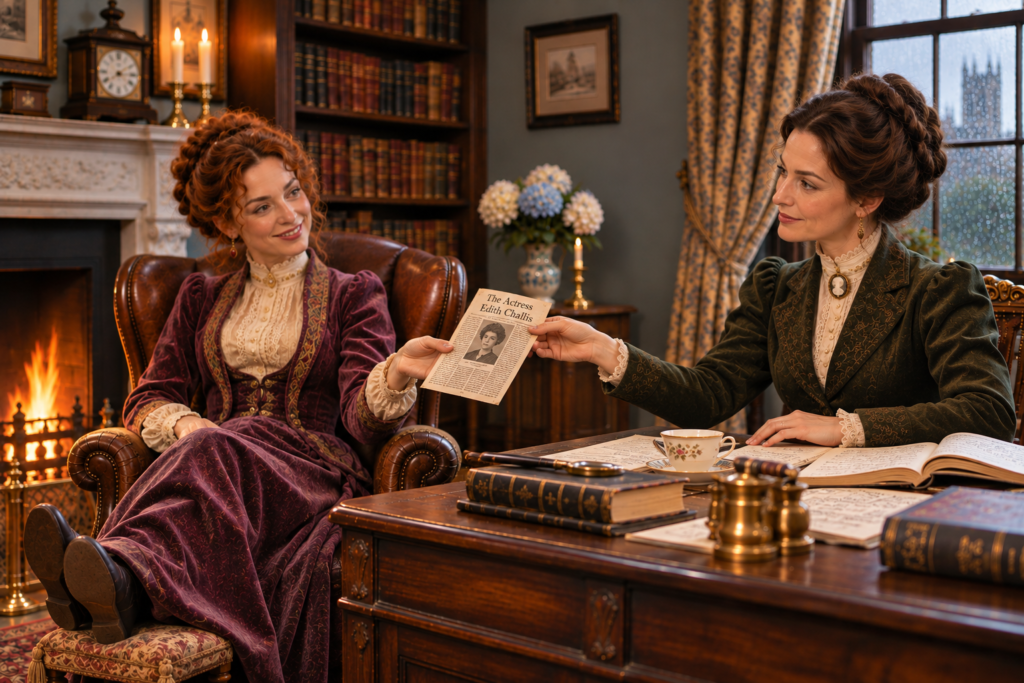
Canterbury, an autumn evening in the 1890s.
The fire had settled into a comfortable glow, and Bella was sitting in the armchair nearest to it, her feet extended towards the hearth. Jemima, at the writing desk, was sorting through a small pile of newspaper cuttings. She had been unusually quiet for the past half-hour, occasionally making a note in one of her books.
At last she picked up a yellowing newspaper clipping and turned towards her sister.
“Bella, I have a question for you.”
Bella looked up from her tea.
“That sounds ominous. Have I done something?”
“Not that I know of. I was wondering whether you would give up the stage if you were offered two thousand pounds a year for the rest of your life.”
Bella stared at her.
“Two thousand pounds a year?”
“Indeed.”
“Without having to perform another night?”
“Without having to perform another night.”
Bella considered the matter for a moment, then shook her head.
“No.”
Jemima raised an eyebrow. “Not even for two thousand pounds a year?”
“Not even for three thousand. I might agree to take a holiday, naturally. A very long holiday, perhaps. But give up the theatre altogether? Good heavens, no. What should I do with myself?”
“You might devote yourself to charitable works, travel, or the improvement of your mind.”
“I already improve my mind, thank you, and I should certainly travel. But I cannot imagine being content to sit in a drawing room merely because I could afford to do so. Besides, I rather enjoy earning my own living.”
“I thought you might say that.”
“Why do you ask?”
Jemima held up the cutting.
“I came across this report in the Whitstable Times, dated August 1872. It concerns an actress called Miss Edith Challis, who was apparently so fortunate as to inherit a considerable fortune from an elderly lady.”
Bella put down her teacup.
“An actress inheriting a fortune? Now that is a story worth hearing.”
“According to the report, Miss Challis was travelling some months previously when an elderly lady became ill. Edith was very attentive to her during the journey, and the lady subsequently died. In gratitude for her kindness, she left the actress an income of two thousand pounds a year for life.”
“And Miss Challis promptly retired?”
“Precisely. The newspaper says that, in consequence of this inheritance, she was leaving the stage.”
Bella gave a little laugh.
“Well, I suppose I cannot blame her for accepting the money. But I should have thought she might have continued to perform occasionally. Two thousand pounds a year would provide a very comfortable existence, but I cannot see why it should require one to abandon everything one enjoys.”
“Perhaps she had grown tired of the theatre.”
“Or perhaps she had never enjoyed it very much in the first place.”
Jemima smiled.
“You are inclined to judge your fellow actresses rather harshly.”
“Not at all. I merely find it difficult to imagine anyone who has experienced the excitement of an audience, the anticipation before the curtain rises, and the satisfaction of a successful performance willingly giving it all up. But then, I suppose we are not all alike.”
Jemima looked down at the clipping.
“There is rather more to the story than that.”
“Oh?”
“I found references to Edith Challis in several American newspapers. She was evidently well known in both London and New York. She had appeared in a production of Lalla Rookh at the Grand Opera House in New York in the spring of 1872.”
“Before the inheritance?”
“Yes. And there is a rather interesting report from November of that year. She was appearing at Wallack’s Theatre in New York as Cynisca in Gilbert’s Pygmalion and Galatea.”
Bella laughed.
“Then she had not retired after all!”
“Not quite. But the most curious part is that Edith herself appears to have denied the inheritance story.”
Bella leaned forward.
“She denied it?”
“An American publication, the Woman’s Exponent, printed her denial in November 1872. It reported that she had been made heiress to an elderly lady, but said that Miss Challis declared the story was untrue.”
“What did she say?”
Jemima consulted her notes.
“She made a rather pointed observation about some of her English relatives. Apparently, certain pious relations who had ceased to recognise her after she entered the theatrical profession had suddenly become most sociable when they heard that she had become a woman of means. They were inviting her to stay with them.”
Bella burst out laughing.
“Oh, I like her!”
“I thought you might.”
“Imagine it! They had disapproved of her profession, but the moment they believed she was wealthy, they were prepared to welcome her back into the family. I hope she gave them a very polite refusal.”
“She certainly seems to have had a sense of humour about it.”
“But why should anyone invent such a story?”
“That is what I wondered. It was reported in several newspapers, both in England and America. Some repeated it as fact, others suggested it was untrue. One American paper even declared that the story had proved true, while another stated that it had turned out to be entirely false.”
Bella shook her head.
“Perhaps someone thought it amusing to pretend that an actress had suddenly become rich. Or perhaps someone wished to embarrass her.”
“Possibly. We cannot establish who originated the story. The New York Tribune attributed it to the London theatrical newspaper, The Era, although I have not managed to find the original report.”
“Do you suppose Edith herself might have started it?”
Jemima looked at her sister thoughtfully.
“That is an interesting suggestion.”
Bella smiled.
“Think about it. An actress who is tired of being judged by her relatives might enjoy letting them believe she has suddenly acquired a fortune. They would all come flocking back, and she would have the satisfaction of discovering precisely how much their affection was worth.”
“A somewhat elaborate experiment in human nature.”
“Not an entirely unsuccessful one, by the sound of it.”
“Although there is no evidence that Edith invented the story. We must be careful not to turn an attractive possibility into a fact.”
Bella sighed.
“You do have a way of spoiling a perfectly good theory, Jemima.”
“I prefer to distinguish between what we know and what we merely suspect.”
“And I prefer to enjoy a good story. Fortunately, we have each other.”
Jemima laughed and reached for another paper.
“There is also some evidence of her continuing career in London. In April 1875 she appeared at the St James’s Theatre in a comedy by W. S. Gilbert called Tom Cobb; or, Fortune’s Toy.”
“Gilbert! What part did she play?”
“Matilda O’Fipp, the daughter of an Irish colonel. The review describes her as somewhat unstable in her Irish brogue, although it adds that the company as a whole had something to do and did it well.”
Bella pulled a face.
“An actress is never forgiven a doubtful accent. I wonder whether the reviewer had ever heard an Irishwoman speak.”
“I suspect not. Nevertheless, it establishes that Edith was still appearing on the London stage in 1875, three years after the supposed retirement.”
“And did she continue for long?”
Jemima turned over a sheet of paper.
“Her career seems to have taken her back and forth between England and America. An obituary published in December 1883 gives a rather fuller account. It mentions her early appearance at Niblo’s Theatre in New York, in a play called After Dark, and later engagements in London at the Haymarket, the Court and the St James’s.”
“She must have had a considerable career.”
“She did. The obituary describes her as a favourite actress, with a handsome face and a comely figure. It mentions appearances in The Two Roses, Money, Our American Cousin and several other productions.”
Bella looked pleased.
“I should like to have known her. She sounds rather spirited.”
“She may well have been. And there is one final detail.”
Jemima paused, looking at the clipping in her hand.
“Edith died in December 1883.”
Bella’s expression changed.
“Died? How old was she?”
“We do not know. The obituary says that she died on Wednesday, the fifth of December, after a painful illness of long duration. She was living at an address in Brownlow Street, Liverpool.”
Bella sat back.
“How sad. And she was still acting?”
“She had appeared at the Prince of Wales Theatre in Liverpool in August of that year, in Still Waters Run Deep. The newspaper review mentions her performance.”
“So she continued working almost until the end.”
“It would seem so.”
Bella was silent for a moment.
“Then the story of the two thousand pounds was doubly unfortunate. First, because it appears not to have been true, and secondly because she did not have a long retirement ahead of her after all.”
“Indeed. I have tried to discover more about her private life, but so far without success. I cannot find a convincing birth record, nor a death registration under the name Edith Challis. It may have been her professional name.”
“Surely someone must have known who she really was?”
“One would think so. But the theatrical records consistently use Edith Challis, and the obituary gives us very little about her family. I have even examined the census entries for the street in Liverpool where she was said to have lived, but nothing has yet revealed her identity.”
Bella shook her head.
“How strange. Her name appeared on playbills, in reviews and in newspapers on both sides of the Atlantic, yet we know so little about the woman herself.”
“That is what makes the case so intriguing. Her public life was recorded in considerable detail, but her private identity remains elusive.”
Bella reached for her teacup again.
“Well, I hope she enjoyed her career. And I hope she did not spend too much time regretting the fortune she never received.”
“I wonder whether she ever regretted not having the money.”
“Perhaps. But I doubt she regretted being an actress.”
Jemima looked at her sister.
“You are quite certain you would not give up the stage for two thousand pounds a year?”
“Quite certain. Though I should be delighted to have the two thousand pounds as well.”
Jemima laughed.
“I thought that might be your answer.”
Bella rose and crossed to the desk, where she examined the old portrait Jemima had placed beside the papers.
“Is this her?”
“Yes. A photograph taken in the late 1860s, I believe. She looks very young.”
Bella studied the face of the woman in the straw hat, her gaze turned slightly away from the camera.
“She has a rather thoughtful expression. I wonder what she was thinking.”
“Perhaps she was contemplating her next engagement. Or perhaps she was wondering whether the photographer would ever finish arranging his camera.”
Bella smiled.
“Or perhaps she was thinking that two thousand pounds a year would be a very nice thing to have.”
Jemima gathered the papers together.
“Whatever she thought, we shall probably never know. I fear we have reached the end of what the evidence can tell us.”
Bella gave the portrait one last look.
“Then let us at least remember her as an actress, Jemima. Not as the woman who supposedly inherited a fortune, but as the woman who went on working, travelling and performing.”
“I think that is a very fitting conclusion.”
Bella returned to her chair.
“And if anyone should ever leave me two thousand pounds a year, I shall be sure to tell you before I decide what to do with it.”
“I shall look forward to hearing your decision.”
“Though I warn you, I may take a little longer than Edith Challis.”
The sisters laughed, and Jemima carefully slipped the portrait back into its paper sleeve.
The fortune had proved a newspaper mystery. The actress herself, however, had left behind a more enduring legacy: a career that had carried her across the Atlantic and onto the stages of two countries, even if the name by which the world remembered her concealed the woman she really was.
And for Bella Mead, at least, there was never any question that the theatre was worth more than money.