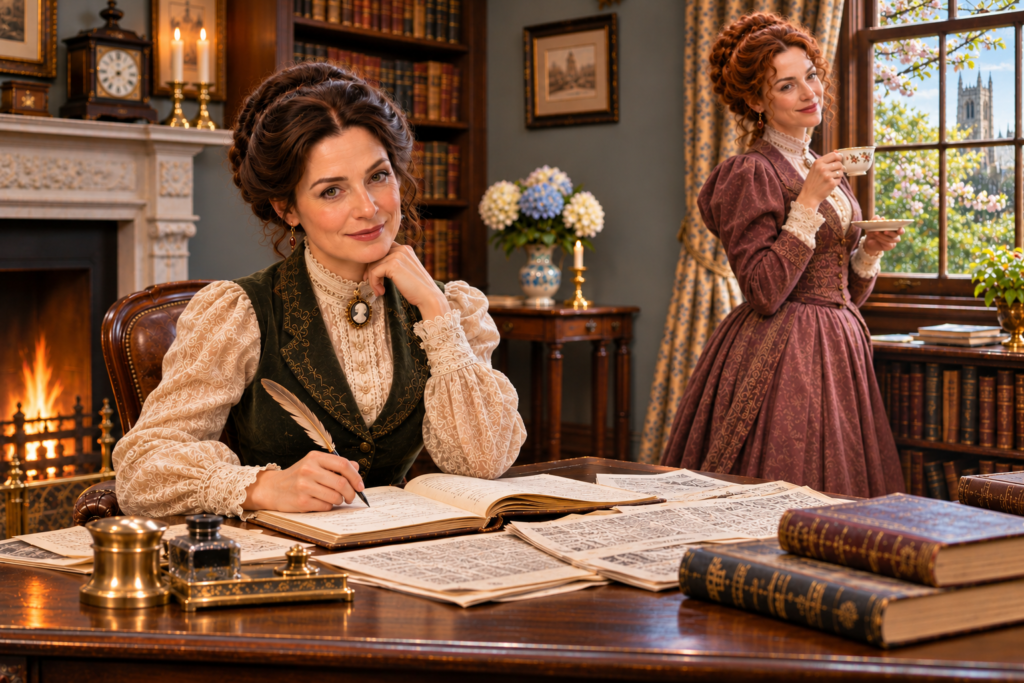
It was a mild spring afternoon in Canterbury, and Jemima Hartford was seated at her writing desk, a pile of newspapers beside her and several sheets of handwritten notes spread before her. Bella, who had recently returned from a theatrical engagement, was sitting comfortably by the window, enjoying a cup of tea.
“Have you found another mystery, Jemima?” she asked, glancing at the newspapers.
“I believe I have found something rather unusual.”
Bella looked up with interest. “A murder? A missing person? Perhaps a mysterious disappearance?”
“Not precisely.”
“Oh dear. What is it, then?”
Jemima adjusted her spectacles and consulted her notes.
“An inquest held at Faversham in April 1876. A little boy, six months old, died during the night, and the coroner returned a verdict of accidental death.”
Bella waited.
“Yes?” she prompted.
“The child was apparently suffocated by a cat.”
Bella stared at her sister.
“A cat?”
“That is what the newspaper reports.”
Bella put down her teacup.
“Jemima, may I ask why you have spent so much time investigating a story about a cat?”
Jemima looked mildly offended.
“Because, Bella, a child has died, and I was interested in the circumstances.”
“Well, naturally. But surely there are more pressing mysteries awaiting your attention? I thought you were looking for something rather more substantial.”
“Perhaps you would be interested to know that the inquest took place in Faversham.”
Bella’s expression changed.
“Faversham? Our Faversham?”
“Indeed. The family lived at number eight, West Street.”
“West Street! Goodness, do you suppose we ever passed the house?”
“Quite possibly. We knew the town well enough as children.”
Bella settled back in her chair.
“Well, that makes it rather more interesting. Tell me what happened.”
Jemima drew the newspaper towards her.
“The report appeared in the Whitstable Times and Herne Bay Herald on Saturday, the fifteenth of April 1876. The inquest concerned a little boy named William Douglas Boseley, the son of Newman Boseley, a hairdresser of West Street, Faversham.”
“And his mother?”
“Emma Jane Boseley.”
Jemima began reading from her notes.
“Mrs Boseley told the inquest that she had put the baby to bed shortly after midnight on the Saturday morning. She went to look at him again at two o’clock, when he appeared to be sleeping quite normally. At about three o’clock, her husband called her upstairs. The child was dead.”
Bella’s expression softened.
“How dreadful. Poor woman.”
“Her husband had apparently found the cat leaving the bedroom. The baby was lying with his mouth slightly open, and there was an impression in the pillow where the animal had apparently been lying.”
“On the baby’s pillow?”
“That is what the report suggests.”
“And the doctor?”
“Dr Gange examined the child. He believed that death had been caused by suffocation, apparently because the cat had lain over the baby’s face. There was a small mark on the child’s neck, but the doctor considered it a superficial scratch, possibly made by the cat’s claw.”
Bella looked thoughtful.
“So the cat was found in the room, and the baby had died. But how could they be certain that the animal had caused his death?”
“That is precisely the difficulty. The doctor considered suffocation to be the cause of death, and the circumstances led him to attribute it to the cat. The coroner was satisfied that there had been no violence and that the child had been properly cared for.”
“And the verdict?”
“Accidental death.”
Bella shook her head.
“It must have been a terrible experience for the parents. I do hope nobody suggested that they had been careless.”
“The report gives no indication of any such accusation. Indeed, the coroner appears to have accepted that this was a tragic accident.”
Bella was silent for a moment.
“And what have you discovered about the family?”
Jemima smiled. “Now that is where the investigation becomes rather more interesting.”
She produced another sheet of paper.
“Newman Boseley married Emma Jane Douglas at Faversham in August 1873. He was twenty-three, a hairdresser, and his father was William Boseley, a labourer. Emma was twenty-one, and her father, George Douglas, was a dredger.”
“Both local families, then?”
“Emma certainly was. Her family were living at Faversham when I found them in the census records.”
“And Newman?”
“He too was born in Kent, at Leeds, near Maidstone.”
Bella nodded approvingly.
“At least we are not wandering off to Yorkshire.”
Jemima ignored the interruption.
“The census of 1881 shows Newman and Emma living at North Lane, Ospringe. Newman was still working as a hairdresser. They had three children living with them: Newman George, Florence Mary and little Charles Frederick.”
“And William?”
“He had died, of course. The census was taken five years after the inquest.”
Jemima consulted her notes.
“I have also found that the couple had several other children. Their family appears to have grown considerably since their marriage.”
“How many?”
“That is something I am still piecing together. There have been a number of births and some very sad early deaths. I have found two little boys, Ernest George and Frederick Charles, who appear to have been twins. They were both baptised on the same day in 1882, and sadly both died the following year.”
Bella’s face grew serious.
“How very sad. Poor Emma. To lose one child is dreadful enough, but to lose two little ones together…”
“Indeed. We must remember that the newspaper inquest concerned only one moment in this family’s life. There may have been other hardships of which we know nothing.”
Bella looked again at the newspaper.
“And Newman? Is he still a hairdresser?”
“He was certainly one in 1881. I should be interested to discover whether he has continued in the same trade.”
“And where are they living now?”
“I have not yet established their present circumstances. But I would imagine they have remained somewhere in the Faversham neighbourhood.”
Bella considered this.
“So the little boy’s death was only one event in a much longer family history.”
“Precisely.”
There was a pause. Bella looked at the newspaper, then back at her sister.
“Jemima, there is something I still don’t understand.”
“What is that?”
“Why did the newspaper devote so much space to this particular inquest?”
Jemima looked pleased.
“Ah! Now you have arrived at the question that interests me most.”
She spread the original newspaper report across the desk.
“Look at the detail, Bella. We are told precisely when the baby was put to bed, when his mother last checked on him, when his father discovered him, how his mouth was positioned, where the impression appeared in the pillow, and even the nature of a tiny scratch on his neck.”
Bella leaned forward.
“It really is quite extraordinary. One might imagine the reporter had been examining the bedroom himself.”
“Quite so. The account is remarkably thorough.”
“And yet,” Bella continued, “you have shown me other newspaper reports of dreadful events where the names of the people involved are not even given.”
Jemima nodded.
“That is what I find so curious. We sometimes come across reports of serious crimes, suspicious deaths and terrible misfortunes which receive only a few lines. The victims may remain unnamed, and we are given almost nothing about their families or circumstances. Yet here, an inquest into an accidental death occupies a considerable amount of newspaper space.”
“Perhaps the cat was particularly interesting to the reporter.”
Jemima gave her sister a reproving glance.
“Bella, I am trying to make a serious observation.”
“I know, dear. But I cannot help wondering whether the reporter had a particular affection for cats.”
Jemima sighed.
“Newspapers were not always consistent in their priorities. What attracted a reporter’s attention, what interested readers, and what an editor considered worth printing could all influence the amount of space given to a story.”
“And that makes our work difficult, doesn’t it?”
“Very much so. We must never assume that an event was unimportant simply because a newspaper barely mentioned it. Nor should we assume that a lengthy report necessarily describes the most significant event.”
Bella smiled.
“So the newspaper has given us a great deal of information about a cat, but perhaps rather less than we would like about many other people whose stories we have investigated.”
“That is a fair summary.”
Bella picked up her teacup again.
“Well, I think we have learned something useful, even if we have not solved a particularly challenging mystery.”
“Indeed.”
“And what happened to the cat?”
Jemima looked up sharply.
“Bella, I have no idea.”
“Did nobody think to ask?”
“There is no mention of its subsequent history.”
Bella shook her head.
“How disappointing. After all that attention, one would have thought the newspaper might at least have followed up its principal suspect.”
Jemima laughed despite herself.
“I rather doubt that the cat was considered a suspect, Bella.”
“Perhaps not. But I should still like to know whether it was allowed to remain in the house.”
Jemima gathered her papers together.
“Well, I think we must leave the cat’s later history to the imagination. We have done what we can for the Boseley family, and I do not think there is much more to discover about this particular incident.”
Bella rose and walked towards the window.
“Then perhaps you should return to one of your more substantial mysteries.”
“I intend to.”
“And, Jemima?”
“Yes?”
“Next time you find a newspaper story involving a cat, perhaps you might tell me before spending an entire afternoon investigating it.”
Jemima smiled.
“I shall bear that in mind.”
Bella returned to her chair.
“Although, I must admit, it has been rather pleasant to hear about Faversham again.”
Jemima glanced towards the window, beyond which the familiar towers of Canterbury Cathedral could just be seen.
“Yes,” she said quietly. “It is always interesting to discover another little piece of the history of the places we once knew.”
And so the curious case of the Faversham cat was added to Jemima’s collection of investigations. It had not revealed a great mystery, nor had it uncovered any hidden crime. But it had provided a glimpse into the life of an ordinary Faversham family, and prompted a question that would remain with Jemima throughout her researches:
Why do some lives occupy columns of newspaper print, while others, equally deserving of remembrance, are almost entirely forgotten?
As for the cat, its subsequent adventures remain unknown. Bella, however, was not entirely convinced that Jemima had asked all the right questions.