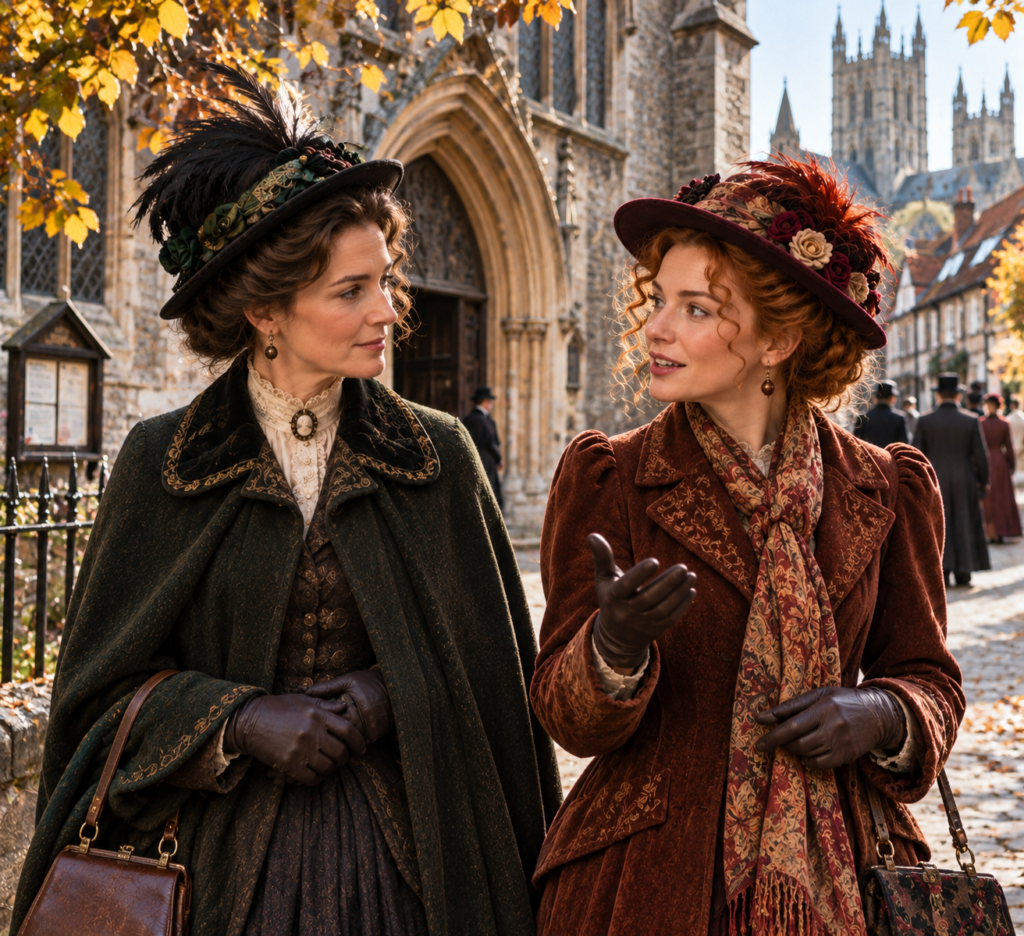
It was a mild afternoon in early autumn, and Jemima and Bella had taken advantage of the pleasant weather to walk into the older part of Canterbury. The streets were busy enough, though not uncomfortably so, and the late afternoon sun caught the pale stonework of the buildings as they made their way along one of the narrower thoroughfares.
They had just passed a small parish church when Jemima slowed her pace and glanced towards its entrance.
“You know, Bella, there is something about churches that has set me thinking rather unpleasantly this morning.”
Bella turned towards her sister, amused.
“That sounds rather ominous. Have you discovered another murder committed in a churchyard?”
“No, nothing quite so dramatic. Although I have been reading about a case of bigamy in Ramsgate, and it has left me wondering how some people can be so extraordinarily brazen.”
“Bigamy? That sounds more interesting than murder, at least for an afternoon’s conversation. What happened?”
“A man named Albert Edward Brown married a young woman in Ramsgate in 1884. They had three children together. Then, in 1892, he went through another marriage ceremony with a different woman, in another church in the same town.”
Bella stopped walking.
“In the same town? Surely he cannot have imagined that nobody would recognise him?”
“Apparently he did. Or perhaps he simply did not care. The curious part is that he used another name altogether. When he married the second woman, he called himself William George Burbridge and declared himself to be a bachelor.”
“Good heavens! And he thought that would be sufficient?”
“It seems so. His first marriage had taken place at St George’s Church, Ramsgate, and the second at St Paul’s. He apparently believed that by assuming another identity and going to a different church, he could begin again without anyone discovering his existing marriage.”
Bella looked back towards the church they had just passed.
“But what I cannot understand is how the clergyman could have performed the second ceremony without knowing that the man was already married. Surely he must have made some enquiry?”
“He would have asked the prescribed questions, I imagine, and the marriage was preceded by banns. But that is precisely the difficulty. What means had the clergyman of knowing that the man standing before him was lying? The first marriage had taken place in another church, and there was no central register which he could simply consult to discover whether a prospective bridegroom was already married elsewhere.”
“So he had only the man’s word?”
“Essentially, yes. Albert declared himself to be a bachelor. Unless somebody came forward with information to the contrary, the clergyman had little reason to suspect him.”
Bella shook her head.
“That seems a remarkable weakness in a system which is supposed to provide such solemn assurances. A man can stand before an altar, promise to love and honour a woman, and know perfectly well that he has already made precisely the same promise to another.”
“Indeed. The ceremony depends upon the honesty of those taking part in it. Albert appears to have taken advantage of that trust.”
“And what became of him?”
“He was not particularly fortunate in his attempt to begin his new life. He married the second woman in July 1892 and went away with her to Harwich for their honeymoon. He was arrested there after his first wife brought the matter to the attention of the authorities.”
“On his honeymoon!” Bella exclaimed. “I can hardly imagine a more uncomfortable interruption.”
“I suspect it was considerably more uncomfortable for his bride than for him. He was eventually brought before the magistrates and committed for trial. In December he appeared at the Maidstone Assizes, pleaded guilty and received twelve months’ imprisonment.”
“Twelve months! And what of the women?”
Jemima looked at her sister.
“That, Bella, is what has occupied most of my thoughts. The newspapers are full of the criminal proceedings, the assumed name, the arrest and the sentence. But behind all that are two women whose lives were considerably less straightforward than the newspaper reports might suggest.”
“Then tell me about them.”
“The first wife was Eliza Ann Payne. She married Albert in August 1884. They were both young, only nineteen, and they had three children together. By the time he deserted her in 1892, the youngest was still a baby.”
Bella’s expression softened.
“Three children. And he simply walked away?”
“So the evidence suggests. He had apparently been courting the second woman for some months, while his first wife remained at home with their children.”
“How could he do such a thing? Did he not think of his children at all?”
“I cannot answer that. But the newspaper account of the magistrates’ hearing contains one detail which I found particularly distressing. Eliza attended to give evidence, carrying the baby in her arms. The report says that she cried bitterly.”
Bella was silent for a moment.
“I wish I had not asked you to tell me that.”
“It is a small detail, but I think it tells us more about the human consequences of the case than several columns of legal proceedings.”
“Of course it does. There she was, having to stand before strangers and explain that her husband had abandoned her and their children. And all the while he was enjoying a honeymoon with another woman.”
“Yes. And I wonder what arrangements she had made for herself and the children. Albert had been working as a labourer, and there is no suggestion that he had provided for them before leaving.”
“She may have had very little money. Three children are a considerable responsibility, particularly when the youngest is still in arms. Did the newspaper say whether she had any family to help her?”
“Not that I could discover. We know that she subsequently continued to live in the district, but I have been unable to establish precisely what support she received at the time.”
Bella resumed walking, her expression thoughtful.
“It is curious, is it not? We speak of marriage as though it offers a woman security. Yet Eliza had done everything expected of her. She had married, kept house and borne children, and still she found herself abandoned through no fault of her own.”
“That is one of the difficulties I find repeatedly in these cases. The law can punish a man for bigamy, but it cannot restore the years of security and companionship that he has taken away from his wife. Nor can it ensure that his children will be properly provided for.”
“And what of the second woman? Did she know he was married?”
“Her name was Sophia Fletcher. I have found nothing to suggest that she knew. Indeed, the newspaper accounts indicate that Albert had represented himself as a single man throughout their courtship.”
“Then she was deceived too.”
“It would appear so. She was twenty-six, and had been working as a domestic servant. Albert had been courting her since December of the previous year, and in July 1892 they went through the marriage ceremony.”
“Did she have any family?”
“She had an aunt, Emma Fletcher, with whom she had lived in Ramsgate. I have found some records relating to her family, and there is another circumstance which makes me particularly sympathetic towards her.”
Bella looked at her expectantly.
“Sophia had a little boy of her own, born in August 1891. His name was George William Fletcher. There is no father named on his birth certificate.”
Bella looked surprised.
“Then she was already a mother when Albert began courting her?”
“Yes. The boy was only about four months old when Albert apparently began his attentions towards her.”
“That makes me wonder all the more about what she believed she was entering into. Perhaps she hoped to provide a proper home for herself and her little boy. Perhaps Albert seemed to offer her the prospect of a settled family life.”
“It is possible. We cannot know precisely what passed between them, but I think we should remember that Sophia was not simply a foolish young woman who failed to make proper enquiries. She was entitled to believe that a man who presented himself as unmarried was telling the truth.”
“Quite so. I should be very reluctant to blame her. After all, he had gone to the trouble of adopting another name. It sounds as though he intended to deceive her.”
“And deceive the clergyman too.”
“Indeed. Though I imagine the clergyman was not particularly pleased to discover that he had unknowingly solemnised a bigamous marriage.”
Jemima smiled faintly.
“I expect not. It is an uncomfortable thought that a church can provide the setting for such a solemn occasion, while the person standing before the altar has no intention of honouring the promises he is making.”
Bella glanced towards the church as they passed another entrance.
“I wonder whether Sophia ever felt able to trust another man after that?”
“That is something we cannot answer from the newspaper reports. But we do know that the second marriage was legally void from the beginning. Albert’s existing marriage meant that he had no capacity to marry again. Sophia had gone through the ceremony believing herself to be his wife, but the law did not recognise her as such.”
“That seems a particularly cruel distinction. She had made her promises in good faith, and yet legally she was not his wife at all.”
“Precisely. And unlike Eliza, she had no marriage to which she could return. She had simply been deceived into believing that she had entered one.”
“Then both women were victims, though in rather different ways.”
“I think that is the most important point in the whole affair.”
They walked on for a little while, passing a row of old houses before Bella spoke again.
“I keep coming back to the children. Three for Eliza, and one for Sophia. Four little lives which might have been quite different had Albert behaved honourably.”
“Yes. And the circumstances of the children were not the same. Eliza’s children were born within a lawful marriage. Sophia’s little boy had been born before she met Albert. Yet all four were vulnerable to the consequences of his conduct.”
“Did the boy go away with her and Albert?”
“I have no evidence of that. In fact, I have found very little about what became of him. Sophia’s aunt Emma appears to have been an important person in her life, and I suspect she may have helped care for the child. Emma died in 1898, and Sophia was present when she died. After that, I have been unable to trace the boy with any certainty.”
Bella looked concerned.
“So we do not know whether he remained with his mother?”
“No. Nor do we know whether he went to live with another relative or was taken into institutional care. I have found a possible entry for a boy of the right age in a district school, but I cannot establish that it is the same child.”
“How very sad. He was quite innocent of everything that happened, yet his future may have been determined by the circumstances of his birth and the decisions made by adults around him.”
“That is one of the uncomfortable truths of family history. We can sometimes establish the birth of a child, the names of his parents and the circumstances surrounding his early life, and then he disappears from the records. We are left not knowing whether he found a happy home, whether he prospered, or whether his life was a difficult one.”
Bella sighed.
“I should like to think he found someone who cared for him.”
“So should I.”
They walked a little further, and Jemima continued.
“There is another matter which I have been considering. Albert received twelve months’ imprisonment. Do you think that was sufficient?”
Bella gave her a rather incredulous look.
“Sufficient? He deceived two women, abandoned a wife and three children, and apparently thought nothing of making false promises in a church. I should have thought twelve months a very modest consequence.”
“But what punishment would have been sufficient? The law was concerned with the offence of bigamy, not necessarily with all the unhappiness that followed from it.”
“I know. But I cannot help feeling that the law sees the offence rather more clearly than it sees the people who suffer from it.”
“That is a fair observation.”
“And what became of Albert after his imprisonment?”
“I have not been able to establish his subsequent life with certainty. There is a possible death registration in 1897, but I have not been able to prove conclusively that it belongs to him.”
Bella frowned.
“So even he disappears from the story?”
“At least from the records I have so far examined. But I am less concerned about what became of him than about what happened to the two women.”
“Do you think either of them ever found happiness?”
Jemima considered the question.
“I think we must allow for the possibility. Women did rebuild their lives after such experiences, though it was not always easy. A woman who had been deserted might find herself with little money, several children and a reputation she had done nothing to deserve. But that did not mean her life was necessarily at an end.”
“Nor should it have been. I cannot bear the idea that a woman’s future should be determined entirely by the dishonesty of a man.”
“Nor can I. And perhaps that is what we should take away from this case. Albert’s actions were his own responsibility. Eliza and Sophia should not be judged by what he did to them.”
Bella nodded.
“I should hope that those who knew them understood that. Though I fear society was not always so generous.”
“Indeed. A deserted wife might be pitied, but a woman who had gone through a bigamous marriage could find herself the subject of gossip, even when she had been entirely deceived. It is one of the injustices of the situation.”
“Then Sophia may have suffered twice over: first through Albert’s deception, and afterwards through the judgement of people who did not know the truth.”
“That is possible. We must be cautious about assuming what people thought, but it is certainly a consideration.”
They had reached a quieter part of the street. The church bells sounded somewhere behind them, marking the hour.
Bella slipped her hand through Jemima’s arm.
“You know, I think I prefer our investigations when we can discover something useful about the people concerned, rather than merely establish that somebody has committed a crime.”
“So do I, increasingly.”
“Although I suppose the crime is what brings us to the story in the first place.”
“Very often. A newspaper reports an arrest, a trial or a mysterious death, and we begin by asking who was involved and what happened. But once we start tracing the families, we discover that the event was only one part of a much longer story.”
“And sometimes the most important people are those who never appear in the headlines.”
Jemima smiled.
“Precisely, Bella. In this case, Albert Brown’s name appeared in the newspapers because he committed bigamy. But Eliza, Sophia and their children were the ones who had to live with the consequences.”
Bella was quiet for a moment.
“I hope Eliza found some peace. And I hope Sophia did too. And that little boy…”
She left the sentence unfinished.
“Yes,” said Jemima gently. “I hope so too.”
For a little while they walked without speaking. Canterbury was beginning to grow quieter as the afternoon drew towards evening, and the two sisters continued along the old streets, their conversation gradually turning to more cheerful matters.
But Jemima would remember the Ramsgate case. Not because of the false name, the two churches or even the sentence at Maidstone, but because of a newspaper description of a young woman standing before the magistrates with a baby in her arms, trying to explain how the man she had married had betrayed her.
It was a small detail in a crowded newspaper column. Yet sometimes, Jemima reflected, the smallest details were the ones that mattered most.