An old newspaper
It was a mild afternoon in March when Jemima Hartford came across the newspaper report that was to occupy rather more of her attention than she had initially anticipated.
She had been sorting through a collection of old newspapers, looking for something that might interest her younger sister Bella, who had recently returned to Canterbury after several weeks away with her theatrical company. Jemima thought that a case with some local interest might provide an excuse for the two sisters to spend an afternoon together.
The report appeared in the Whitstable Times of 29 March 1873. Its heading was quite dramatic:
Fatal Fall Over a Cliff.
It concerned the death of a young man named David Watson, who had fallen from a precipitous cliff near Lamorna Cover, in Cornwall, whilst collecting ferns.
At first glance, there seemed little mystery about the matter. The young man had been holidaying with his sisters and other female relatives. He had stayed behind to gather some ferns, had apparently approached too close to the edge of the cliff, and the ground had given way beneath him. His body had subsequently been recovered from the rocks below.
The coroner’s jury had returned a verdict of accidental death.
Jemima might ordinarily have put the cutting aside, but one sentence caught her attention.
Mr Watson, the newspaper explained, was from Canterbury, where his parents and friends occupied a highly respectable position.
Canterbury!
She read the article again.
David Watson had been twenty-three years of age, a young gentleman in delicate health, and an undergraduate at Cambridge. His father had been the Reverend John David Watson, formerly Vicar of Guilsborough in Northamptonshire.
There was something else that interested her. The article was remarkably long. It described the excursion in considerable detail, reproduced the evidence of several witnesses and even included the doctor’s examination of the deceased.
Jemima wondered why an accidental death should have received such extensive coverage.
She began with David himself.
A search of the census returns soon revealed that he had been living in Canterbury with his sisters in 1871. The address was given as Westgate Court House, Water Lane.
She knew Water Lane, although she had not previously given much thought to its history. This meant the house was scarcely five minutes’ walk from her own home in Blackfriars Street.
She put down her pencil and looked at the address again.
A young man who had died on a Cornish cliff thirty years earlier had once lived almost on her doorstep.
She felt that Bella would find this interesting.
A walk through Canterbury
Bella arrived the following morning, bringing with her the usual cheerful disturbance that accompanied her visits.
She had been performing in London and was full of theatrical gossip, but Jemima eventually persuaded her to abandon the subject of a particularly troublesome leading man and listen to her discovery.
“An accidental death?” Bella said, examining the newspaper cutting. “You have been searching for a murder, Jemima, and have brought me a gentleman who fell off a cliff?”
“That is rather how it appeared to me at first.”
“And you think there is more to it?”
“I think there is more to the family. And I have discovered that he lived here in Canterbury.”
That caught Bella’s attention.
“Here? Where?”
“Westgate Court House, in Water Lane.”
“Then we must go and see it!”
Jemima laughed. She had rather expected that response.
They set out after luncheon, walking through the familiar streets towards the Westgate.
The weather was agreeable, and Bella was in particularly good spirits. She had always enjoyed their excursions around Canterbury, although she was inclined to become distracted by shop windows and interesting passers-by when Jemima was trying to explain something historical.
As they approached Water Lane, Jemima told her what she had discovered about the Watson family.
David’s father had been a clergyman in Northamptonshire and had died in January 1864. His mother, Caroline, had died several years earlier, in 1857.
“Poor young man,” Bella observed. “To lose both parents before he was grown.”
“Indeed. His father left a substantial estate. The probate entry records effects of forty thousand pounds, although the amount was subsequently resworn at a lower figure. The family was evidently comfortably placed.”
“And his sisters?”
“Caroline and Mary were living here with him in 1871. Both were unmarried. They had several servants, most of whom came from Northamptonshire.”
“Then they must have brought their household with them.”
“That is what I suspect. It is rather interesting, isn’t it? A family from Northamptonshire establishing itself in Canterbury, bringing familiar servants and maintaining a household of some standing.”
Bella considered this.
“Perhaps they came because they had friends here.”
“Perhaps. Or there may have been family connections or other reasons. I have not yet discovered what brought them to Kent.”
They continued towards the house.
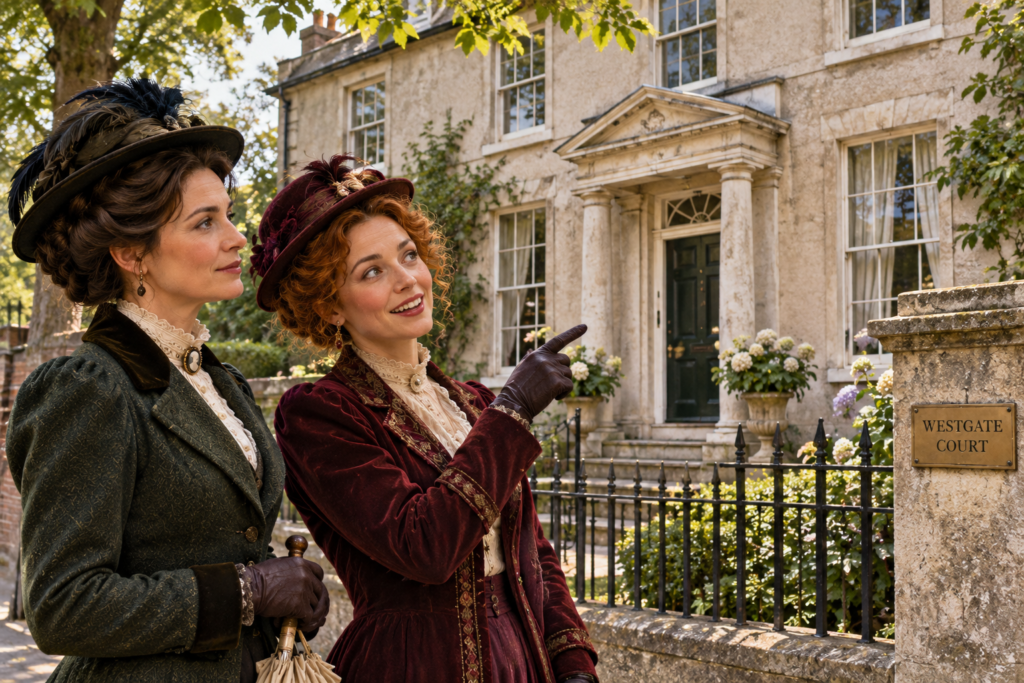
There it stood, a handsome Georgian residence with a dignified frontage, elegant windows and an imposing entrance.
Jemima stopped.
“That must surely be it.”
Bella looked up at the building.
“Well, it is certainly grand enough for a clergyman’s family with a considerable inheritance.”
“Imagine,” Bella said, “the two sisters living here with their brother. He would have been studying at Cambridge, I suppose, and returning to Canterbury during the holidays.”
“Yes. And two years after this census was taken, he was dead.”
For a moment they were both quiet.
Then Bella turned back towards her sister.
“Tell me about the accident. I want to know why the newspaper devoted so much space to it.”
A very long newspaper report
Back at home, Jemima returned to the newspaper report and began explaining the circumstances of the accident in greater detail.
“The excursion took place on a Thursday afternoon. David Watson, his two sisters and several other female relatives had been staying at Beachfield House, near Penzance, for six or seven weeks.”
“Six or seven weeks! That was quite a holiday.”
“It seems they were enjoying themselves. They went out to Lamorna, about five miles from Penzance, and walked along the cliffs. David was interested in botany, and the newspaper tells us that the ladies were also finding employment in sketching and collecting specimens.”
“How agreeable.”
“They eventually reached a spot called Cairn-a-bargis, near the Bucks Rocks. David remained behind to gather some ferns while the others went on.”
“And he never caught them up?”
“No. When they returned, they were horrified to find him lying on the turf near the cliff edge. His worst fears were realised when they discovered that he had fallen.”
Bella shuddered.
“How dreadful for them.”
“The newspaper describes the cliff as about eighty feet high. The ground had crumbled beneath him, and he fell head foremost onto a granite ledge before continuing down towards the sea.”
“And they could not recover him immediately?”
“No. The tide prevented them reaching the cove. Eventually a boat was sent, but even then the recovery was difficult. His body was found wedged between a large rock and the cliff, and ropes had to be used to lift him.”
Bella looked at the cutting again.
“And the doctor?”
“Dr John Quiller Coan examined the body. He found that David’s skull had been fractured and concluded that death had been instantaneous. He considered that death had been caused by the blow to the head rather than drowning.”
“Then the jury had little difficulty in reaching its verdict.”
“Precisely. Accidental death.”
Bella was silent for a moment before asking:
“But why so many words? I have seen reports of dreadful accidents that occupied scarcely more than a line.”
“That is what first interested me. I think there were several reasons. David was a young gentleman from a respectable family, his father had been a clergyman, and he was studying at Cambridge. His family was well connected, and the local readers in Canterbury would have known something of them.”
“And the circumstances were dramatic.”
“Very much so. The newspaper was able to reproduce the evidence of several witnesses. The inquest provided a considerable amount of material, and the account had evidently been thought worthy of publication in full.”
Bella nodded.
“So the length of the report tells us something about the family as well as the accident.”
“Exactly. Newspapers did not always give equal attention to every death. Social position, local interest and the availability of witnesses could make a considerable difference.”
Bella smiled.
“I suppose that is why you enjoy old newspapers so much. Even when they tell us something apparently straightforward, they reveal something else if we look carefully.”
Jemima agreed that she had put it rather well.
But there was one part of the evidence that she had not yet fully investigated.
The witnesses included a woman named Mary Elizabeth Caswall, who described herself as a cousin of the deceased.
It was her evidence, Jemima suspected, that might lead them into a rather more interesting family history.
The memorial cross
Back at her desk, Jemima began looking more closely at the circumstances of the accident.
She discovered that a memorial cross had been erected at the place where David fell.
She found this particularly moving.
The newspaper had described the terrible mechanics of his death, but the cross represented something quite different. It was a lasting memorial to a young man whose life had ended suddenly, far from his home and family.
Jemima tried to imagine the scene.
David had been twenty-three, away on holiday with his sisters and cousins, enjoying the freedom of the Cornish countryside. He had been interested in ferns and botanical specimens, and had probably imagined that he would return to Canterbury with a collection of interesting finds.
Instead, his companions had returned without him.
She wondered whether his sisters had ever visited the place again.
Perhaps the memorial had been arranged by the family. Perhaps it was intended to ensure that the place of his death would not be forgotten.
She made a note to include the cross in her account.
Then she turned to the witnesses.
The two women who interested her most were Mary Elizabeth Caswall and her daughter Anna Maria.
Anna Maria had explained that she was a cousin of David’s. Mary Elizabeth had also given evidence, describing herself as related to him on both sides of the family.
This was a curious statement.
Jemima had encountered many Victorian family relationships in her work, but it was unusual to find someone who could claim connections through both the father’s and the mother’s families.
She decided that she must discover precisely how the Caswalls were related to the Watsons.
The Powell family
Her first task was to identify Mary Elizabeth Caswall.
The census returns provided the starting point. In 1871 she was living at The Elms, Binfield, Berkshire, with four daughters.
She was recorded as Mary Elizabeth Caswall, aged fifty-five, and her occupation was given as landowner dividends. She was clearly a woman of independent means. An earlier census showed that she had already been widowed by 1861, when she was living on the Isle of Wight with her daughters.
Jemima eventually established that she had been born Mary Elizabeth Powell and had married Alfred Caswall in 1843.
Their children included Anna Maria, born in 1844, Katherine Elizabeth, Jane Mary Cotton and Ellen.
She then traced Mary Elizabeth’s parents.
They were James Powell and Catherine Cotton, who had married in 1808. Mary Elizabeth was their sixth child.
The Cotton name had been preserved in the next generation through the name of her daughter Jane Mary Cotton.
Jemima began constructing a family tree.
The Powell family was considerably more extensive than she had anticipated. There were several branches, numerous marriages and a number of individuals who shared the same Christian names.
She had to be particularly careful not to confuse one James Powell with another.
Gradually, however, the relationships began to emerge.
Mary Elizabeth Caswall and David Watson belonged to the same extended Powell family. David’s mother, Caroline Marriott, was also descended from the Powell family through her mother, Anne Powell, who had married the Reverend Robert Marriott.
The two family lines therefore came together in more than one way.
Jemima returned to the inquest testimony.
Mary Elizabeth had described herself as a first cousin once removed of David on his father’s side and a second cousin of his mother.
The family tree now made sense of her statement.
It was a satisfying discovery. The woman who had stood beside David’s body in Cornwall was not merely a distant acquaintance or an incidental companion. She was connected to him through both branches of his ancestry.
Jemima imagined how delighted she would have been to discover such a connection had she been investigating the family at the time of the inquest.
But there was more.
As she followed the Powell family backwards, she began to recognise a name.
A rather famous connection
Jemima was checking one of the Powell branches when she came across the name Baden Powell.
At first she thought it must be another individual of the same family, but the dates soon made the connection clear.
The Powell ancestry of Mary Elizabeth Caswall led into the family of Baden Powell, and through that line to his son, Robert Baden-Powell.
Jemima sat back in her chair.
Surely this was the same Robert Baden-Powell who had become so famous during the recent war in South Africa?
The defence of Mafeking had made him a household name. His name had appeared in newspapers throughout the country, and the relief of the town had been greeted with extraordinary enthusiasm.
She checked the family connections again.
There was no mistake.
David Wordsworth Watson, the unfortunate young man who had died on the Cornish cliffs, was related through the wider Powell family to Major-General Robert Baden-Powell.
It was a remarkable coincidence.
Jemima was still considering this when Bella arrived.
She found her sister with several sheets of paper spread across her desk.
“You look particularly pleased with yourself,” Bella observed. “Have you discovered a murderer?”
“Nothing quite so dramatic.”
“Then what?”
“I have discovered that our young Mr Watson was related to a very famous gentleman.”
Bella took the chair opposite her.
“Who?”
“Major-General Robert Baden-Powell.”
She stared at Jemima.
“Not the Baden-Powell?”
“The very same.”
“The gentleman of Mafeking?”
“Yes.”
Bella laughed with astonishment.
“Well, Jemima! I never expected that. You begin with a young man who falls off a cliff, and end with one of the most celebrated soldiers in the country.”
“It is a rather unexpected family connection.”
“And does Major-General Baden-Powell know that he is related to our Mr Watson?”
“I have no idea. I rather doubt that the unfortunate David Watson features prominently in his family history.”
Bella examined the family tree.
“It is extraordinary how these things happen. One family branches out in all directions, and people who might never meet turn out to share ancestors.”
“That is the nature of family history. We are often connected to people of whom we know nothing.”
Bella looked thoughtful.
“And I suppose it means that David Watson’s family was rather more distinguished than we first imagined.”
“Perhaps. Although I would not wish to exaggerate his relationship to Baden-Powell. It is a connection through the extended Powell ancestry, not a close family relationship.”
“Still, it is a splendid discovery.”
Jemima agreed.
Westgate Court
A few days later, Bella suggested that they should visit Westgate Court again.
“We have spent so much time discussing the Watson family,” she said, “that I think we ought to pay another visit to their old home.”
Jemima thought this an excellent idea.
They walked from Blackfriars Street towards Water Lane, taking their time and enjoying the mild spring weather.
When they reached Westgate Court, they stopped outside the railings.
The house looked much as it had on their previous visit. Its handsome Georgian façade, elegant entrance and well-proportioned windows gave it an air of quiet respectability.
Jemima thought of the 1871 census.
There had been Caroline Watson, aged thirty, and her younger sister Mary, aged twenty-five. David, then twenty-one, had been living with them, described as an undergraduate at Cambridge.
There had also been the servants, several of whom had come from Northamptonshire.
She could almost imagine the household.
Caroline and Mary managing their affairs, David returning from university, the servants going about their duties, and the ordinary rhythms of a prosperous Victorian home.
“Do you suppose they were happy here?” Bella asked.
“I hope so. It seems to have been a comfortable household.”
“And David would have been here only two years before he died.”
“Yes. He was still a young man with most of his life before him.”
Bella looked towards the upper windows.
“It is strange to think that he once looked out of those windows, perhaps planning his next visit to Cambridge, without having the slightest idea that his life would end in Cornwall.”
Jemima thought about this.
“His death was an accident, Bella. There was no mystery in the verdict. But his story has led us into a remarkable family history.”
“And to Major-General Baden-Powell!”
Jemima smiled.
“And to Major-General Baden-Powell.”
They stood for a little longer, looking at the house.
Jemima reflected that the investigation had begun with a newspaper account of a young man’s death. She had wanted to know who he was, where he had lived and why his family had received such extensive attention in the press.
Now she knew rather more about him.
She knew something of his parents, his sisters, his inheritance, his education and his family connections. She knew that the woman who had accompanied him on his last excursion was related to him on both sides of his ancestry. She knew that a memorial cross had been erected at the place where he fell.
And she knew that the house before them had once been his home.
Bella slipped her arm through her sister’s.
“Well, Jemima, I think we have done rather well with this one.”
“I think so too.”
“Although I must confess that I am rather disappointed that we have not discovered a scandal.”
Jemima laughed.
“Not every family has a scandal to offer you, Bella.”
“Perhaps not. But you must admit that a connection to Baden-Powell is a very respectable substitute.”
They turned towards home.
As they walked back through Canterbury, Jemima found herself thinking that the most interesting part of historical investigation was often not the event with which one began, but the unexpected paths along which it led.
A young gentleman had gone to Cornwall for a holiday and had never returned. His death had been reported at length in a newspaper, and the coroner had recorded a verdict of accidental death.
Yet, thirty years later, his name had brought two sisters back to an old Canterbury house, uncovered the history of an extensive family and revealed a connection to one of the most celebrated men of the age.
It was, Jemima thought, quite enough for one case.
And Bella, for once, seemed to agree.
A note on Robert Baden-Powell: In 1903, Robert Baden-Powell was already a celebrated military figure, particularly following his role in the defence of Mafeking during the Boer War. He had not yet founded the Scout movement, which began with his experimental camp on Brownsea Island in 1907 and the publication of Scouting for Boys in 1908. He was knighted in 1922 and created Baron Baden-Powell of Gilwell in 1929. Thus, the familiar name Lord Baden-Powell belongs to a much later chapter of his life.