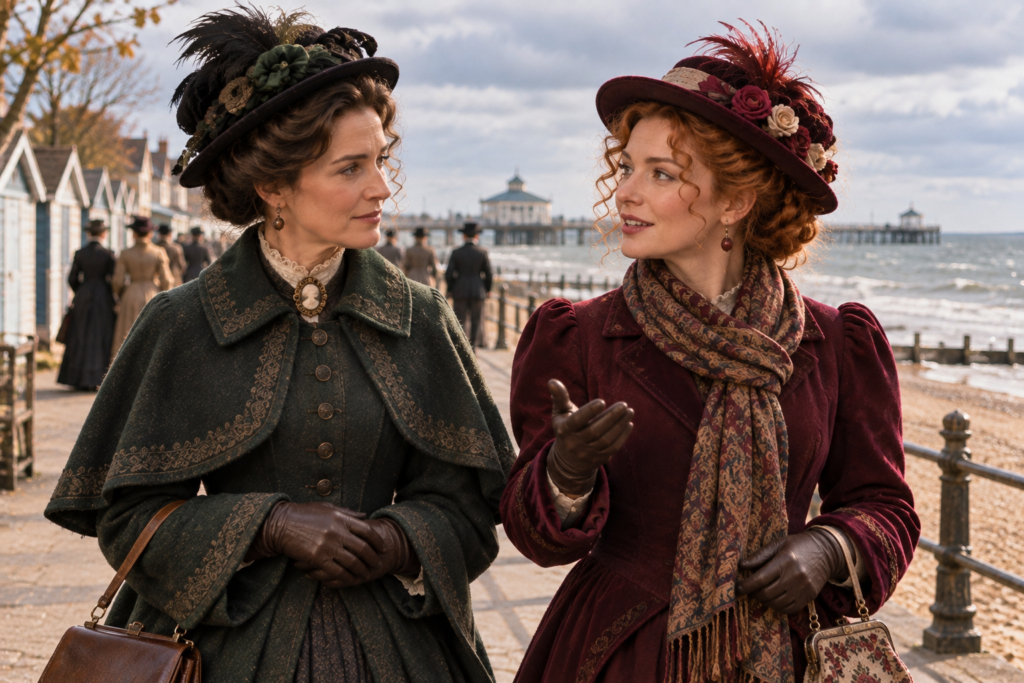
The afternoon was unusually still along the Herne Bay shore. The tide had retreated, leaving a broad stretch of wet sand that reflected the pale sky. A few sailing boats moved lazily beyond the harbour, their sails catching what little breeze there was.
Jemima Hartford walked with her hands tucked into the pockets of her jacket, her attention divided between the path ahead and the newspaper cutting she had folded carefully inside her bag. Beside her, Bella Mead was enjoying the fresh air, though she had been listening with increasing interest to her sister’s account of the boating accident.
“So it was only a pleasure outing?” Bella asked. “Nothing more than a party going out for a sail?”
“That is how the newspapers described it,” Jemima replied. “A small boat, fitted with a lug sail, carrying a party of people who had gone out for an afternoon on the water. They were caught in a sudden squall, and the boat overturned.”
Bella looked towards the sea.
“It is difficult to imagine anything more innocent. A fine day, a little sailing, the pleasure of being out on the water. And then, in a moment, everything changed.”
“Indeed. The report says that the accident occurred on the ninth of June, 1875. The boat was some distance from the shore when it capsized. There is a discrepancy between the newspaper accounts about precisely how far out they were, but there is no doubt that they were beyond immediate reach of the beach.”
“And the people aboard?”
“Captain Henry Geary Hill, his wife Isabel, their little boy, the Captain’s sister Helen, and two others who survived. One was the young Arthur Collard of Herne Bay. The child Maud was also saved.”
“Four drowned, then?”
“Yes. Henry Hill, his wife Isabel, their little boy, and his sister Helen. The other two survived.”
Bella was silent for a moment.
“And the sea took them all so quickly?”
“The boat overturned in the squall. We cannot know precisely what happened in those final moments, but the consequences were dreadful.”
They walked a little further, passing a group of children playing near the water’s edge.
“I suppose the first thing one wonders,” Bella said, “is whether anyone saw them in trouble.”
“There were people who responded very quickly. The reports describe the efforts of local boatmen to reach the scene and assist those in the water. But the sea was against them, and the boat had capsized some distance offshore.”
Jemima took the folded newspaper from her bag.
“I found another report, published on the nineteenth of June. It describes the funerals, and I think it is one of the saddest accounts I have read for some time.”
“Tell me.”
“The funeral of Mrs Hill and her little boy took place at Herne on the Monday. They were placed in one coffin.”
Bella stopped walking.
“Together?”
“Yes. The report says that the whole town seemed to share in the mourning. Shutters were closed and blinds drawn down, and a large number of inhabitants attended the funeral.”
“How terribly sad. I wonder whether the little boy was buried in his mother’s arms, or whether they were simply placed together in the same coffin.”
“We cannot know that from the report. But the image is difficult to forget.”
Bella looked down towards the sand.
“And Captain Hill?”
“His body had not been recovered in time for that funeral. It was found a few days later, on the Thursday morning, when the sea had become calm enough for the boatmen to resume their search.”
“Who went out?”
“Four boats, under the charge of local boatmen. The report names Quick and Field, Manning and Prestley, Rogers and Stupple, and Frederick and William Hudson.”
“Four boats searching for the missing bodies?”
“Yes. They went out at daybreak. Between seven and eight o’clock, Quick and Field found Captain Hill’s body. It was only about two hundred yards from the place where the boat had overturned.”
“After all that searching, so near the very place where it happened.”
“Just so. His body was brought ashore and taken to the Dolphin Inn. The newspaper says that the Coroner was informed and issued a warrant for burial without holding another inquest.”
“And his sister?”
“Her body had still not been found when the report went to press on Thursday evening. The searching continued throughout the day. A reward of five pounds had been offered for the recovery of the two missing bodies.”
Bella shook her head.
“To think of the family waiting, not knowing whether they would ever be able to bury her.”
“Yes. The report says that Captain Hill’s grave had to be reopened shortly after the funeral to receive his remains. One can imagine how painful that must have been for those who had already gathered to mourn his wife and child.”
“Did they ever find his sister?”
“I have not yet established precisely when her body was recovered. I would not wish to pretend we know more than the records tell us.”
They continued along the shore. A breeze had begun to rise, and the water was no longer quite so smooth.
“Who attended the funeral?” Bella asked.
“Several members of the family. The newspaper names Mr R. Voss, who was Mrs Hill’s brother, and Captain A. Hill and Mr H. Hill, brothers of the late Captain Henry Geary Hill. There were also Mr W. Phillips, Mr John Geary, Mr W. A. Hill and Mr T. Geary, together with the Reverend Henry Geary and Dr Wallich.”
“And Arthur Collard?”
“His name is there too.”
“Then he survived and attended the funeral.”
“Indeed. It is a small detail, but an important one. We have been able to trace something of his later life.”
Bella turned towards her.
“You have found out about him?”
“Rather more than I expected. Arthur Henry Allan Collard was the son of John and Catherine Collard of Herne Bay. I found him in the 1861 census, aged four, living with his family at East Street, Herne.”
“So he was a local young man.”
“Yes. The newspaper described him as a young man, and his age fits very well. More interestingly, I found that he went on to qualify in the Merchant Service.”
“Was he a sailor?”
“He certainly became one. In April 1877 he received a Certificate of Competency as Second Mate. Then, in October 1891, he obtained his certificate as First Mate.”
Bella looked surprised.
“Then the accident did not frighten him away from the sea. And what of the other people? You have been looking into the Hills, haven’t you?”
“I have. Captain Henry Geary Hill came from a family with some interesting connections. His father’s name was Harcourt Hill, which Henry passed on to his eldest son.”
Bella laughed softly.
“Harcourt! That is a fine name. One might imagine it belonging to a gentleman in a novel.”
“Indeed. But it is a useful family name for a genealogist. It helps distinguish one generation from another.”
“And Isabel?”
Jemima’s expression became more thoughtful.
“Isabel Cave Voss. Her background has been particularly interesting. She was the youngest of thirteen children, born into a Welsh family whose fortunes had risen considerably. Her father, John Matthew Voss, was a banker in Swansea.”
“Thirteen children! Was there a great difference in their ages?”
“The eldest was already about twenty-one when Isabel was born. That was not especially extraordinary, but it meant that Isabel grew up with siblings who were almost of another generation.”
“And her parents?”
“Her father died in January 1845, when Isabel was only about four. Her mother, Jane, lived until 1858, so Isabel lost her too when she was about seventeen.”
Bella looked at her sister.
“So she was already an orphan when she married?”
“Yes. She married Henry in 1860, when she was about nineteen.”
“That is very young to have lost both parents.”
“It is. I found her in the 1851 census as a pupil at a girls’ school in Bristol. Her mother and some of the older children were living in Clifton, so Isabel was not far away. It seems she was receiving a good education, which is consistent with the family’s circumstances.”
“And her father had been a banker?”
“Yes. His own father was a draper, so John Matthew Voss appears to have advanced considerably in his lifetime. I found his will, which contains elaborate arrangements for his estate and the provision of his family. It suggests that he was careful to make financial arrangements for those he left behind.”
“Then Isabel was born into comfortable circumstances, despite losing her parents so young.”
“That is how the evidence appears. And she was not necessarily without family support. Some of her brothers and sisters remained in the same parts of the country as she did. Her brother Howell, for example, died in Kensington, where she had married, and her sister Elizabeth eventually died in Hertfordshire.”
“Did she have children of her own?”
“Yes. And that is another sad part of the story. The family experienced further losses. Maud, who survived the accident, died in the first quarter of 1879, less than four years later. Rosalie died aged only twenty.”
Bella stopped again and looked out to sea.
“So even the child who was rescued did not live a long life.”
“No. We must be careful not to make the accident responsible for later deaths without evidence, but it does add to the sadness of the family history.”
“I suppose that is what happens when one follows a family beyond the newspaper report. At first we see only the terrible event, and then we discover all the lives that came before it and all the losses that followed.”
Jemima nodded.
“That is precisely why I find these investigations so absorbing. The newspaper records the disaster, but it cannot tell us everything about the people involved. Isabel was not merely the wife of Captain Hill. She was the youngest daughter of a Welsh banking family, a girl who lost her parents before adulthood, a young woman who married at nineteen and died at about thirty-four.”
“And Arthur Collard was not merely a young man who happened to be aboard the boat. He went on to become a qualified First Mate.”
“Exactly. And the family mourners named in the funeral report give us further connections to follow.”
Bella glanced back towards the town.
“I wonder whether the people of Herne Bay remembered the accident for very long.”
“The funeral report suggests that the town was deeply affected. Closing shutters and drawing blinds was a visible public expression of grief. The people who attended were not simply the family; many inhabitants came to pay their respects.”
Bella was quiet for a while. Then she said, “It is strange, Jemima. We have spent the afternoon walking beside a sea that looks so peaceful. Yet a little more than a mile or two out, a sudden squall can turn a pleasure outing into a tragedy.”
“The sea has always been both generous and dangerous,” Jemima replied. “It brings people to our shores for work, recreation and travel, but it makes no promises about their safe return.”
Bella watched a small sailing boat turn towards the harbour.
“I shall look at those boats rather differently now.”
“So shall I,” said Jemima.
They walked on towards the town, the conversation gradually turning to other matters. Behind them, the tide continued its steady movement across the beach, leaving little trace of the afternoon’s footsteps.
But the newspaper cutting in Jemima’s bag would remain. It had begun as a brief account of a boat overturned in a squall. It had become the record of a family tragedy, a community’s mourning, and the lives of people whose names might otherwise have disappeared into the columns of an old newspaper.