1784-1800
Jemimah Charlotte Augusta Fairfax was born in 1784 at Englishcombe in Somerset, where her father’s family had lived for several generations. She was the eldest daughter of Edward William Augustus Fairfax and his wife, Charlotte Augusta Adelaide, née Langford. Her arrival was followed by three sisters: Georgiana Caroline Adelaide, born in 1786; Sophia Catherine Elizabeth, in 1789; and, much later, Frances Mary Louisa, in 1799.
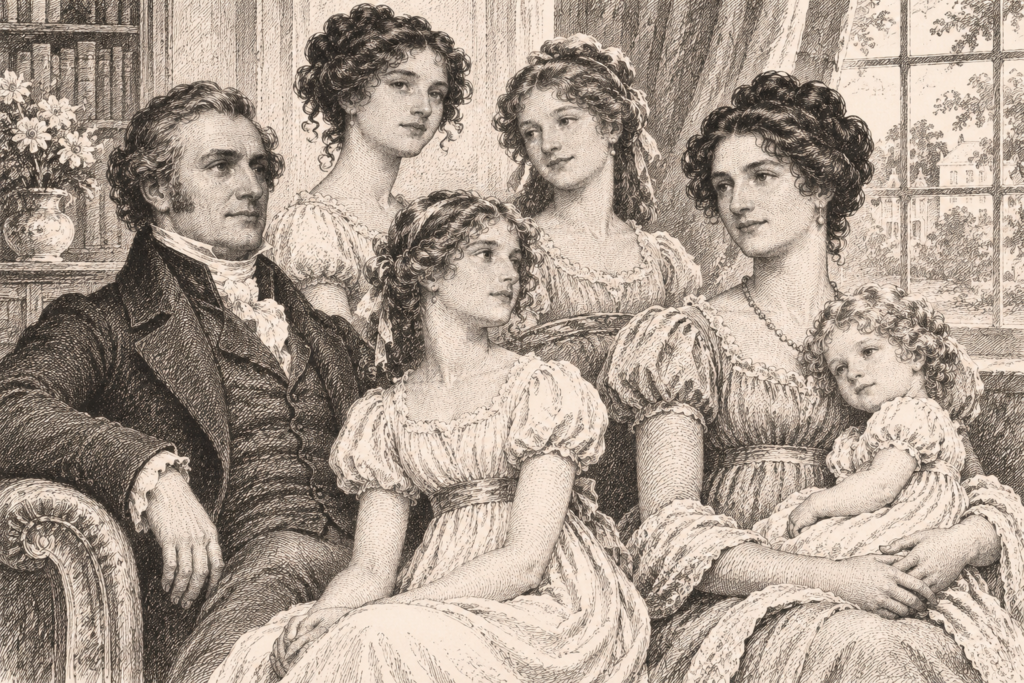
The Fairfaxes were a respectable family, though not one of great wealth. Edward was a younger son, and the prospect of inheriting the family estate had never been his. He had therefore looked elsewhere for a career, and in time entered the civil service of the East India Company.
Founded two centuries earlier as a trading concern, the Company had gradually acquired immense political and territorial power in India. By the beginning of the nineteenth century, it governed extensive regions, collected revenues and maintained its own civil and military establishments. Edward’s work was administrative rather than military, and service with the Company offered the prospect of advancement and a degree of financial independence that might otherwise have been difficult to secure.
Charlotte had accepted the prospect of India with the same practical determination with which she approached most of the duties of her life. She was not a woman given to impulsive decisions. The move would mean leaving familiar surroundings, relations and friends, but Edward’s prospects were promising, and she understood that the family’s future might depend upon his success.
The youngest child, Frances, was still very small when the family prepared to leave England. Jemimah was sixteen, old enough to understand something of what the decision meant, though not old enough to imagine how profoundly it would alter the course of her life.
The difference in age between the sisters meant that each occupied a rather different place in Jemimah’s affections. Georgiana, being close to her in age, had grown up as her companion and confidante. She was sensible and observant, and although she did not always share Jemimah’s inclination to question things, she understood her better than anyone else in the family. Sophia, quieter in temperament, was affectionate towards both her elder sisters and generally more inclined to accept the arrangements made for her. Frances, by contrast, was still a little girl. Jemimah had always been protective of her, and Frances adored her eldest sister, finding great pleasure in her company.
Jemimah had been educated at home, as was customary for a girl of her position. Her father encouraged her reading, and her mother ensured that she acquired the accomplishments and manners expected of a young woman. Jemimah was fortunate, too, in the presence of Miss Jane Ellwood, who had been engaged to assist with the education of the girls.
Jane was the daughter of the Reverend William Ellwood, a country clergyman whose family lived within reach of Englishcombe. Her circumstances were modest but respectable. She had been educated largely through her father’s library and private instruction, and had developed a serious interest in history, literature and the wider world. She was not particularly striking in appearance, nor did she make much effort to attract attention. Her intelligence was evident in conversation, and her dry humour sometimes surprised those who mistook her quiet manner for reserve.
Jemimah had found in Jane a companion as well as a teacher. Jane did not encourage her to question everything merely for the pleasure of disagreement, but she did teach her to look beyond the first explanation offered and to consider why people might think or behave as they did. She was patient with questions, even when they led into subjects that had little to do with the lesson in hand.
When the prospect of Bengal became certain, Jemimah’s curiosity was greater than her apprehension. She had read accounts of India, though she knew that books could convey only a limited impression of a place. She wondered about the people, the landscape, the languages and the customs. She had no intention of believing that everything she encountered would be as she had imagined it.
Jane, who was also preparing to leave the country of her birth, understood that they would all be newcomers. She had never lived in India and did not pretend otherwise. She and Jemimah spoke often of what they might find there, and Jane reminded her that the first impressions of a traveller were not always reliable.
On 27 May 1800, the Fairfax family together with Jane embarked at Torbay aboard the City of London, bound for Calcutta. They were leaving England behind for what would prove to be a long and uncertain passage to India
Their journey was long, and the experience of travelling by sea was unlike anything Jemimah had known. The gradual disappearance of familiar coastlines, the changing light and weather, and the presence of people whose lives and occupations were entirely different from those she had known at home made the voyage an education in itself.
She was conscious, as the ship approached Bengal, that she was leaving behind a childhood whose shape she could not yet understand. England remained her country, and she missed it, but she was also eager to see what lay ahead.
Calcutta was to become her home for the next several years. It would give her friendships she could never have anticipated, and introduce her to a world that was both more complicated and more fascinating than the books she had read. It would also bring her into the life of a man whose presence would eventually require her to make the most difficult decision of her young life.
She could not have known any of that as the ship carried the Fairfax family across the Bay of Bengal and up the Hooghly towards Calcutta, where they arrived on 6 December 1800. She knew only that a new country awaited them, and that she intended to understand as much of it as she could.