Late January 1809
Madhav had always known that, in time, his father would expect him to marry.
It was not an unreasonable expectation. He was twenty-nine years old, established in his father’s business and no longer a young man whose future could be left indefinitely undecided. His elder brother, Haranath, was expected to carry the principal responsibility for the family business, but Madhav had his own important place within it. His father relied upon him, and there were matters of commerce and administration for which he was increasingly responsible.
Marriage, too, was understood as part of the future that awaited him. It would bring another family into the circle of their relationships, strengthen existing connections and provide for the next generation. Madhav had never supposed that he would be free to disregard these expectations, nor had he wished to do so.
Until recently, he had assumed that when the time came, he and his father would discuss the matter and reach an understanding.
Now he found himself in a very different position.
His feelings for Jemimah were no longer something he could dismiss as an attachment that might pass. They had spoken openly enough to understand that they wished to consider a future together. Jemimah had shown herself willing to contemplate joining his household, and he knew that she was not approaching the prospect lightly. She understood that she would have much to learn and that marriage would bring responsibilities quite different from those she had known as a daughter in the Fairfax household.
He had been encouraged by her willingness, but he was also conscious that her acceptance alone could not settle the matter. His parents would have their own views, and he could not assume that they would welcome a decision which challenged so many of their expectations.
He had delayed speaking to them, partly because he wished to be certain of his own feelings and partly because he knew how difficult the conversation might be. But he could not continue to ask Jemimah to consider their future without first discovering whether his family would be prepared to consider it too.
He decided that he must speak to his father.
The opportunity came one evening when the business of the day was finished and Raghunath was sitting in his usual room, looking through a number of papers. Madhav had spent some time considering how best to approach the subject. He did not wish to make an announcement which would appear to challenge his father’s authority, but neither could he allow the matter to remain unspoken.
“Father, may I speak with you?”
Raghunath looked up.
“Of course. Is there something concerning the business?”
“Not directly. It is a family matter.”
His father put the papers aside and indicated that he should sit.
“Then tell me.”
Madhav took a moment before beginning.
“You have spoken before of the possibility of my marriage.”
“I have,” Raghunath replied. “You are no longer a young man, and it is right that we should give thought to your future.”
“I know.”
“It is a matter we shall need to consider seriously. Your responsibilities within the family are increasing, and I should like to see you settled.”
Madhav nodded.
“I understand, Father. And I am grateful that you have thought about my future. But there is something I should tell you before you make any arrangements.”
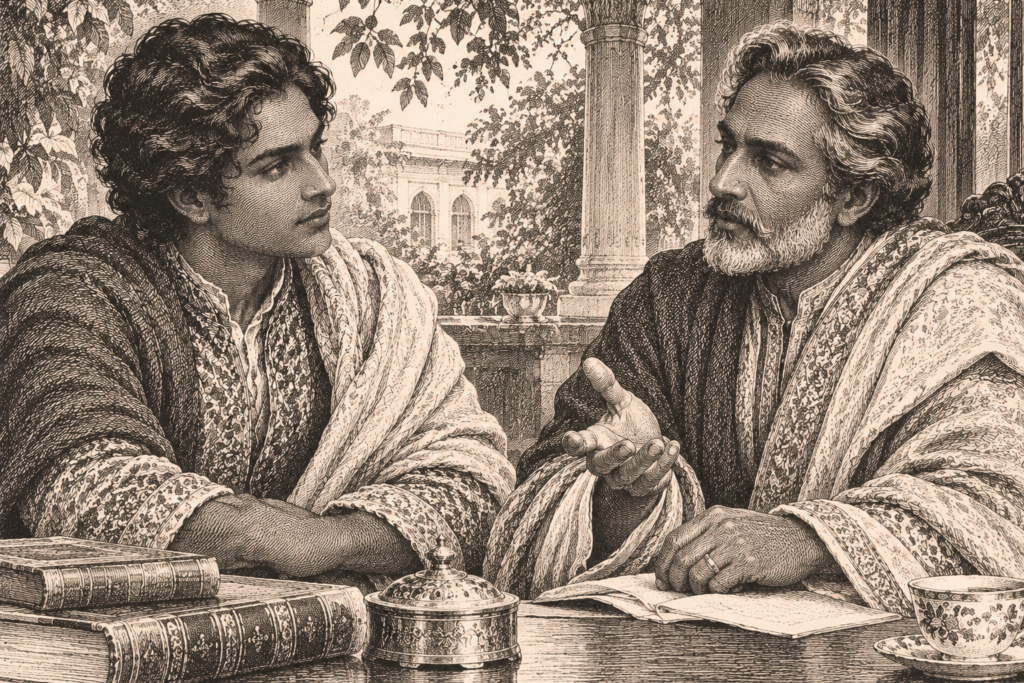
Raghunath studied him.
“What is it?”
“There is someone I have come to care for. We have known one another for some years, and our affection has become serious.”
His father did not interrupt, but Madhav saw a change in his expression.
“Who is she?”
“Miss Jemimah Fairfax.”
For a moment Raghunath said nothing.
“And you are telling me that you wish to marry this young woman?”
“I am telling you that we have come to understand that we wish to make a life together. I have not asked her to make any decision, nor have we made arrangements. But I believe I must speak honestly with you before matters go further.”
His father rose and walked a short distance across the room. He appeared less surprised than disappointed, as though something he had not wished to consider had now been placed before him.
“You have known her for some time …”
“Yes.”
“… and yet you have allowed this attachment to develop without speaking to your family?”
“I wished to be certain of my own feelings before bringing the matter to you.”
Raghunath turned towards him.
“Have you considered what such a marriage would mean?”
“I have been thinking of little else.”
“She is English. She has been brought up in a different religion, among people whose customs and expectations are not ours. You may admire her, and I have no reason to doubt that she is an intelligent and agreeable young woman. But marriage is not simply a matter of affection between two people.”
“I understand that.”
“Do you? A wife does not enter a family as a visitor. She becomes part of it. She shares its obligations, its customs and its religious life. Your mother would be expected to guide her, and the household would have to make room for someone whose upbringing has been entirely different from our own.”
Madhav listened without interruption.
“I know that Jemimah would have much to learn,” he said. “But she is not unwilling to learn. She has always shown genuine interest in our family and our customs. She has become very fond of you and Mother, and of Kamala and Anandamayi.”
“That is not the same as being able to live by our customs.”
“No. But I believe she would make every effort to understand them.”
“And what would she be expected to do when those customs conflict with her own beliefs?”
Madhav was quiet for a moment.
“I would not ask her to pretend to believe what she does not believe.”
“And would that be sufficient? What of the religious life of this household? What would become of the traditions which have been observed here for generations? Your mother could not simply disregard them, nor could I expect her to.”
“I have thought about that.”
“Have you thought about your children? Would they be brought up in our faith? Would they understand the traditions of their father’s family? Or would you allow them to be divided between two worlds, pleasing neither?”
Madhav had considered the question, but he knew there was no easy answer.
“I would wish them to know their father’s faith and traditions, and also to understand their mother’s.”
“That is not an answer.”
“No,” Madhav replied quietly. “It is not. We have not yet reached an answer to every question.”
Raghunath returned to his seat.
“Then you are asking me to accept a marriage for which you have not even considered all the consequences.”
“I am asking you to consider whether there might be a way for us to live together without abandoning either family.”
His father looked at him for a long moment.
“You speak as though this were simply a question of finding an arrangement which would satisfy everyone. It is not. There are matters which cannot be reconciled by goodwill alone.”
“Perhaps. But I should like to understand whether you would refuse the marriage under any circumstances.”
Raghunath’s expression became more serious.
“I cannot approve of it, Madhav. I had hoped you would make a suitable marriage within our own community. There are families whose circumstances and traditions are known to us, and whose daughters would be able to take their place in this household without the difficulties you now propose.”
Madhav understood that his father was not speaking of an abstract possibility. There were particular families in their social circle whom Raghunath considered suitable.
“I had hoped you might at least be willing to consider Jemimah.”
“I have considered what you have told me. But you must also consider what you are asking of us.”
“I have no wish to turn away from my responsibilities.”
“Then you must think carefully. Your position in this family is not yours alone. You have a responsibility to your mother, your brothers and the work your grandfather and I have built. Your choices will affect them all.”
Madhav lowered his eyes briefly.
“I know, Father.”
“I hope you do. I do not wish to see you unhappy, but neither can I disregard the obligations which belong to this family.”
There was a pause before Raghunath continued.
“There is a family I have been considering for you. You know the Mukherjees, of course. I have known them for many years, and I believe the connection would be a suitable one. Their daughter, Sabitri, is of an appropriate age, and I should like you to consider it.”
Madhav recognised the family name.
“I know the family, Father.”
“And you have met Sabitri?”
“Yes.”
“She is well brought up, and her family is respectable. I believe the match would be a good one.”
Madhav looked at his father.
“I could not consider another marriage while my feelings for Jemimah remain as they are.”
Raghunath’s expression tightened, but he did not raise his voice.
“I am not asking you to make a decision this evening. I am asking you to give thought to what I have said. You must not assume that the wishes of two people can be considered without regard for everyone else.”
“I shall think about it.”
“I hope you will.”
The conversation ended without agreement. Raghunath had not threatened him, nor had he demanded that he immediately abandon the idea. But Madhav understood that his father had made his position clear. He could not expect an easy acceptance, and the possibility of a marriage within the family had been firmly discouraged.
Madhav left his father’s room with a heavy sense of responsibility. He had not expected the conversation to be easy, but he had hoped that his father’s affection for him, and his knowledge of the Fairfax family, might make him more willing to consider the possibility.
He knew now that this was unlikely.
A few days later, he spoke to his mother.
He found Annapurna in the inner part of the house, attending to a small matter concerning the household. She looked up when he entered, and he sat beside her. For a little while they spoke of ordinary family matters before he told her that he had something important to discuss.
“Mother, I must tell you something. There is someone I have come to care for.”
Annapurna looked at him with quiet attention.
“Jemimah Fairfax?”
He nodded.
“I have wondered whether there was something between you,” she said. “She has always seemed very fond of you, and you have often spoken of her. I had thought it was a friendship.”
“It has become more than that.”
Annapurna was silent for a moment. She did not appear angry, but he could see that the news troubled her.
“She is a good young woman,” she said. “I have always liked her. She is courteous, curious about our household and affectionate towards Kamala and Anandamayi. I know that she has been welcomed here.”
“She has.”
“But to welcome her as a friend is not the same as welcoming her as your wife.”
“I know.”
Annapurna looked down at the work in her hands.
“I have thought about what it would mean. She would have to live among us, and there would be so much that would be unfamiliar to her. I should wish her to be happy here, but I do not know how that could be achieved. Our customs are not merely habits which we can change when convenient. They are part of our faith and the way we understand our family.”
“I would not ask you to change them.”
“And what would she be asked to change?”
“Nothing that she could not accept willingly.”
Annapurna looked at him.
“You cannot know that. Nor can she, until she has lived here as a wife rather than visited as a friend.”
Madhav was quiet. He had made much the same distinction himself, but hearing it from his mother gave it a different weight.
“I do not wish to lose her,” he said.
His mother’s expression softened.
“I know, my son. And I do not wish to see you unhappy. But I cannot pretend that I can welcome this marriage without fear. I should worry about her, and about you, and about the place of your children in the family.”
She reached out and touched his hand.
“You must think very carefully. Your father has his responsibilities, and I have mine. I cannot tell you that I agree with him in every matter, but in this I understand his concern.”
Madhav knew that she meant what she said. Her affection for Jemimah was genuine, but it could not overcome the beliefs by which she had lived her life.
A day or two later, Kamala came to Basu Bari to visit her mother. She and Madhav found themselves together in a quieter part of the veranda while the household went about its afternoon business. He had been considering whether to speak to her, but now that the opportunity had come, he found himself hesitating.
“Kamala, there is something I should like to talk to you about.”
She looked at him with interest.
“You sound rather serious. What is it?”
“It concerns Jemimah Fairfax. I have come to care for her very deeply, and I believe she feels the same about me.”
Kamala looked at him in surprise. She had known that they were close, and had often seen how readily they sought one another’s company, but she had not realised that their feelings had become so serious.
“You mean that you wish to marry her?”
“Yes. We have begun to speak about what that might mean.”
Kamala was quiet for a moment.
“And have you spoken to Father?”
“I have.”
“And what did he say?”
“You can probably guess.”
She looked at him more closely.
“I am sorry,” she said. “I know how fond you are of her.”
“I had hoped that he might be willing to consider it.”
“Did you explain that she has been willing to join the household?”
“I did. She understands that it would mean a considerable change in her life, but she is not unwilling.”
Kamala considered this.
“That is a great deal for her to contemplate. She has grown fond of us, but she has known us as friends. It is different to become part of the household, with all the responsibilities that would bring.”
“I know.”
“And what did Mother say?”
“She likes Jemimah, but she cannot imagine her living here as my wife.”
Kamala nodded slowly. She understood her mother’s feelings, even if she did not necessarily find them easy to accept.
“Have you thought about what it would mean for Jemimah?” she asked. “Not only living here, but being separated from the life she has always known?”
“She would not be separated from her family .”
“But would they accept her marriage? And would she be able to visit them as freely as she does now? You know how people talk. It would not be easy for her.”
“I have thought of that.”
“And what of her faith? Would she be expected to take part in things she does not believe? Would she feel that she had to change herself to please us?”
“I would not want that.”
“Then you must be certain that she understands what she is choosing. It is not enough that she likes us, or that we like her.”
Madhav smiled faintly.
“You sound very much like Father.”
Kamala gave a small laugh.
“Perhaps because I have thought about it from his point of view, as well as yours. I do not say that I cannot understand why you wish to marry her. I can. But I should not like to see either of you enter a life which brings unhappiness to everyone.”
“I would not wish that either.”
Kamala looked at him more directly.
“Do you love her?”
“Yes.”
“Then I hope you will find a way to be happy. But you must not mistake the affection we have for her for an assurance that the marriage would be accepted.”
He knew she was right.
By the time Madhav left Kamala, he had little doubt about the position of his family. His father would not approve, and neither his mother nor his sister could see how the marriage might be accommodated within the household. Their affection for Jemimah had not been in question. That, in some ways, made the situation more painful.
He thought again of the conversation in the garden, when Jemimah had spoken of making a home at Basu Bari. She had not been reluctant. She had seemed willing to learn, to adapt and to become part of the family. He knew that she would make every effort to do so.
But it was not hers alone to decide.
He had hoped that his parents might be willing to consider the possibility, even if they could not immediately approve of it. Now he understood that their objections went deeper than he had wished to believe.
He could not ask Jemimah to give up the life she knew in order to join a family which might never fully accept her.
Yet he could not bring himself to abandon the thought of a life with her.
He would have to consider whether there was another way for them to build a future together, one which did not require either family to change its deepest convictions, and which would allow them to remain true to themselves.
He had no answer yet. But he was beginning to understand that he must find one.