1806–1807
Jemimah’s visits to Basu Bari became more frequent during the months that followed. At first they were made with her parents, but as the families grew more familiar with one another, she was sometimes invited to spend an afternoon with Kamala and Anandamayi while Edward and Charlotte attended to other engagements.
She soon found that the household had its own rhythm, quite distinct from that of the Fairfax home. There were visitors, family matters, business discussions and the daily work of the household. The courtyard was rarely still for long, and there was nearly always someone passing through with a message or a question. Jemimah began to recognise the voices of those who worked there, and to understand something of the small routines which made up the life of the family.
She was also becoming increasingly comfortable with the different arrangements of the house. What had seemed unfamiliar on her first visit now appeared quite natural. She knew where the family usually gathered, where visitors were received, and which rooms were likely to be occupied at different times of the day. She was still curious about many things, but no longer felt that she must observe everything at once.
Of all the members of the family, Kamala became her closest companion. They were not so alike that they had nothing to learn from one another, nor so different that conversation became difficult. Kamala was intelligent and perceptive, with a quiet confidence that Jemimah admired. She was accustomed to the responsibilities of her own household, and she sometimes spoke of the adjustments she had made after marriage. Jemimah listened with interest, for these were experiences very different from her own.
Kamala, in return, was curious about Jemimah’s upbringing. She wanted to know about England, about the Fairfax family home, and about the way in which young women were educated and introduced into society. They sometimes discovered that they had made quite different assumptions about one another’s lives.
Their conversations were conducted in English whenever possible, though Kamala occasionally struggled to find the precise word she wanted. Madhav would sometimes help, although he was careful not to take over the conversation. On other occasions, a gesture or an amused expression was sufficient to make the meaning clear.
Anandamayi was a livelier presence. She enjoyed teasing her brother and was quick to notice when a conversation became too serious. She was affectionate towards Madhav and plainly admired him, though she was quite capable of disagreeing with him. She also took pleasure in having Jemimah to talk to, and was always ready to ask about the latest news from the Fairfax household.
She was less interested than Kamala in long discussions about books and family responsibilities, but she enjoyed music, stories and the ordinary happenings of the day. Sometimes she would bring a piece of embroidery to show Jemimah, or ask her to describe a tune she had heard at one of the British gatherings. Jemimah found her company refreshing, and soon came to look forward to the interruptions she was inclined to make when the others became too absorbed in their conversation.
Annapurna remained somewhat reserved when speaking directly with Jemimah, largely because of the difficulty of language, but her welcome was unmistakable. She would ask after Jemimah’s family and make sure that refreshments were offered. Jemimah gradually came to understand that much of Annapurna’s communication was conveyed through gesture, expression and the practical kindnesses of hospitality.
She also noticed the quiet authority with which Annapurna managed the household. Servants came to her with questions, visitors were received, and family arrangements were discussed in her presence. She was not always at the centre of the conversation, but she was rarely unaware of what was happening around her. Jemimah had come to admire the way in which she combined warmth with a firm understanding of her responsibilities.
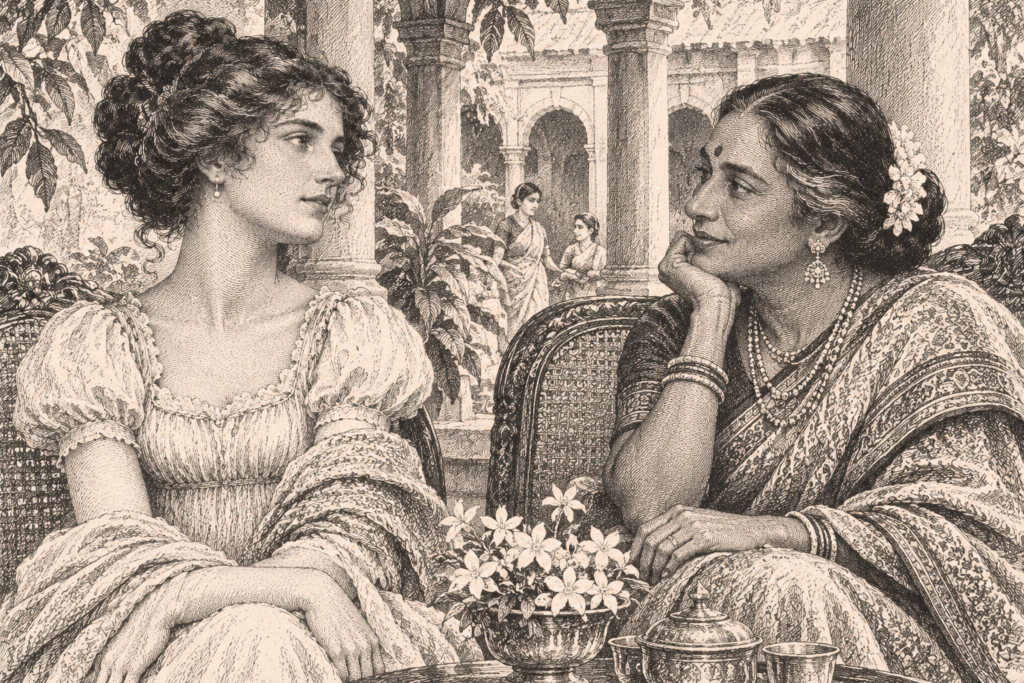
On one occasion, Jemimah complimented Annapurna on a dish which had been served with the afternoon refreshments. Annapurna smiled broadly, and Madhav, who was sitting nearby, translated the remark.
“My mother is pleased,” he said. “She says you must try it again when you next come.”
“I shall be very glad to.”
Annapurna replied, and Madhav translated again.
“She says that you must not be too polite. If you do not like something, you should say so.”
Jemimah laughed.
“Then I shall have to be careful. I should not wish to offend her.”
Madhav answered his mother, who shook her head with amusement.
“She says that she would rather you were honest.”
“Then I shall endeavour to be.”
Annapurna smiled, apparently satisfied, and turned to speak to someone who had approached her with a question. It was a small exchange, but Jemimah felt that she had been welcomed a little further into the family.
Madhav was often occupied with his father’s business, but he joined them whenever he could. He and Jemimah discovered that they shared an interest in books and history. Their conversations were not always profound. Sometimes they spoke of a passage they had read, or of a question raised by a book, or of some incident in the city. It was the ease of these exchanges that Jemimah valued.
He was interested in her reading, and she found that he was willing to discuss almost any subject without making her feel that she ought to know more than she did. He rarely offered an opinion merely to demonstrate his knowledge, and when they disagreed he seemed to regard it as an opportunity for further conversation rather than a discourtesy.
One afternoon, when they were sitting together in the reception room, Jemimah remarked upon a book she had recently finished.
“I have been fortunate in having Miss Ellwood as my teacher,” she said. “She has always encouraged me to read beyond what might ordinarily be considered suitable for a young lady.”
“And what would ordinarily be considered suitable?” Madhav asked.
Jemimah laughed.
“I suspect that depends upon the lady, and upon the opinion of the person making the judgement.”
“That seems a sensible answer.”
“I have always thought it rather unfortunate that curiosity should be regarded as a failing in a woman.”
Madhav looked amused.
“Perhaps it is only regarded as a failing when it leads her to ask questions which other people would prefer not to answer.”
Jemimah smiled.
“I shall remember that.”
He was often gently teasing, particularly when she expressed an opinion with more certainty than the subject deserved.
“I have considered the possibility that I might be mistaken,” she told him on one occasion. “I have simply decided that I am not.”
He laughed, and she was pleased to have made him do so.
Their shared interest in books led to longer conversations. Jemimah was particularly fond of history, though she had sometimes been dissatisfied with the way in which it was written. One afternoon she was looking through a volume which Madhav had brought into the room. He noticed that she had paused over a passage and seemed less than convinced by the author’s argument.
“You seem to disagree with him,” he observed.
“I do. He makes it sound as though the history of a country can be understood entirely through the actions of its rulers. I think there must be rather more to it than that.”
“I should agree with you. The lives of ordinary people rarely find their way into such accounts, though they are the people who experience the consequences.”
“Exactly! A king may make a decision, but it is other people who must live with the consequences.”
“Most of the records which survive were made by people in positions of authority,” Madhav replied. “They tell us what governments did, what land was taxed, what battles were fought. They rarely tell us what a family thought when its circumstances changed.”
“Or what a woman thought when she had to leave her home,” Jemimah added.
“Or what a merchant thought when a new regulation altered his business. Or what a child remembered of a journey.”
Jemimah looked up.
“Then perhaps histories ought to be written from the point of view of the people who lived through events.”
“That would be difficult,” he said. “It would require patience, and a willingness to look for evidence that is not always easy to find.”
“I should not mind the patience.”
“I can believe that.”
She laughed. “You make it sound like a formidable undertaking.”
“Perhaps it is. But you seem to have the necessary curiosity.”
“Curiosity is not the same as knowledge.”
“No,” he said. “But it may be where knowledge begins.”
There were other occasions when the four of them spent time together. Sometimes they read, sometimes they talked, and sometimes they simply sat in the shade while the household continued around them. Kamala might be occupied with a letter or some domestic matter, while Anandamayi embroidered or listened to the conversation. Madhav would sometimes be called away to speak with his father, only to return later and take up the discussion where it had been left.
Jemimah also began to understand that the Basu family was not a single, uniform household in which everyone thought alike. Raghunath’s authority was clear, and his expectations of his sons were considerable. Haranath, the eldest, was serious and practical, already accustomed to the responsibilities that would eventually fall upon him. Gopinath was more sociable and light-hearted, and looked up to Madhav. The younger members of the family had their own interests and opinions, even when they understood the limits imposed by family duty.
Madhav’s position was not always an easy one. His education in England had given him a wider perspective, but he was also conscious of what he owed his parents and the family business. He did not speak of these obligations as though they were merely restrictions. They were part of the life he had been brought up to value, and he took pride in his family’s standing and in the work his father had built.
Jemimah found this interesting. She had been taught to think of duty as something that could sometimes be burdensome, particularly when it was imposed without question. Madhav seemed to regard it as something more complicated: a responsibility that could bring satisfaction as well as constraint. He did not necessarily agree with every expectation placed upon him, but neither did he dismiss them lightly.
Kamala understood this side of her brother particularly well. She knew how much was expected of him, and occasionally reminded him that he was not obliged to spend every available hour discussing business with their father.
“You will make yourself quite indispensable,” she remarked to him one afternoon, “and then you will never be allowed to do anything else.”
Madhav smiled.
“I believe that is the intention.”
“Then you should take care. You may find that you have no time left for books.”
“Or for the peace and quiet in which to read them,” Jemimah added.
Kamala laughed, and Madhav looked from one to the other with an expression of mock resignation.
“I see that I have very little sympathy in this room.”
“You have plenty,” Kamala replied. “But you must sometimes be reminded that there are other things in life.”
Jemimah enjoyed these glimpses of the affection between the members of the family. Madhav was thoughtful and composed in company, but with his sisters he could be more relaxed. Kamala teased him without hesitation, while Anandamayi was quick to seek his attention and approval. He was not simply the young man she enjoyed talking to; he was a much-loved son and brother, with a place in a family whose life was already full of its own relationships and responsibilities.
By the end of 1807, the Fairfaxes and the Basus were no longer merely acquaintances who met occasionally at one another’s houses. There was genuine affection between the families. Edward and Raghunath continued to enjoy their discussions, while Charlotte had grown comfortable with Annapurna and the other women of the household. Jemimah’s friendship with Kamala had become a valued part of her social life, and Anandamayi had become a familiar and welcome companion.
And Madhav had become someone she looked forward to seeing.
She did not yet ask herself why his presence mattered so much, nor did she examine too closely the pleasure she felt when a conversation with him lasted longer than she had expected. She simply knew that they understood one another in a way she had not often experienced. She trusted his judgement, enjoyed his humour and felt able to speak freely in his company.
For the present, that was enough.