Spring 1806
The months following the Fairfaxes’ dinner passed without any dramatic change in the pattern of their lives, though the acquaintance between Edward and Raghunath continued to grow. The two men discovered that they had more in common than their initial business dealings had suggested. Both valued sound judgement, both took their family responsibilities seriously, and neither was inclined to waste time on empty conversation.
Raghunath occasionally called upon Edward, sometimes accompanied by Madhav. On other occasions, Edward was invited to visit the Basu family’s business premises, where he gained a better understanding of the range of their commercial interests. Their conversations were not always confined to business. They spoke of the changes taking place in Calcutta, of the Company’s growing influence, and of the difficulties of conducting trade in a city where so many different interests met.
Charlotte, meanwhile, had begun to regard the Basus as more than simply business acquaintances. She was pleased that Edward had found a gentleman whose company he enjoyed, and she was curious about the family behind him. She had heard enough about their household to understand that it was a substantial one, and that Raghunath’s position in the Bengali community was considerable.
It was therefore no surprise when an invitation arrived for the Fairfaxes to visit Basu Bari.
The invitation was extended to the whole family, and Charlotte was pleased to accept. Jemimah, too, was interested. She had spoken with Madhav on several occasions since their first meeting, but always in the familiar surroundings of British households. She had not yet seen the world in which he lived, and she was curious to discover something of it.
The visit was arranged for an afternoon in the early Spring of 1806.
They travelled through the city in the Fairfax carriage, accompanied by a servant who knew the route. As they left the more familiar streets behind, Jemimah found herself looking out with particular attention. The movement of people and vehicles seemed endless, and the variety of buildings and shops gave her the impression that she was passing through several different worlds within a single city.
Although Jemimah had lived in Calcutta for several years, she had never before been invited into the private home of a Bengali family. She had seen something of the city and its people in the course of everyday life, and had often wondered about the households behind the great entrances and courtyards she passed. But until now, her own social world had remained largely within the British community. She was conscious that this visit would be a new experience, and she was determined to observe everything with interest, while taking care not to appear too curious.
“Papa,” she asked, “Mr Basu’s house is called Basu Bari, is it not? What exactly does Bari mean?”
“It means house, or home,” Edward replied. “You will find that it is often used in the name of a family residence. Basu Bari is, quite simply, the home of the Basu family.”
“I see. And is it much like our own house?”
Edward smiled. “I think you will find it rather different. I have visited a number of Bengali households in the course of my work, and their arrangements are not quite those to which you are accustomed. The house is generally built around a courtyard, with different rooms and areas serving particular purposes. Family life is rather more closely gathered together than ours, and there may be many more people moving about than you would expect.”
“Do you mean the whole family lives there?”
“In some cases, yes. Sons, their wives and children, unmarried daughters, and other relations may all form part of the household. There are also servants and people whose duties are connected with the family business. You must remember that a house of this kind is not simply somewhere people sleep. It is the centre of family life.”
Jemimah looked out of the carriage window, newly curious.
“Then I shall have a great deal to see.”
“You will,” Edward replied. “But remember, my dear, that you are a guest. Be interested, by all means, but allow your hosts to show you what they wish you to see.”
“I shall try, Papa.”
“I have no doubt you will. Though I suspect Miss Ellwood has already taught you that curiosity is not always a fault, provided it is accompanied by good manners.”
Jemimah smiled. She had no intention of being discourteous, but she was already wondering what she might discover.
Basu Bari stood behind a substantial entrance which gave little indication of the size and activity of the household within. Once they had entered, however, Jemimah found herself in a spacious courtyard, with rooms and covered verandas arranged around it. There was a sense of movement everywhere, though not of disorder. Servants carried things from one part of the house to another, voices could be heard from rooms beyond the courtyard, and somewhere nearby came the sounds of household work and conversation.
The air held the faint fragrance of cooking, and Jemimah caught glimpses of activity through open doorways. Women were speaking together in one part of the house, while a servant crossed the courtyard carrying a tray. A child hurried past, apparently intent on some errand of his own, and disappeared into another room.
It was unlike the arrangement of the Fairfax home, where the different activities of the household were more clearly separated. Here, family life seemed to extend through the building, with the courtyard providing a natural meeting place between its different parts.
Raghunath came forward to welcome them, accompanied by Madhav. He greeted Edward warmly, and then turned to Charlotte.
“Madam, we are very pleased that you have come. I hope you will find our home agreeable.”
Charlotte thanked him, looking about with interest.
“It is most kind of you to receive us. Your house is very handsome.”
Raghunath inclined his head, and Madhav offered to show them into the rooms where refreshments had been prepared.
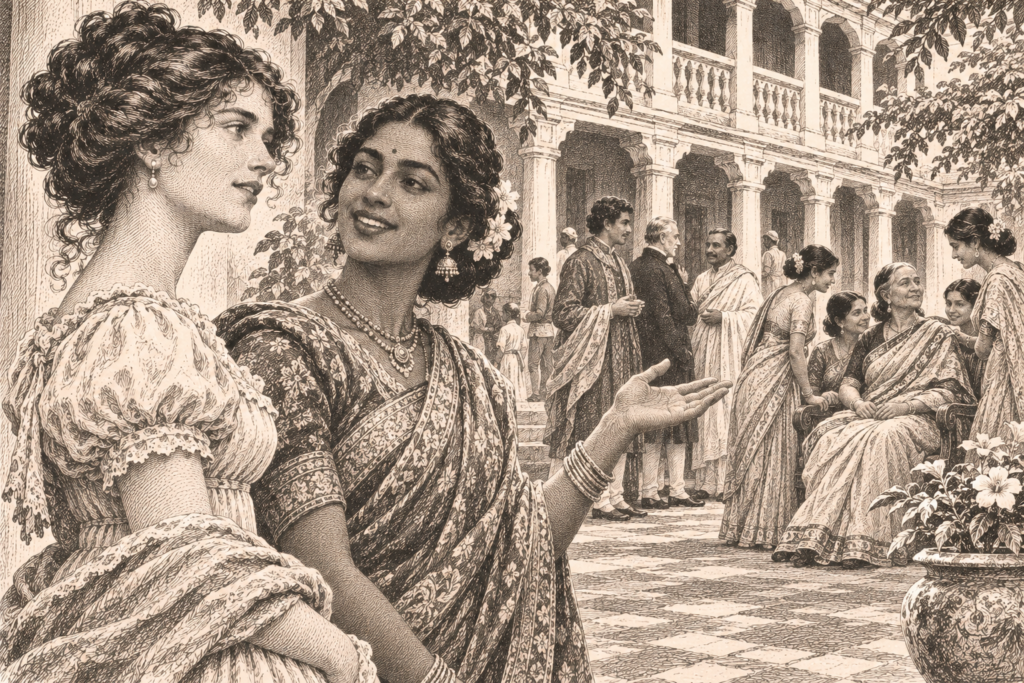
Jemimah followed her parents, conscious that she was entering a household whose arrangements were quite different from those of her own. There were areas clearly intended for family use, and others in which visitors were received. She noticed that the courtyard formed the centre of much of the household’s activity, and that the rooms opening onto it seemed to offer a degree of privacy while remaining connected to the rest of the house.
Madhav explained something of the arrangement as they walked.
“Our family has lived in this house for many years,” he said. “It has been altered and extended, but the courtyard has always been at its centre.”
“It seems a very practical arrangement,” Jemimah replied.
“It is, though I suspect every member of the family would give you a different reason for liking it.”
He smiled, and she found herself wondering what those reasons might be.
They were received in a comfortable room where refreshments had been prepared. Edward and Raghunath soon settled into conversation, while Charlotte was introduced to Raghunath’s wife, Annapurna.
Annapurna was not quite what Jemimah had imagined. She was dressed elegantly, though without ostentation, and her manner was composed and welcoming. She spoke some English, but not with the fluency of her son. At first, conversation between her and Charlotte was necessarily limited, with Madhav occasionally helping when a word or expression proved difficult. Yet there was no sense of embarrassment. Annapurna smiled readily, and her interest in her visitors was evident.
Jemimah was introduced to her, and Annapurna greeted her warmly. Madhav then introduced his sister Kamala, who had come to the house for the afternoon, and his younger sister Anandamayi.
Kamala was married and lived with her husband in a nearby household, but she remained closely connected with her family and visited frequently. She was several years older than Jemimah, with an intelligent expression and an easy manner. Anandamayi, still unmarried, was younger and more openly curious about their visitors.
The introductions were conducted with a little assistance from Madhav, though Kamala spoke enough English to make conversation possible. She had a lively interest in the British family and asked Jemimah how long they had lived in Bengal.
“For about five years,” Jemimah replied. “I remember very little of England now, though I hope to see it again one day.”
“Do you miss it?” Kamala asked.
“Sometimes. But there is so much here that I have not yet discovered.”
Kamala smiled.
“Then perhaps you must come again. There is much to see in our household too.”
Jemimah laughed.
“I should like that very much.”
The two young women found that they could converse more easily than Jemimah had expected. Kamala’s English was not perfect, but she was intelligent and expressive, and she had a gift for making herself understood. She was also interested in hearing about Jemimah’s life, rather than merely asking polite questions.
Anandamayi, who had been listening, eventually joined in. She was more hesitant in English, but her curiosity overcame her reserve. She asked Jemimah whether she liked music, whether she had sisters, and whether she enjoyed living in Calcutta.
When Jemimah told her that she had three sisters, Anandamayi was surprised.
“Three? And you are the eldest?”
“Yes.”
“Then you must have a great deal to do.”
Jemimah smiled.
“Not as much as you might suppose. My sisters are quite capable of occupying themselves.”
Anandamayi laughed, and the small exchange seemed to put them both at ease.
During the afternoon, Jemimah began to understand that Basu Bari was not simply a large house in which a prosperous family lived. It was a place where family relationships, business, hospitality and household responsibilities were closely interwoven. People came and went, and there was a constant sense of activity beyond the rooms in which the visitors were received.
She was particularly struck by Annapurna’s manner. Although she did not speak much English, she was clearly at the centre of the household. Servants came to her with questions, and she dealt with them calmly and decisively. She was attentive to her visitors without allowing the demands of hospitality to distract her from the other responsibilities of the house.
Jemimah found herself admiring her.
At one point, while Charlotte and Annapurna were being helped through a conversation by Madhav, Kamala drew Jemimah’s attention to a small group of women who had come into the courtyard.
“They are relatives,” she explained. “My mother’s cousin and her daughters. They have come to visit.”
Jemimah watched as they greeted Annapurna and exchanged news. Their conversation was animated, and there was an ease between them which suggested long familiarity.
“You see,” Kamala said, noticing her interest, “our mother has many visitors. She is not often without someone to talk to.”
Jemimah smiled.
“I am glad. I had wondered whether she found it difficult to receive visitors who speak so little of her language.”
“She understands more than she says,” Kamala replied. “And she knows how to make people welcome without needing many words.”
It was a remark which Jemimah remembered.
Later, the family were invited to take refreshments. The conversation became more relaxed, and Madhav joined them after spending some time with his father and Edward.
He asked Jemimah what she thought of the house.
“It is very different from ours,” she said, “but I like it. There seems to be so much life in it.”
“There usually is,” he replied. “Sometimes more than I would wish.”
Kamala, who had overheard him, laughed.
“He means that he cannot always find a quiet room in which to read.”
“Is that so?” Jemimah asked.
“I am afraid my sister exaggerates.”
“Not at all,” Kamala replied. “He has always believed that a book is a sufficient reason to escape the rest of us.”
Madhav smiled, accepting the accusation with good humour.
Jemimah was beginning to see something of the family relationships which lay behind his quiet manner. He was clearly loved, and not merely because he was the son expected to carry forward his father’s business. Kamala teased him without hesitation, while Anandamayi watched him with the affectionate admiration of a younger sister.
It was a warm and welcoming household, though Jemimah understood that its customs and expectations were not the same as those of her own family.
The visit was not long, but it left a strong impression on her. She had expected to find unfamiliar customs and arrangements, and she had found them. But she had also discovered familiar things: affection between brothers and sisters, the care of parents for their children, the bustle of a busy household and the pleasure of welcoming guests.
As the afternoon drew to a close, Raghunath and Annapurna expressed the hope that the Fairfaxes would visit again. Charlotte thanked them warmly, and Edward said that he would be pleased to continue their conversations.
When they were ready to leave, Kamala turned to Jemimah.
“I hope you will come again,” she said. “We have not had time to talk properly.”
“I should like that very much.”
“Then we must arrange it.”
Jemimah left Basu Bari with a sense that she had been given a glimpse into a world which she had known only at a distance.
On the journey home, Charlotte remarked that Annapurna had been a very gracious hostess, despite the difficulty of conversation.
“She seemed very capable,” Jemimah said.
“She plainly manages a large household,” Edward observed. “Raghunath is fortunate to have such a wife.”
Jemimah looked out of the carriage window, thinking of Kamala and Anandamayi. She had enjoyed their company, and she hoped that the invitation would be repeated.
She had gone to Basu Bari expecting to learn something about Madhav’s family. She had come away feeling that she might have found new friends.
And that, though she did not yet know it, was the beginning of a much closer acquaintance.