Friday, 15 September 1809
Jemimah woke before dawn.
For a few moments she lay still, looking towards the familiar outline of the furniture in her room. The house was quiet, and the first faint sounds of the morning had not yet begun. Then she remembered. This was the day she would leave Calcutta.
She had slept little, though she had tried to rest. Her thoughts had moved repeatedly between the people she was leaving and the life she and Madhav hoped to begin. She felt apprehensive, but beneath the uncertainty there was also a sense of calm. The decision had been made, the arrangements completed, and there was no longer anything to be gained by hesitation.
She rose and dressed carefully in a practical travelling gown, with a shawl against the morning air and a bonnet which would not be too cumbersome when she went aboard. Her small reticule contained her purse, a handkerchief and a few personal necessities. There was little else she needed to carry.
Her locket rested beneath her dress. Inside it were the locks of hair from Georgiana and Frances. She touched it briefly, thinking of her sisters, before turning away from the dressing table.
She looked around her room once more. Her books stood on the shelves, her writing things remained on the table, and the familiar objects which had accompanied her through so many years were still where she had left them. She had chosen to take very little with her. Most of what she owned would remain behind, just as the rooms themselves would continue to be part of the life she had known.
The house was still quiet as she made her way downstairs. She had no wish to wake anyone or risk an unexpected encounter. The servants would soon begin their morning duties, and the family would wake to another ordinary day, unaware that Jemimah had already gone.
She paused for a moment in the hall, looking towards the rooms beyond it. She thought of her childhood, of her sisters playing and reading together, of her mother’s familiar presence and her father’s quiet voice. There had been disagreements and disappointments, as there were in every family, but there had also been affection, security and many happy years.
She felt the sadness of leaving them, but she knew that she could not remain simply because the parting was painful.
Then she let herself out.
The morning air was warm, and the streets were beginning to stir. Jemimah made her way towards Tank Square, conscious of the familiar sounds of Calcutta around her. Vendors were beginning their calls, carts moved along the streets, and people were already occupied with the business of the day.
She had known this city for nearly nine years. It had been strange and unfamiliar when she first arrived, a place she had tried to understand through observation, questions and the books she could find. Gradually, it had become home. Its streets, its river, its varied people and customs, and the friendships she had made there had become part of her life.
She wondered whether she would ever see it again.
At eight o’clock she reached the southern side of Tank Square, near Old Court House Street. Madhav was already there. He had arrived early, and when he saw her approaching, he came forward to meet her.
“You are here,” he said.
“Yes. I was afraid I might be late.”
“I have been here for some time. There was no need to hurry.”
She smiled, though he could see that she was nervous.
“Are you well?”
“I think so. I did not sleep very much.”
“Nor did I.”
For a moment they stood together, neither quite knowing what to say. They had spoken so often about this morning, and yet now that it had arrived, it seemed difficult to believe that they were actually standing there, ready to leave.
Madhav had arranged for a carriage to meet them near Tank Square. Before they went to it, they walked the short distance to the keeper’s premises, and he brought out the travelling case without asking questions. Madhav thanked him, and the case was placed securely in the carriage beside his own smaller bag.
The keeper had looked after their belongings as promised. There was no delay, and soon they were on their way towards the riverfront.
Jemimah looked out through the carriage window as they made their way towards the Hooghly. The familiar streets were beginning to stir, and the sounds of Calcutta came to them through the open window: the calls of vendors, the movement of carts and the voices of people beginning their day’s work.
She recognised buildings and street corners, some associated with particular memories, others simply familiar through years of passing them. She thought of the journeys she had made with her father, the visits to friends, and the many occasions when she had travelled through these streets without giving much thought to where she was going.
Now every familiar sight seemed to matter.
Madhav sat opposite her, allowing her the quiet she needed. He, too, was leaving a city in which he had spent almost all his adult life. Although he had travelled to England as a young man, he had always known that he would return to Calcutta. This departure was different. He was leaving his family, his father’s business and the familiar surroundings in which his life had been shaped.
At last Jemimah turned from the window.
“I wonder whether it will seem strange when we are no longer here.”
“It will,” he replied. “There will be many things we shall miss.”
“Do you regret it?”
He considered her question.
“No. But that does not mean I find it easy.”
She nodded. She understood exactly what he meant.
When they reached the riverfront, the Meridian was already preparing for departure. She was a British merchant brig, smaller than the great East Indiamen Jemimah had often seen in the river, but a substantial vessel nevertheless. Men were moving about the deck, attending to the final preparations, while others were occupied with the cargo and the ship’s lines.
The carriage stopped, and the cases were taken down. Madhav spoke briefly with the agent, who confirmed their passage and directed them towards the gangway.
The captain came forward as they approached.
“Mr and Mrs Basu?”
“Yes,” Madhav replied.
“Welcome aboard. We are making ready to sail shortly. Your cabin is below, and one of the crew will show you where it is.”
Jemimah followed Madhav up the gangway and onto the deck. She glanced back towards the wharf, where the carriage was being driven away, and then towards the ship around her. The crew were busy with their duties, and the noise of the riverfront continued behind them.
The captain directed a crewman to take their belongings below.
Their cabin was modest, but private, with sufficient room for their cases and a small space in which they could sit together. Jemimah looked around it carefully, conscious that this would be their home for the next part of their journey.
“It will do very well,” she said.
“I am glad you think so.”
The crewman placed their belongings inside and left them alone.
Jemimah stood for a moment, taking in the small cabin.
“So this is where we begin,” she said.
Madhav came beside her.
“Yes. Though I think our beginning was some time ago.”
She smiled and took his hand.
They returned to the deck as the final preparations continued.
The river was busy, as it always was. Smaller boats moved between the vessels and the shore, carrying goods and passengers, while men called instructions across the water. Beyond the wharf, Calcutta stretched along the riverbank, its buildings and trees familiar to Jemimah from so many years of daily life.
She looked towards the city.
There was no single place she could identify as the centre of her life there. It was the whole of it: the family house, the streets, the river, the people she had known, the visits to Basu Bari and the many ordinary occasions which had made up her years in Bengal.
She thought of her parents, who would soon discover that she had gone. She thought of Sophia and little Frances, who would wake without knowing that their eldest sister was already aboard a ship. She wondered whether Frances would look for her that morning, and whether Georgiana would be able to comfort her.
And she thought of Georgiana herself, who would be waiting somewhere along the riverfront.
She hoped her sister would be able to see her.
Madhav stood beside her, his hand resting lightly on hers.
“Are you ready?” he asked.
She looked at him.
“Yes.”
He did not ask whether she was afraid. He knew that she was, and she knew that he was too. But they had made their decision together, and there was no need to pretend that it was an easy one.
The captain gave the order to prepare for departure. The crew moved to their stations, and the ship’s lines were made ready. There was a final flurry of activity on the wharf as the last of those who had come aboard went ashore.
Then the Meridian began to move.
At first the movement was slight, almost imperceptible. The vessel shifted away from the wharf, and the water opened between ship and shore. The crew worked steadily, and gradually the brig gathered way, moving out into the river.
Jemimah stood beside Madhav, watching the familiar riverfront begin to recede.
Then she saw her.
Georgiana was standing among the people gathered along the bank. Jemimah could not make out every detail, but she recognised her sister’s figure and the way she stood, watching the ship.
Georgiana raised her hand, and Jemimah felt her breath catch. She lifted her own hand and waved in return.
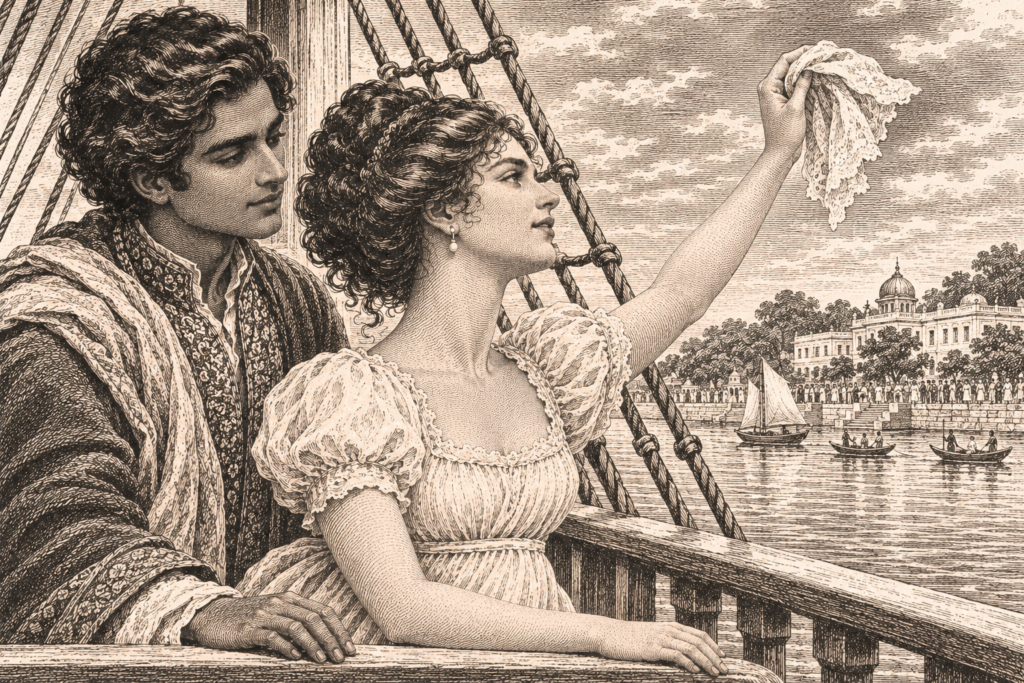
She could not hear her sister, nor could she make out whether Georgiana was speaking, but she knew what she was saying.
Goodbye.
She kept her hand raised until the distance made it impossible to distinguish one face from another.
Madhav said nothing. He stood beside her, allowing her the moment. His hand remained in hers, and she was grateful that he understood she needed no words just then.
At last Jemimah lowered her hand. She turned towards him, and he took both her hands in his.
“Are you afraid?” he asked quietly.
“A little,” she replied. “But I am glad we are going together.”
“So am I.”
She looked back once more towards the city. Calcutta was disappearing behind them, but she knew that it would remain part of her, just as England had remained part of her after so many years in Bengal. She had not left behind the people or the memories which had made her who she was. They would travel with her, in her thoughts and in the small locket beneath her dress.
The Meridian continued down the Hooghly, carrying them away from the familiar riverfront and towards the sea.
There would be a long passage ahead, and beyond it a place neither of them had seen. They would have to make a home, establish new friendships and discover what their life together would become. There would be practical difficulties, and perhaps moments when they would question the wisdom of leaving everything familiar.
But they had chosen this future together.
Madhav looked towards her.
“And everything we have yet to find,” he said.
Jemimah smiled.
“Yes. I suppose that is what lies before us.”
They remained on deck, watching the riverbanks slip past as the ship continued downstream. The sounds of Calcutta gradually became more distant, and the busy waterfront gave way to the changing landscape of the lower Hooghly.
She felt the sadness of leaving, but beneath it was a quiet certainty that she had chosen the right path.
For now, there was only the journey, and the man beside her.
And that was enough.
So, on Friday, 15 September 1809, Jemimah Charlotte Augusta Fairfax and Madhav Chandra Basu left Calcutta aboard the Meridian, bound for a new life together.
THE END