Autumn 1805
By the autumn of 1805 Jemimah had lived in Calcutta long enough to feel at home there. She knew the rhythms of the household and the familiar faces of the British community. She had formed friendships, attended dinners and musical evenings, and become increasingly confident in expressing her opinions.
Her father had also established a number of useful professional relationships. Among his more recent acquaintances was Raghunath Chandra Basu, a prosperous Bengali merchant whose business interests brought him into contact with Company officials and other members of the commercial community. Edward respected his judgement and found him a man of intelligence and considerable experience.
Edward had first encountered Raghunath through a mutual professional acquaintance. Their initial conversations had concerned matters of trade and finance, but Edward had been impressed by the older man’s intelligence and sound judgement. Raghunath was direct in his manner, accustomed to making decisions and expecting them to be understood. He was also well informed, and Edward soon discovered that a conversation with him was rarely without interest.
Their acquaintance gradually became more personal. Raghunath occasionally called upon Edward, and in time the visits were returned. They did not yet belong to precisely the same social circle, but a growing respect had developed between them.
It was through this connection that the Fairfaxes came to know the Basu family.
Raghunath was invited to dine at the Fairfax house one evening, accompanied by his younger son, Madhav. His wife, Annapurna, did not accompany them. Although she was accustomed to receiving visitors in her own home, she was less comfortable in gatherings where the conversation was conducted in English, a language she understood only to a limited extent. She preferred the familiar company of her own household and female relations, though she was by no means indifferent to the people her husband and son were coming to know.
The Pritchards were also to be present, and Charlotte was pleased to have a gathering which brought together people she already knew and a family she was beginning to know better. The evening promised to be a pleasant mixture of professional acquaintance and family company.
Madhav Chandra Basu was twenty-six. He had returned to Calcutta in 1798, after spending six years in England, where he had been educated under the supervision of a trusted associate of his father. He had been sent away at the age of thirteen, an unusual decision for a young man of his family and community, and one which had required considerable thought on his father’s part.
His education had included English literature, history, mathematics and geography. He had returned with a fluent command of the language and an understanding of British manners, though he had no wish to conceal his Bengali identity or to make himself appear English. Since his return, he had been working in his father’s business, gradually taking on greater responsibility. Raghunath valued his judgement, although he was conscious that his son still had much to learn about the commercial affairs of Calcutta.
Jemimah was told that Mr Basu and his son would be joining them. The name meant little to her, although she remembered hearing her father speak of Raghunath on several occasions. She had no particular expectation of the evening beyond the pleasure of dinner with familiar company.
The Basus arrived shortly before the appointed hour. Raghunath was introduced to Charlotte, who received him with the gracious composure she reserved for her husband’s more important acquaintances. Madhav followed his father into the drawing room, and Edward presented him to the family.
Jemimah noticed him, naturally enough, but there was nothing in that first exchange to suggest that he would become important to her. He was a handsome young man, dressed with care, and his manner was assured without being overbearing. His expression was attentive, and when he spoke, he did so with a quiet confidence that made it easy to listen.
Dinner was a pleasant affair. Raghunath and Edward found plenty to discuss, and William Pritchard joined them in conversation about the Company’s commercial interests. Their discussion was serious but friendly, and it was evident that Edward was genuinely pleased to have Raghunath as a guest.
Charlotte and Elizabeth Pritchard exchanged news of mutual acquaintances and discussed the usual matters of family and society. The younger people were left to make their own conversation, although the arrangement of the company meant that the conversation moved easily between the different groups.
Madhav found himself seated near Jemimah and James Pritchard. At first the conversation was general. James asked about his education in England, and Madhav explained that he had spent several years there as a boy, returning to Bengal in 1798.
“Did you find it difficult to return?” Jemimah asked.
Madhav considered the question.
“In some respects. England had become familiar to me, but it was never quite home. I missed my family, and I missed Bengal. Yet when I returned, I discovered that I had changed, and that the place I remembered was not quite the place I had left.”
“That sounds rather lonely,” Jemimah said.
“Sometimes it was. But I was fortunate. My family welcomed me home, and there was much to occupy me.”
“Did you miss England?”
“I missed certain things. The books, perhaps, and some of the friendships I had made. But I have found that one can be fond of a place without wishing to live there.”
Jemimah smiled.
“I wonder whether I shall feel the same when I return to England.”
“You have been here for several years now?”
“Since I was a girl. I remember England, of course, but I think I have changed too. I should like to see it again, though I cannot say that I wish to leave Bengal.”
“Then perhaps you have discovered what I did. One may belong to more than one place, in different ways.”
It was a thoughtful answer, and Jemimah found herself interested in him.
James, who had been listening, asked Madhav about his work with his father. The conversation moved naturally to business, and Jemimah soon found herself listening rather than taking part. She was not especially interested in accounts and commercial arrangements, although she was beginning to understand how much of Calcutta’s life depended upon them.
She was struck, however, by the ease with which Madhav moved between subjects. He could discuss his education in England, the history of the country and the commercial affairs of Bengal without seeming to consider any of them more important than the others. He listened carefully when James spoke, and did not appear anxious to demonstrate how much he knew.
Later, when the ladies and gentlemen had withdrawn from the dining room, the conversation became less formal. Frances, who had been permitted to remain for a little while, was beginning to grow restless. She had been looking with some interest at a small ornament on a side table, and was examining it rather more closely than Charlotte would have approved.
Madhav noticed her attention.
“Do you know what that is?” he asked.
Frances looked at him suspiciously.
“I don’t know.”
“Then perhaps we should find out.”
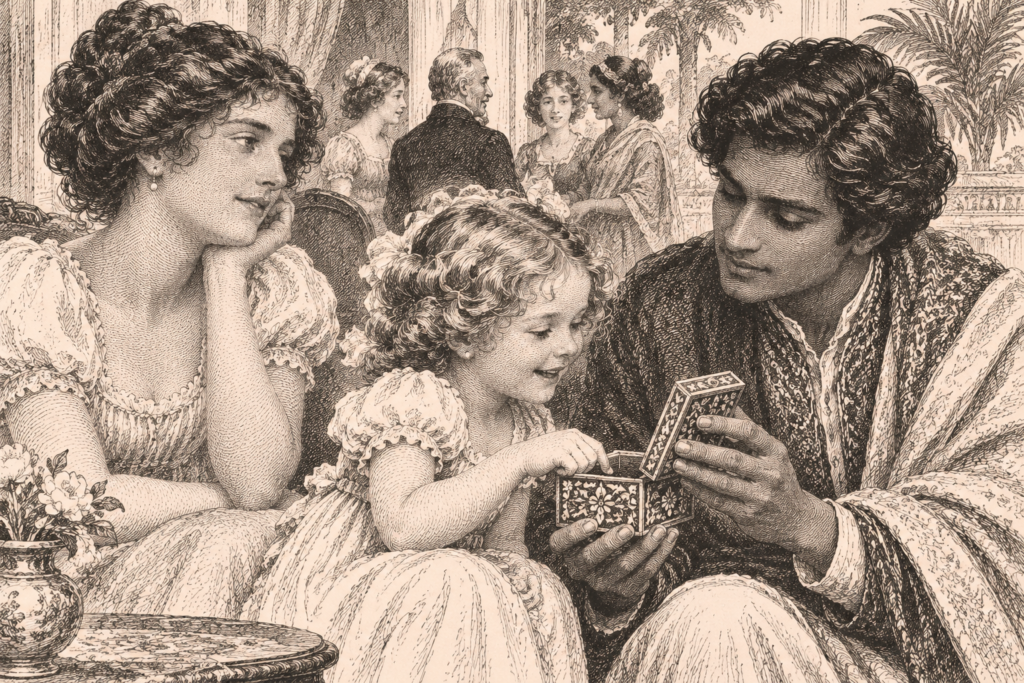
He showed her how the ornament opened, revealing a small compartment inside. Frances was delighted, and insisted on showing it to Sophia. Madhav listened patiently to her explanation of what she thought might be kept inside, and did not hurry her when she took some time to make up her mind.
Jemimah watched the exchange with amusement. She had already discovered that the way a person treated children could tell her something about their character. Madhav had neither dismissed Frances because she was young nor treated her with exaggerated indulgence. He had simply taken an interest in what interested her.
The evening passed without incident. There was no particular moment which distinguished it from other dinners, and when the Basus departed, the conversation in the Fairfax drawing room turned naturally to their guests.
Charlotte remarked that she had found Raghunath a most agreeable gentleman.
“And his son?” Edward asked.
“Very well mannered,” she replied. “And certainly well educated. I was surprised by how easily he conversed with everyone.”
“He has had an unusual education,” Edward said. “His father sent him to England when he was quite young. I believe he was away for six years.”
“I thought he spoke remarkably well,” Elizabeth Pritchard added. “And he seemed quite at ease.”
James agreed. He had enjoyed talking with Madhav and thought him a young man of considerable intelligence. He had found their conversation about history and the Company’s affairs particularly interesting.
Edward was pleased by the general impression his guests had made. He had already formed a high opinion of Raghunath, and his son had done nothing to diminish it.
Jemimah said little. She had found the evening agreeable, and Madhav’s conversation had interested her, but she had not yet formed any particular opinion of him. He was simply a new acquaintance, and one she would probably see again.
She did, however, remember something he had said about belonging to more than one place.
It was not an idea she had considered in quite that way before. For Jemimah, Bengal had become familiar through years of living there, but England remained the country of her birth and childhood. She had never thought that affection for one place need diminish affection for another.
She wondered whether the same might be true of other people, and whether the experience of living between different worlds could give a person a rather different understanding of both.
She did not dwell upon it for long. There were other things to occupy her attention, and the following days brought their usual succession of visits, lessons and household concerns.
Raghunath and Madhav did not become regular visitors to the Fairfax house immediately, but the acquaintance continued. Edward and Raghunath had business matters to discuss, and their conversations gradually developed into a genuine friendship. In time, the families would become more familiar with one another, and the Basus would cease to be merely occasional dinner guests.
For now, Madhav remained a new acquaintance. Jemimah did not yet know how important he would become, nor could she have imagined that the friendship beginning in so ordinary a way would eventually alter the course of both their lives.