Spring 1808
By the spring of 1808, Jemimah had become a familiar and welcome visitor at Basu Bari. She no longer felt that she was entering an unfamiliar world each time she crossed its threshold, although there was always something new to notice. She had learned the names of the household’s principal servants, recognised the different sounds and activities of the courtyard, and become accustomed to the comings and goings of relatives who seemed to regard the house as a natural meeting place.
Her friendship with Kamala had become particularly important to her. They sometimes wrote occasional notes to one another, though their correspondence was interrupted from time to time by the practical difficulties of arranging their meetings. Kamala had her own household to attend to, and Jemimah’s visits depended upon the arrangements made by Charlotte and the demands of family life.
When they were together, however, conversation came easily. They spoke of books, family matters, music and the expectations placed upon women. Kamala was often amused by Jemimah’s opinions, but she never dismissed them. She had a practical understanding of the world which Jemimah sometimes lacked, and Jemimah valued her honesty.
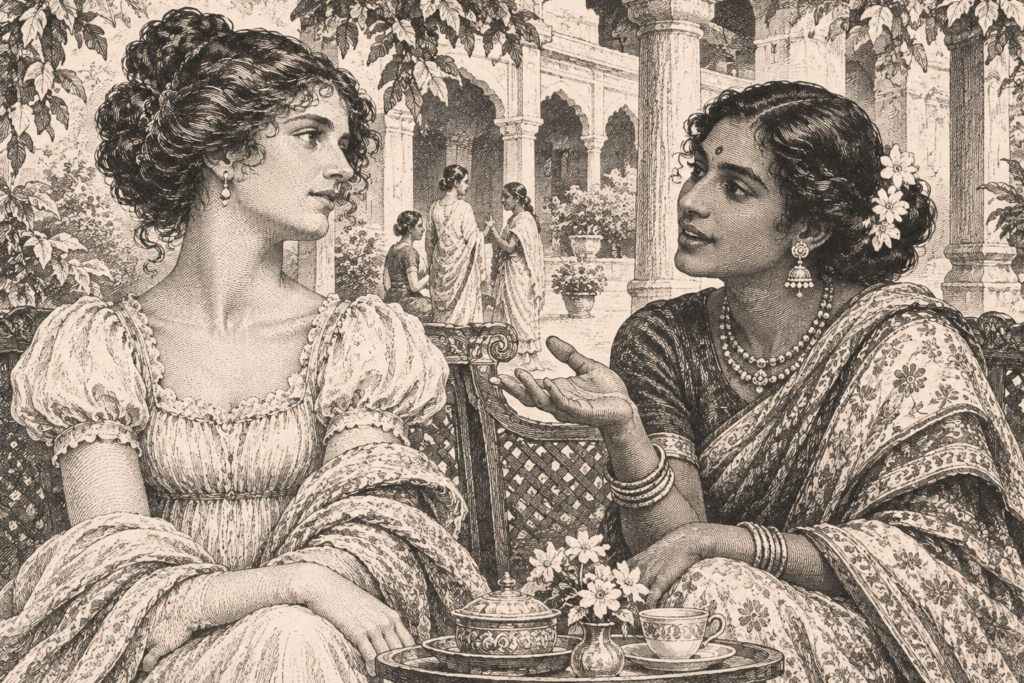
It was through Kamala that Jemimah began to understand more about the pressures and responsibilities which shaped the lives of Bengali women of her own social standing. Kamala did not pretend that her life was without restrictions, but neither did she speak as though she were unhappy. She loved her family and took pride in her responsibilities, while recognising that there were occasions when duty and personal wishes did not sit comfortably together.
One afternoon, when the two women were sitting together, Kamala remarked that Jemimah seemed unusually fortunate in having so much freedom to read and pursue her interests.
“Do you think so?” Jemimah asked.
“I do. You can spend an afternoon with a book, or go out with your mother, or visit a friend. You are not yet responsible for a household of your own.”
“That is true. But I do not think my mother would consider me entirely free.”
Kamala laughed.
“No mother considers her daughter entirely free.”
Jemimah smiled. “Perhaps that is the same in every country.”
“Perhaps it is.”
“Do you ever wish you could have chosen everything for yourself?” Jemimah asked after a moment.
Kamala considered the question. “Of course. But I do not think that anyone chooses everything. Marriage brings two families together, and there are obligations which belong to more than one person.”
“That seems a great deal to ask of a woman.”
“It is. But there are also kindnesses, and friendships, and ways of making a life that are not always apparent at the beginning.”
Jemimah thought about this. She had been brought up to expect that marriage would be a matter of family approval and suitable arrangements, but she had also assumed that she would have a voice in the decision. She wondered how much of that freedom would remain if she married into a family whose customs were very different from her own.
Kamala did not offer easy answers. She understood that Jemimah’s upbringing had given her a different idea of independence, just as Jemimah was beginning to understand that Kamala’s life was not simply a matter of obedience. There was affection and satisfaction in the life Kamala had made, even if it was not always free from difficulty.
Their conversation was interrupted by Anandamayi, who had come to tell Kamala that Madhav was looking for her. He had been expected to join them, but had apparently been delayed by a conversation with his father.
“He will come,” Anandamayi said. “He always does when there is a book involved.”
Kamala gave her a knowing look.
“You make him sound very predictable.”
“He is predictable where books are concerned.”
“And what about the rest of the time?”
Anandamayi laughed. “That is more difficult to say.”
When Madhav eventually joined them, he found Jemimah reading a volume she had brought from home. He asked what it was, and she explained that she had been looking again at a passage which had troubled her.
“Is it still troubling you?” he asked.
“Rather more than before.”
“Then perhaps you should put it aside.”
“That would be surrender.”
“Or good sense.”
Jemimah looked at him with mock indignation.
“I should have thought that a historian would encourage perseverance.”
“A historian should also know when a book is wasting his time.”
Kamala laughed, and Madhav took a seat opposite them. The conversation moved briefly to the book, but soon turned to more general questions about the way in which people understood the past. Jemimah had begun to think differently about the histories she read, and she was still interested in the absence of ordinary lives from so many accounts.
Madhav agreed that history was frequently told from the perspective of those who held power.
“The difficulty,” he said, “is that the people whose lives you wish to understand rarely leave records of themselves. Their experiences are not always preserved.”
“Then perhaps we must look for them in other places,” Jemimah replied. “In letters, household accounts, old objects, and the things which people leave behind without intending them to become part of history.”
Madhav considered this.
“That is an interesting thought. You would have to be very patient.”
“I think I could manage that.”
“I have no doubt of it.”
Kamala looked from one to the other.
“You are both becoming very serious. I think we must find something more cheerful to discuss.”
Madhav smiled.
“My sister believes that all serious conversation should be brought to an end before it becomes interesting.”
“I believe,” Kamala replied, “that there is more to life than listening to you and Jemimah discussing books.”
Anandamayi agreed, and the conversation turned to a recent family occasion which had provided the household with considerable amusement. Jemimah enjoyed these exchanges. She was beginning to feel that she belonged, in a small way, to the family circle. She knew when Kamala was teasing her brother, and when Anandamayi was trying to attract his attention. She had also learned that Madhav, for all his thoughtful manner, could be quite as mischievous as his sisters when the occasion permitted.
Yet it was not only the lighter moments which stayed with her.
There were occasions when she and Madhav found themselves talking more seriously, particularly when the others had left them together for a few minutes. Their conversations were never planned, but they seemed increasingly to return to questions of family, duty and the expectations which governed their lives.
One such conversation took place later that afternoon. Kamala had been called away, and Anandamayi had gone to speak with one of the women in the household. Jemimah and Madhav remained in the reception room, where the afternoon light fell across the floor of the veranda. Beyond them, the courtyard had grown quieter as the heat of the day settled over the house.
They had been discussing a book about ancient societies, and Jemimah had remarked that she found it difficult to understand why people accepted so many restrictions simply because they had always existed.
“Do you think they accept them?” Madhav asked.
“Surely they must, if they continue to live by them.”
“Or perhaps they have learned that some restrictions cannot easily be challenged.”
“Is that not the same thing?”
“Not necessarily.”
Jemimah looked at him, waiting.
Madhav took a moment before answering.
“There are customs which give a family its identity. There are obligations which people accept because they believe they are necessary, or because they wish to preserve something which matters to them. But there are also occasions when a person must decide whether obedience is the same as wisdom.”
Jemimah considered this.
“I have sometimes thought that obedience is expected of women more readily than of men.”
“That may be true.”
“And that a woman who questions what is expected of her is considered difficult.”
Madhav smiled slightly.
“Would you say that you are difficult?”
“I should hope so, on occasion.”
He laughed.
“I suspect your mother might agree.”
Jemimah smiled, but then became thoughtful again.
“Do you ever find it difficult to reconcile what your family expects of you with what you wish for yourself?”
It was a more personal question than she had intended to ask. Madhav did not answer immediately.
“I have not always agreed with my father,” he said at last. “But I know what he has done for me, and I understand the reasons behind many of his expectations. He has spent his life building something for his family. It would be easy for me to dismiss his wishes as old-fashioned, but that would be unfair.”
“Then you believe one should always obey one’s father?”
“No. I believe one should listen carefully before deciding that one cannot agree.”
Jemimah looked down at the book in her lap.
“My father is a good man. I love him very much. But there are times when I think he would prefer me not to question anything.”
“Perhaps he worries that you will question too much.”
“Perhaps.”
Madhav did not press her. He seemed to understand that she was not asking him to criticise her father, but trying to explain something about herself.
After a little while he said, “It is possible to love one’s family and still wish to make some decisions for oneself.”
Jemimah looked up.
“I should like to believe that.”
“I think it must be so. Otherwise, what becomes of the person beneath all the obligations?”
The words stayed with her.
They were not a declaration of independence, nor an invitation to disregard their families. Both understood the importance of family, and neither wished to cause unnecessary pain to those they loved. But they had begun to recognise in one another a similar unease about the assumption that duty must always settle every question.
When Kamala returned, she found them still talking, though the subject had become lighter. She said nothing, but she noticed that Jemimah seemed unusually quiet on the journey home.
In the weeks that followed, Jemimah found herself thinking about their conversation more than once. It had not changed her understanding of Madhav, but it had added something to it. She had known him as a thoughtful and well-educated young man, and had come to enjoy his company. Now she was beginning to recognise that beneath his courtesy and good humour lay a seriousness of feeling which she found increasingly compelling.
For Madhav, too, the friendship had become important. He admired Jemimah’s intelligence, but also her willingness to question things which others accepted without thought. He liked her humour, her curiosity and the warmth she showed towards his family. She did not treat him as an interesting exception to the British world in which she lived. She was genuinely interested in him, and in the life which had made him who he was.
Neither spoke of these feelings. There was no reason to do so, and perhaps neither had yet fully acknowledged them to themselves.
The Basu household had become important to Jemimah in its own right. She liked Kamala’s good sense, Anandamayi’s liveliness and Annapurna’s quiet kindness. She had come to respect Raghunath, even though his manner was more formal than that of her own father. She was also increasingly aware of Madhav’s place within the family, and of the obligations that shaped his choices.
Their friendship was still part of the wider affection between the two families. It was expressed through visits, books, conversations and the easy familiarity of people who had grown comfortable in one another’s company.
Yet, gradually, Jemimah had begun to look forward not simply to visiting Basu Bari, but to seeing Madhav.
And that was a difference she had not yet found a reason to explain.