This case began with the suspicious death of a 22-year old man that was reported in the Daily Telegraph on 18 August 1876.
| MYSTERIOUS DEATH – Yesterday, Mr. W. L. Donaldson, Deputy-Coroner for the Eastern Division of Middlesex, held an inquest at the Earl of Ellesmere, Ellesmere Road, Victoria Park, to inquire into the cause of the death of Richard Sedgett Evans, aged 22, who expired under suspicious circumstances. Martha Cole, 17 Lansdowne-terrace, Grove-road, Victoria Park, stated that the deceased had lodged in her house since November last, and kept company with her sister, Mary Maria Smith, and that they were to have been married on the 6th inst., to which the mother objected, and several quarrels ensued in consequence. Deceased was a man of colour, earning a few shillings a week, her sister having an income of 3 guineas per week. All the family strongly objected to the marriage. On Thursday last he was taken ill with a pain in the chest and vomiting. Hot ginger-and-water, brandy, spirits of camphor, and mustard poultices were used, but he died the following day. Henry Hancock , 51 Sewardstone-road, East Old Ford, said that he was a companion of the deceased, and was out with him on the morning of the 7th. During conversation he said to witness that he was in fear of his life where he lodged. At nine o’clock on Saturday morning witness called for deceased, when he was informed that he was dead. Witness suggested to Mrs. Cole to have the body opened, as the death had been so sudden, but she replied that she did not like to have that done, for fear her mother might get into trouble. The coroner said after that evidence he should at once order Dr. Rogerson to make a post-mortem examination. The inquest was then adjourned. |
A subsequent newspaper article reported the results of the inquest following the post-mortem.
| ALLEGED DEATH BY POISONING. – The inquiry into the death of Richard Ledgett Evans, a black, aged 22, who had died at 17, Lansdowne-terrace, Grove-road, Victoria Park, was resumed yesterday by Mr. Donaldson, at the Earl of Ellesmere, Bethnal-green. On the 10th inst. the deceased was taken suddenly ill, and, becoming much worse. Dr. Rogerson, of Aberdeen-terrace, saw him a short time before his death, afterwards giving a certificate that Evans had died of disease of the heart; and the young man would have been buried, but the case reaching the ears of Mr. Burrows, the summoning officer for the district, as one of poison, he immediately stopped the funeral and sent information to the coroner. Medical evidence was now given that death was clearly owing to heart disease, and the jury returned a verdict to that effect. |
In summary, Richard Evans, who had been lodging with Martha Cole, and had been due to marry her sister,Mary Maria Smith, on 6 August 1876, became ill on 10 August, suffering chest pain and vomiting, and died the following day. Although a doctor had initially certified the death as heart disease, the funeral was subsequently stopped by the authorities and following a post-mortem, the death was confirmed as heart disease. This case made for an intriguing genealogical and historical mystery.
The first thing we did was to identify and confirm the identities of the key players in the mystery.
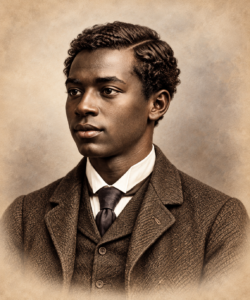 We first confirmed Richard’s identity. His civil birth registration shows he was born Richard Lidyeat Evans on 21 March 1854 in Saint George in the East. His father was named as: James Evans, a mariner and his mother as Sarah Ann Evans formerly Cousins.
His baptism four years later, at Christ Church, Stepney, on 25 October 1858, gives his name as Richard Ledgett Evans
Other records produce further variants of his middle name Lidyeat, Ledgett, Lidiard, Sidgett and Sedgett. His unusual name was potentially significant but remains unexplained.
Richard’s father, James Evans established the crucial fact that he was a mariner. This opened up an entirely new line of investigation. James has proved extremely difficult to identify in the ordinary census records, which is entirely plausible for a working mariner.
We subsequently found several maritime records for men called James Evans, including a particularly intriguing James Evans on a 1870 merchant-navy crew agreement, where James Evans, age 36, was born in Bermuda. That implies a birth around 1833–34, which is perfectly compatible with being Richard’s father, who would have been about 20–21 when Richard was born. It is therefore a possible candidate, but absolutely not proven.
We also found numerous other James Evanses of roughly the right age, particularly men born in Wales, so name + age alone cannot identify him. We eventually decided that trying to chase every James Evans was becoming circular and put this strand on hold.
One of the most important discoveries was that the contemporary newspaper described Richard as “a man of colour”. This raised the question of where Richard’s African/Caribbean or other non-European ancestry might have come from. The Bermuda-born James Evans became interesting in this context because Bermuda had a substantial Black population and James was recorded as born in Bermuda. However, we were careful not to make the leap: Bermuda-born = Black. It doesn’t prove James’s ancestry or appearance. The Bermuda James remains simply a potential candidate for Richard’s father, and the racial question remains unresolved.
Richard’s mother was identified as Sarah Ann Evans, formerly Cousins. This is potentially one of the most promising avenues still open. We have not yet satisfactorily reconstructed Sarah’s own family, origins and relationship with James. Doing so might ultimately be more productive than continuing to search blindly for James Evans.
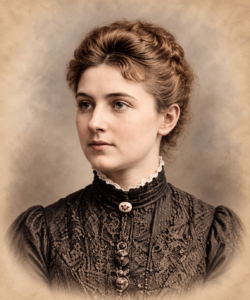 Richard’s fiancée, Mary Maria Smith was almost certainly Mary Maria Smeeth. She was the daughter of William Smeeth and Ann Freeland, and was born about 1852. In the 1871 census she was living with her widowed mother and siblings at 19 Royston Street, Bethnal Green, and was recorded as a machinist.
Her sister, Martha Smeeth married Abraham Cole, a boot finisher. Martha was the woman who was living at 17 Lansdowne Terrace when Richard died.
The Smeeth family had a strong connection with the boot/shoe trade:
- William Smeeth was a master shoemaker
- Abraham Cole was a boot finisher
- Mary Smeeth was connected with boot-making/finishing occupations in later records.
This made the occupational network around Richard particularly interesting.
Mary Maria Smeeth subsequently married Walter Baines Woodhouse in November 1877.
Richard’s death certificate described him as a boot finisher, but we questioned the reliability of this. The newspaper said Richard earned only a few shillings a week, whereas Mary was said to have an income of 3 guineas aweek. Given the strong boot-making connection within the Smeeth/Cole family, it is possible that the occupation on Richard’s death certificate was incorrectly reported or confused with Mary’s occupation. We therefore treat “boot finisher” as unconfirmed, rather than as an established fact.
One of the most intriguing discoveries was Richard’s address on the marriage banns. He was recorded as living at 320 Oxford Street. This initially seemed very strange because it was a prestigious central-London commercial address, so we investigated the property.
In 1861 and 1871, Samuel Gale, an ironmonger, was occupying 320 Oxford Street. Samuel Gale was a Chippenham-born ironmonger who apparently established a substantial business there and later retired to Chippenham.
We also discovered that William R. Loftus had businesses at 146, 320 and 321 Oxford Street, dealing in specialist scientific/brewing equipment and publishing technical works. The precise transition of the premises between these businesses remains unclear, particularly in the critical period 1874–1879, after which the premises were acquired by the draper, D H Evans.
So Richard’s appearance at 320 Oxford Street in 1876 could potentially be an employment or lodging clue, but we never established exactly what Richard was doing there. This remains an open research avenue.
The second major strand of the case concerns whether Richard really died from natural causes.
To recap, the evidence established that Richard became suddenly ill on 10 August 1876. His symptoms included chest pain and vomiting. He was treated at home with a number of remedies, but he died on 11 August 1876. The doctor initially certified heart disease.
But Henry Hancock, who had been with Richard earlier that week, said Richard had told him that he was “in fear of his life where he lodged.” The subsequent inquest was sufficiently suspicious that the funeral was stopped and a post-mortem ordered. The medical evidence ultimately attributed the death to heart disease, and the jury returned that verdict.
We cannot say however that poisoning was proved. Nor can we say that the post-mortem definitively demonstrated that poisoning was impossible. The surviving newspaper account tells us that the medical evidence concluded heart disease, but doesn’t give us enough detail about the post-mortem findings to reconstruct precisely what was examined or excluded. So the poisoning theory remains unproven.
The most intriguing sentence in the original report was Martha Cole’s objection to the post-mortem: she feared “her mother might get into trouble.”
Her mother was Ann Smeeth (nee Freeland). Richard’s relationship with her daughter, Mary Maria Smeeth had apparently caused conflict because Mary’s mother objected to the relationship. They had quarrelled several times. That gives us a possible motive for suspicion, but there is no evidence proving that Ann harmed Richard. It’s an intriguing hypothesis, not a conclusion.
Finally, we located a Find a Grave memorial for Richard Sidgett Evans at Manor Park Cemetery, Forest Gate. The memorial gives 18 August 1876 as the death date, but notes that this may actually be the interment date. That fits our contemporary evidence, which establishes Richard’s death as 11 August 1876. The original burial register has not yet been examined, so this is another useful unfinished thread.
Race and Identity in Victorian London
Richard Evans’s story also provides a glimpse into the racial attitudes of Victorian London. The contemporary newspaper specifically described him as “a man of colour”, indicating that his appearance was considered sufficiently unusual or significant to be included in an account of his death. Victorian Britain was a racially hierarchical society, shaped by Britain’s expanding empire and by widespread beliefs in European superiority. Black people nevertheless formed established communities in Britain and worked in a wide variety of occupations, including the merchant navy, as well as marrying and raising families within British society. Their presence was therefore not new or unknown, although social equality certainly did not follow from their presence.
Richard’s relationship with Mary Maria Smeeth provides a more personal insight into these attitudes. Mary was a young white East London woman and the couple intended to marry, although her mother apparently strongly objected to the relationship. The case therefore illustrates the difference between the existence of interracial relationships and the social attitudes surrounding them. Racial prejudice existed alongside ordinary human relationships, friendships, employment and family life. Richard was not simply an abstract example of Victorian racial attitudes: he was a young man living in East London, earning a living, forming relationships and planning to marry. His story gives us a rare glimpse of the everyday experience of a Black man within Victorian London.
CONCLUSION
The mystery is unresolved — deliberately. But we have transformed it from a newspaper story about a suspicious death into a much richer case involving many people. And, importantly, we’ve reached the sensible point where more searching wasn’t producing proportionately more information.
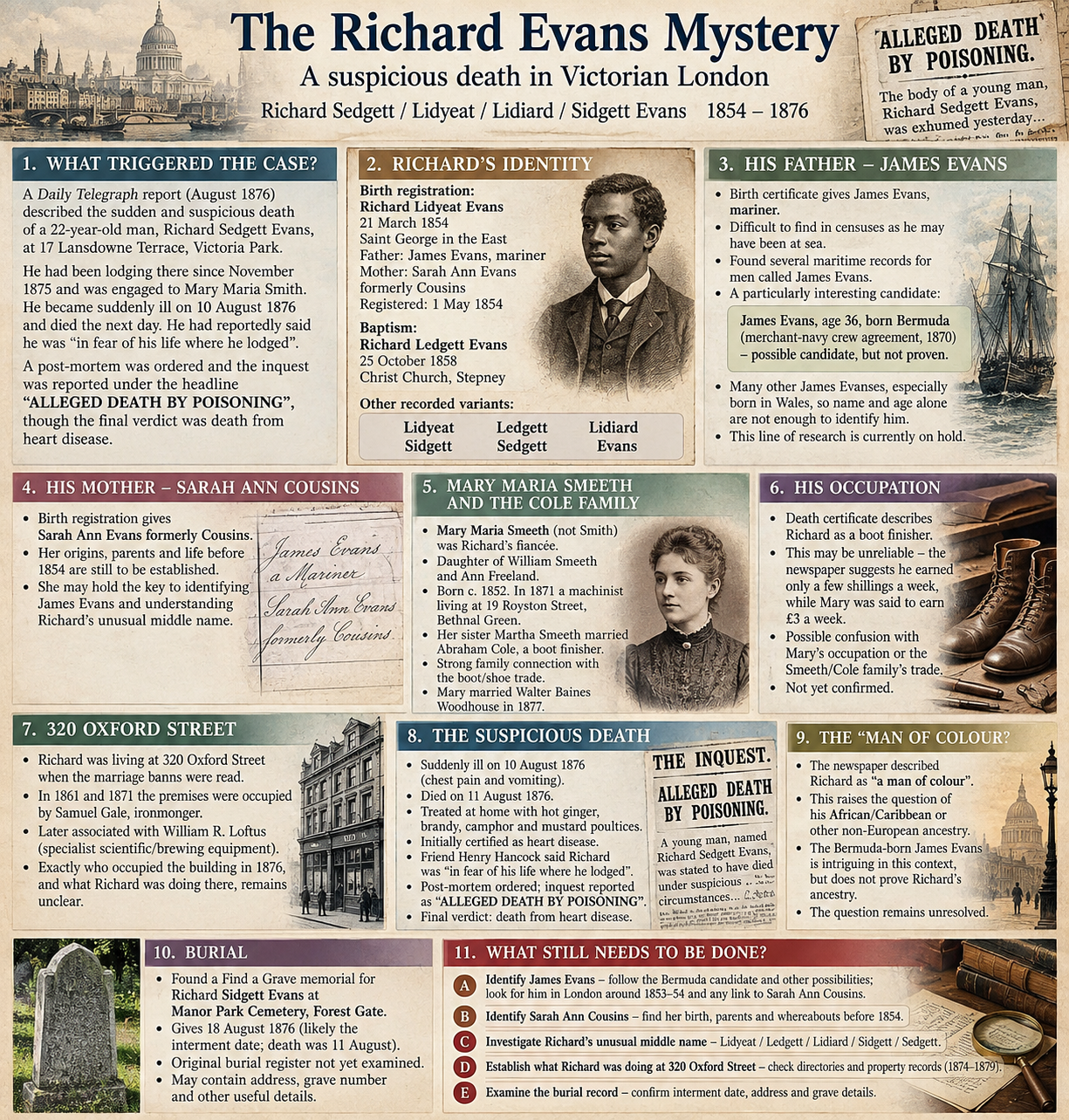
Note: All images generated by ChatGPT