The mystery began with an Our Warwickshire blog post entitled ‘The Whereabouts of Elizabeth Wynn’: A Mystery of Dickensian Proportions which I reproduce below.
|
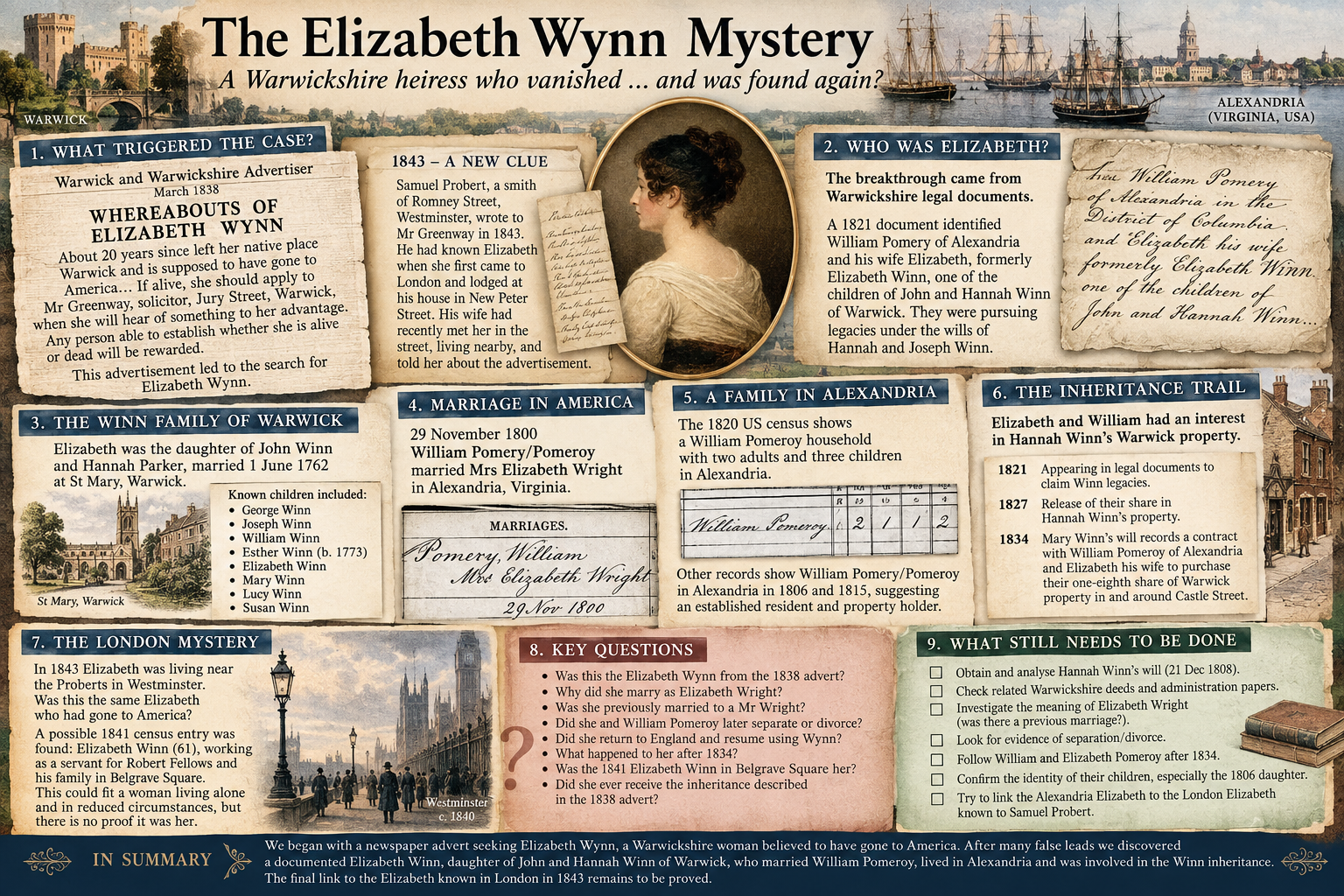
Picture the scene; the year is 1838, autumn is closing in. In the bustling streets of Victorian London we find Samuel Probert, a smith in his late 30s, purchasing a newspaper. This might not have been anything out of the ordinary for Samuel, except that today, he happens to notice a particular advertisement. It reads as follows: ‘Elizabeth Wynn, who about 20 years since left her native place Warwick, and was supposed to have gone to America, but her friends not having heard from her since presume she is dead; though if not, & she will apply to Mr Greenway, solicitor, Jury Street Warwick she will hear of something to hear advantage. Or any person giving information whether she be living or dead, will be rewarded for their Trouble.’ Elizabeth Wynn, now there’s a name he remembers. Samuel recalls how she lodged with him some years back, when he was living elsewhere in Westminster. She was in a poor way, but had repeatedly told him that she expected some property to be left to her, and would ultimately be better off. He hadn’t heard from her in years, but the rumour was that she was supposed to have travelled to America. Although he doesn’t suppose he’ll hear from her again, Samuel pockets the advertisement. A sudden reunion Fast-forward five years to the summer of 1843, and Samuel has long since abandoned hope of ever having cause to write to ‘Mr Greenway, solicitor’. His wife, however, has not forgotten the advertisement; thankfully so, because one day in the street, by total coincidence, she stumbles once more upon Elizabeth Wynn. As it turns out, Elizabeth is living very near to the Probert’s house at 4 Romney Street. Mrs. Probert is sorry to see that her circumstances are even further reduced. She eagerly tells Elizabeth about the advertisement, both curious and excited to know what this news ‘to her advantage’ would entail. When Samuel hears of their meeting, he resolves to write, finally, to Mr. Greenway. Unsatisfactory conclusions But here, unfortunately, our story must come to an abrupt end. The letter that Samuel Probert wrote to Mr. Greenway has arrived in our archives and it describes the story as laid out above. Unfortunately there is no context to the document from which we could ascertain what happened next. It is a mystery, and one which is nothing short of Dickensian. Was this Elizabeth Wynn truly the person Mr. Greenway sought, or was this all pretence in the hopes of a misbegotten inheritance? Why did she leave Warwick, did she ever travel for America and if so, why did she return so many years later? Was she reunited with the friends who thought her dead? Was she ever contacted by Mr. Greenway? Did she indeed learn something to her advantage, and was it enough to pull her from the ‘reduced circumstances’ that she found herself in? Was there a large estate to be claimed, or was it so eaten up by legal costs that there was nothing left? Or perhaps there was never an inheritance, and this was simply a ruse by Mr. Greenway to ‘smoke her out’ from hiding? I have not been able to find the answers, but I can’t help but feel that there must be documents out there (wills, probate, passenger lists, newspapers, parish and census records) which could shed some light on the story. Do you fancy playing the detective and solving our mystery for us? |
We initially tried to identify Elizabeth Wynn through baptisms and marriages.
 We found a very plausible Elizabeth Winn of Wroxall, baptised 1784, daughter of Thomas Winn and Mary Doughty, but she married Isaac Brown in 1815 and was still living with him in Rowington in 1841. That made her a poor fit for the mystery.
We then explored Birmingham and Staffordshire Elizabeth Wynns/Winns/Whinns, as well as various London marriages. Several looked promising for age or geography but failed when followed forward. This was frustrating at the time, but it established something important: simply finding an Elizabeth Wynn of the right age was not going to solve the case.
The real breakthrough came through the Warwickshire Archives property papers, rather than through the census. We found a 1821 document concerning William Pomery of Alexandria in the District of Columbia and Elizabeth his wife, formerly Elizabeth Winn, one of the children of John and Hannah Winn, appointing Walter Pomery of St Austell, Cornwall, as their attorney to recover legacies due to them under the wills of Hannah and Joseph Winn. This is enormously important because it is contemporary legal evidence, not a later family-tree assertion.
It established that Elizabeth Winn married William Pomery/Pomeroy, and was living in Alexandria, USA, the daughter of John and Hannah Winn pursuing Winn-family legacies.
The same document refers to a copy of the couple’s marriage certificate, which named her as Elizabeth Wright. That created another mystery: why is a woman explicitly described in Warwickshire legal records as formerly Elizabeth Winn marrying William Pomeroy as Elizabeth Wright?
We considered a transcription error, but also the possibility that Elizabeth had previously been a Wright, perhaps through an earlier marriage. That remains unresolved.
We then reconstructed the Winn family, and found John Winn had married Hannah Parker at St Mary, Warwick, on 1 June 1762. We then found documentary evidence for several of their children, including: George Winn, Joseph Winn, William Winn, Esther Winn, baptised 29 December 1773, Elizabeth Winn, Mary Winn, Lucy Winn and Susan Winn
The exact sequence of all the baptisms remains incomplete because the Warwick baptism indexing is problematic, and we could not locate Elizabeth’s own baptism. But the legal document explicitly identifies her as one of the children of John and Hannah Winn, so her parentage is not dependent on the missing baptism.
Joseph Winn’s will independently confirms that Hannah Winn was his mother and refers to his Winn brothers and sisters. Joseph died in 1820, aged 44.
We also discovered that George Winn, another son, received administration of Hannah Winn’s estate in 1821 and subsequently dealt with his share of her real and personal property.
The inheritance/property trail became the really exciting part. A Warwickshire Archives document dated 8 January 1827 records a release by William Pomery of Alexandria in the United States of America concerning the share of himself and his wife Elizabeth in Hannah Winn’s property.
Then, in Mary Winn’s 1834 will, Mary is recorded as having contracted with William Pomeroy of the City of Alexandria and Elizabeth his wife to purchase their one-eighth share in a Warwick property in and around Castle Street. So the Pomeroy connection to Warwick is absolutely not coincidence.
We have therefore a documented chain:
John & Hannah Winn of Warwick
↓
their daughter Elizabeth Winn
↓
Elizabeth marries William Pomery/Pomeroy
↓
the couple live in Alexandria, District of Columbia
↓
Elizabeth claims legacies under the Winn wills
↓
the couple possess a share of Hannah Winn’s Warwick property
↓
that share is still being dealt with in Warwick in 1827 and 1834
That was our major breakthrough.
The 1820 US census shows a William Pomeroy household with two adults and three children in Alexandria. This fits reasonably with the documented William and Elizabeth Pomeroy who appear in the Warwickshire legal papers in 1821, although the census itself does not name the wife.
We also found the Alexandria marriage record for William Pomery/Pomeroy and Elizabeth Wright, dated 29 November 1800.
The discovery of the real Elizabeth Winn/Pomeroy was tremendously exciting because she fits two major parts of the original story:
Warwick — she was the daughter of John and Hannah Winn of Warwick.
America — she was living in Alexandria and actively dealing with property there.
And she was connected to an inheritance/property interest in Warwick.
However, we have not proved that she was the Elizabeth whom Samuel Probert met in London in 1843. That remains the central unanswered question.
The biggest difficulty is why would Samuel know her as Elizabeth Wynn in the 1830s if she had been Elizabeth Pomeroy for decades?
There are possible explanations — for example, she may have returned to England and resumed using Wynn after a separation, or Samuel may simply have remembered her by her maiden name — but we cannot assume any of these without evidence. We also found a possible undated family-tree reference to a divorce/separation between William and Elizabeth Pomeroy, but this has not been verified from an underlying record.
We went through a very large number of Elizabeth Winn/Wynn/Wynne/Whinn possibilities in 1the 841 census
One particularly interesting woman was Elizabeth Wynne, age 40, at the Clergy Orphan School in Marylebone, but the age and later evidence did not produce a convincing identification.
Another, Elizabeth Winn, age 45, schoolmistress in Westminster with a daughter Sophia, turned out to be the widow of Robert Winn, with Sophia born in Boston, Lincolnshire, and therefore another plausible but unproven woman.
We eventually found an Elizabeth Winn aged 61, working as a servant for Robert Fellows and his family in Belgrave Square. She would at least fit the notion of an older woman alone and in reduced circumstances, but there is no evidence connecting her to our Warwick/Alexandria Elizabeth.
So the 1841 census did not solve the London identity problem, and that is where we decided to stop chasing Elizabeths.
So, what we know with good documentary confidence. There really was an Elizabeth Winn of the Warwick Winn family who went to America. She was a daughter of John Winn and Hannah Parker. She became Elizabeth Pomeroy/Pomery. She was living in Alexandria, District of Columbia, by 1821. She was actively pursuing legacies under the wills of Hannah and Joseph Winn. She and her husband possessed a share of Hannah Winn’s Warwick property. The property connection continued through at least 1827 and 1834.
What is strongly suggestive: This Elizabeth fits the Warwick + America + inheritance elements of the original 1838 advertisement extraordinarily well. That is why the discovery was such a major breakthrough.
What is not yet proved.That she is the same Elizabeth Wynn whom Samuel Probert knew in London. That she returned to England. That she separated/divorced from William Pomeroy. That she resumed using the name Winn/Wynn. That she was the woman living near the Proberts in 1843. And that the inheritance Greenway was pursuing in 1838 was specifically the Winn property we’ve uncovered.
Respectability, Property and the Vulnerability of Women
One of the striking social-history themes in the Elizabeth Wynn case is the financial vulnerability of women, even when they came from families with property and inheritance. Elizabeth appears to have had a legitimate interest in Winn family property, yet Samuel Probert later described her as being in “reduced circumstances”. Her inheritance was not necessarily money she could simply access: the surviving documents show shares in property, mortgages, trustees, attorneys and lengthy legal transactions. This illustrates how a woman could possess a legal entitlement to property without necessarily enjoying immediate financial security, particularly within a society in which married women’s control over property was heavily constrained.
The case also illustrates the importance placed on respectability and social standing in Victorian society. Elizabeth’s poverty did not necessarily mean that she belonged to the stereotypical “undeserving poor”; Samuel’s letter effectively presents her as a respectable woman with a legitimate claim to property who had fallen into difficult circumstances. This is significant in the context of the New Poor Law of 1834, when poverty increasingly became associated with the workhouse and with ideas of deserving and undeserving dependency. Elizabeth’s story reminds us that economic hardship could result from widowhood, family circumstances, mobility or the complexities of property ownership, rather than from any moral failing.
Finally, Elizabeth’s story illustrates how migration could sever family connections in an age when communication was slow and international travel was difficult. The Warwick family apparently lost touch with her after she left, and her presumed move to America was enough for friends to believe that she had died. Yet the legal ties to Warwick continued through her inheritance, with solicitors and attorneys attempting to maintain those connections across the Atlantic. The eventual newspaper advertisement shows how newspapers had become an important means of reconnecting dispersed families and resolving private matters of identity and property. In this sense, the mystery offers a fascinating glimpse of a society in which family, property, mobility, reputation and emerging mass communication were becoming increasingly intertwined.
CONCLUSION
We began with an apparently hopeless search for an Elizabeth Wynn who vanished from Warwick and was believed to have gone to America; after chasing countless false leads, we discovered a documented Warwick woman named Elizabeth Winn who actually did go to America, married William Pomeroy, inherited Warwick property through her Winn family, and was still involved with that inheritance decades later — but the final link proving that she was Samuel Probert’s Elizabeth of London remains to be found.
And I think that’s why this has been such a satisfying case: the groundwork really did suddenly join up. What looked for a long time like an endless hunt through unrelated Elizabeth Wynns eventually produced a completely documented Warwick-to-America inheritance story.
Note: All images generated by ChatGPT