This case started with an alarming newspaper report in the Birmingham Post on 2 January 1863.
|
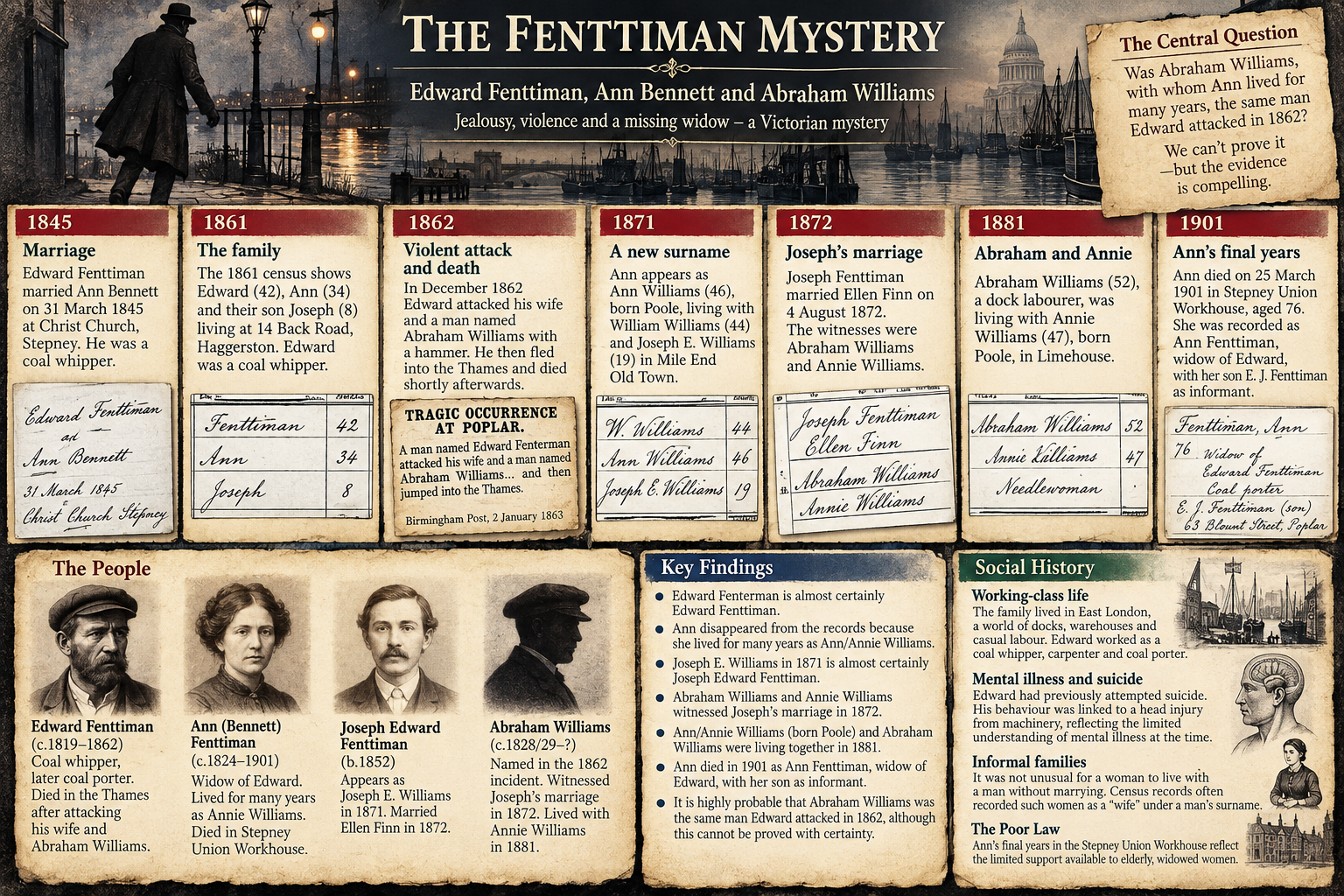
ATTEMPTED DOUBLE MURDER & SUICIDE On Wednesday evening Mr Walthew held an enquiry at Poplar respecting the death of Edward Fenterman, aged forty-five, who was alleged to have committed suicide after attempting to murder his wife and a man named Williams, under the following extraordinary circumstances:- Mrs. Anne Fenterman, 2 Park Buildings, Poplar, said that she was the widow of the deceased. Last Saturday evening deceased, witness, and a man named Abraham Williams were in the back room singing, when deceased suddenly rose and left the room. He returned immediately armed with a heavy hammer, with which he struck witness and Williams desperate blows on the back of the head. Witness was knocked insensible, and had not yet recovered from her injuries. Witness heard that after rendering Williams also insensible, he fled from the house and jumped into the Thames. He did so believing he had murdered them. – By the Court: She had given deceased no grounds for jealousy. Williams was always at the house, but it was because he was a lodger. They had been drinking, but there was no impropriety. Witness believed deceased attempted to murder her and Williams under a sudden impulse. He had twice before attempted to commit suicide, once by hanging and once by cutting his throat. His mind was affected by his head being jammed by some machinery last summer. Abraham Williams gave a similar account of the occurrence, and said that he had not doubt the deceased destroyed himself in the belief that he had murdered his wife and witness. Would swear there was no ground for jealousy. A respectable female, who stated that she was a relative of the deceased, addressed the court, and said that she believed that the whole of what took place on the evening in question had not been disclosed. Deceased was a very sober, steady man. Witness never heard, and did not believe, that he had previously attempted suicide. Without doubt he was driven to attack his wife and Williams through jealousy. The two previous witnesses were recalled, and solemnly denied that there were any grounds for jealousy. The wife had only told Williams and his brother of her husband’s attempts on his life. The jury said that the case was so suspicious in its nature that they could only return an open verdict, so as to allow the police to prosecute further inquiries. |
Later newspaper reports, checked through January 1863, appear to repeat the original account rather than provide further information, and no subsequent prosecution has been found.
Identifying Edward Fenterman
 The surname proved problematic because there was no obvious Edward Fenterman in the 1861 census. The breakthrough came when the family was found under the variant spelling Fenttiman.
In the 1861 census, the family consisted of Edward Fenttiman, about 42, married, and a a coal whipper, Ann Fenttiman, about 34 and their son, Joseph Fenttiman, aged 8, living at 14 Back Road, Haggerston.
Edward had married Ann Bennett on 31 March 1845 at Christ Church, Stepney; he was then 24 and described as a coal whipper, and Ann was 20 and born in Creekmoor, Poole, Dorset
Their daughter Mary Ann Maria Fentiman was born in 1849 and baptised at Christ Church, Stepney. The baptism gives Edward’s occupation as carpenter. Their son Joseph Edward Fenttiman was born in 1852. However, their daughter, Mary Ann, died in 1856, aged 7.
Thus the family can be followed from the 1840s right up to the 1861 census, and after that to the death registration of Edward Fenterman in Poplar in the fourth quarter of 1862.
The disappearance of Ann Fenttiman
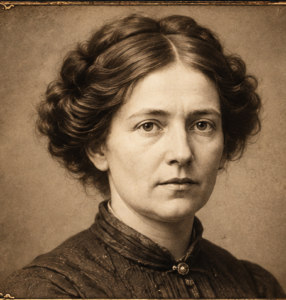 After Edward’s death, however, his widow Ann virtually disappeared from the conventional records.
Extensive searches failed to locate her under Fenttiman, Fentiman or Fenterman in the later censuses. This initially suggested several possibilities: remarriage, living as a lodger, living with relatives, or perhaps a change of surname.
The eventual breakthrough came from looking (a) not for Ann Fenttiman, but for an Ann born in Poole, Dorset, with another surname, and (b) wondering if she was in fact living with the Abraham Williams mentioned in the 1862 attempted murder/suicide incident.
In the 1871 census, a household was found in Mile End Old Town containing William Williams, aged 44, a general labourer, Ann Williams, aged 46, born Poole, and their son Joseph E. Williams, aged about 19.
This was striking. Not only was Ann Williams exactly the right age and born in exactly the same place as Ann Fenttimen, but also Joseph E Williams was the same age as Joseph Edward Fenttiman.
No marriage has been found between Ann Fenttiman and William Williams that has been found, which raised the possibility that Ann was living with William without marrying him, and that the Williams surname was being used socially within the household.
But the most remarkable discovery and confirmation came from Joseph Fenttiman’s marriage to Ellen Finn in August 1872. The witnesses at the ceremony were Abraham Williams and Annie Williams.
Then, in the 1881 census, another remarkable household was found with Abraham Williams, aged 52, dock labourer, living with Annie Williams, aged 47, a needlewoman, born Poole.
We cannot quite prove that this Abraham Williams was the same Abraham Williams who was attacked by Edward in 1862. Williams was an extremely common surname in London. Nevertheless, the coincidence is overwhelming.
When Ann died in 1901, her death record was as follows:
| Ann Fenttiman, aged 76, died on 25 March 1901 at Stepney Union Workhouse, widow of Edward Fenttiman, coal porter, informant: E. J. Fenttiman, son, of 63 Blount Street, Poplar. |
From this we can infer that Ann never married Abraham, and that she merely assumed the Williams surname whilst she was living with him. Furthermore, that her son, Joseph, knew this and ensured that her death was recorded with her legal surname.
Working-class life in East London
The Fenttiman family belonged to the working population of London’s East End, a world dominated by docks, warehouses, coal yards, factories and casual labour. Edward’s occupations — carpenter, labourer, coal whipper and later coal porter — illustrate the occupational flexibility that was often necessary among working-class men. Employment could be insecure and physically demanding, and workers moved between related occupations as opportunities arose. The fact that Edward’s head had reportedly been injured by machinery is particularly significant. Industrial and dockside work could expose men to serious accidents, while the boundaries between different forms of manual labour were often fluid.
Informal families and the importance of surnames
Victorian society placed considerable emphasis on formal marriage, but working-class communities also contained many households that did not conform neatly to the legal ideal. A woman could live with a man without marrying him, and census enumerators did not necessarily investigate the legal status of relationships. A woman might therefore appear as a “wife” under a man’s surname even when no marriage existed. This provides an important context for Ann’s disappearance from the records. She clearly lived her life socially as Ann/Annie Williams, while remaining legally the widow, Ann Fenttiman.
Victorian attitudes towards mental illness and suicide
Edward’s history also provides a glimpse into Victorian attitudes towards mental disturbance. The newspaper linked his behaviour to his previous suicide attempts and to an injury to his head. Yet there was no modern medical understanding of traumatic brain injury, depression or other forms of mental illness. His behaviour was instead described in terms such as his mind being “affected”.
Suicide was also heavily stigmatised. Although the legal position had begun to change by this period, suicide still carried powerful moral and social implications. The newspaper’s decision to emphasise Edward’s previous attempts would have shaped how readers interpreted the entire episode: he was presented not simply as a violent husband, but as a troubled and unstable man.
The coroner and the limits of Victorian investigation
The open verdict is another important feature. The coroner’s jury did not have the modern investigative resources available today. The police, coroner, newspapers and witnesses each possessed fragments of the story, and the reliability of witnesses was crucial.
The statement by the “respectable female” witness that the whole story had not been disclosed is therefore particularly intriguing. It suggests that people within the community may have possessed information that never became part of the official record. In a society where reputation, sexual morality and respectability mattered enormously, witnesses might have had reasons to conceal or soften information about relationships. We cannot know whether that happened here, but the possibility is an important part of understanding the case.
The Poor Law and Ann’s final years
Ann’s death in Stepney Union Workhouse also reflects another aspect of Victorian working-class life. The workhouse was not necessarily a permanent home for every person who died there. Elderly, widowed or destitute people could enter the Poor Law system when their circumstances deteriorated, sometimes only shortly before death.
Ann’s final appearance in the records is therefore particularly poignant. She had survived Edward by nearly four decades, apparently lived under another surname for many years, and ultimately died as a poor widow in the institution that had become responsible for her care. Her son Joseph, however, remained sufficiently connected to her to identify her formally at her death.
CONCLUSION
We haven’t solved every question in this case, but we have solved the mystery behind the missing widow while leaving the central Victorian mystery intact.
Edward died believing — or at least acting as though he believed — that something was happening between his wife and Abraham Williams. The official evidence of the time did not establish such a relationship. Nearly forty years later, however, we find Edward’s widow living under the Williams name, and an Abraham Williams acting as a witness at her son’s marriage.
And that leaves the most tantalising question of the whole case: was Edward’s jealousy entirely unfounded, as the witnesses maintained, or did the witnesses know more about Ann and Abraham’s relationship than they were prepared to reveal? The surviving records cannot answer that with certainty.
Note: all images generated by ChatGPT