Our starting point for this case was a short report report in the Morning Post of 30 December 1880.
| BURNT TO DEATH – An inquest was held yesterday at Plumstead before Mr. Carttar, on the body of Margaret Radford, aged 62, of 141, Plumstead Road, who was burnt to death on Christmas Day. The husband of the deceased stated that their daughter got married on Christmas morning, and the marriage festivities were kept up at the house of a relative living in Vicarage Road, Plumstead. After drinking to the health of the newly-wedded pair the deceased left, saying that she would return to dinner; but she did not do so. It appeared, however, that she went to her own home about two o’clock, staggering from the effects of drink, and some time afterwards was found lying against the door of her room burnt to death. It seemed evident from the time which elapsed that deceased must have gone to a public-house after leaving her daughter and indulged in drink. The jury returned a verdict of accidentally burnt to death. |
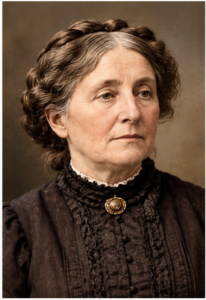 At first, there wasn’t much more than a tragedy and a few tantalising clues in this report. Margaret Radford had been at her daughter’s wedding celebrations that morning, had drunk the health of the newlyweds, returned home, and was later found burned to death in her room. What followed was a remarkably rapid piece of genealogical detective work.
We first wanted to find Margaret’s family, and the first breakthrough came with the 1871 census. At Burrage Road, Plumstead, we found Thomas Radford, aged 45, carpenter, Margaret Radford, his wife, aged 53, Janey Radford, his daughter, aged 14, and Jane Radford, Thomas’s mother, aged 70. (The ages immediately fitted the newspaper, as Margaret in 53 in 1871 would make her about 62 in 1880.)
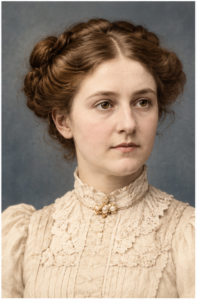 We also discovered that Janey was Thomas and Margaret’s only child, and that the “Milward” came from Thomas’s mother, Jane Milward.
The newspaper said that Margaret’s daughter had married on Christmas morning, and we found her marriage certificate that confirmed that:
Jane (Janey) Milward Radford, full-age spinster, married Stephen Mills, full-age bachelor, on 25 December 1880, at Plumstead Parish Church. Most importantly, Janey’s father was named as: Thomas Radford, a carpenter.
The newspapers said the wedding festivities continued at the house of a relative living in Vicarage-road, Plumstead. That initially looked like a loose end. Then we found two of Thomas’s younger brothers and their families living in Vicarage Road in 1881.
- George Radford, aged 49 and a licensed grocer was living with his wife Nancy and their children at, 56 Vicarage Road.
- John Radford, aged 45 and a carpenter was living with his wife Eliza and their children at 48 Vicarage Road.
Once the records and newspapers were pieced together, Christmas Day 1880 – Margaret’s final day – became surprisingly vivid.
Christmas morning: Her only child, Janey Milward Radford, married Stephen Mills.
Afterwards: Thomas and Margaret attended the wedding festivities at the home of a Radford relative in Vicarage Road. Margaret drank to the health of the newlyweds.
About 2 pm: According to the inquest reporting, Margaret returned home alone. She was described as staggering from the effects of drink.
Later: A fire broke out in her room at 141 Plumstead Road, and this is where the different newspapers became particularly valuable.
The Yorkshire Herald on 28 December said that a spark from Margaret’s pipe ignited her clothing. It also established that the fire was at the house occupied by Mr T. Radford. So we had independent confirmation that the Thomas Radford we had reconstructed was indeed the man living at the address.
The Evening Express on 28 December added an important physical detail, that a tobacco pipe was found underneath Margaret. The report asuggested that she had been smoking, fallen asleep and dropped the lighted tobacco onto her dress, and it also said she was found at the point of death, with her clothes in flames.
The Times on 30 December added more detail about the inquest. The landlady went to Margaret’s room but couldn’t open the door because something heavy was against it. She saw through the window that the room was on fire. Entry was made through the window and Margaret was found lying against the door, burned to death. It was also suggested that a lighted match or paper had fallen into her lap and ignited her clothing.
So there is a small discrepancy in the precise mechanism: pipe/spark in one account, lighted tobacco from the pipe in another, match or paper in the Times, but the broad conclusion is consistent: Margaret was smoking, her clothing caught fire, and she was unable to escape.
The curious question of Margaret’s drinking was probably the most intriguing social history aspect of the case. Why did a mother celebrating her only daughter’s wedding apparently leave the festivities, already drunk, and perhaps go somewhere else to drink? We looked for evidence that Margaret had previously been charged with drunkenness — but we haven’t found any. So we shouldn’t turn the evidence into a diagnosis of alcoholism. However, the contemporary language is striking.
The coroner described the case as one of death arising from “intemperance” and criticised publicans for supplying spirits to a woman who had already been drinking. That tells us that the coroner clearly regarded excessive alcohol consumption as an important part of the circumstances, even though the evidence doesn’t prove that Margaret was a habitual drinker.
Victorian drinking and the wider social history
Alcohol was not unusual in Victorian Britain. Drinking was deeply embedded in everyday life, particularly beer drinking, and alcohol was consumed across social classes. In early nineteenth-century London, drinking beer and gin could even be regarded as safer than drinking polluted water.
But by the later nineteenth century, “the drink question” had become a major social and political issue. Temperance organisations argued that alcohol was responsible for poverty, family problems and other social ills. The movement grew enormously, with both moderation and complete abstinence represented within it. The British Women’s Temperance Association was founded in 1876.
There’s an especially interesting female dimension. Victorian ideas about women and alcohol were highly gendered. Women were supposed to be guardians of the home and family, so female drinking could be seen as threatening the very domestic sphere that Victorian society assigned to them.
So there was a particularly strong concern about women’s drinking. Victorian reformers were increasingly worried about respectable women who drank privately or secretly, particularly alcohol obtained from licensed grocers. Modern historical research stresses that the scale of secret female drinking was actually difficult to establish, because much of the contemporary evidence was anecdotal and polemical.
So when it comes to Margaret, we shouldn’t say: “Margaret was an alcoholic.” What we can say is, Margaret was clearly very drunk on Christmas Day 1880, and the coroner explicitly interpreted her death through the contemporary concept of “intemperance”.
Victorian medicine was beginning to see habitual drunkenness differently. During the nineteenth century, terminology developed to distinguish ordinary drunkenness from what was increasingly regarded as a pathological condition. The word, “alcoholism” was already in use by the mid-century, while “dipsomania” and “inebriety” became increasingly established medical terms from the 1860s. Dipsomania was associated with an uncontrollable or recurrent craving for alcohol, rather than simply someone occasionally becoming drunk. By the 1870s and 1880s, some medical reformers were arguing that habitual drunkenness should be regarded less as a moral failing and more as a disease requiring treatment.
So the Victorian world in which Margaret died was actually in the middle of a fascinating transition: from drunkenness as vice to drunkenness as social problem to habitual drunkenness as possible disease. But Margaret’s evidence doesn’t allow us to place her in the latter category.
But this makes the coroner’s comments particularly revealing. He wasn’t simply recording “woman accidentally caught fire”, he turned Margaret’s death into a temperance lesson, warning others about excessive drinking during the Christmas season. In other words, Margaret’s death was being interpreted not only as an individual accident but as an example of a wider Victorian social problem.
CONCLUSION
I think this is a case where the mystery was never really “who killed Margaret?” The contemporary evidence pointed strongly towards an accident, and the inquest confirmed that. The real mystery was who Margaret was and what happened around her final day. And that’s what the records have allowed us to reconstruct.
We have also seen something that is particularly valuable for this project as a whole – how different newspapers can be treated almost like pieces of a jigsaw puzzle. One gave the basic story; another supplied the pipe; another supplied the obstructed door and the landlady; the inquest report supplied the coroner’s interpretation; and the census and marriage records supplied the family behind the newspaper story.
So this is definitely a completed case. The remaining questions — exactly which Radford brother hosted the festivities, and whether Margaret really visited a public house afterwards — are interesting loose ends, but they don’t prevent us from understanding what happened.
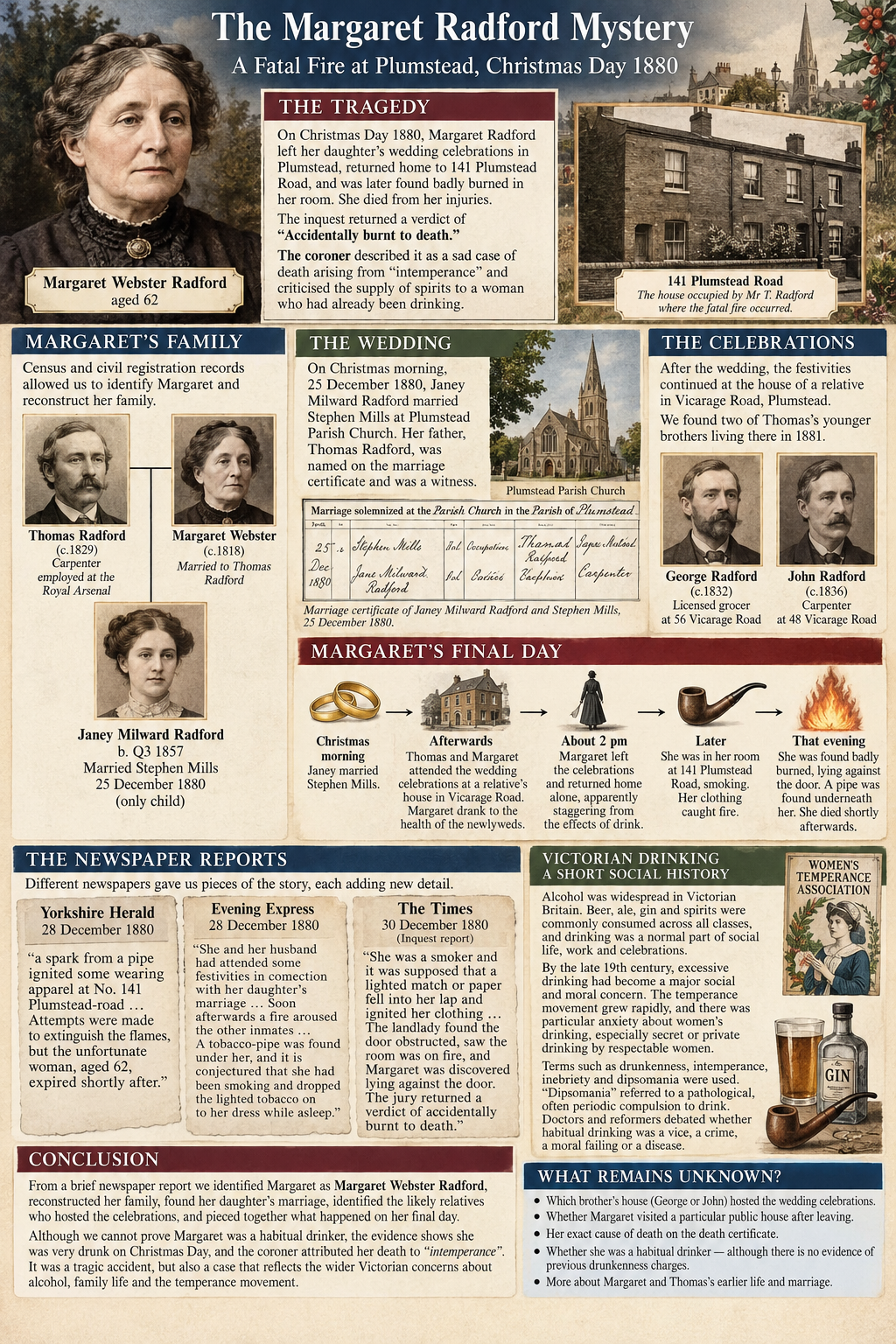
Note: All images were generated by ChatGPT