This short clipping in The Times on 1 January 1875 caught my attention.
| Sophia Head of respectable appearance, living at 96, Clifton-street, Finsbury, informed the magistrate at Worship-street that her son had mysteriously disappeared. He was 25 years old and in good health. On Christmas-day he was to have been married at Haggerston Church, but the bride, after waiting a considerable time in the church, had to go home. The applicant’s son had left his home in the morning and had not since been heard of. |
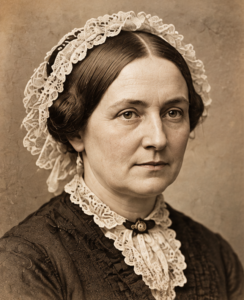 We quickly found out that Sophia’s son was Charles Head, who was born in 1850, the son of James Gould Barty Head and Sophia Tuck.
Charles’s father had died in 1869 and in the 1871 census he was living with his widowed mother, Sophia, in Clifton Street and working as a perfumer.
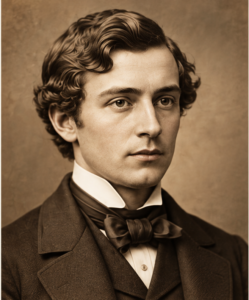 The reason that Charles’s disappearance was particularly extraordinary was that he was due to marry Ellen Austin Strange at Haggerston Church on Christmas Day, 25 December 1874. Their banns had been duly published on three Sundays — 6, 13 and 20 December — establishing that this was not a casual or hastily arranged wedding.
Yet when the wedding day arrived, Ellen went to the church and waited for her bridegroom, but Charles never appeared. After waiting for a considerable time she was forced to return home. Charles had left his mother’s house that morning and, according to Sophia, had not been heard of since.
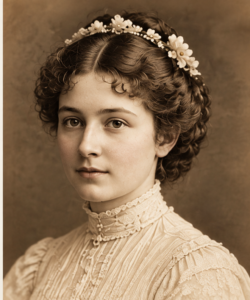 There the contemporary newspaper story ends. But the genealogical records provide a remarkable postscript. On 26 August 1877, nearly three years later, Charles Head and Ellen Austin Strange were finally married at Christ Church, Hackney. Charles was then 27 and now a cabinet maker.
Thus the missing bridegroom was not lost forever: somehow, Charles and Ellen resumed their relationship and eventually married. What happened between Christmas Day 1874 and August 1877 remains unknown.
A Victorian bride left waiting at the altar
For a couple marrying through the Church of England, the wedding was not simply a private exchange of vows. The intention to marry was publicly announced through the reading of the banns on three Sundays, giving the congregation an opportunity to raise any legal objection. In Charles and Ellen’s case, their names had therefore been publicly announced in church three times before Christmas. Their forthcoming marriage was known to the local community and was an established social event rather than something that could quietly be cancelled without embarrassment.
The wedding itself was also highly structured. Contemporary advice instructed that the bridegroom should arrive at the church before the bride, accompanied by his best man, and wait for her at the altar. The bride would arrive with her family and attendants and proceed to the altar to meet him. Charles’s failure to appear therefore wasn’t merely a private change of heart. Ellen had arrived at the appointed church expecting to find her bridegroom waiting for her — exactly the reverse of what was expected. She was left publicly exposed and humiliated, having to wait and then return home without the marriage taking place.
That makes the later marriage particularly fascinating. We don’t know whether Charles had suffered a crisis of nerve, had discovered some obstacle to the marriage, had deliberately fled, or whether some private event intervened. Nor do we know what passed between Charles and Ellen during the following three years. But the fact that Ellen eventually married the same man who had failed to appear on their wedding day suggests that whatever happened was ultimately overcome or forgiven. Victorian newspapers could be remarkably interested in broken engagements, runaway brides and bridegrooms, because marriage occupied such an important place in respectable social life. Yet in Charles and Ellen’s case, the final chapter is surprisingly absent from the newspapers.
CONCLUSION
We have a complete little Victorian mystery in miniature: the banns were read, the bride arrived, the bridegroom vanished, his mother reported him missing. Three years passed, and then, they married after all. We don’t know why Charles disappeared, and I think that’s more interesting than trying to invent an answer.
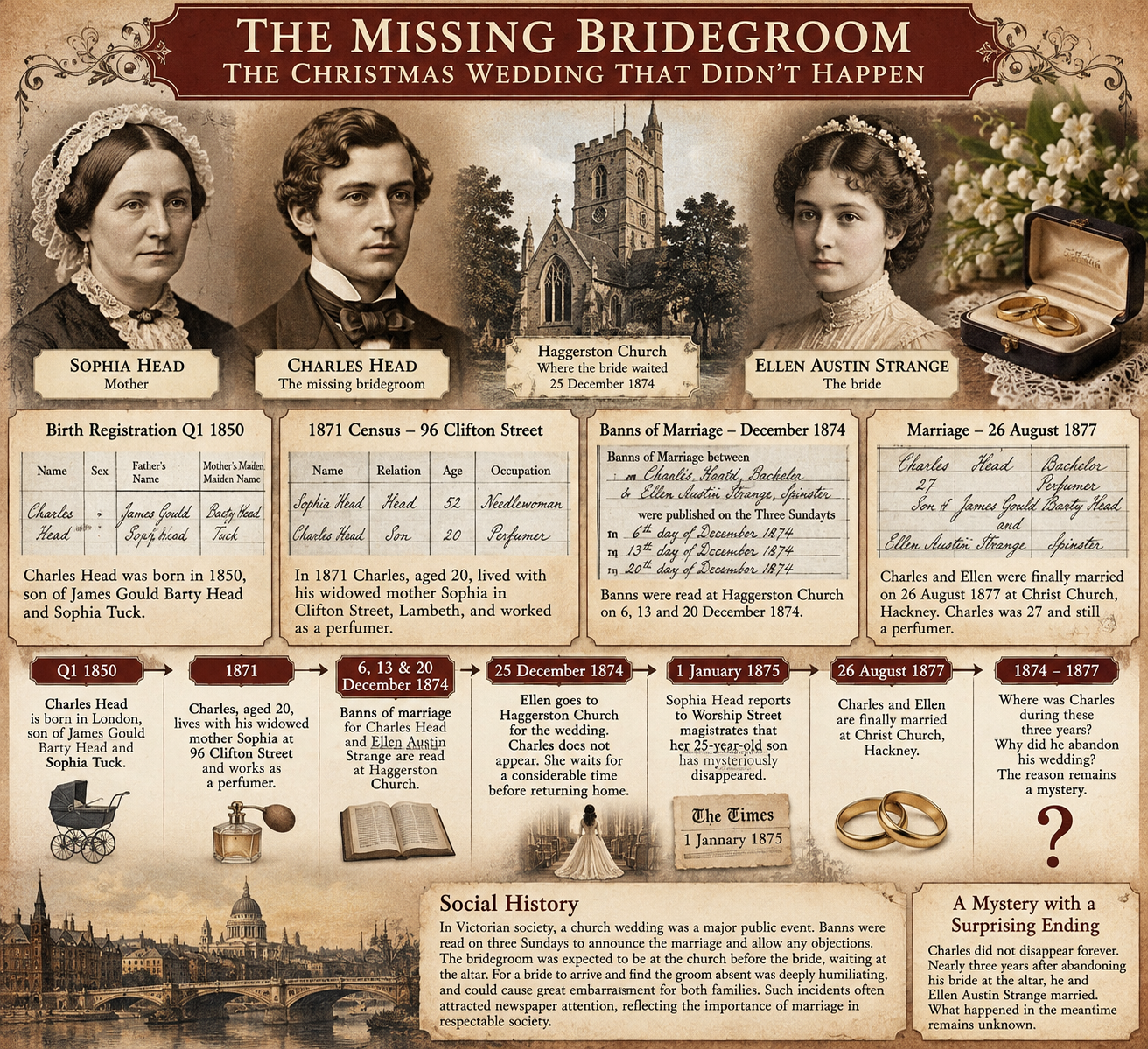
Note: all images generated by ChatGPT