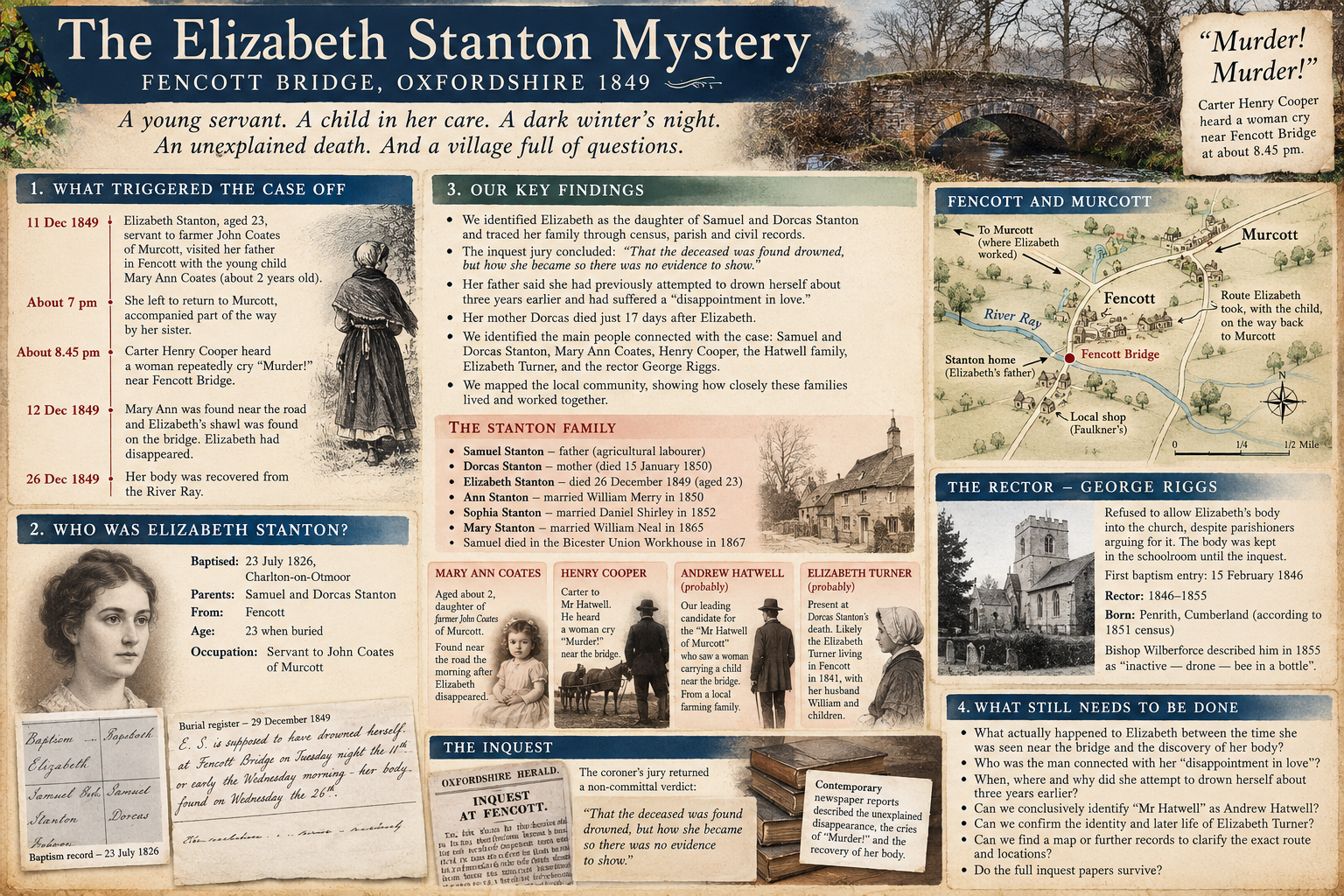
The case begins with the mysterious disappearance of Elizabeth Stanton, aged about 23, at Fencott Bridge in Oxfordshire on 11 December 1849 as reported by the Oxford Chronicle and syndicated to newspapers around the country.
|
MYSTERIOUS DISAPPEARANCE OF A YOUNG WOMAN. The neighbourhood around the Ottmoor district has for some days been excited, in consequence of the mysterious disappearance of a female in the service of Mr. John Coates, farmer, Murcott and of rumours that she had been unfairly dealt with. The facts, as far as ascertained, are as follows: – Elizabeth Stanton, the young woman in question, aged 24, daughter of Samuel Stanton, mat-make of Fencott, went on the 11th instant, having with her at the time her mistress’s child, about two years old, to Mr Kimbell’s of Fencott, shopkeeper, to purchase some goods. This she did, and having paid for them left, and went to her father’s house where she had tea. At about seven o’clock she left for her master’s, having with her the, child. and being accompanied part of the way home by a younger sister. At about eight o’clock, a Mrs. Faulkner heard a child cry, and on going out of her cottage saw Stanton and spoke to her. She had the child with her at the time, and it was in her way from Mr. Coates’s. The conversation was merely formal. Between eight and nine the same night, Mr. Hatwell, of Murcott, when returning from Charlton, and near Fencott-bridge over the river Ray, was passed by a female. They wished each other good night. The female, who had a child in her arms, went for Charlton, and Mr. Hatwell for home. H Cooper, carter to Mr. Hatwell, when going home to Fencott, and when near to Charlton Windwell, at about quarter to nine, heard a female voice cry “murder” four or five times. The cries appeared to come as from the bridge; but on his passing over all was still. He went home and told his mother what he had heard. As the girl did not return with the child to her master’s house, the family became alarmed and unsuccessful efforts were made to obtain tidings of her. At a little before seven o’clock in the morning of the 12th, a young man of the name of Higgs, of Fencott, when driving a team over the bridge saw a child lying on the road. He thinking, as he says, that it was a gypsy’s child, moved it out of the road and went on his way. At about seven o’clock, James Preston, a labourer, on going over the bridge, saw a child by the side of the road. He took it up, and it proved to be Mr. Coates’s, and the one that E. Stanton had. A shawl, which it appears is the one that Stanton had on the day before, was found on the bridge a few yards from the child. The goods which Stanton had purchased were found near the residence of Mr. Faulkner; but of the young woman nothing had been ascertained up to Thursday last. After she was spoken to by Mrs. Faulkner she must have re-passed her father’s house to reach the bridge where the child and her shawl were found. The river is now deep and has overflowed its banks. It is, therefore, impossible to drag it properly, but it has been partially done, and it is intended to make a thorough search as soon as the subsiding of the waters will admit of it. The magistrates of the Ploughley division have instituted proceedings with a view of bringing the mysterious disappearance of the female to light. The child, from its tender age, is incapable of giving the slightest information. The cry of murder is suspicious and leads to the inference that the missing woman was foully dealt with, and then thrown over the bridge into the river. She is described as 5 feet 3 or 4 inches high, and stout built, dark hair which was cut short, light complexion, grey eyes, and as having a dimple on her chin; and to have been dressed in a pink frock with purple sprigs, purple apron, light straw bonnet, trimmed with purple and orange ribbon, and high shoes. This river falls into the Cherwell, a few yards north of the city. |
 In summary: Elizabeth Stanton disappeared after having gone to a shop with a child, and visiting her father. A carter heard a wman repeatedly cry “Murder” near the bridge, but found nothing.
The following morning the child (who we subsequently identified as Mary Ann Coates) was found beside the road near the bridge. Elizabeth’s shawl was found on the bridge, and the goods she had bought were found elsewhere.
Once the water had subsided the River Ray was dragged, and on Boxing Day, Wednesday 26 December 1849 Elizabeth’s body was recovered The circumstances generated considerable suspicion locally, including the possibility of murder — hence the newspaper interest and an inquest that took place on Friday 28 December 1849.
The next day’s, Saturday newspaper was only able to report that a verdict of “Found Drowned” was returned due to the late hour at which the inquest terminated, so it wasn’t until the following Saturday, that the newspaper reported more detail about the inquest.
| INQUEST BY W. BRUNNER ESQ – The Drowing Case at Fencott – In our last Journal we had only time to announce that on the day previously an inquest was held at Chalton-on-Ottmoor, on the body of Elizabeth Stanton, a young woman, who was found drowned, near Fencott Bridge, having been missing ever since the 11th of December. It appeared in evidence, that on that day the deceased, accompanied by a child, was at the shop of Thomas Kimbell, of Fencott, and purchased some articles, and was not seen thereafter, but her shawl was found on Fencott Bridge, and the child near the spot, on the following morning about seven o’clock. A witness of the name of H Cooper deposed that he heard a cry of “murder!” four or five times on the night in question, but he did not mention the circumstance for two or three days. – The father of the deceased deposed that she called at his house on the 11th of December, and appeared altered in her manner; had heard her speak of some disappointment in love, which irritated her, and knew that she attempted to drown herself three years ago. – From the evidence of the surgeon, Mr. Sydenham, it appeared that the deceased suffered from typhus fever last year, and was of weak intellect, besides being afflicted with hysterical mania. – In the absence of more satisfactory evidence, the Jury returned a verdict “That the deceased was found drowned, but how she became so there is no evidence to shew.”. |
As the inquest was not able to establish how Elizabeth died, we cannot legitimately call it suicide or murder. There was evidence pointing in several directions: the “Murder!” cries heard near the bridge; her father’s evidence that she had previously attempted to drown herself; and his account of a “disappointment in love” which had distressed her. The inquest therefore left the central mystery unresolved.
Elizabeth’s burial took place the day after the inquest, on Saturday 29 December 1849, and the burial register contains an extraordinarily marginal note written by Rev. George Riggs, the rector, who conducted the burial.
“E.S. is supposed to have drowned herself at Fencott Bridge on Tuesday night the 11th or early the Wednesday morning – her body found on Wednesday the 26th.”
That, of course, is not exactly the verdict of the inquest. It might seem from this note the rector believed it was suicide. But if it had been suicide, then Elizabeth would not have been able to have a conventional burial.
But there is an extraordinary story about how Rev. Riggs behaved when the body was found, and this was reported in the newspaper. Here is the relevant extract from the newspaper report of 31 December 1849.
| On the subsiding of the overflowed waters, dragging was commenced, and on Wednesday last the body was found by Mr. Beckley, fisherman of Islip. She was dressed as described by us last week, and had the whole of her scanty clothing on, including her bonnet, which it appears had been tied securely on her head. The features were fully distinguishable, and the body was but little decomposed. The sediment of the water adhered so closely to the body as to form a skin-like covering. From the body having been drawn from the water on the Charlton-on-Ottmoor side of the river, it was, after having been placed on a hurdle carried to that village, where for about an hour, it was, in consequence of the peremptory refusal of the Rev. G. Riggs, rector, to allow it to be placed in the church, exposed to view in the road near his mansion. The arguments of the parishioners in favour of the placing the remains in the church were met with a direct negative, and an intimation that he would take the consequences of the refusal. Mr. Riggs suggested that the body should be taken back and conveyed to the cottage of the father of the deceased, but this was opposed, for reasons stated by the bystanders, and the proposer of it then suggested that the remains should be place in the parish coal-house. Cause was shown against this proposition also, and ultimately the body was placed in the parish school-room. |
This contemporary account reports Rev. George Riggs refusing to allow Elizabeth’s body to be brought into the church, and describes parishioners arguing with him and his refusal being described as a “direct negative.”
George Riggs was a relative newcomer to the parish. The Victoria County History confirms that he was rector 1846–1855, following a period when the parish had been served by a curate. It also gives the extraordinary assessment made by Bishop Wilberforce in 1855 of him being “inactive — drone — bee in a bottle”, and records that the bishop found “no warmth or enthusiasm” in the parish.
Our working interpretation of Riggs’s refusal is that Elizabeth was suspected locally of having drowned herself. Riggs may therefore have believed that the death could have been suicide and was unwilling to permit the body into the church until the inquest had established the circumstances. That would explain why the body was kept out of the church while the matter was unresolved. But it seems that even though the inquest did not find suicide, he continued to believe it himself.
Elizabeth’s father, Samuel had told the inquest that Elizabeth had attempted to drown herself about three years earlier, around 1846, but although we searched for an earlier newspaper record, we haven’t found one. But of course that doesn’t mean it didn’t happen.
Our attention then turned to Elizabeth’s family. Elizabeth was baptised on 23 July 1826, the daughter of Samuel and Dorcas Stanton. She had two younger brothers, James and William, and two younger sisters, Ann, Sophia and Mary – one of these accompanied here part of the way home on 11 December 1849.
Dorcas Stanton, Elizabeth’s mother Dorcas died on 12 January 1850 just two weeks after her daughter was buried. She was 44 years old. Dorcas’s death certificate gives the cause as anasarca – a severe medical condition characterized by extreme, generalized fluid accumulation throughout the entire body (oedema).
Although the timing is striking, we cannot prove that Elizabeth’s death caused or contributed to Dorcas’s own death.
The informant for Dorcas’s death was Elizabeth Turner, who was present at the death. In the 1841 census she was living in Fencott with her husband William and their children. We cannot establish the precise relationship between the Turners and Stantons, but she was clearly part of a close knit community, that was evident in the census that showed the Hatwell, Cooper, Turner and Stanton families living very closely together.
Elizabeth’s father, Samuel Stanton remained in the Fencott area and was eventually recorded in the Bicester Union Workhouse, where he died in early 1867, he was 67
Suicide, stigma and the Victorian Church
In Victorian England, suicide carried a powerful moral, religious and legal stigma. For centuries, English law had treated suicide not simply as a tragic death but as a serious offence against both God and society. Although the legal position had begun to change by the nineteenth century, a person who was formally judged to have committed suicide felo de se (“felon of himself”) could still suffer serious consequences. The 1823 Burial of Suicide Act made the treatment less harsh than previously — ending the practice of burial at a crossroads with a stake through the body — but a formal finding of felo de se could still mean burial without the normal Christian rites, privately and at an unusual hour. Suicide therefore remained something families had reason to fear would bring shame and disgrace upon the deceased and themselves, quite apart from their personal grief.
This helps put the events following Elizabeth’s death into perspective. Her body was recovered from the river amid considerable suspicion that she might have deliberately drowned herself. Her father’s evidence that she had previously attempted to drown herself, together with the reference to her “disappointment in love,” would have strengthened that suspicion. The burial register itself records that Elizabeth was “supposed to have drowned herself”. Against this background, Rev. George Riggs’s refusal to allow her body into the church before the inquest can be understood in a very different light. He may have feared that Elizabeth had taken her own life and therefore considered it inappropriate to admit the body to the church until the circumstances had been established. Importantly, the coroner’s jury did not find suicide: it returned the carefully limited verdict that Elizabeth had been found drowned, but that there was no evidence to show how she had come to be there.
The case therefore illustrates the difficult position of a Victorian family when a death might have been suicide. Grief was accompanied by uncertainty, public suspicion and the possibility of religious and social disgrace. In Elizabeth’s case, the ultimate verdict left the family with no formal finding of suicide, and she received an ordinary burial on 29 December 1849. Yet the wording in the burial register shows that the suspicion did not disappear completely. Her story gives us a rare glimpse of the gap between what a community believed, what a family knew, what the Church could accept, and what the law and coroner were prepared to establish as fact.
CONCLUSION
Although we know that Elizabeth disappeared at Fencott Bridge on 11 December 1849 and was found drowned in the River Ray on 26 December 1849, the local belief seems to be that it was suicide. But what actually happened at the bridge, who — if anyone — was with Elizabeth, the meaning of the “Murder!” cries, her earlier drowning attempt, and the identity behind the “disappointment in love – all these things still remain unresolved.