This case begins with this newspaper cutting from the Ormskirk Advertiser on 19 April 1860.
| DOUBLE MURDER AT PENDLEBURY – On Thursday night, William Scholes, aged seventy-five, and William Edward Scholes, aged forty-one, were murdered in the house in which they lived in Irlams-o-th’-Height, about a mile from the Pendleton toll-bar. In the same house lived two children of the former – Joseph, aged thirty-four, and Sarah, aged thirty, the latter a strongly-built woman, said to be subject to fits, and at times very violent. The former states that when proceeding home through Salford, about seven o’clock on Thursday night, he was seized with a fit and taken to the police-office. On arriving at home there was no one below but he heard a noise like someone knocking in his sister’s bedroom. Before going to bed he went to his sister’s room door, but could not get in. During the night he was awakened several times by a noise in his sister’s bedroom, and went to the door but still found it fast. About six o’clock in the morning he went out to get some water and met a young woman, whom he told about the noise, and induced her to accompany him into the house. Having broken open the door of his sister’s room with a hatchet, he beheld a horrible spectacle. On one side of the bed was his father murdered, the upper portion of his body resting upon that of his son William, who had also been murdered. His sister lay upon the bed in the same room with her clothes on. Joseph Scholes and his sister were afterwards apprehended. It was a general opinion that the daughter was in one of her violent moods on Thursday night, before Joseph returned home; that the father and brother went into her bedroom to endeavour to keep her quiet; and whilst there during the night she had attacked and strangled them both. The neighbours, and those who live in the house adjourning, say that quarrels were of frequent occurrence in the family, and on the night referred to the people next door were awakened in consequence of the noise which was heard, and the wife suggested to her husband that they might be killing one another. The most remarkable part of the affair is that Joseph Scholes should have been in the house whilst the murders were being committed, and should have not heard sufficient noise to cause him to give an alarm. Sarah Eliza Scholes was taken before the magistrates on Friday, and it appeared that when arrested she alleged that, having been seized with one of her fits, her father and brother, who were annoyed by her cries, had come upstairs and commenced to beat her, and that, in self-defence, she took a stick, struck her brother, and throttled him, and then served her father in the same way. Her story is partially corroborated by marks on her body. |
 This newspaper article told an extraordinary story, and its reconstruction of the event was that Sarah Eliza Scholes had gone into one of her violent states and that her father and brother had gone into her bedroom to restrain or quiet her, and she had attacked them. But there was immediately a major mystery, Joseph was apparently in the house during the murders. During the night he heard noises from Sarah’s locked bedroom but did not enter, and it wasn’t until the next day that he broke down Sarah’s bedroom door and discovered the two bodies. That was the starting mystery – how could Joseph have been in the house, heard noises and yet apparently not realise that his father and brother were being killed?
We then reconstructed the Scholes family The census evidence turned out to be remarkably good. In 1841 the family was together at Irlams of the Height: William Scholes aged 55, a farmer, was with his wife, Sarah, aged 55 and their children William Edward, aged 20, a letterpress printer. George aged 15, a mechanic, Thomas, aged 15, Joseph, aged 14, Sarah, aged 11 and Jane aged 2. In 1851, living at Scholes Corner, Pendlebury, we found: Sarah Scholes, aged 64, provisions dealer’s wife, Joseph, aged 24, a printer/compositor pressman, Sarah E, aged 21 and Mary Griffiths. William senior and William Edward were absent from this household.
Then we found the burial of Sarah Scholes in December 1856, the wife of William Scholes, who had died aged 69 in Pendlebury. So Sarah Eliza’s mother had died about three years before the murders.
Subsequent newspaper reports gave us much more detail about the murder scene: There had clearly been a violent struggle. The evidence included: scratches and injuries on Sarah, bruising to her arms and legs, scratches around her neck as well as a walking stick, penknives, blood, and injuries to both men.
William senior was found with a closed clasp knife in his hand. William Edward was found on the bed, with serious injuries. The medical evidence reported at the time said that William senior died from suffocation/strangulation, while the early report described William Edward as having suffered a fatal stab wound involving the eye and brain. However, a later September 1860 newspaper retrospectively described William Edward’s injury differently, as a stab wound to the throat. That discrepancy remains unresolved.
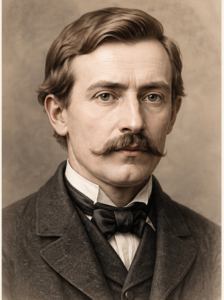 Joseph’s story became increasingly interesting. His evidence was one of the most intriguing aspects of the case. He said he had suffered a fit while returning home and had been taken to the police station because initially the police thought he was drunk. Later, when he returned home, he heard Sarah moving about upstairs. During the night he heard noises from her room. At one point he apparently heard Sarah calling “Help, help!”, and another account records something resembling “I’m choking.” Yet he did not enter the room. This was one of the things that made the original newspaper report so suspicious of the circumstances.
But we subsequently discovered something important about Joseph himself. He was admitted to Prestwich Lunatic Asylum on 11 February 1865 and died there on 6 May 1873. So Joseph too had a significant history of mental disturbance/fits – probably epilepsy. That doesn’t prove anything about what he knew or did on the night of the murders, but it certainly makes his behaviour in April 1860 more understandable as a subject for further investigation.
Maria Turner was the mysterious “young woman” who helped Joseph break into his sister’s In fact the Manchester Guardian account of the incident identified her as aged only nine. She had seen Sarah and her brother, William Edward, sitting quietly together by the fire at about 9 p.m. That is a surprisingly important little detail because it gives us an approximate last-known peaceful moment between Sarah and her brother. But it also makes the original description of the witness as a “young woman” rather misleading!
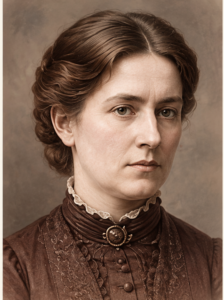
Sarah eventually gave an extraordinary account. This was perhaps the biggest development from the original clipping. While being held at the Salford workhouse on Thursday afternoon, she gave a voluntary statement to Police Constable Dixon. Her account was broadly: she went upstairs to her bedroom; her father and brother came into the room; they got onto her bed and began to beat her; she took up the stick in self-defence; she struck William Edward; she throttled him; she then did the same to her father; and then her father fell on top of her brother. This was not simply a denial. It was effectively an admission that she had killed both men, coupled with a claim of self-defence and lack of control during a fit. There was some corroboration for the allegation that she had been assaulted: witnesses observed numerous bruises and other marks on Sarah’s body.
But Sarah then claimed she remembered nothing This is where the case became considerably more complicated. When brought before the magistrates, Sarah repeatedly said: “I don’t remember anything at all about it.” She appeared to accept some of the evidence by nodding, but continued to say she had no memory of the events. Later she said: “I have no remembrance whatever until they spoke to me the following morning, when they were dead.” So we have three things existing simultaneously: 1: She admitted killing them. 2: She claimed she had acted in self-defence, and 3: She claimed she could not remember doing it. That is one of the central mysteries of the case.
The medical evidence was crucial. The prison surgeon, Frederick Merton, examined Sarah. He considered her to show signs of insanity and epilepsy. He described her as powerful and muscular and said that when under the influence of a fit she could be extremely difficult and dangerous to interfere with. He also observed bruising, scratches and other injuries.
Joseph confirmed that their father sometimes struck Sarah with his walking stick, although he said this was intended to frighten or control her rather than seriously injure her. Joseph also said their father normally entered Sarah’s bedroom only when she was having a fit. That provides an important possible context for the fatal encounter: Father and brother may genuinely have gone into Sarah’s room because she was having a fit — exactly as Sarah herself claimed. What happened once they were in the room is much less certain.
The legal position became extremely unusual. Sarah was committed for trial, but the charges were not reported consistently. The April 1860 newspaper evidence says she was committed for the murder of her father and the manslaughter of her brother. A later newspaper report in September 1860 stated that she had been committed for the murders of both.
Then came the crucial discovery. A September 1860 newspaper report explained why Sarah had disappeared from the Liverpool trial reports. When her case reached the Liverpool Grand Jury, it was determined that her mental condition was such that she was unable to plead. Consequently, the case was not taken into court – it was remanded until the next assizes, and Sarah was sent to Prestwich Lunatic Asylum meanwhile. This finally explained why we could find no conventional trial.
Then we found Sarah’s Prestwich record. Findmypast’s transcription gives:
| Sarah Eliza Scholes. Admitted: 27 April 1860 Patient no. 1139. Death: 6 October 1869. |
It also contains the intriguing note: “Manslaughter charge father.” That doesn’t agree neatly with the April 1860 newspaper evidence, which described the charge as murder of the father and manslaughter of the brother. So we have deliberately left that discrepancy unresolved.
It now appears that the Lancashire Archives catalogue actually has an individual casebook record for Sarah. Most importantly, the catalogue says the material is open and available to view at their Archives room. So we now know that Sarah’s actual asylum casebook record survives. Obtaining a copy of this will help us to understand the circumstances of her admission, her epilepsy/fits, and whether she remained under any form of criminal detention.
There was apparently no subsequent trial in the newspapers in 1860 or 1861 nor in the Liverpool Assize records. Sarah remained at Prestwich Asylum, and as we have seen, she eventually died on 6 October 1869, aged 39. She was buried at St Mary the Virgin, Prestwich, 3 days later, on 9 October 1869, and recorded as
| Sarah Eliza Scholes, daughter of William Scholes, aged 39, abode Prestwich Asylum, formerly of Pendlebury. |
So, as far as we can currently establish, she spent approximately nine years in Prestwich Asylum after the murders.
Epilepsy, Violence and the Victorian Understanding of Mental Illness
This case provides a striking glimpse into the Victorian understanding of epilepsy and its relationship with insanity. In the 1860s epilepsy was still poorly understood, and the boundaries between a physical seizure disorder, mental illness and supposed moral or behavioural abnormality were far less clearly drawn than they are today. Modern historical research describes the period from about 1860 onwards as the beginning of the “modern” era of epilepsy, but also notes that epilepsy was widely associated with mental deficiency, abnormality and even particular personality traits. It carried considerable social stigma and was often concealed rather than openly discussed.
The Scholes case illustrates this attitude particularly vividly. Sarah was described as being subject to fits, and the newspapers portrayed her as becoming extremely violent when affected by them. The prison surgeon, Frederick Merton, believed that she was epileptic and that during a fit she could be “very fearful to be interfered with”. Her family evidently regarded her fits as sufficiently serious that her father and brother would enter her bedroom to assist her. Yet the same behaviour could also be interpreted as dangerous insanity. The distinction between an involuntary manifestation of illness and deliberate violence was therefore blurred. This helps explain the extraordinary situation in which Sarah could apparently admit killing both men, yet the authorities subsequently concluded that her mental state was such that she was unable to plead.
Her eventual confinement at Prestwich also demonstrates how epilepsy could become entangled with the Victorian asylum system. People suffering from epilepsy were not necessarily treated separately from those regarded as mentally ill: nineteenth-century institutions frequently grouped epileptic patients with people described as lunatics, idiots or otherwise of unsound mind. Sarah’s nine years at Prestwich therefore tell us something about the way Victorian society dealt with people whose behaviour was considered both medically abnormal and potentially dangerous. The tragedy at Irlams-o’-th’-Height was not simply a story about a woman who killed two members of her family; it was also a case in which Victorian medicine, law and society struggled to decide where epilepsy ended and insanity, responsibility and dangerousness began. That uncertainty is perhaps the most revealing social-history aspect of the whole case.
CONCLUSION
What began as a newspaper clipping about a rather bizarre double murder has turned into a remarkably well-documented story.
We can now follow Sarah from her family home
through epileptic/violent episodes to the terrible night of 12 April 1860, which resulted in two deaths. Then her extraordinary admission
and claims of self-defence and amnesia, and the medical evidence of epilepsy and unsoundness of mind, which meant that although she was committed
to the next Assizes, she went into the Prestwich Asylum on 27 April 1860, which resulted in her inability to plead. Then nine years late she died in the asylum in 1869, aged 39.
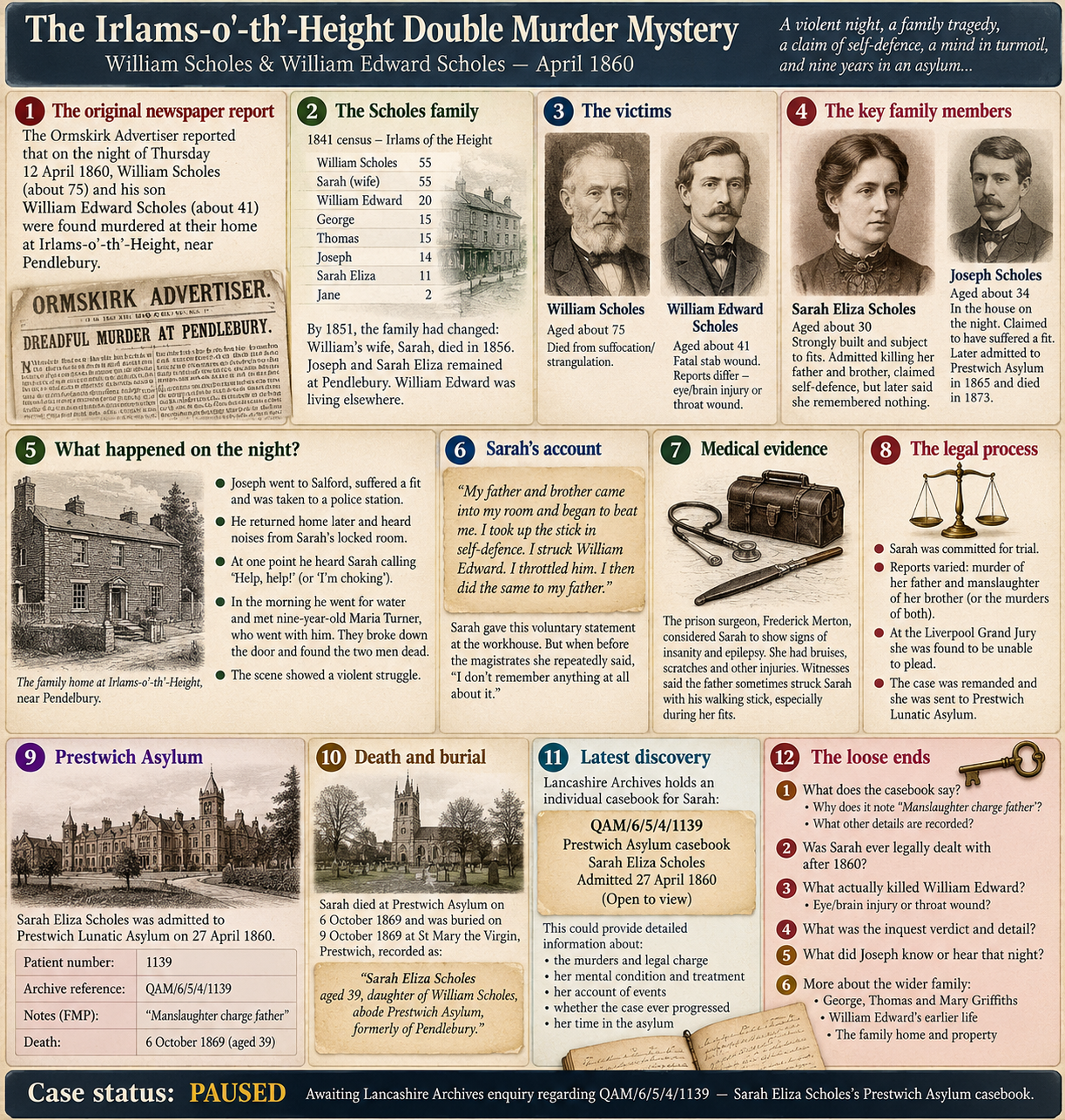
Note: All images have been generated by ChatGPT.