This case begins with the newspaper report below from Reynolds’s Newspaper on 1 January 1860.
(Reynolds’s Newspaper was a Sunday newspaper founded in 1850 by George W. M. Reynolds. It became particularly associated with a popular, relatively radical readership and was extremely widely circulated in the Victorian period. One modern historical study describes Reynolds’s Newspaper as one of the most widely read Victorian newspapers, alongside Lloyd’s Weekly.)
| On Friday night, Mr Bedford, coroner, held an inquiry at St. George’s Hospital, as to the death of Mrs. Anne Grace, wife of a licensed victualler, residing at 30, Arthur Street, Chelsea. Her husband said that, between three and four o’clock on Sunday morning, the 18th instant, he was awakened by groans, and missing his wife from their bed, he arose and found her sitting on a chest in the room with her throat frightfully cut, and bleeding perfusely; by her side was a razor covered with blood. Verdict, “That deceased destroyed herself while in a state of temporary insanity.” |
The aim of this case was to find out more about Anne Grace, her family and perhaps even what caused her to commit suicide.
At the beginning we knew nothing about Anne Grace than what appeared in this clipping, but when we found her burial on 27 December 1859 in Brompton Cemetery, it gave her age as between 53 and 54, which meant her birth date was around 1805–06.
 We then established that her husband was Alfred Grace and that the couple lived at 30 Arthur Street, Chelsea. This was particularly valuable because the 1861 census confirmed that Alfred Grace, age 57, widower, a licensed victualler (who was born in Waddesdon Bucks) was still living at that address. At that time he was with Anne Grace, aged 26, his niece and housekeeper, Martha Bartlett, aged 14, his niece, and a potman. So we had a very strong identification of the Anne in the newspaper as Alfred Grace’s wife.
We then found a possible marriage – on 10 March 1834 at St Marylebone between Alfred Grace and Ann Parish.
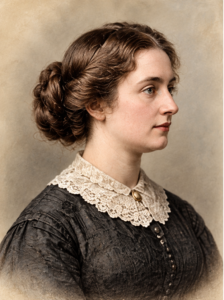 The census evidence was remarkably consistent about Ann’s age. In 1841 Ann Grace, aged 35, was living at Gloucester Row, St Mary Newington, with Alfred Grace aged 30. There were no children. Because 1841 ages were rounded down, this is compatible with an actual birth around 1805–06. In 1851 Ann Grace, aged 44 (born Birmingham) was living in Trinity Street, Newington with Alfred Grace, aged 41, a livery stable keeper. Also present was Alfred Grace, aged 6, a nephew, born Hackney. Again, there were no children of Alfred and Ann.
This indication of a birthplace in Birmingham was particularly important because it gave us our best clue to Anne’s origins. We’ve searched for Anne’s baptism but haven’t found one yet. There are, however, several Parish baptisms in Birmingham around the right period. One particularly interesting possibility is William Parish, baptised 1806, son of James and Susanna Parish. The dates and location are tantalisingly close to our Anne, but we have not established that Anne was a daughter of James and Susanna, so this remains a hypothesis only.
We found a family tree showing Alfred as the eldest of 12 children, the son of Thomas Grace and Ann Griffin. This fits very well with the possible baptism we found of 25 June 1810 in Waddesdon, Buckinghamshire, son of Thomas Grace and Ann Griffin. The 1851 census age of 41 fits this baptism particularly well. The 1861 census gives him as 57, which is about six years older than the baptism would suggest, but census ages can be unreliable – and it may even be a transcription error so should be 51. So Alfred’s identity is looking quite convincing, although we’d ideally like further independent evidence.
We tried to use Alfred’s large Grace family to identify the relatives living with him.Alfred Grace, nephew, Anne Grace, niece and Martha Bartlett, niece, but we can’t be sure who their parents were. So, the nieces/nephew are therefore currently an unresolved side branch rather than essential to the main investigation.
Alfred and Ann appear to have moved around London during their marriage, from Newington in 1841 and 1851 to Arthur Street, Chelsea by 1859 where Alfred was a licensed victualler, and where he was still living in 1861. The fact that Alfred was still operating the premises more than a year after Anne’s death provides no obvious evidence of a financial collapse. It doesn’t rule out private financial difficulties, but we’ve found no evidence of bankruptcy or some dramatic business failure.
I then found another newspaper report in the West Middlesex Advertiser and Family Journal, dated 31 December 1859.
| TERRIBLE SUICIDE. – On Friday morning about 3 o’clock, a fearful scene took place at the house of Mr. Alfred Grace, the Hope Tavern, 30 Arthur-street, Chelsea. It appears that Mrs. Grace, who had been in a desponding state of mind, was found with her throat severely cut with a razor, as appeared, by her own hand. She was promptly taken to St. George’s Hospital, where death took place. An inquest was held on the body yesterday at the hospital, by Mr. Bedford, coroner for the Westminster District. |
This newspaper report was extremely useful because it gave us information missing from Reynolds’s account. It describes the location explicitly as the Hope Tavern, 30, Arthur-street, Chelsea, and and identifies the proprietor as Mr Alfred Grace.
Most importantly, it says that Mrs Grace “had been in a desponding state of mind” before she was found with her throat severely cut. This is the first evidence about her state of mind. It doesn’t tell us why she was despondent, but it does suggest that her final act may not have been completely unexpected.
And this is where the mystery really lies. We don’t know what caused the despondency, and that’s the part we don’t want to try to fill in with guesswork.
We have discovered that there are surviving St George’s Hospital records that cover this period, including hospital admission/death registers and a substantial collection of post-mortem and case records dating from the nineteenth century. We’ve searched the material available online but haven’t found an indexed case for Anne Grace. That doesn’t prove her record isn’t there.
Suicide and the Victorian Medicalisation of Despair
Anne Grace’s death provides another insight into changing Victorian attitudes towards suicide. By the mid-nineteenth century, suicide was increasingly being interpreted not simply as a moral or religious transgression, but as an act committed during a state of mental disturbance. The coroner’s verdict that Anne had “destroyed herself while in a state of temporary insanity” is particularly revealing. Rather than treating her simply as a wilful sinner, the verdict attributed her actions to a temporary failure of reason. The contemporary description that she had been “in a desponding state of mind” also reflects the growing association between melancholy, mental disturbance and suicide.
This does not tell us why Anne took her own life; that remains unknown. But it does tell us how those around her sought to understand it. Her suicide was apparently made more comprehensible by assuming that she had not been in her normal state of mind. This was part of a broader nineteenth-century movement towards the medicalisation of suicide, in which coroners, doctors and the public increasingly looked for evidence of insanity or mental disorder behind self-destruction.
CONCLUSION
We’ve turned a 6-line newspaper report about an otherwise anonymous Victorian suicide into the story of a real woman with a name, a husband, a marriage, a birthplace, a 25-year married life, two decades of London addresses and a final home at the Hope Tavern. That’s quite a lot to have recovered from one tiny clipping.
Why she committed suicide?” is genuinely one of those questions where we may ultimately have to say unknown. The final step would be to see whether any hospital/post-mortem records survive at St George’s, and whether the inquest itself left any surviving documentation. 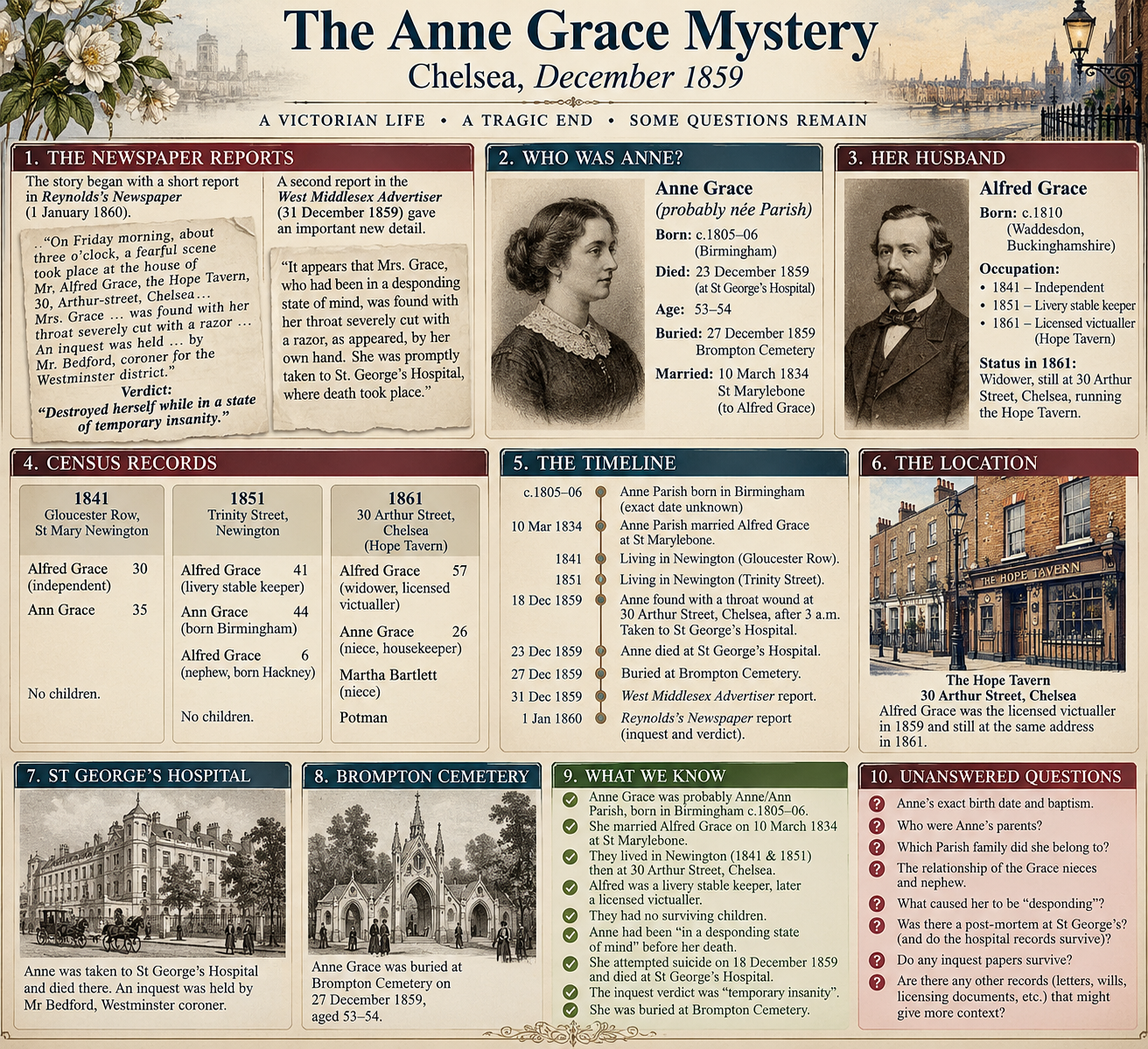
Note: All images generated by ChatGPT