This case began with this sensational newspaper report from the Sunday Dispatch on 22nd September 1895.
|
A ROMANTIC STORY. At Bow-Street on Tuesday, Catherine Elizabeth Malenoir, of 61 Lambs Conduit-street, a married woman, stylishly dressed was charged with using threats to George James Shipway and Dora Shipway, whereby they went in fear of their lives. Mr. C. M Williams, who prosecuted, stated that one of the complainants was Mr. James Charles Shipway, a financial agent and his wife, Dora Shipway, who was a member of the theatrical profession. Some time ago Mr Shipway put defendant into one of his own houses, where she was to carry on the business of a boarding-house keeper. This arrangement was financially unsuccessful, and both parties agreed to discontinue it. On August 31 defendant met Mrs. Shipway in the street, and threatened to stab her in the back. Complainant came to this court, when the magistrate sent an officer to warn the defendant against a repetition of her conduct. On September 2 defendant quitted Mr. Shipway’s house, and she subsequently met him in the Strand, and USED LANGUAGE OF A THREATENING NATURE, to the effect that she would stab him. As she was carrying a knife in her hand at the time, complainant was considerably alarmed, and thought that she might do him some bodily injury. On the evening of the 14th inst. defendant called at complainant’s house disguised as a sister of mercy, and so complete was this disguise that the servant who admitted her failed to recognise her. Upon discovering who his visitor was, Mr. Shipway at once took steps to have her put out of the house. On this occasion defendant’s conduct was so violent that before she could be ejected she tore down the curtains and did other damage to the furniture. George James Shipway, financial agent, of 81 Gower-street, deposed that when the defendant came to his house disguised he at once recognised her, as she had previously called at his office similarly attired. As he entered the room she tried to close and fasten the door, but he succeeded in preventing this. He got her into the hall, where she threatened to stab him. Witness said he knew the woman to be a married woman, but separated from her husband. Sir John Bridge asked the defendant if she had anything to say. The defendant replied, in a voice broken with emotion: Nearly every word that has been said is false. When I first saw this man I WAS SELLING NEWSPAPERS IN THE STREET and he met me, and asked me to meet me the next day. And I said, “No; you are a married man.” He turned to his companion, a Mr. Raphael, and said “Am I a married man?” He laughed, and said, “Of course not.” And I met this man the next day. It was the first wrong step I took in my whole life. And I loved this man, and I still love him; and I shall ever love him, no matter what he does to me. I left his house so that he could have peace with his wife, and he promised to come to see me every day. I never threatened to stab this man. He is sacred to me, and I would never hurt a hair of his head. All I asked was that he would give me ten minutes’ interview alone – alone – SO THAT HIS HEART MAY SPEAK TO MINE. I have written to him again and again, asking for only ten minutes alone, so that he might tell me what was in his heart, and he would not even grant this to me. His conduct has made me seem loathsome to myself; and I said, “I will put a knife through myself and die at your feet.” Those were all the threats I used. In reply to Sir John Bridge, she said: He said he would put me in the boarding-house, and that it would be a good living for me, and help me to bring up my children – for I have five. But it was only last Friday that I knew this man was Shipway. To me he was always Tyrrell – Walter Tyrrell. Dora Shipway, wife of the previous witness, also gave evidence. Sergeant Ford, 11E, stated that he apprehended the prisoner in Lambs Conduit-street when she was walking with two children. When he read the warrant to her she said, “It is all false, I never threatened Mr. Shipway; but I have threatened my own life.” Sir John Bridge: Are you able to support yourself? Prisoner: No; I have never been brought up to any business, and it is through this man that I AM HOMELESS, PENNILESS AND WITHOUT A HUSBAND. My husband warned me against this man; he said “You don’t know the world, my girl. I do. Don’t have anything to do with this man; he is a scamp.” I said, “No, he is a good, true, pure, honest man, and he has promised to love me through life.” Sir John Bridge then ordered the case to be put back. Later in the afternoon the defendant was again placed in the dock. Her cousin, Miss E. H Buchanan, came into the witness-box, and stated that she had spoken to the defendant, who had solemnly promised never to molest the complainants again. On this understanding Sir John Bridge released the defendant on her own recognisances in £100 to keep the peace for twelve months. |
Summary: The original newspaper story presented a wonderfully melodramatic tale. Catherine Elizabeth Malenoir, a married woman with five surviving children, was brought before Sir John Bridge at Bow Street after allegedly threatening George James Shipway, a financial agent and his wife, Mrs Dora Shipway.
Catherine claimed that she had fallen in love with Shipway, believing him to be unmarried. She said she had known him as “Walter Tyrrell”, and only discovered shortly before the hearing that his real name was Shipway. She maintained that she had left his house so that he could live peacefully with his wife.
The newspapers portrayed the whole thing as a “romantic story”, an “extraordinary case” and “pitiful confusion”. But, as we have discovered, the reality underneath the sensational reporting was considerably more complicated.
 Catherine was Catherine Elizabeth Kelly, daughter of Thomas Kelly, an artist/wood engraver/lithographic draughtsman. She married Samuel Richard Malenoir in 1880, and they had six children of which five survived into adulthood. By 1891 the family was living in Forest Gate, although Catherine’s eldest son Claude was with his paternal grandmother. By 1901 the marriage had effectively broken down, Catherine, describing herself as an actress, was at Great Ormond Street, and Samuel, a fish porter, was elsewhere in Mile End and described himself as single. However, Catherine was still describing herself as married in 1901. So the 1895 court description of her as a married woman separated from her husband fits the subsequent documentary picture.
Catherine’s theatrical side became one of the most interesting discoveries. She told the court that she had previously sold newspapers and that Shipway had first approached her in the street. Dora Shipway independently corroborated that detail, describing Catherine selling newspapers with her hair down her back, short skirts and a “theatrical get-up”. Catherine subsequently appears in the 1901 census as an actress, so her theatrical presentation in the court story wasn’t simply something invented by the reporter.
However, we also have to remember that Catherine’s own evidence was highly emotional: “I loved this man, and I still love him…” She described Shipway as “sacred” to her and said she would never hurt him. The newspapers clearly enjoyed the melodrama. We cannot know how much of her courtroom performance was deliberate.
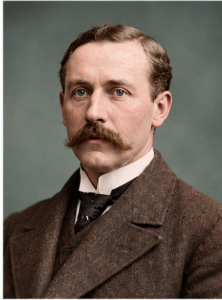 It was with George James Shipway where the investigation really expanded. We established that the man in the case was George James Shipway, a financial agent. His business history was more complicated than the newspaper suggested.
George’s own response in divorce proceedings with his first wife reveals that his business had failed in June 1880 and that his affairs remained in liquidation. By 1883 his financial position was still difficult. He said his affairs were in liquidation; he was liable for debts of about £120; he was paying debts by instalments; his income was only about £85 a year; he had a wife and three children to maintain. But, importantly, his sworn address was 3 Tavistock Street, Covent Garden. That address later becomes extremely important.
By the time of the Catherine case in 1895 he had become a financial agent, making advances against security. We found the contemporary business entry: Real & Personal Advance Co. Ltd. — G. J. Shipway, 16C, Tavistock Street, Covent Garden, WC. And later advertisements show George conducting his money-advance business from 3 Tavistock Street. So George appears to have gone from serious financial difficulties in 1880–83 to operating professionally in the money/advance business by the 1890s.
George’s first wife was Charlotte Staite, whom he married in 1865. Their marriage produced two children, Amy and George. The divorce material initially looked as though it might contain a connection to his second wife, Victoria — but the actual petition gave us an important correction. Charlotte’s allegations concerned cruelty/attacks by George, and adultery with Alice Ellen Haigh in 1882. Alice Ellen Haigh was living with George when Charlotte’s petition was filed in 1883.
George’s divorce eventually became absolute in December 1888 so the divorce papers do not provide evidence that Victoria was involved in the earlier breakdown of the marriage. That’s an important negative finding.
In 1881 George and his two children were boarding with Victoria Lloyd and her mother Alice. Her mother’s full name was Alicia Elizabeth St. Lawrence, and after George and Victoria married in 1884 they had a son in 1895 whom they called Victor St Lawrence Shipway.
 But what we found out about his second wife Victoria Lloyd was fascinating. Prior to her marriage to George, Victoria was already involved in theatrical activity under the name V. St. Lawrence. In fact we found V. St. Lawrence performing as early as 1888, including a performance with W. Tyrrell. By January 1891 she was performing with the West London Dramatic Club and was described as a lady amateur. Later she became a professional actress. That gives us a very plausible explanation for the otherwise puzzling St. Lawrence name. Victoria Lloyd was using her mother’s family name professionally as Victoria St. Lawrence .
And then came 81 Gower Street. This may be the biggest discovery of the entire case. The The Era newspaper in July 1895 reported that V. St. Lawrence had just completed a stock season in Nottingham. Her professional advertisements gave 81 Gower Street, Bedford Square, W.C. as her permanent London address at precisely the same time we have the Bow Street reports identifying George James Shipway of 81 Gower Street and his wife Mrs Shipway in the theatrical profession. That is an extraordinary convergence.
We then found contemporary advertisements for 81 Gower Street showing that it was actually being used for board and residence. One reads: “Apartments … also Board-Residence in superior house … 81, Gower-street, W.C.”
Another, on 10 September 1895, says: “Board and Residence: comfortable home; moderate rents; liberal table; bath — 81, Gower-street.” and there is another virtually identical advertisement on 11 September 1895.
This is extraordinarily close to the wording of the court evidence. George told the court that he had put Catherine into “a house of his own” where she was supposed to operate it as a boarding house. Catherine left that house on 3 September 1895. Then, on 10 and 11 September, No. 81 is being advertised for board and residence. We still cannot prove that 81 Gower Street was the house George put Catherine into, nor have we proved that George owned it. But it is now by far the strongest candidate.
The property has a fascinating history. In 1891 the Waterlow household was living there, with servants — and we found advertisements for a cook and parlour maid at the address. By the mid-1890s the character of the property appears to have changed – like many of the grand properties in Upper Gower Street. By 1901 the property was unquestionably functioning as a boarding house. That is a remarkably neat sequence.
The Dora problem is the one major mystery we haven’t completely solved. The newspapers consistently called George’s wife, Dora Shipway, but the theatrical evidence gives us V. St. Lawrence and the genealogical evidence gives us Victoria Lloyd/Shipway. We have found no convincing independent Dora Shipway in the 1891/1901 census searches, so our working identification is that Dora Shipway was probably Victoria Lloyd/Shipway, professionally known as V. St. Lawrence, an actress. I think that is now a strong working hypothesis, but it is not an established fact.
So why might she have referred to herself as “Dora”? We simply don’t know. Possibilities include: it was a private/familiar name; it was a theatrical/professional choice; it was a name used deliberately in connection with the court case to keep her professional identity out of the sensational newspapers, or it may even have been an reporting error. The last few are hypotheses, not evidence.
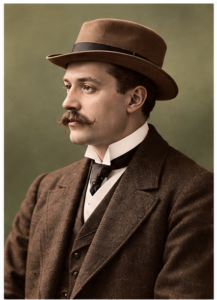 And then we found the other extraordinary strand. Catherine said the man she knew was “Walter Tyrrell.” At first this looked like perhaps just an alias, but there really was a Walter Tyrrell operating in precisely the same world. We found:
- W. Tyrrell and V. St. Lawrence together in theatrical activity as early as 1888.
- Walter Tyrrell living at 3 Tavistock Street in the 1896 rate book.
- George Shipway also operating from 3 Tavistock Street.
- V. St. Lawrence herself giving 3 Tavistock Street as her theatrical address in November 1895.
In 1896/97 Walter Tyrrell was associated with the Novelty Theatre and V. St. Lawrence subsequently worked with him there.
So there is a very real Shipway–Tyrrell–St. Lawrence/Tavistock Street theatrical/business network.
This sensational story ultimately ended rather quietly at Bow Street. Catherine denied most of the allegations but admitted making threats against herself. Her cousin Miss E. Buchanan came forward and promised that Catherine would not molest the Shipways again. Sir John Bridge ultimately released Catherine on her own recognisances of £100 to keep the peace for twelve months. There was no reported conviction. So the whole extraordinary episode ends not with imprisonment or trial, but with a peace bond. That helps explain why the newspaper story is much more dramatic than the eventual legal outcome.
A Victorian World of Marriage, Independence and Melodrama
This case provides a fascinating glimpse into the complicated position of women in late-Victorian society. Catherine was a married woman who had effectively separated from her husband, had five surviving children, and had little independent means of support. Her statement that she had never been brought up to business and could not support herself is particularly revealing. Although legislation such as the Married Women’s Property Act 1882 had begun to give married women greater control over their own property and earnings, economic independence was still far from the everyday reality for many women. The case therefore illustrates the vulnerability of a woman who found herself outside the conventional security of marriage but without the skills or resources to establish an independent livelihood.
Marriage itself was also becoming a more complicated institution. George Shipway’s own history — an unhappy first marriage, allegations of cruelty and adultery, separation and eventually divorce — illustrates how difficult and expensive marital breakdown could be in Victorian England. Divorce had become legally possible through the Matrimonial Causes Act of 1857, but the system remained restrictive and particularly difficult for women. The lives of Catherine, George and the woman identified in the newspapers as Dora therefore sit within a period when traditional expectations of marriage were still powerful, while divorce, separation, women’s employment and changing ideas about female independence were beginning to challenge those expectations.
There is also a wonderfully theatrical quality to the whole affair — and that is more than coincidence. Theatre literally runs through the story. Catherine had theatrical connections and later described herself as an actress; George’s wife was herself a theatrical professional; V. St. Lawrence was performing professionally; and Walter Tyrrell was part of the same theatrical world. The newspapers seized upon this, presenting the story as a “romantic” and “extraordinary” drama complete with disguises, declarations of undying love, threats, jealousy and a mysterious assumed name. Yet that melodrama also tells us something about Victorian popular culture: newspapers could transform a private domestic dispute into public entertainment, particularly when it involved actresses, sexuality, marriage and scandal. In this case, the theatre was not simply the setting — it became part of the way the story was understood and sold to the Victorian reading public.
CONCLUSION
We started with a sensational newspaper cutting and initially had almost nothing except names and a dramatic story to work with. But we have now made considerably more sense of it than it did when we started. The original cutting made the court case look like a bizarre little romantic melodrama, but we’ve now been able to put a substantial amount of documentary structure around the people and places referred in it.
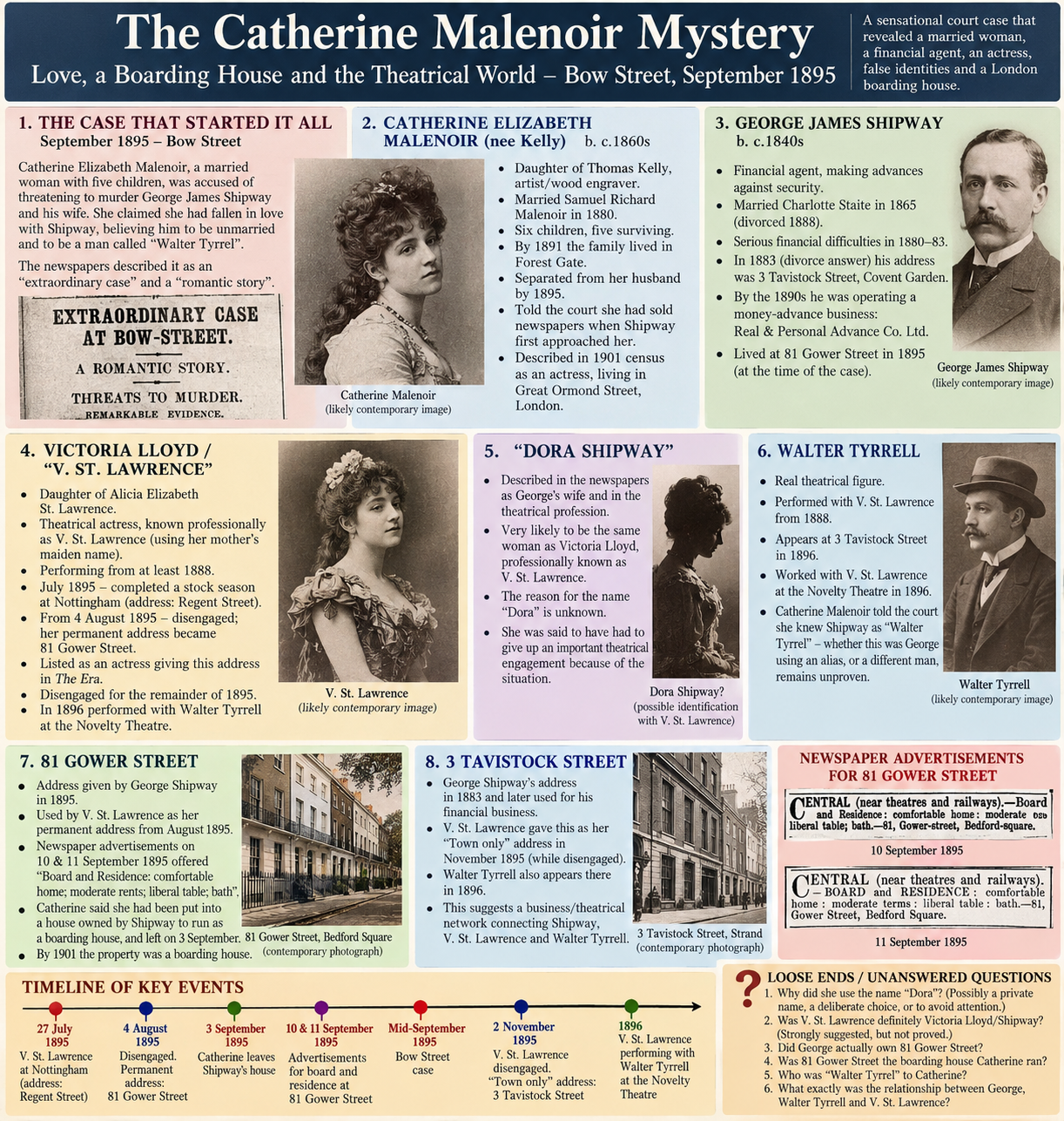
Note: All images generated by ChatGPT