This case begins with a report in the Sheffield and Rotherham Independent on 17 December 1870.
|
THE FICTITIOUS CHILD CASE. On Tuesday, at the Central Criminal Court, Mary Hall, 41, a married woman, was charged with unlawfully conspiring with one “Annie Agatha” to palm off upon James Lowe a certain child as the child of the last-named defendant, with intent to injure and prejudice him. The prisoner was also charged with administering a certain narcotic drug to the infant in question with intent to do it grievous bodily harm. Mr. Willis prosecuted; Mr. Griffiths was counsel for the defence. This case was one of a very extraordinary character. The prosecutor, Mr. Lowe, was a gentleman of property, living at Peckham, and “Annie Augusta” who it appeared, was not known by any other name, had lived with him for more than four years and passed as his wife. In the year 1868, she was delivered, or at all events the prosecutor was led to believe that a child he found in the house was her child, and it was brought up as his child until 1869 when it died. At the commencement of the present year Annie Augusta appeared to have presented that she was again in the family-way, and even the medical gentleman who attended her, Dr. Farr, was induced to believe that this was the case from her appearance. On the 22nd of October the prosecutor was at Brighton, and a telegram was sent to him informing him that Annie Augusta had been delivered of a child. He returned to town, and found Annie Augusta in bed, and the prisoner, who had also acted in her first confinement, was also in the house in the same capacity at this time, and a child was shown him, of which it was represented Annie Augusta was the mother. The doctor had again been duly introduced into the house, but his suspicions appeared to have been excited, and he soon discovered that the representation that Annie Augusta had been delivered of a child was utterly false. This, of course, led to further inquiries, and it was ascertained that the prisoner Hall had gone to a married woman named Farrant, who was in the family-way, and represented to her that she knew a lady and gentleman who were anxious to adopt a baby, and she consented to let the prisoner have the child of which she expected to be delivered. On the 22nd October the prisoner appeared, accordingly, to have taken away the child in question, of which the woman Farrant had only been delivered about an hour before, and in order to keep it quiet, some narcotic was undoubtedly administered, and while it was in this condition the infant in question was introduced into the house of the prosecutor. It was contended on behalf of the prosecution that the object of these proceedings on the part of the prisoner and Annie Augusta was to throw the burden of maintaining the child upon the prosecutor, or at all events to make him liable to support it as its putative father … Mr. G. J. Lowe, the prosecutor, who was severely cross-examined by Mr. Griffiths said that his wife was alive when Annie Augusta first became acquainted with him, and he took a house for her, and she was under his protection till his wife died, when Annie Augusta came to his house and passed off as Mrs. Lowe. He said that for a long time he believed that the first child was really his own child, and it was not until he heard of the case of the two Skeplehorns, which was disposed of in this court at the beginning of the year, that his suspicions were excited. – The prisoner was found guilty, and sentenced to two years imprisonment, with a fine of £100 in addition. |
So what actually happened when this extraordinary event took place? Using a number of other sources including contemporary newspaper reports as well as the actual trial proceedings from the Central Criminal Court, we pieced the story together
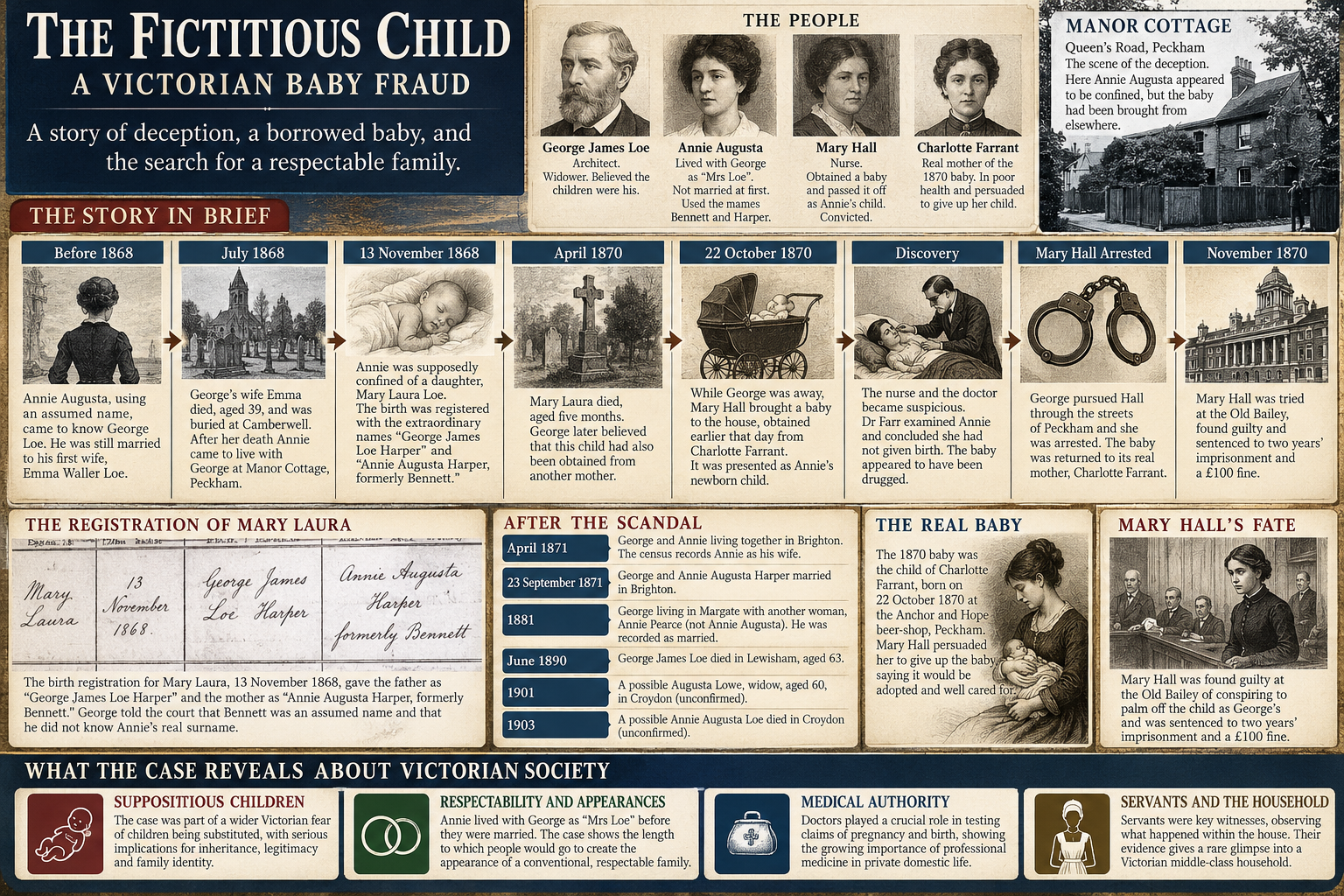
On 22 October 1870 a remarkable deception came to light at Manor Cottage, Queen’s Road, Peckham. George James Loe – as his surname was actually spelled – aged 43, was living with a woman known to him as Annie Augusta, aged 28, who had passed herself off as his wife for several years. They were not legally married.
Annie had already apparently had one child, a little girl whom George had accepted as his own. In the autumn of 1870 she appeared to be pregnant again, and even her medical attendant, Dr George Frederick Farr, believed that she was expecting a baby.
 On 22 October George (a surveyor) was in Brighton on business, and while he was away, Annie was apparently confined at Manor Cottage and a child was presented as hers. When George returned that evening, however, the nurse, Ann Collins, told him that something was seriously wrong: “There is a baby in the house, but Mrs Loe has never been confined, and the doctor is of the same opinion.” The ensuing investigation revealed that the baby had not been born to Annie at all.
The infant had in fact been born only a few hours earlier to Charlotte Farrant, at the home of her sister-in-law, Eliza Reeves, who kept the Anchor and Hope beer-shop in Smith Street, Peckham. Mary Hall, a woman who had previously acted as Annie’s nurse, had approached Charlotte before the birth, telling her that a lady and gentleman wanted to adopt a baby and would give it a good home. Charlotte, who was in poor health, eventually agreed. On 22 October Mary Hall collected the newborn child and took it away in a cab, saying that it was going to be adopted.
Mary Hall then took the baby to Manor Cottage and the child was presented as the product of Annie’s supposed confinement. The deception might have succeeded but for Mrs Collins and Dr Farr. Collins noticed that the baby had already been washed and did not have the appearance of a just born infant. Dr Farr became suspicious almost immediately. He examined Annie and concluded that she had not given birth; he also found that she had no milk in her breasts. The infant itself was pale, cold and deeply lethargic, leading him to suspect that a narcotic had been administered.
Meanwhile George was pursuing Mary Hall after she attempted to leave the neighbourhood. He followed her through several streets, to Queen’s Road station and then in a cab towards Peckham, eventually securing her arrest near Peckham Station. The baby was recovered alive and was subsequently returned to the Farrant family. Mary Hall was charged with conspiring with Annie Augusta to palm off the child as George’s and induce him to foster and maintain it. She was found guilty and sentenced to two years’ imprisonment and fined £100.
The baby girl
The baby at the centre of the deception was not merely an anonymous “female child” described in the newspaper reports. Further research into the Farrant family has identified her as Hannah Charlotte Farrant, whose birth was registered in Q4 1870. Charlotte Farrant and her family can be found in Smith Street in the 1871 census, living with the Reeves family, but Hannah is absent — an apparent puzzle until her death registration is found in the same quarter in which she was born. This real little girl briefly became the centre of an extraordinary Victorian scandal.
Annie’s earlier child
The court proceedings added an important correction to some of the newspaper chronology. The first child was not born in April 1868, as some of the newspaper accounts might suggest. George told the court that he believed Annie had been confined in November 1868 and that the child was a girl. He produced the General Register Office entry for Mary Laura Loe Harper, born 13 November 1868. George maintained her until her death in April 1870, believing throughout that she was his daughter, and he later discovered that she had not been Annie’s child at all.
The registration of Mary Laura is one of the most extraordinary documents in the entire case. The father was entered as George James Loe Harper and the mother as Annie Augusta Harper, formerly Bennett. Under cross-examination George explained that Annie had originally gone by the name Bennett, which he knew was an assumed name, and that he himself did not know her true surname. He said that the name Harper had been used because Annie had asked him to put it on the registration. He emphatically denied that he had ever been called Harper or Bennett.
This is significant because it changes our interpretation of Annie’s identity. Harper was not simply an established surname which George knew from the beginning. According to his sworn evidence, Annie’s identity had already been elusive before the fictitious-child affair: she had used Bennett as an assumed name, and George did not know her real surname.
What the other newspaper reports add
The contemporary newspaper reports provide a fuller picture of the background and also show how George came to suspect that he had been deceived before. According to his evidence, Annie had been with him for several years and had lived under his protection. His first wife, Emma Waller Loe, was still alive when he first knew Annie, but Emma died in the summer of 1868. The surviving burial record gives Emma’s age as 39 and her address as Manor Cottage. George told the court that after Emma’s death Annie came to live with him.
By 1870 George had begun to suspect that the first child might also have been a deception. His suspicions were strengthened by the notorious Skeplehorn case, heard earlier that year, in which another couple had procured an unrelated infant and arranged for it to be passed off as a husband’s child. George actually sent Mary Hall a newspaper account of the Skeplehorn case and confronted her with his suspicion that she had been responsible for bringing the earlier child into his household.
That detail is particularly revealing because it shows that the 1870 fraud was not an isolated event. George himself believed that the November 1868 child had also been obtained from elsewhere, although the court case against Mary Hall dealt formally with the baby taken from Charlotte Farrant in October 1870.
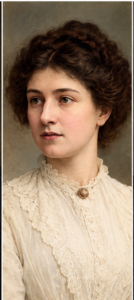 Annie Augusta — the missing woman in the story
Perhaps the greatest unresolved mystery concerns Annie Augusta herself.
At the trial George described her as a woman he had loved deeply. He called her beautiful, said that he had been very fond of her and of the first child, and admitted that he would have been delighted if the second child had genuinely been his. Yet when the deception was exposed, Annie disappeared from Manor Cottage. After Hall’s arrest, Annie left the house and was not seen again by the time of the trial. George said that he had not seen her since, although he subsequently heard from her by a mysterious undated letter.
Yet the story did not end there. Our subsequent research has identified an April 1871 Brighton census entry in which George is living with Annie Loe (who records she was born in Essex), and the household includes George’s niece, Florence Loe. (We traced Florence as the daughter of George’s brother Henry John Loe and his wife Elizabeth Sarah Oades.) Annie therefore appears to have returned to George remarkably quickly after the scandal.
On 23 September 1871 George James Loe, a widower, married Annie Augusta Harper in Cuckfield, Sussex. He was described as an architect, and his father was named as James Loe, a builder. Annie was recorded as a spinster residing at Burgess Hill, with a father named William Henry Harper, a gentleman. This is a fascinating development, because George had sworn in 1870 that he had not known Annie’s surname, while by 1871 she was apparently able to marry him under the name Annie Augusta Harper.
The marriage certificate therefore gives us a possible formal identity for Annie, but does not completely solve the mystery. We have still not found convincing evidence of her early life under that surname. The later discovery of an Augusta Lowe in Croydon in 1901, born at Hurstpierpoint, and a possible Annie Augusta Loe who died in Croydon in 1903, offers an intriguing possible continuation of her life, but at present this remains a hypothesis rather than a proven identification.
The later years
George and Annie’s marriage evidently did not remain a conventional one. By 1881 George was living in Margate, still recorded as married, but with a different woman, Annie Pearce, described as his cousin. Annie Augusta was no longer in the household. George subsequently died in Lewisham in June 1890, aged 63.
Thus the end of the story is almost as mysterious as its beginning. We can trace George with considerable confidence, but Annie Augusta effectively disappears from the documentary record after her marriage, leaving tantalising clues rather than a continuous biography.
Supposititious children: A Victorian fear of false births
The events surrounding the Loe case belonged to a much older and recognised type of fraud known in legal and medical writing as the “supposititious child” — a child who was substituted for, or falsely represented as, the natural child of another woman. The expression was already well established before the nineteenth century, and cases involving alleged child substitution had attracted particular attention because birth was normally a private event, taking place within the home and witnessed by relatively few people. This meant that, in the absence of reliable medical or documentary verification, it was theoretically possible for a woman to present another woman’s baby as her own.
What made such cases especially serious in Victorian society was that the consequences went far beyond deception within a household. A falsely represented child could acquire a legal identity, be maintained as the husband’s offspring and potentially acquire property, inheritance and family status to which it was not entitled. The earlier Skeplehorn case of 1870, which George Loe specifically cited when his suspicions were aroused, demonstrated exactly these fears. In that case an infant born to another woman was passed off as the child of a married couple, and the prosecution raised questions not only about deception but also about maintenance, registration and the consequences for a family’s legitimate succession.
The Loe case illustrates how the possibility of such a deception could become extraordinarily difficult to detect. Annie Augusta appeared to be pregnant, was attended by a nurse and a doctor, and apparently went through all the outward stages of a confinement. Even Dr Farr initially believed that she was expecting a child. It was only when the supposed birth took place that the physical evidence began to unravel the story: the nurse noticed that the baby did not appear newly born, while Dr Farr concluded that Annie had not recently given birth and suspected that the infant had been drugged. The court proceedings therefore reveal the importance Victorian society placed upon medical observation as one of the few means of testing a woman’s claim to have given birth.
The persistence of the “supposititious child” as a legal and cultural concern also tells us something about Victorian attitudes towards marriage, legitimate birth and the construction of respectable families. A child was not simply an individual with a biological parentage; its legitimacy determined its position within the household and could affect inheritance and social identity. The fear of a child being substituted therefore touched some of the deepest assumptions of Victorian family life. The Loe case is particularly revealing because the deception was not discovered through a birth certificate or official registration, but through a combination of suspicion, medical examination and the testimony of ordinary household witnesses. It shows just how fragile the supposedly secure boundaries between legitimate family, illegitimacy, adoption and deliberate fraud could sometimes be.
Respectability, marriage and the appearance of a family
One of the most revealing aspects of the case is the importance attached to appearing to be a respectable married couple. Annie lived with George for several years and was known within the household as “Mrs Loe”, although they were not married. George himself said that when they moved to Queen’s Road, Annie assumed the name Mrs Loe, although he did not tell people that she was his wife.
Yet when the 1871 census was taken, only a few months after the scandal, Annie was actually recorded as Annie Loe, wife, and later that year George formally married her as Annie Augusta Harper. This suggests how important the outward appearance of a conventional household could be. The case repeatedly revolves around creating the appearance of something that did not quite exist: a legitimate marriage, a pregnancy, a birth and a family relationship. In Victorian terms, respectability was not simply a private moral condition; it was something that had to be demonstrated to neighbours, servants, doctors, registrars and society at large.
The Victorian household as a world of servants and witnesses
The case also gives us a wonderfully detailed glimpse into the domestic household. George’s servants were not merely background figures: Emily Pay, Caroline Saville and the others became important witnesses because they observed what happened in the house. Emily had been there for nearly two years and said that she believed Annie really was her master’s wife.
This is socially revealing. A respectable middle-class household depended heavily on servants, but servants could also become unofficial observers of the family’s private life. They saw who came and went, knew the arrangements within the house and could later provide evidence about them. The fact that Emily subsequently moved with George and Annie to Brighton is an intriguing reminder that the sensational events reported in the newspapers were, for the people actually living in the household, part of an ongoing domestic world rather than a neatly concluded scandal.
Medical authority and the proof of pregnancy
Another particularly strong Victorian theme is the growing authority of medical knowledge. Annie’s apparent pregnancy had been convincing enough for George and even for Dr Farr, who had agreed to attend her confinement. When the supposed birth occurred, however, medical examination became the means of challenging the story. Farr concluded that she had not given birth, examined her breasts and found no milk, and then observed that the baby appeared to be under the influence of a narcotic.
That is useful social history because it illustrates the tension between the private female experience of childbirth and the increasingly important role of professional medicine in establishing what had physically happened. Pregnancy and confinement were normally matters occurring largely within the domestic sphere, but here the doctor’s judgment became crucial evidence in a criminal prosecution.
Illegitimacy, motherhood and economic vulnerability
Charlotte Farrant’s part in the story gives us another perspective. She agreed to surrender her newborn because she was in poor health and had apparently experienced difficulties after previous confinements. She was told that the baby would have a good home and that she would be able to know how it was doing.
That brings out the economic and social vulnerability surrounding motherhood. The Farrant family were associated with a beer-shop, while Hall represented herself as someone able to arrange a respectable home for the child. Whatever Hall’s intentions ultimately were, the arrangement depended upon the fact that a woman in difficult circumstances might consider giving up her newborn to people who promised a better future for it. This sits very naturally alongside the larger Victorian concern with illegitimacy, poverty, infant care and the boundaries between charity, adoption and exploitation.
CONCLUSION
The central criminal mystery was solved: Mary Hall had obtained a newly born baby from Charlotte Farrant and taken it to George Loe’s house, where it was passed off as the child of Annie Augusta. The evidence from the nurse, doctors, servants and Farrant family established the deception, and Hall was convicted.
But the deeper mystery has never been completely solved. Who was Annie Augusta really? Why had she used the name Bennett? Why did she want George to register the first child under the name Harper? Was the 1868 child also obtained from another woman? Why did she disappear when the 1870 deception was discovered, only to return and marry George the following year? And what became of her after their marriage broke down?
Those questions are precisely what make this more than a straightforward criminal case. Beneath the sensational story of the “fictitious child” lies a much more elusive story about identity, respectable marriage, illegitimacy, adoption, deception and the extraordinary lengths to which people could go to construct the appearance of a conventional family in Victorian England.
Note: all images were generated by ChatGPT