The case began with this dramatic article in the Daily Telegraph of 6 May 1893.
| MANSION HOUSE. – VITRIOL THROWING. – Annie Love, 33, was charged with throwing vitriol in the face of her husband, Acting-Sergeant Love, of the City police, with intent to do him grievous bodily harm. – The injured man appeared in the witness-box with the right-side of his face and head covered with bandages. He said that at about midnight, on the 20th ult., he was in bed, when his wife, who was partly undressed, threw the contents of a jar over him, exclaiming, “Now you will not go into the third division.” He had had no quarrel with his wife previously: but she was a very jealous woman. He was about to be transferred to the third division, and she seemed to be very disappointed at it, not liking him to be in that locality. He did not wish to press the charge against her, and should leave the matter in the hands of the court. She had been suffering from neuralgia for several weeks, but did not complain about it that night. – The prisoner here exclaimed, “Oh John, you liar! you know I was nearly dead with it.” – Mr. Stagg, ophthalmic surgeon at the hospital, said that the unfortunate man was burned on the right eye, cheek and arm. He might lose the sight of his eye eventually. – Alderman Sir. David Evans sent the accused for trial, and as she left the dock she exclaimed, “That old cat of a mother-in-law wants to take my home. It is through her I am here now.” |
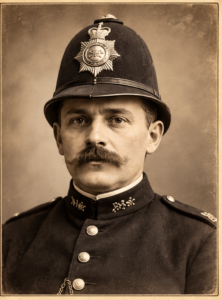 This case presented itself as a domestic crime, with the newspaper account capturing the sensational nature of the incident, however the subsequent Old Bailey evidence allowed us to reconstruct what actually happened in much greater detail.
Joseph Love was a City of London policeman who had recently been appointed acting sergeant and transferred from Cloak Lane to Bridewell — a move from the Fourth Division to the Third. It was this promotion and transfer which appears to have triggered the crisis. Joseph told the court that his wife was intensely unhappy about his new posting because she was jealous of the women he would encounter there. She feared, he said, that “there would be no more happiness”.
On the evening of 19 April 1893, Joseph and his wife went out together and discussed the transfer throughout the evening. He said there had been no quarrel and that he had tried to reassure her. When they returned home shortly before midnight, Joseph went to bed while Annie (who we later found out was actually called Sarah Ann) went briefly into the kitchen. She returned carrying a jar of vitriol and, from only three or four feet away, threw it into his face, saying: “Now you will not go to the third division.”
The substance had been kept in the building for cleaning the lavatories. Joseph immediately tried to wash the acid away with water before making his way into Cheapside, where he obtained a hansom cab to take him to hospital.
The consequences were devastating. The ophthalmic surgeon at St Bartholomew’s found severe burns to Joseph’s right eye, arm and chest, and testified that the sight of the eye was permanently lost. The court convicted Annie/Sarah Ann of throwing corrosive fluid with intent to cause grievous bodily harm and sentenced her to nine months’ hard labour.
But even at the trial there was another side to the story. Joseph described their marriage as generally happy, acknowledged that both had quick tempers, and — extraordinarily — told the court: “I quite forgive her for the offence, and I hope you will be merciful to her.”
He also revealed something that the newspaper account could not tell us: they had one child.
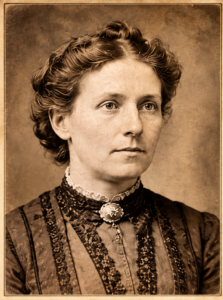 The Old Bailey case initially seemed to bring the story to an end; it did not. Joseph subsequently took Sarah Ann back after her imprisonment, but according to the evidence reported when their divorce was heard in 1897, the reconciliation did not last. They separated in January 1895, and Joseph eventually petitioned for divorce.
The divorce papers transformed the story. Joseph alleged that Sarah Ann had committed adultery with William Featherstone, who had been visiting her at her home in Stratford. Both Sarah Ann and Featherstone initially denied the allegations. During the proceedings Joseph was ordered to pay Sarah Ann £6 a week in alimony, while the litigation generated further costs and orders.
By November 1897 the court accepted Joseph’s evidence and that of his witnesses. Featherstone did not appear to defend the case at the final hearing, and a decree nisi was granted. The divorce became absolute on 8 August 1898.
Most significantly for our reconstruction of the family, the decree absolute contained a provision that the child or children of the marriage were to remain in Joseph’s custody until further order. That is an important correction to what the original newspaper story might lead us to assume. Joseph did not simply walk away from the marriage and leave the child behind: the divorce court formally placed custody with him.
Then, in 1899, Joseph married Amelia Carvell, and that is where another mystery begins.
By 1901, Sarah Ann Love was living in Yorkshire with her nine-year-old son, Albert Edward Love (who was born in London). At the time of the 1911 census she was still living with Albert, then aged 19, and recorded that she had had only one child, who was still alive.
We have never found a satisfactory birth registration for Albert, nor have we been able to prove whether he was Joseph and Sarah’s biological son, a child brought into the household informally, or a child whose origins were concealed or recorded under another name.
There is a possibility that Joseph’s remarriage in 1899 altered the custody arrangement and that Albert subsequently returned to Sarah, but there is no surviving evidence that allows us to say this with certainty.
We even found a potentially corresponding Albert Edward Love in the 1921 census, living as a single boarder in Darlington, aged 28 years 10 months and giving his birthplace as Liverpool Street, London. His approximate birth date of August 1892 fits surprisingly well with the ages recorded for Albert in 1901 and 1911.
And so the case ends with an intriguing loose thread: we can follow Sarah Ann’s life remarkably well, but the fate and origins of her only known child remain uncertain.
Vitriol: an extraordinarily accessible weapon
To modern eyes it seems extraordinary that a woman could simply obtain a substance capable of permanently blinding somebody. Yet sulphuric acid — “oil of vitriol” — was a familiar industrial and household substance in nineteenth-century Britain. In this case it was not obtained specially for the attack – Joseph said that vitriol had already been kept in the building for cleaning the lavatory pans.
Vitriol throwing had become a recognised form of violent crime by the Victorian period. Section 29 of the Offences Against the Person Act 1861 specifically made throwing corrosive fluid at somebody with intent to burn, maim, disfigure or disable them a felony.
What is particularly interesting is the Victorian perception of the crime. Newspapers and commentators frequently portrayed vitriol throwing as a “woman’s crime”, associated with jealousy, sexual rivalry and revenge. Modern historical research has shown that this stereotype was misleading: men and women both committed such attacks, and motives included romantic disputes, family quarrels, financial disagreements and other grievances.
Yet the stereotype is particularly relevant to Sarah Ann because jealousy really does appear in the evidence of this particular case. Her fear of Joseph’s new workplace and the women he would encounter there was explicitly given as the reason for her anger. Her attack therefore fitted a Victorian cultural stereotype — although we should be careful not to allow that stereotype to become the explanation for her behaviour.
Most chillingly, vitriol was not normally intended simply to kill. It was capable of blinding, burning and permanently disfiguring its victim. Sarah Ann’s attack illustrates this perfectly: Joseph survived, but lost the sight of one eye permanently. The face was particularly vulnerable and therefore vitriol could transform the victim’s appearance and future prospects as well as causing physical injury.
There is also an important domestic detail here. The weapon was already in the home. This reminds us that Victorian industrial and household life could put extremely dangerous chemicals into ordinary domestic environments. The attack did not require a specialist weapon or elaborate preparation; the corrosive substance was simply there.
Divorce, adultery and the changing possibilities of marriage
When Sarah Ann and Joseph married in 1884, divorce was no longer the preserve of Parliament. The Matrimonial Causes Act 1857 had created a court-based system in which marriages could be dissolved, although adultery remained central to the law of divorce. The Act also provided for financial provision to wives through alimony.
That is precisely what we see in the Love case. Joseph did not merely separate from Sarah: he went through a formal legal process in which allegations of adultery were made, witnesses were heard, money was ordered to be paid, costs were assessed, and ultimately the marriage was dissolved.
The case therefore gives us a glimpse of the enormous intrusion of the law into private married life. Matters which today might remain entirely private — where Sarah Ann went, who visited her, who lodged with her, what happened in her home — became evidence in a public legal process.
And there was a striking financial dimension. While the divorce was proceeding, Sarah Ann was entitled to £6 a week in alimony, while Joseph was required to meet legal costs. Divorce was therefore not simply a moral judgement on the marriage; it involved a complex redistribution of financial responsibilities.
The case also illustrates the continuing gender imbalance in Victorian divorce law. A husband could obtain a divorce for his wife’s adultery, whereas a wife faced additional hurdles when seeking divorce because of her husband’s adultery. The 1857 legislation had improved matters considerably compared with the old system, but it had not created equality between husbands and wives.
Children, custody and the Victorian family
At the Old Bailey in 1893, Joseph casually stated that he and Sarah had one child. Five years later, however, their divorce decree specifically dealt with custody. By the late nineteenth century, the question of who should raise a child after marital breakdown was becoming an increasingly important matter for the courts.
The Guardianship of Infants Act 1886 had given courts powers to make orders concerning custody and access, explicitly taking into account the child’s welfare, the conduct of the parents and the wishes of both mother and father. In divorce cases, the court could also declare a parent whose misconduct had caused the divorce unfit to have custody.
That makes the Love decree especially revealing. The court did not simply leave the child in an undefined position: custody was awarded to Joseph. Yet within a few years Sarah Ann was living with Albert again. We cannot explain that with certainty. There may have been a later private arrangement; the child may have been returned to Sarah after Joseph remarried; or Albert may not have been the biological child we assume him to be. The records do not tell us.
And that uncertainty itself is historically interesting. Victorian families did not always conform to the neat biological and legal categories that modern records encourage us to assume. Children could be fostered, boarded, taken in by relatives or raised informally by people who were not their biological parents. There was no statutory adoption system in England until the twentieth century. So Albert may ultimately tell us something about the informal ways Victorian families dealt with children outside the simple two-parent household.
The respectable policeman and the hidden domestic world
Joseph was a policeman, a man in uniform whose occupation represented law, order and public authority. By 1893 he had been promoted to acting sergeant. Yet behind the respectable public identity was a troubled marriage marked by jealousy, separation, violence and ultimately divorce.
The Old Bailey evidence also gives us an unusually intimate glimpse into their domestic circumstances. They lived in quarters on the fourth floor, the vitriol was stored there for cleaning purposes, a girl was sleeping in the kitchen, and a policeman who encountered the couple shortly before the attack thought they appeared to be on perfectly good terms.
That is perhaps the most valuable thing about cases like this. The official records don’t simply tell us that a crime occurred. They allow us to see how an ordinary Victorian couple lived, worked, quarrelled, reconciled, separated and eventually placed the most intimate details of their marriage before the courts.
CONCLUSION
There is an extraordinary human element at the centre of this story. Despite being permanently blinded in one eye by his wife’s attack, Joseph initially asked the court to be merciful to Annie. That makes the case much more complicated than the sensational newspaper headline suggests.
We have been able to reconstruct almost everything about their marriage – except for one thing – who was Albert Lowe and what happened to this one child who stood at its centre?
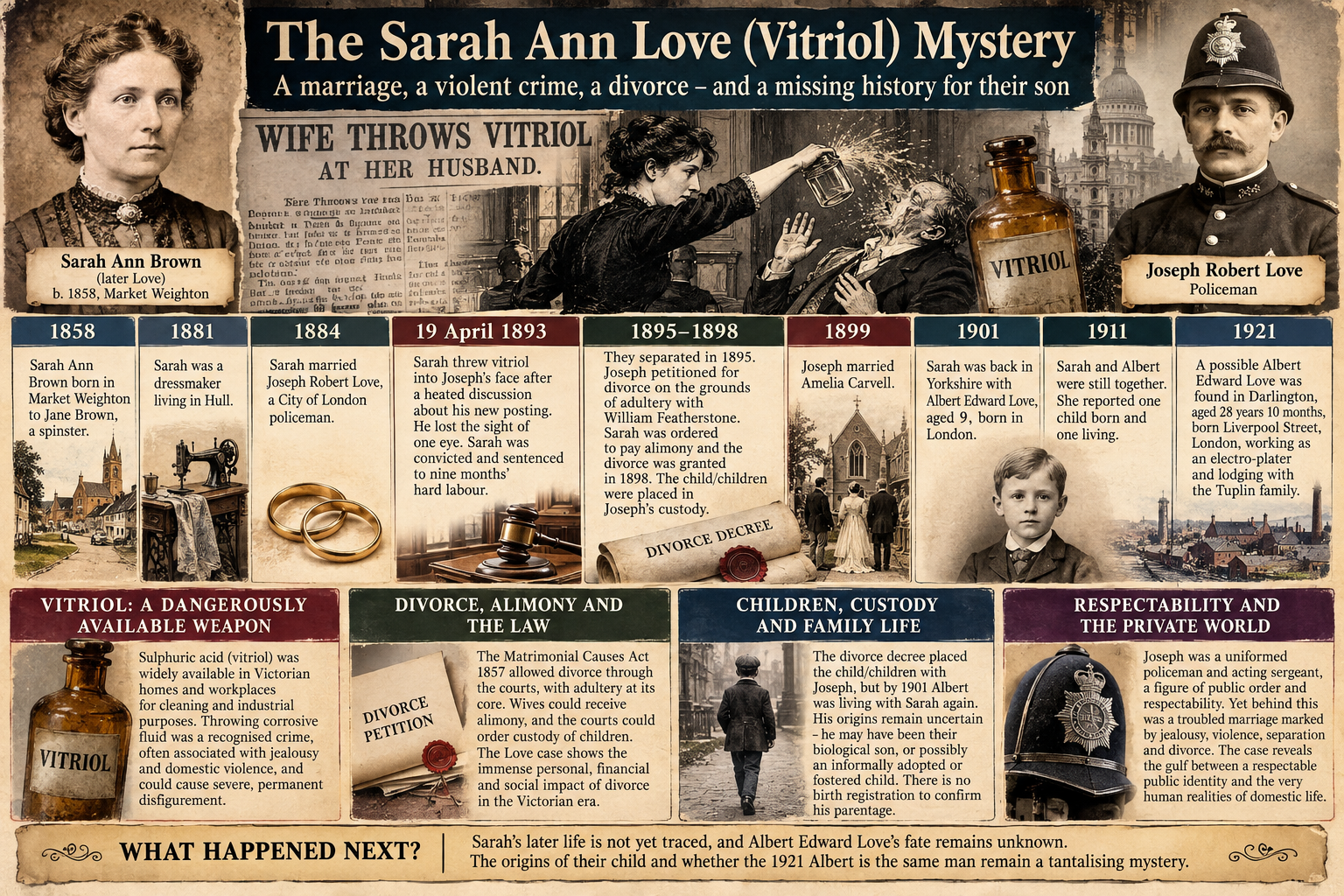
Note: all images generated by ChatGPT