This case begins with this shocking newspaper clipping from the Hertford Mercury and Reformer on 27 December 1862,
|
Charge of Attempting suicide. William Sears, aged 45, a stupid exciteable looking man, was charged with attempting to murder himself, at Harpenden, on the 28th of July. The witnesses in the case were the prisoner’s sister, a policeman, and Dr. West. It appeared that the prisoner went home drunk, took up a razor and cut his throat, saying he wanted to go to Hertford gaol again, and would do something to be sent there for. He then went and laid down upon the common. The wound was two or three inches in length, but superficial, being merely through the skin and cellular tissue. The razor with which the wound was inflicted had no handle. The prisoner, in defence, said, “If you forgive me this time, I will never do so again.” Baron BRAMWELL, in summing up, said – There was some sort of justice in the prisoner cutting a throat which had been so bad a throat to him, and it was making better use of it than he had been accustomed to do. But the question was whether the man intended to kill himself. He (the learned Judge) believed that his only object was to frighten and trouble his friends. He could hardly have intended to kill himself with such a weapon, and by inflicting so unimportant a wound. The Jury returned a verdict of Not Guilty. Baron BRAMWELL (to the prisoner): I most heartily wish I could order you a whipping. You have been supported in the gaol for five months at the expense of the county, and you ought to be made to work it out. Go away you foolish fellow, and don’t get drunk anymore. |
The most extraordinary part of this report cames from Baron Bramwell, who presided over the case. He remarked that there was “some sort of justice” in William Sears cutting a throat which had apparently been such a bad throat to him, and suggested that he had made better use of it than he was accustomed to. He had little sympathy for William. He told him to “go away”, calling him a foolish fellow and telling him not to get drunk again.
 The Hertfordshire Assize calendar provides an independent official confirmation of the trial: William Sears appeared at the Hertfordshire Assizes on 22 December 1862, charged with attempting to murder himself, and was acquitted. This is particularly valuable because it demonstrates that the newspaper account was not simply a garbled anecdote: the underlying prosecution really did occur.
The family records add a melancholy dimension to the case.
William’s mother had died in April 1854.
The 1861 census places William Sears, aged 41, an agricultural labourer, living at Harpenden with his elderly father Thomas, aged 76, and his younger sister Mary Ann, aged 31.
The 1862 attempted suicide episode therefore took place within a household in which an elderly father and two adult children were still living together. William’s sister was sufficiently involved in the events surrounding his behaviour to appear as a witness at his trial.
Then, in November 1863, his father, Thomas, died.
We have been unable to establish what happened to his sister, Mary Ann. She may have married, died, or moved away, but none of those possibilities can presently be demonstrated.
William died two years later on 2 December 1865, aged 48, and an inquest was held two days after that. His death certificate shows that the cause of death was “epilepsy”. He was buried at Harpenden on 6 December 1865.
It is tempting to see William’s family support as progressively disappearing — his mother had died eight years before the episode, his father died less than a year after his acquittal, and his sister subsequently disappears from the records. We cannot demonstrate that these events caused or contributed to William’s behaviour, but they provide an important context. The family household visible in 1861 had effectively disappeared by the time William himself died in 1865.
William’s earlier criminal record
Our research also produced several earlier Hertfordshire records for men called William Sears — larceny by servant in 1850, another case in 1855 and larceny in 1858. Initially these appeared to offer the possibility of a criminal history for our William. However, the evidence ultimately proved insufficient to make that connection safely.
An 1858 newspaper report was particularly revealing: it described a William Sears aged 21, of St Albans, who pleaded guilty to four thefts and received a total of twelve months’ imprisonment with hard labour. That William cannot confidently be equated with the 41-year-old agricultural labourer living at Harpenden in 1861. Rather than forcing these records into William’s biography, they should therefore remain unresolved possibilities.
Victorian attitudes to suicide
In 1862, an attempted suicide was not simply regarded as a medical emergency or a private tragedy. It was a criminal matter. William was formally charged with “attempting to murder himself”, and the case came before the Assizes.
The language itself is revealing. Suicide was framed through the language of criminality — essentially as an attempt to commit the crime of self-murder. At the same time, nineteenth-century Britain was increasingly beginning to regard suicidal behaviour through medical and psychological lenses. Historians of Victorian suicide have identified the nineteenth century as a period in which ideas about “temporary insanity”, medical diagnosis and suicidal propensity increasingly complicated the older purely moral and legal interpretation of suicide. William’s case sits right in the middle of that transition.
Nobody appears to have seriously explored whether he was mentally ill. Instead, the judge concentrated upon whether he genuinely intended to kill himself. Bramwell interpreted the episode largely as drunken foolishness and an attempt to frighten his friends.
That distinction was legally important. The jury did not convict him. There is something particularly revealing here: the court had to decide not merely what William had done, but what he had intended to do. The superficial wound and inadequate razor became evidence of his state of mind.
Epilepsy, insanity and the limits of Victorian diagnosis
William’s death from “epilepsy” three years later adds an intriguing — but ultimately unanswerable — question. Was this simply a genuine neurological illness? Almost certainly epilepsy was a recognised physical disorder by this period. But nineteenth-century medical thinking did not always draw the same boundaries between epilepsy, mental disturbance and abnormal behaviour that we do today.
Epilepsy had historically been associated with insanity, and during the nineteenth century doctors debated the extent to which epileptic disorders could produce mental or behavioural disturbances. Medical literature subsequently described forms of epilepsy associated with temporary mental disturbance and even violent or apparently purposeless behaviour.
It would therefore be tempting to look backwards from William’s death and wonder whether his strange behaviour in 1862 was connected with epilepsy or some other neurological or psychological disorder. But we cannot establish that. His death certificate gives us only the word “epilepsy”, and we have no medical case notes describing seizures or mental symptoms.
The most responsible conclusion is therefore also the most interesting one: we cannot know whether William’s epilepsy had anything to do with his behaviour in 1862, but his case illustrates just how difficult it can be to interpret Victorian medical diagnoses using modern categories. A diagnosis which seems straightforward to us may conceal a much more complicated clinical history.
Drunkenness and working-class respectability
William’s behaviour was explicitly linked to drunkenness. The newspaper says that he went home drunk before taking the razor, and Bramwell’s final instruction was essentially: don’t get drunk again.
That sounds almost trivial to modern ears, but drunkenness had enormous moral significance in Victorian Britain. Temperance movements were becoming increasingly influential during the 1850s and 1860s, and excessive drinking was frequently discussed not merely as a personal weakness but as a social problem associated particularly with working-class men.
This makes Bramwell’s response especially revealing. He did not treat William primarily as someone who needed psychiatric treatment. He treated him as a foolish, drunken man who needed to exercise self-control. That distinction matters. Victorian society was increasingly developing medical explanations for problematic behaviour, but older ideas of moral responsibility, self-discipline and personal blame remained extremely powerful.
William was therefore caught between two possible interpretations: a man responsible for his own foolish behaviour, or a man whose behaviour might have arisen from illness. The court chose the former.
The punitive Victorian prison
Bramwell’s reference to William having been supported in gaol for five months also gives us a glimpse of another aspect of Victorian social policy. The judge clearly regarded imprisonment not merely as punishment but as something which the respectable taxpayer had to pay for. His complaint that William had been “supported” at the expense of the county expresses a very characteristic Victorian concern with the cost of maintaining prisoners and paupers.
And his wish that he could order William a whipping is a reminder that corporal punishment had not disappeared from Victorian criminal justice. It was still available for certain offences, although not as a punishment for William’s particular offence. The contrast is striking: William had just been acquitted, yet the judge was still able to express the view that he deserved physical punishment.
CONCLUSION
The most interesting thing about the William Sears case is that it sits at the intersection of several changing Victorian attitudes. It is a story about a society in which:
- suicide was still treated as a crime;
- drunkenness was increasingly seen as a serious social and moral problem;
- imprisonment was both punishment and a burden on the ratepayer;
- ideas about insanity and mental illness were becoming increasingly medicalised, but remained highly uncertain;
- epilepsy occupied an uncomfortable position between neurology and ideas about mental disturbance;
- and family remained an important source of support for people who had little other social security.
And then there is the human story beneath all of that. William was not an infamous criminal or a celebrated patient. He was an agricultural labourer in Harpenden, living an apparently ordinary life with his elderly father and sister. One drunken night in July 1862, he cut his throat. His action was sufficiently serious to take him to the Assizes, yet sufficiently ambiguous for the jury to acquit him. His judge mocked and rebuked him. His father died the following year. His sister subsequently disappears from our records. And in December 1865, at only 48, William himself died from epilepsy.
We can reconstruct the events. We can identify the family. We can establish the legal outcome. But we can never know what William himself was experiencing. The documentary record is surprisingly rich around one extraordinary episode, but almost silent about the ordinary human life surrounding it.
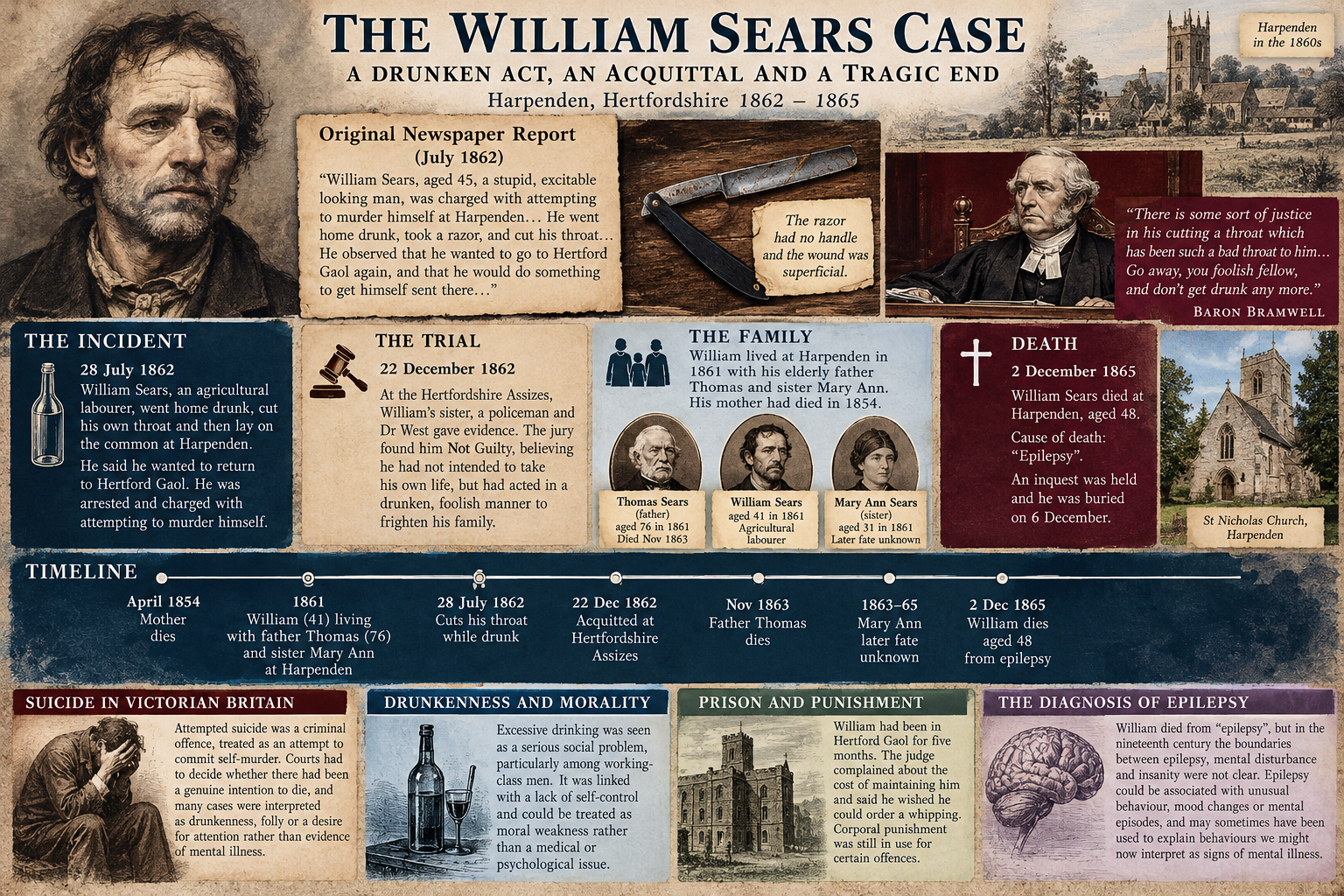
Note: All images generated by ChatGPT