The case began with a dramatic report in the Reading Chronicle of 19 January 1867.
| EXTRAORDINARY ELOPEMENT. – Considerable amusement, and even astonishment, was felt in Oxford, on Monday night, by a rumour that Mrs. Buckingham, wife of the landlord of the University Arms, the mother of ten children, most of whom are living, had eloped with a juvenile Knight of St. Crispin, and took with her about £200 in money, and a quantity of linen and various other articles. The parties, it appears, had known each other for sometime, and their friendship gradually grew into a very strong attachment. The woman, under these circumstances, became tired of her husband, to whom she had been married for 20 years, and determined to leave him in company with her more youthful Adonis, who was nothing loath to follow his more elderly and amorous companion to wherever she would bid him go. For this purpose the necessary arrangements were made, and on Monday afternoon, the guilty pair left Oxford for Reading. The news of what had occurred spread rapidly; the telegraphic wires were brought into requisition, and Detective Robey of the Reading Borough Police force, commenced a search throughout the town. His efforts were soon successful, for on visiting the Thames Restaurant in New Town, he found Mrs. Buckingham and Willis very quietly enjoying themselves, and evidently much pleased with the success which had attended them. Their pleasure, was, however, doomed to be of short duration, and evident was their chagrin, when Robey gave them to understand that they must accompany him to the police-station. Making a virtue of necessity they consented to do so; but not before they condoled with each other in most piteous terms upon their misfortune. At the time of the apprehension Willis was sporting a ring belonging to Mr. Buckingham, but not more than £17 in addition to the wearing apparel was found upon the woman. They were both conveyed to Oxford on Tuesday by P.C. Robey, when Willis was taken before the magistrates and remanded. |
This newspaper account made the affair sound like a straightforward case of an unfaithful wife running away with a younger lover and stealing her husband’s property. But the subsequent court proceedings tell a rather more complicated story.
Reuben Henry Willis was brought before the magistrates on a much narrower charge: stealing a sheet, two towels and a tablecloth, said to be the property of Thomas Buckingham. The prosecution alleged that the missing articles had been discovered at the house of Willis’s father in Reading, where the couple had apparently been staying. Two trunks were found there, one containing the articles in question. The defence, however, argued that the property had actually been given to Willis by Mrs Buckingham, and that he had been acting as her friend. Most importantly, the case was dismissed.
This is an important distinction from the sensational newspaper report. The original story suggested that Mrs Buckingham had taken approximately £200 worth of money and property. The subsequent proceedings did not establish that a large-scale theft had taken place. We therefore have to be careful not to turn the newspaper’s allegations into established fact.
Reuben Henry Willis
One of the most satisfying parts of the investigation was being able to follow the young shoemaker beyond the sensational newspaper story.

Reuben Henry Willis was born on 2 April 1842 in Andover, Hampshire, the son of George Willis, a cordwainer, and Julia Anna Pain.
The 1861 census shows George and Julia living in Reading with their children. George was still working as a cordwainer at that point and was not yet a publican, despite the later newspaper reference to Reuben’s father living in a public house.
Reuben was absent from the family household in 1861 because he had entered naval service. His naval record shows him entering at HMS Fisgard on 4 October 1860, aged 18, with a ten-year continuous-service engagement. Fisgard was a Royal Navy training establishment, recorded in naval records in the same way as a ship.
Thus, by the time of the 1867 elopement, Reuben was not simply an unidentified young shoemaker: he had already had experience of naval service and had subsequently returned to civilian life.
There is also an interesting discrepancy in his age. The newspaper called him 22, whereas his documented birth date makes him 24 in January 1867. Victorian newspaper reports were clearly not necessarily reliable about ages.
Remarkably, only about six months after the elopement – on 10 July 1867 – Reuben married Elizabeth Jackson at St Giles, Reading, and in the 1871 census, Reuben was living with his young wife and daughter and working as a cordwainer. By the time of the 1881 census Reuben and Elizabeth had a growing family – and in fact had a total of twelve children.
Reuben’s career subsequently changed again. By 1884 he was the licensee of the Swan and Castle in Castle Street, when his licence was challenged because he had been convicted of keeping the premises open during prohibited hours. The authorities nevertheless granted the licence after evidence that the house had subsequently been properly conducted. So the young shoemaker at the centre of the 1867 scandal eventually became a publican himself.
Thomas Buckingham
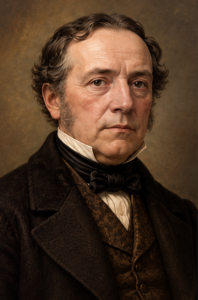 We were also able to reconstruct much of Thomas Buckingham’s earlier life. Thomas married Ann Cockhead first in December 1836, and they had at least 3 children. Their daughter, Zilpah Buckingham, born in 1839, died at Cassington Wharf on 16 July 1858, aged only 19. His wife, Ann, died in 1844.
On 21 July 1845, Thomas, then a widower, married Eliza Smith, a spinster, at Eynsham. The marriage certificate is particularly valuable. Thomas was recorded as of full age, a woodman, resident at Eynsham, and the son of Philip Buckingham, labourer (deceased)
Thomas and Eliza subsequently had at least 4 children, including William Richard, Tom, Eliza Emma, John and Sarah Ann.
Thomas’s occupational career is particularly interesting. He appears to have progressed from woodman, through the world of the Cassington Wharf and licensed trade, to becoming a publican.
In 1863, he was recorded as the wharfinger and licensee of the Barge Inn at Cassington Wharf, and by 1867 he was landlord of the University Arms in Gloucester Street, Oxford, where the extraordinary elopement took place.
The elusive Eliza Buckingham
 The evidence strongly suggests that the Mrs Buckingham in the 1867 newspaper report was Eliza Smith, Thomas’s wife. The dates fit remarkably well – their marriage in 1845 and the newspaper’s statement that Mrs Buckingham had been married for around twenty years, and was about 45 years old.
In the 1871 census (4 years after the incident) Thomas (aged 54 and now a gardener) was still recorded as married and living with his daughter Sarah Ann in Nelson Street, Oxford. Eliza is not present.
In fact, she has also not been found in the 1881 or 1891 censuses, and searches through her daughters and sons have not produced a convincing later record. Consequently, we cannot say what became of her after the events of 1867.
She may have died, lived with another member of the family, been recorded under a different form of her name, or otherwise disappeared from the records. The possibility that she deliberately left Thomas again is intriguing, but there is currently no evidence to establish it. Her later whereabouts therefore remain an open question.
Victorian attitudes towards female infidelity
The newspaper language is perhaps as revealing as the events themselves. Mrs Buckingham is described as having become “tired of her husband” and running away with a youthful “Adonis.” Reuben is called a “juvenile Knight of St. Crispin” — St Crispin being the traditional patron saint of shoemakers. The story was presented as entertainment as much as news. A married woman leaving her husband and children for a younger man was an irresistible newspaper sensation. There is also a striking gender imbalance in the way the story was framed. Mrs Buckingham was presented as the transgressor who had abandoned her respectable married position, while the young man was portrayed almost as a comic romantic adventurer.
Marriage and the Victorian household
Mrs Buckingham was said to have ten children, most of them living. This gives us a glimpse of the size of a prosperous working family’s household in the mid-Victorian period. Her marriage had apparently lasted about twenty years. Yet the newspaper could reduce that long domestic history to the dramatic phrase that she had become tired of her husband. The reality was almost certainly more complicated than the newspaper story allows us to see.
Money and property within marriage
The alleged removal of nearly £200 is significant. That was a very substantial sum for a working household in 1867. Yet the court proceedings demonstrate an important distinction between accusation and proof. The sensational newspaper claimed that money and household property had been taken, but the actual charge brought against Willis concerned only a sheet, two towels and a tablecloth — and that charge was dismissed. The case therefore illustrates how Victorian newspapers could transform a domestic dispute into a much more dramatic story than the subsequent legal proceedings supported.
Public houses as centres of Victorian life
Both sides of this story are connected with the licensed trade. Thomas Buckingham progressed from a rural occupation into the wharf and public-house world, becoming landlord of the University Arms. Reuben Willis, meanwhile, eventually followed a similar path and became a publican himself. Public houses were not simply places where people drank. They were businesses, meeting places, lodging places and important centres of working-class social life. The Buckingham and Willis stories show how occupations and social networks could move between the trades, transport and licensed victualling.
CONCLUSION
This began as a wonderfully lurid Victorian newspaper story: a middle-aged publican’s wife, mother of ten, runs away from Oxford with a young shoemaker, carrying money and household goods, and is caught enjoying herself in a Reading restaurant. But the deeper investigation produced something much more interesting.
We discovered that the theft story was not proved, that Reuben, the young shoemaker, had a substantial life before and after the affair, and that Thomas Buckingham had risen from woodman to wharfinger and licensed victualler.
The one remaining mystery is Eliza Smith Buckingham herself. We can reconstruct her marriage and family, and place her at the centre of the 1867 scandal, but her later life remains hidden. And perhaps that’s a fitting ending for a Victorian mystery. We know why Eliza disappeared from the newspaper. We just don’t know where she disappeared to afterwards.
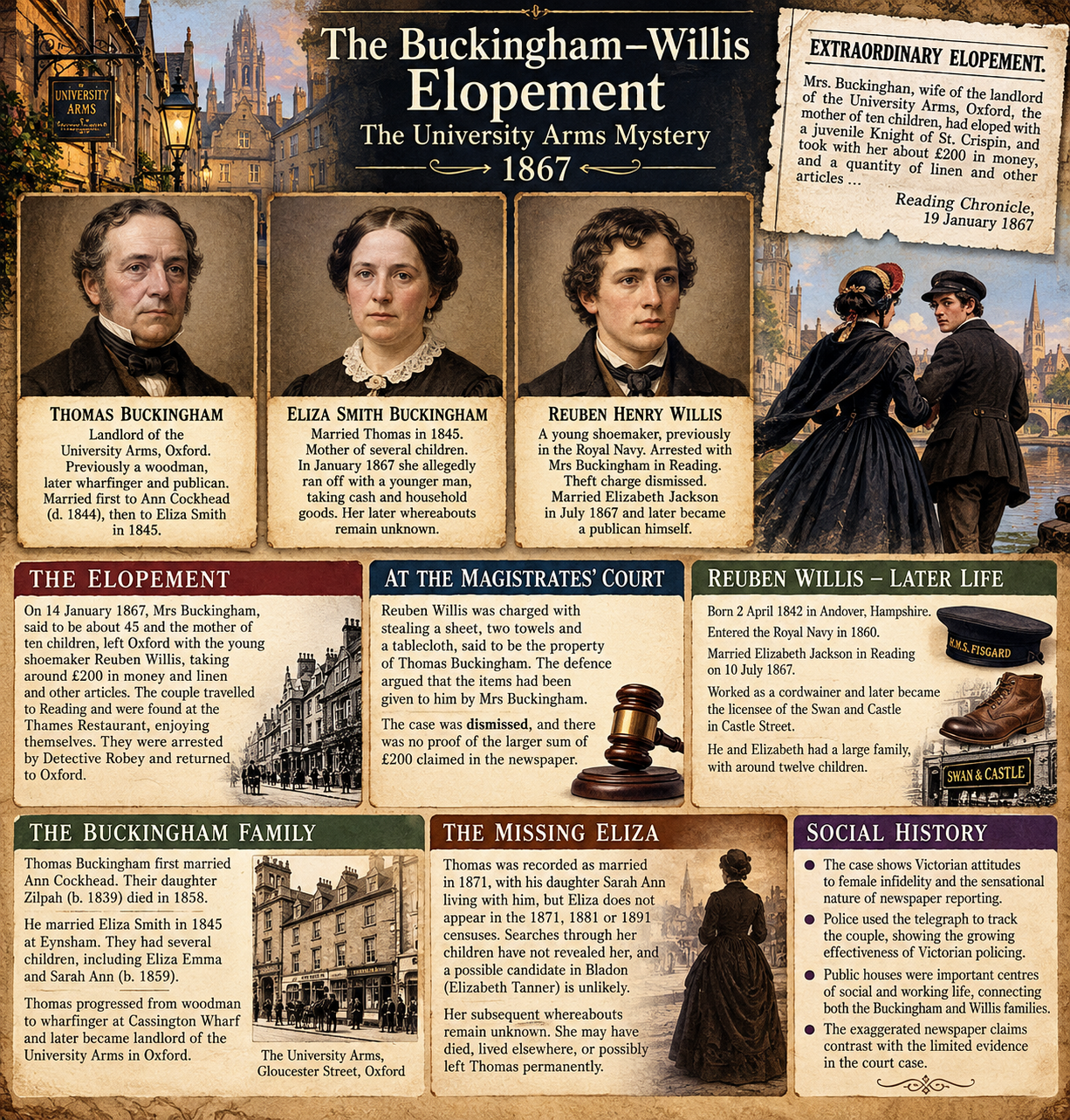
Note: All images generated by ChatGPT