Theis case began with a newspaper report of a breach-of-promise action in the West Cumberland Times on 29 June 1893.
|
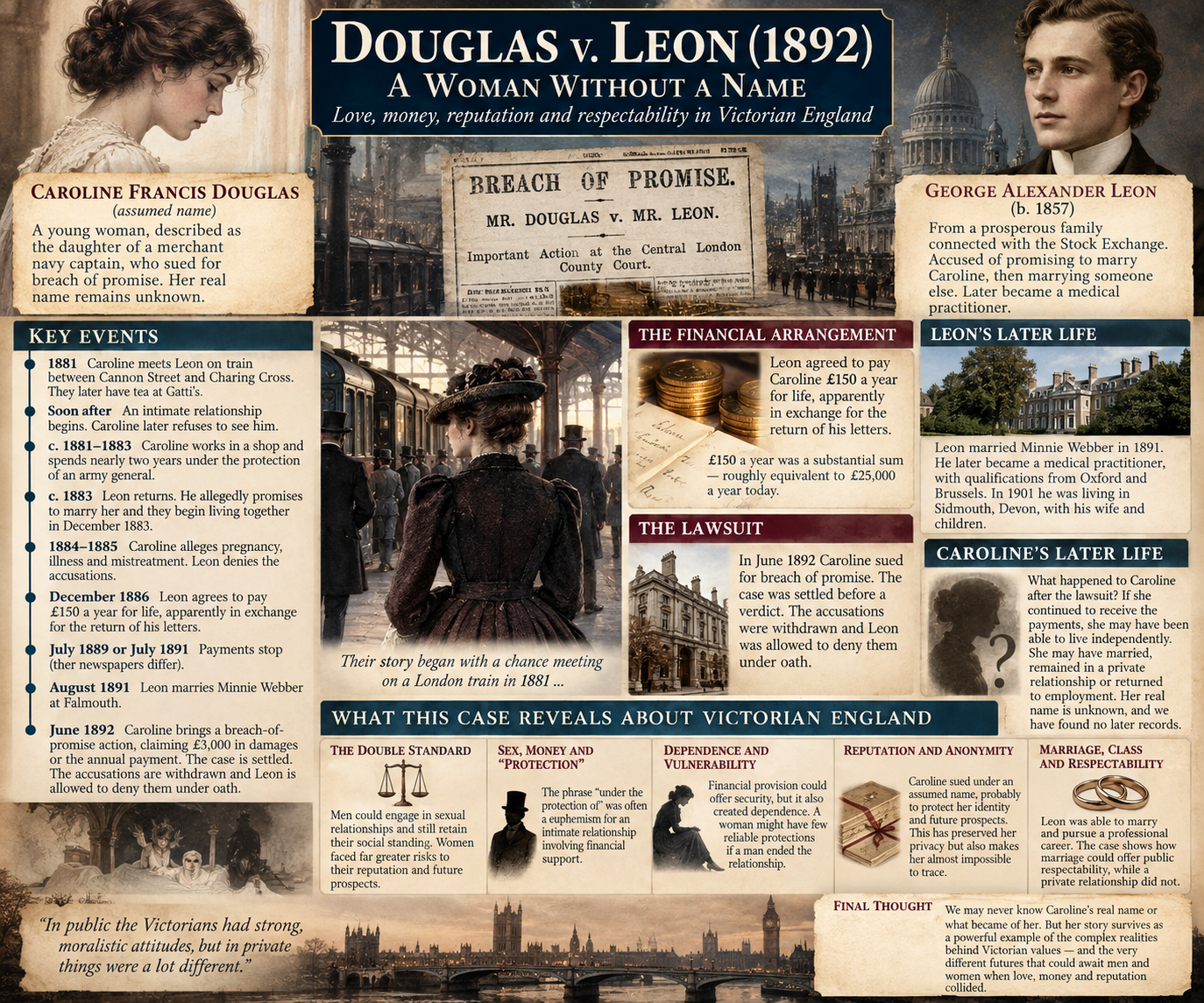
SENSATIONAL BREACH OF PROMISE CASE In the Queens Bench on Monday, before Baron Pollock and a special jury, the case of Douglas v. Leon came on. This was an action to recover £3,000 for breach of promise of marriage and seduction, or in the alternative the specific performance of an agreement to pay the plaintiff an annuity of £150 for life. The plaintiff was described as the daughter of a captain in the merchant service, and the defendant as a young gentleman moving in high society. – Mr. Shee, Q.C., and Mr. Stewart appeared for the plaintiff, and Mr. Willis, Q.C. and Mr Scott for the defendant. – Mr. Shee, in opening the case, said the defendant met the plaintiff in 1881 in the train, when she was eighteen years old. He gave her flowers and sweets, and took her to tea at Gatti’s. After that they met at various restaurants and hotels, dining and “teaing” together, and she alleged that the defendant ultimately seduced her at the Charing-cross Hotel. After this she was so horrified at what she had done that she refused to see the defendant any more, and did, in fact, not see him again for two years. In the meantime, however, it appears she went to live under the protection of a General. One day, whilst still under the protection of the General, she met the defendant accidentally in London, when he begged her to leave the General, and said if she would do so he would marry her as soon as his mother died. She consented, and lived with the defendant from 1883 to 1886. He promised several times to marry her, and ultimately, in consideration of getting his letters back, agreed to allow her £150 for life. He continued to pay the allowance quarterly till July, 1889, from which time he ceased to pay. – Caroline Francis Douglas, a dark, neatly-dressed girl of medium height, went into the witness-box, but before she was sworn negotiations for a settlement commenced, and after some conversation the leading counsel, retired to the Judge’s room with his Lordship. After a brief absence in the Judge’s room counsel returned to court, where a long and earnest conversation took place between counsel, solicitors and defendant. After nearly a hour’s consultation, a settlement was arrived at. – Mr. Willis then applied that the defendant might be allowed to go into the witness-box to deny on oath the imputations made against him. The defendant having done so, the case was concluded. |
The newspaper offered a story of a young woman, a wealthy man, an alleged seduction, a promise of marriage, a long period of cohabitation, a financial arrangement and, finally, a lawsuit when the man prepared to marry someone else. We have been able to reconstruct much of the defendant’s life. The woman at the centre of the action, however, remains unidentified.
George Alexander Leon: the defendant
 The defendant was named in the reports as George Alexander Leon, of 19 Surrey Street, Strand. A number of records support the identification of the defendant:
- Birth registration: George Alexander Leon was registered in the fourth quarter of 1857 in St Pancras, with his mother’s maiden name recorded as Samuel.
- The 1861 census: George Alexander Leon appears aged four in a household at Horsville House, Highbury. His father, George Leon, was recorded as a member of the Stock Exchange. Other children included Arthur Lewis Leon and Constance Ellen Mary Leon.
- The 1885 Post Office London Directory: An entry for George Alexander Leon connects him with Leon A. & Co., suggesting involvement in the family or commercial business.
- The 1890 street directory: George Alexander Leon is listed at 19 Surrey Street, London W.C.
- The 1891 Stock Exchange application: A surviving application for re-election gives his residence as 19 Surrey Street and his business address as 31 Throgmorton Street. It also names Herbert Samuel Leon and Albert Lewis Leon as partners.
- Marriage: George Alexander Leon married Minnie Webber at Falmouth, Cornwall, in August 1891.
- Later professional records: The Medical Directory for 1905 records a George Alexander Leon at Hillsdon, Sidmouth, Devon, with medical qualifications including an M.A. from Oxford in 1883, an M.D. from Brussels in 1895, and further medical qualifications in 1895–96.
- The 1901 census: A George A. Leon appears at Sidmouth as a medical practitioner, living with his wife Minnie and daughters.
His career is particularly interesting. The records suggest a progression from a family associated with the Stock Exchange to commercial work in the City and, later, a medical career. His Oxford degree dates from 1883, while his recorded medical qualifications came in the mid-1890s. We do not know precisely when or why he changed professional direction.
The family names and commercial background also raise the possibility that the Leon family was Jewish. His mother’s maiden name, Samuel, and his father’s Stock Exchange connection make this a reasonable avenue for further investigation, but neither establishes religious identity.
Caroline Francis Douglas: the plaintiff
 The plaintiff was identified as Caroline Francis Douglas. But early in the proceedings, counsel made it clear that she was not suing under her real name. That single detail changed the nature of the investigation. Who was Caroline Francis Douglas? Why did she need to conceal her identity? And what had happened to her during the preceding decade?
Caroline’s real identity has proved much harder to establish. We investigated possible women named Caroline Frances, particularly those born around 1863, but have not found a convincing candidate whose father was a captain in the merchant service.
The newspapers reportedly described her as the daughter of such a captain. That is an important clue, but it comes from the account of the court proceedings and has not been independently verified.
We also cannot be certain that her assumed name preserved her real forenames. It is possible that only her surname was changed, but the statement that she was not suing under her real name leaves open the possibility that the whole name was fictitious.
Why did she conceal her identity? The most plausible explanation is that she wished to protect her reputation and future prospects. A public lawsuit involving intimate relationships, alleged seduction and a broken promise of marriage could have exposed a woman to considerable social embarrassment. Concealing her name may have allowed her to pursue her claim while limiting the damage to her private life. That remains an interpretation rather than a proven motive, but it fits the circumstances.
The relationship: what the newspapers reported
The press accounts describe a relationship extending over several years. The chronology below is reconstructed from those reports; it should not be mistaken for a sequence of events independently proved by a court.
Caroline reportedly met Leon on a train travelling between Cannon Street and Charing Cross in London in 1881. The journey was short, and the two subsequently went for tea at Gatti’s. The account presents the meeting as the beginning of their acquaintance. We do not know where Caroline was living, what had brought her to that particular train, or whether she was already working in London.
The reports describe an intimate encounter at the Charing Cross Hotel and a subsequent period in which Caroline refused to see Leon.
She reportedly worked in a shop and spent nearly two years under the protection of an army general. The exact nature of that arrangement is unknown. In Victorian usage, the expression “under the protection of” could refer to financial support, patronage or an intimate relationship that was not openly acknowledged. In the context of Caroline’s circumstances, a discreet sexual relationship involving financial maintenance is a plausible interpretation. It cannot, however, be established as fact, and the general’s identity remains unknown.
The newspaper narrative describes a subsequent accidental meeting in London in 1883. Leon allegedly renewed his attentions and promised to marry Caroline after his mother died. They reportedly began living together in December 1883.
Caroline alleged that she became pregnant around 1884 and that Leon induced her to take medicine. The newspaper accounts also refer to disease in 1885. These are allegations reported in the proceedings, not findings that we can treat as established facts. Leon denied the accusations. The details are sensitive, and the surviving reports do not permit us to reconstruct the events with certainty.
According to the reports, Leon agreed to pay Caroline £150 a year for life, apparently in exchange for the return of his letters. The arrangement is one of the most significant elements of the case. It suggests that the relationship had resulted in a negotiated financial settlement years before the lawsuit. The newspapers differ over when payments stopped. The Daily Telegraph account gives July 1891, while the West Cumberland Times report gives July 1889. We have not resolved that discrepancy.
Leon reportedly told Caroline in 1891 that he intended to marry. Subsequent negotiations failed, and he married Minnie Webber at Falmouth in August of that year.
The timing raises an obvious question: did the proposed marriage and the breakdown of the financial arrangement form part of the same dispute? The chronology suggests a connection, but the evidence does not establish precisely what prompted the cessation of payments or the final negotiations.
Caroline brought the breach-of-promise action in June 1892. The reported claim involved £3,000 in damages or the enforcement of the annual payment. The case was settled following discussions between counsel. The accusations were withdrawn, and Leon was permitted to deny them under oath. There was no verdict establishing the truth of Caroline’s allegations. The settlement should not be represented as proof that either party’s account was correct.
The annual payment was not a trivial sum. Using a broad inflation-based comparison, £150 in the late 1880s would represent roughly £25,000 a year in modern purchasing-power terms, although different methods of comparison produce different figures. It is important to remember that this was an annual payment, not a single lump sum. If it had continued for twenty years, the nominal total would have been £3,000 before allowing for inflation.
We do not know whether Caroline received every payment, whether the arrangement was enforceable in practice, or whether the settlement in 1892 altered its terms. Nevertheless, the promised income may have represented a significant degree of financial security. For a woman without an independently established source of income, an annual sum of that size could have made a considerable difference to her choices.
It is tempting to imagine that the payment enabled Caroline to establish an independent life. That is possible, but we have no later record to confirm it.
The surviving reports invite a broader reconstruction. It is possible that Leon first became involved with Caroline when she was very young, that their relationship left her financially dependent, and that he subsequently offered marriage when he returned to her life. If she had meanwhile been supported by another man, Leon’s renewed promise may have appeared to offer a more secure future.
When he decided to marry Minnie Webber, Caroline may have faced the prospect of losing both the relationship and the financial arrangements on which she had come to rely. Taking him to court could have been her attempt to secure the money she believed he had promised.
This is a coherent interpretation of the chronology, but it contains several unproved assumptions. We do not know whether Caroline was previously maintained by the general, whether Leon deliberately extracted her from another relationship, or how she understood her own circumstances.
We should also resist assuming that Caroline’s beauty explains Leon’s initial attraction. The newspaper account tells us that he approached her on a train, but it provides no reliable description of her appearance or his motives. What we can say is that the relationship, as reported, involved a marked difference in financial and social power.
The double standard
Victorian sexual morality placed different expectations on men and women. Respectability was important to both sexes, but women’s sexual reputations could have especially serious consequences for their social standing and prospects of marriage. A man who had engaged in a sexual relationship outside marriage might still retain his occupation, social connections and prospects. A woman in the same relationship could face stigma, financial dependence and the possibility that her past would be used against her. This did not mean that all men escaped consequences or that all women were treated identically. But the disparity is a useful framework for understanding Caroline’s predicament.
Leon was able to marry and subsequently pursue a medical career. Caroline’s real identity remains unknown, and the newspaper accounts of her intimate life survive without the context of her own testimony beyond what counsel reported. The difference is striking, even if we cannot know how either person’s reputation was affected privately.
Sexual relationships and financial maintenance
The phrase “under the protection of a general” is a revealing example of the euphemistic language used in Victorian accounts of relationships between men and women. In our earlier Fictitious Child Mystery, George James Loe described Annie Augusta as being “under his protection” before she entered his household after his wife’s death. The subsequent history of that relationship makes an intimate, financially supported arrangement a plausible interpretation of the earlier phrase.
That comparison helps us read Caroline’s story with greater sensitivity to contemporary language. It does not prove that the two arrangements were identical, but it shows why the phrase in the Leon case may have conveyed more to contemporary readers than its literal wording suggests.
Men of means could sometimes support women privately without publicly acknowledging the nature of the relationship. Such arrangements could provide women with accommodation and money, but they could also leave them dependent on the continued goodwill of the man providing it. The relationship might offer short-term security without the social standing or legal protections associated with marriage.
The economics of women’s lives
Caroline’s alleged circumstances also raise questions about women’s access to independent income. The newspapers reportedly stated that she worked in a shop after the first break with Leon. That detail matters: it suggests that paid employment was part of her life, at least for a time. But we do not know her earnings, family resources, education or employment opportunities. Nor can we assume that she chose financial dependence freely. A woman might enter a relationship for affection, security, material necessity, or a mixture of all three.
The annual payment of £150 could have given Caroline greater freedom if it continued. It might have enabled her to live independently, or it might simply have replaced one source of support with another. Without her later records, we cannot decide between these possibilities. The case therefore illustrates the difference between financial provision and genuine security. Money could offer choices, but it did not necessarily erase social vulnerability.
Breach of promise and the expectation of marriage
Breach-of-promise actions arose from a legal and social world in which a promise to marry could carry substantial consequences. Marriage was not merely a private romantic decision. It could affect a woman’s financial prospects, household arrangements, social standing and future opportunities. Where a woman had relied on a promise of marriage, its withdrawal could leave her in a precarious position. Such actions were not always straightforward disputes about love. They could involve questions of financial loss, reputation, reliance and the expectations created by a relationship.
Caroline’s claim must be understood in this context. If her account was accurate, the alleged promise had formed part of a relationship lasting years, not a brief courtship. The annual payment also suggests that financial matters were already central to the parties’ dealings. We should not assume that every breach-of-promise plaintiff was motivated by money, any more than we should assume that every defendant was acting dishonourably. In this particular case, however, the financial agreement and the proposed marriage to another woman were central to the reported dispute.
Marriage, class and respectability
Leon married Minnie Webber in 1891. The records subsequently show him as a medical practitioner, living with his wife and children. It is tempting to conclude that he abandoned Caroline in order to marry a woman of his own class. His family background and later professional standing make that possibility worth considering, but we have no evidence establishing Minnie’s social class or Leon’s motive for marrying her.
What is clearer is that marriage offered a recognised social status that a private sexual relationship did not. A man could leave one relationship and enter another that was publicly acknowledged, while the woman he left might be burdened by the consequences of the earlier arrangement. This is the central inequality suggested by the case.
Euphemism and the Victorian press
Victorian newspapers could publish explicit accounts of sexual scandal, but they also used euphemism, indirect phrasing and carefully chosen descriptions. The phrase “under the protection of” may have allowed counsel to communicate the nature of an arrangement without stating it directly. It may also have reflected the conventions of courtroom speech and newspaper reporting. We cannot know exactly what every contemporary reader understood, but the phrase was capable of conveying a meaning beyond simple guardianship or protection.
There is another complication: the reports were not necessarily verbatim transcripts. Different newspapers selected and summarised different details, and the discrepancy over the date payments stopped demonstrates the need to compare accounts rather than treat any single report as a perfect record. The language of the newspapers is therefore evidence in its own right—not only of the alleged events, but of the conventions through which Victorian society discussed intimate relationships.
Privacy, anonymity and reputation
Caroline’s assumed name may have been an attempt to preserve her privacy while pursuing a public legal claim. That possibility is particularly poignant. The legal action required her to bring her history before a court, yet concealing her identity may have limited the wider consequences of that exposure.
If she was concerned about her future, she may have understood that the same publicity which could help her secure money might also damage her prospects. We cannot prove that reputation was her reason for using a pseudonym. Nevertheless, her anonymity is consistent with the risks faced by women whose intimate histories became public.
It has also shaped the historical record. Leon can be traced through birth, marriage, professional and census records. Caroline, whose name was deliberately concealed in the very case that preserved her story, remains elusive.
The power of money
Leon came from a family associated with the Stock Exchange, and his own records show commercial connections before his later medical career. The evidence suggests that he had access to social and professional networks, although it does not establish his precise wealth. Caroline’s financial circumstances are much less clear. The reports suggest that she worked in a shop and later received, or was promised, a substantial annual payment.
The imbalance matters. Money could allow Leon to support a relationship, negotiate an agreement and move on to a publicly recognised marriage. For Caroline, the same money may have represented protection against destitution. The settlement may have given her leverage, but we cannot know whether it secured her future. The case exposes the limits of a system in which a woman’s security might depend heavily on a man’s private promises and continued payments.
What happened to Caroline?
This is the question the records leave unanswered. If the annual payment continued, she may have been able to live independently. She may have married, returned to employment, remained in a private relationship, or moved somewhere where her earlier history was unknown. It is also possible that the payments stopped, that she received less than she expected, or that other circumstances undermined her security. We cannot establish any of these outcomes.
The anonymity that may have protected her in 1892 now prevents us from following her through later censuses, marriage registrations, addresses or probate records. Without a reliable identity, a search for her later life risks attaching the wrong woman’s records to the case.
It is tempting to hope that Caroline used the settlement to build a quiet, secure life away from the men and the publicity. That remains possible, and perhaps it is a fitting hope to retain. But it must remain a hope, not a conclusion.
CONCLUSION
The case has produced two very different historical portraits.
George Alexander Leon can be followed from childhood in a prosperous household to commercial work, marriage, medical qualifications and family life. His identification is supported by several records, although the precise relationship between every record and the defendant should remain open to verification.
Caroline Francis Douglas survives chiefly through a newspaper account of intimate allegations and a lawsuit brought under an assumed name. Her parentage, true identity, financial circumstances and later life remain unknown.
The evidence does not establish every allegation made against Leon, and the settlement was not a verdict on the truth of Caroline’s account. We must preserve that distinction. Yet the case remains valuable. It illustrates how a private relationship could become a financial dispute, how the promise of marriage could carry practical as well as emotional significance, and how differences in money and social standing could shape the consequences of a relationship.
Most poignantly, it shows how unevenly the historical record can preserve people’s lives. We can trace the man who went on to marry and build a professional career, while the woman who took him to court remains hidden behind a name she may have chosen for her own protection.
We have not solved Caroline’s identity. But we have recovered something of the circumstances in which she lived, the risks she may have faced, and the determination she showed in pursuing her claim.
Note: All images generated by ChatGPT