1776–1778
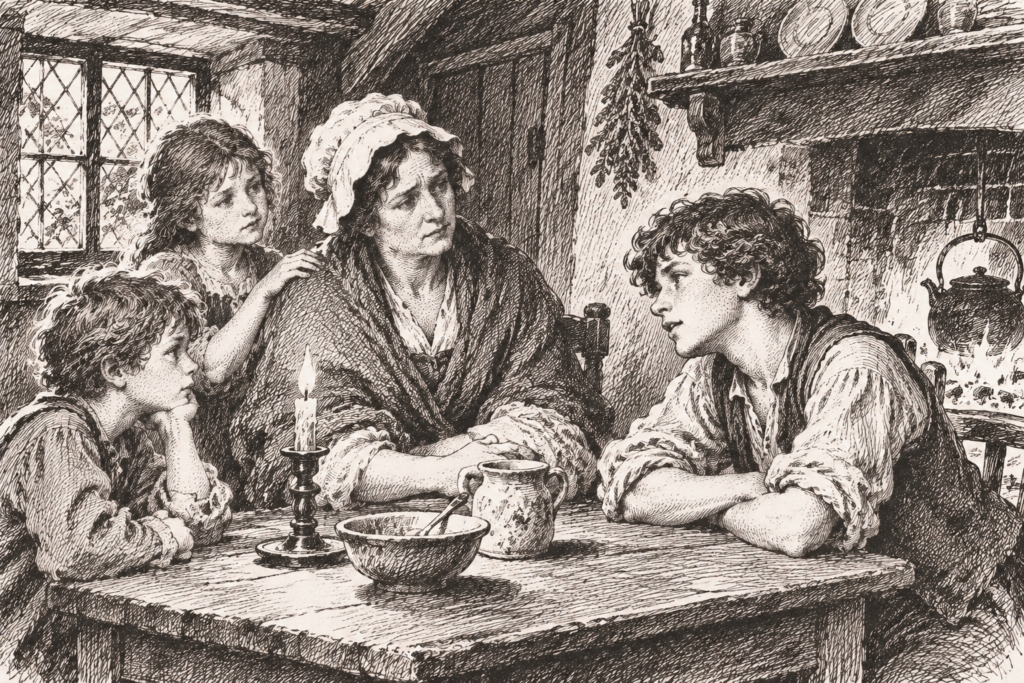
The weeks following Nathaneal Kirby’s funeral were difficult for the family. The familiar order of the household had been disturbed, and Mary soon discovered how much of its daily security had depended upon her husband’s labour. There was no longer a regular wage coming into the house, and the responsibility for keeping six children fed, clothed and properly cared for rested entirely upon her.
She was not a woman accustomed to complaining. There were meals to prepare, clothes to mend and younger children to attend to, and these things could not be neglected simply because she was grieving. The house had to be kept in order, and the children had to understand that life would continue, although it would be different from before.
The older boys were expected to help. Nathaneal, the eldest, was beginning to take on more of the responsibilities that had previously belonged to his father. Samuel and William were growing old enough to undertake useful work, while Susannah and little Joseph still needed considerable attention. Jack, meanwhile, was expected to contribute what he could.
There was no question of the family remaining idle. Work had to be found wherever possible, and Mary was determined that her sons should not become a burden upon their neighbours or the parish. She knew that people in a small community noticed such things, and she was anxious to maintain the good reputation her husband had left behind.
The family had always been known as respectable. Nathaneal had been a well-regarded man, and Mary intended to preserve that standing. She expected her children to behave properly, to be helpful and to remember the principles their father had taught them.
For Jack, however, the change was not entirely unwelcome.
His father’s presence had meant a degree of discipline that he had never particularly enjoyed. Nathaneal had expected him to work, had kept an eye on his movements and had been quick to notice when he was avoiding his responsibilities. With him gone, there was no longer anyone who could exercise quite the same authority.
Mary did her best, but her circumstances were different. She had too much to occupy her to supervise Jack’s every movement. She could remind him of his duties and question him when he returned late, but she could not accompany him everywhere or know precisely how he spent his time.
Jack was beginning to discover a freedom that had not previously been available to him.
Finding work
His father’s death had brought an end to their regular work together in the woods, but Jack was not without opportunities to earn a little money. There were farms and small holdings in the neighbourhood where an active boy could find occasional employment, particularly with the outdoor work that required an extra pair of hands.
The work was familiar to him. He knew how to handle tools, understood something of woodland labour and was accustomed to the countryside around Blean. He could be useful when he chose to apply himself.
Yet he was not particularly attracted to the idea of settling into a regular occupation. He preferred work that came and went, leaving him free to spend his time as he pleased. A day’s employment might provide a little money, but the prospect of being expected to turn up every morning and follow instructions was less appealing.
Mary encouraged him to take whatever work was available. She knew that the household could not afford to support a son who was unwilling to contribute, and she wanted Jack to develop the habits of industry that had been so important to his father.
He sometimes worked alongside other labourers, helping with tasks around farms and woodland. He knew many of the local families, and his father’s former acquaintances were generally willing to offer him work when they could.
But Jack was as usual easily distracted. He enjoyed the company of other young men, and the opportunity to spend a day in Canterbury or follow some activity along the road to Whitstable was often more tempting than the prospect of another day of labour.
The town held a particular attraction. Canterbury was large enough to offer a variety of entertainments and occupations, and its streets were busy with tradesmen, market sellers, travellers and people from the surrounding villages. To a young man from Blean, it offered a different kind of life from the familiar routine of the countryside.
Jack began to spend more time there.
He was still known in Blean, and his family remained his home, but his interests were gradually extending beyond the village. He was making acquaintances who had little connection with the respectable household in which he had been brought up.
Mrs Cullen
Among those who employed Jack occasionally was Mrs Cath Cullen, a widow who lived not far from Mary. Her husband, who had worked as a sheep looker, had died the previous year, leaving her alone in her early sixties.
She was therefore familiar with the difficulties of widowhood, although her circumstances were not quite the same as Mary’s. She had lived in the district for many years and was well acquainted with the people around Blean. Her household was modest, and there were animals and outdoor tasks that required attention.
Jack occasionally went to her house to fodder the cattle and undertake other work outside. It suited him reasonably well. The tasks were straightforward, and he was not required to spend the entire day under close supervision. Mrs Cullen was glad of the help, and Jack was paid for the work he did. She treated him kindly and left him alone to carry out the work she gave him.
Jack was comfortable in her household. He knew where the animals were kept and was familiar with the rooms and outbuildings. He was sometimes sent on small errands, and he became accustomed to coming and going without attracting particular attention.
Mrs Cullen was not a wealthy woman, but she possessed the ordinary household goods that had accumulated over many years. There was furniture, linen, kitchen equipment and the silver spoons that were kept for domestic use. Such possessions represented something of the security she had enjoyed during her married life.
Jack had no particular reason to take notice of them. They were simply part of the household in which he worked.
For a time, he continued to help her whenever she required assistance. The arrangement might have continued indefinitely, had he remained content with the small earnings it provided.
But Jack was becoming increasingly impatient with the limitations of his circumstances. He wanted money that he could spend as he pleased, and he was beginning to compare the modest sums earned through honest work with the quicker rewards that seemed available elsewhere.
An opportunity
It happened one day when the household was quiet.
Mrs Cullen and the other members of the household were absent, leaving Jack alone in the house for a time. He had been carrying out some of the ordinary work for which he was employed and was familiar with the rooms.
On a table he noticed some silver spoons.
He knew they belonged to Mrs Cullen. He also knew that there was no one nearby to see him take them. The opportunity presented itself almost casually, and he was able to persuade himself that the risk was small.
He stood for a moment looking at them.
Until then, his earnings had come from work. The money might have been limited, but it was his own, and he had been able to spend it as he wished. Now he found himself considering a different way of obtaining money.
He took one table spoon and one tea spoon and slipped them into his pocket.
The act was over in a moment. There was no confrontation, no sudden interruption and no immediate consequence. He simply returned to his work and left the house with the spoons concealed about his person.
The following day he went into Canterbury and sold them to a man who was willing to buy the silver. He received one shilling and eightpence.
It was not a large sum, but to Jack it represented money obtained with very little effort. He had not needed to work for a full day, and no one had challenged him. The transaction was completed, and he returned to his ordinary pursuits with the money in his pocket.
For Mrs Cullen, however, the loss was immediately apparent.
She noticed that the spoons were missing and began to consider who might have taken them. There were not many people who had access to the house, and Jack was among those who had been working there.
She was reluctant to believe that he could have done such a thing. His father had been an honest man, and she had known the family for years. Yet the circumstances made it difficult to dismiss the possibility.
When Jack next came to work, she watched him more closely. She did not openly accuse him, but he could tell that something had changed in her manner.
Mrs Cullen eventually decided that she no longer wished to employ him.
She told him that the spoons had disappeared and that she suspected he knew something about their loss. Jack denied taking them, but his denial did little to reassure her.
She had no wish to pursue the matter further. She was an older woman living alone, and she did not want trouble with a neighbour’s family. Nevertheless, she could not continue to have someone in her house whom she suspected of stealing from her.
She told Jack that she would not require his services again.
He left without making any great protest.
The loss of the employment was inconvenient, but he had the money from the spoons, and the experience had given him something else to consider. He had discovered that a valuable object could be exchanged for money without the need to earn it through labour.
He did not yet appreciate the consequences of what he had done. Mrs Cullen’s disappointment and the damage to her trust in him mattered less to him than the immediate reward.
Canterbury acquaintances
With his work at Mrs Cullen’s brought to an end, Jack spent more time in Canterbury.
The town was familiar enough for him to move about without difficulty, but it offered opportunities that were not available in Blean. There were inns and public houses where young men gathered, streets where money changed hands and a constant flow of people who were not known to one another.
Jack began to associate with a small group of young men who lived by irregular means. Some had occasional employment, while others relied upon petty thefts and whatever money they could obtain from questionable dealings. They were not necessarily hardened criminals, but they were accustomed to avoiding regular work and finding easier ways to support themselves.
Among those he came to know was Thomas Rooke.
Thomas was a few years older than Jack and had already acquired a reputation among certain circles in Canterbury. He was quick-witted and sociable, with an ability to make acquaintances easily. He knew which public houses attracted particular groups and was familiar with people who could buy or dispose of goods without asking too many questions.
He was not an especially imposing figure, but he possessed confidence and knew how to make himself useful. Jack found him entertaining company.
Their acquaintance developed gradually. They met in public houses, exchanged news and spent time with other young men who shared their interests. Thomas was interested in Jack’s knowledge of the surrounding villages and farms, while Jack enjoyed the company of someone who seemed to know so much about the town.
There was a difference between them. Thomas had more experience of Canterbury and its less respectable inhabitants, while Jack was still learning his way around this world. He knew the countryside well, but he was less familiar with the people who made their living from the disposal of stolen goods.
Thomas introduced him to some of these acquaintances.
The company was not always respectable. Women who lived on the margins of society were among those who frequented the same establishments, and the young men often spent money on drink and entertainment. Jack was easily drawn into this way of life, particularly when he had a little money to spend.
The money from the spoons did not last long.
He was not careful with it. A few drinks, an evening in company and the small pleasures of town life quickly reduced what he had received. When it was gone, he found himself in much the same position as before, with no regular employment and little money in his pocket.
Mary was aware that Jack was spending more time away from home, although she could not know everything about his new acquaintances. She continued to encourage him to find work and reminded him that his father would have expected him to behave differently.
Jack listened, but he was becoming less inclined to accept advice.
He had always disliked being told what to do, and the freedom of his new companions was attractive. They appeared to live without the restrictions that governed the lives of the labouring families around Blean. They worked when they needed money, spent it when they had it and found other ways of obtaining more when it ran out.
To Jack, this seemed an easier existence than the one his father had tried to prepare him for.
A new direction
By the time Jack was approaching seventeen, his days had become less settled.
He still returned to his mother’s house, and he had not severed his ties with Blean. His family remained there, and the village was still the place he knew best. But his time was increasingly divided between home, occasional work and his visits to Canterbury.
He had begun to acquire a different circle of friends, and their influence was becoming important to him. They did not share Nathaneal Kirby’s ideas about honesty and industry. They were more interested in immediate pleasures and the money needed to pay for them.
Jack was not entirely unaware of the difference between the life his father had wanted for him and the one he was beginning to lead. But he was young, impatient and easily influenced by those whose company he enjoyed.
His mother continued to hope that he would settle down. She had already lost her husband, and the last thing she wanted was for one of her sons to bring further trouble upon the family. She had worked hard to maintain their respectability, and she was anxious that the boys should follow the example their father had set.
Jack’s visits home became less predictable. Sometimes he would return with a little money, sometimes with nothing. He was not always forthcoming about where he had been or whom he had seen.
Mary could question him, but she could not force him to spend his time as she wished. She had the younger children to care for and a household to maintain. Her authority over Jack was not what Nathaneal’s had been, and she knew it.
The summer and autumn passed, and Jack continued to spend time in Canterbury. His acquaintance with Thomas Rooke and the other young men became more established. They were beginning to look upon him as someone who knew the villages and country roads beyond the town, someone who might be useful when they needed to find their way around the farms and houses outside Canterbury. He liked the feeling of belonging to a group, and he was pleased when his knowledge of the countryside attracted their attention.
He was still young enough to believe that he could move between the two worlds without difficulty: the respectable household in Blean and the less respectable company he kept in Canterbury.
But the distance between them was growing.
For the moment, the family continued its daily routine. Mary worked to keep the household together, the younger children grew older, and Jack came and went as he pleased.
He had taken his first step away from the life his father had wanted for him, although there was still much ahead that he had yet to encounter.