1784
Jack Kirby had never been particularly troubled by the distinction between buying and selling, borrowing and stealing. If an animal came into his possession and he could make money from it, he was generally satisfied. Dogs, in particular, offered him a useful opportunity. A good hunting dog was worth something to the right person, and there were always men willing to pay for an animal that might improve a pack or prove itself in the field. Jack had discovered that a dog could be stolen, sold, stolen again and, with sufficient ingenuity, sold once more.
His dealings with the Folkestone sporting fraternity had already brought him a modest income. He had made acquaintances among those who kept hounds and those who bought and sold them, and he had learned that a man did not always need to tell the whole truth when offering an animal for sale. Indeed, a convincing appearance of honesty could sometimes be more useful than honesty itself.
There was, however, one matter which had begun to irritate him.
He had left his own bitch, Stroller, in the care of an acquaintance at Folkestone, with the understanding that she would be returned when he asked for her. The arrangement had not been honoured. Jack had made enquiries and received assurances, but the dog had not been sent back.
“I have waited long enough,” he remarked to Mutton one day. “I shall have to go and fetch her myself.”
“Perhaps your friend has taken a liking to her.”
“Then he should have bought her. I left her in his care, not as a present.”
“And you think he will give her up?”
“He will have little choice.”
Jack’s annoyance was not entirely about the dog. He disliked being made to feel that another man had taken advantage of him, particularly when he considered himself the more cunning of the two. He had no intention of allowing the matter to rest.
He set off for Folkestone and, having found the person with whom Stroller had been left, recovered his bitch. But he did not leave empty-handed. There was also a puppy which he had previously sold to the same man, and another bitch named Pleasant. Jack took both animals as well.
It was a bold piece of work, though he seems to have regarded it as no more than recovering what he could from a man who had broken his word. He had no difficulty in persuading himself that the other animals were fair payment for the inconvenience he had suffered.
By the following day he was on his way back towards Canterbury, with all three dogs.
The puppy was of particular interest to him. It had originally belonged to a huntsman from whom Jack had stolen it some time before. Having sold it at Folkestone, he had later taken the opportunity to alter its appearance. Its ears had been rounded and its tail docked, so that it no longer looked quite as the huntsman might remember it.
Jack had a plan.
He called upon the huntsman and offered him the puppy for five shillings.
The man examined the animal with interest.
“Where did you come by this one, Kirby?”
“Had him some time.”
“Good-looking little dog.”
“He should make a useful hound.”
The huntsman turned the puppy over in his hands, looking at its ears and tail.
“Five shillings, you say?”
“That’s right.”
The man considered the price. There was nothing obviously suspicious about the animal, and he had no reason to suppose that Jack would bring him a dog which he had once owned himself.
“I’ll take him.”
Jack accepted the five shillings without showing any sign of amusement. The transaction was complete, and the puppy had been sold to its original owner for the second time.
Pleasant was disposed of at Hearn Hill for two shillings and sixpence. Jack had little difficulty in finding a buyer, and he continued on his way with only Stroller remaining.
For a time, the trick appeared to have succeeded. But the huntsman was not entirely satisfied. Something about the puppy troubled him. Perhaps it was a familiar look in the animal’s face, or perhaps the circumstances of its appearance seemed too much like an earlier occurrence. He had once owned a puppy which had disappeared, and the one Jack had now sold him bore a resemblance to it.
He questioned Jack.
“You have sold me a dog before, Kirby.”
“I have sold a good many dogs.”
“This one reminds me of a puppy I lost.”
“Then you have found yourself another like it.”
The huntsman looked at him closely.
“I thought I knew the other one.”
Jack shrugged. “There are plenty of dogs in Kent.”
The man hesitated. He was not certain enough to accuse Jack, but he was curious enough to press the matter.
“Come now. Tell me honestly. Is this the same puppy?”
Jack studied him for a moment. He could have denied it, but he saw an opportunity in the huntsman’s uncertainty. The man appeared more concerned with discovering the truth than with making a formal complaint.
“If I tell you, will you keep it to yourself?”
The huntsman looked surprised.
“What have you to tell me?”
“That the puppy was yours.”
The man’s expression changed.
“Mine?”
“I stole it from you. I sold it to a man at Folkestone, and when I went there to recover my own bitch, I took the puppy back. Now I have sold it to you again.”
The huntsman stared at him.
“You have a curious way of doing business, Kirby.”
Jack laughed. “You have your puppy back. That is something.”
“I have paid for it twice, you mean.”
“You have paid five shillings this time. I cannot answer for what happened before.”
The huntsman was not pleased, but he had given Jack his word that he would not mention the matter to his master. He kept it. Jack left with his money and another story to tell Mutton.
He was evidently pleased with the ingenuity of the affair. It was not simply the money that amused him, but the thought that he had managed to deceive the same man twice with the same animal.
The next day he turned his attention to another opportunity.
At Stone-house, he stole a couple of hounds belonging to Mr Hammond. They were valuable enough to attract a buyer, and Jack sold them for nine shillings. He had become practised at moving animals from one place to another without attracting too much attention, and he knew that a dog might be missed by its owner without anyone immediately suspecting that it had been stolen.
Yet not every transaction was entirely without consequence.
Some time before, Mr Wootton of Chartham had lost a dog named Ruler at Peyton’s, at Blean. He had made enquiries and eventually approached Jack, who was known to have dealings with dogs and sporting men. Wootton offered him five shillings if he could discover where Ruler had gone.
Jack knew perfectly well where the dog was. He had placed it in the subscription pack at Folkestone, where it was being kept with other hounds.
When Wootton came to him, Jack listened to the account of the missing animal.
“I have searched everywhere,” Wootton said. “He was at Peyton’s, and then he was gone. Someone must know what became of him.”
Jack affected to consider the matter.
“Have you made enquiries at Folkestone?”
“Why should I look there?”
“There is a subscription pack there. Ruler may have found his way into it.”
Wootton looked at him with renewed interest.
“You think he is there?”
“I would make enquiries if I were you.”
Mr Wootton was grateful for the information. He went to Folkestone, found Ruler among the pack and recovered him. True to his word, he paid Jack the five shillings.
But he had something else to say.
“You have done me a service, Kirby,” he remarked. “And I am obliged to you for it. But I hear things about you, and I would rather not believe them.”
Jack said nothing.
“You are a young man with your life before you. You have intelligence enough to do something better than this. Why not leave off this wicked course of life before it is too late?”
Jack accepted the five shillings, but the advice was less welcome.
“I shall think on it, Mr Wootton.”
“I hope you will. There are people who would be glad to see you do well.”
Jack thanked him and went away. He may even have felt a moment’s discomfort at the words, for Mr Wootton had spoken kindly and without anger. But a few words of good advice were unlikely to alter a way of life which had become so profitable and so familiar.
He had been able to make money from dogs, and he had also discovered that he could sometimes earn a little by telling people where their own missing animals might be found. The irony of the arrangement did not trouble him. He was more interested in the five shillings in his pocket.
It was not long before his attention turned to another kind of opportunity, one which would bring him and Mutton into much more dangerous territory.
One afternoon, Mutton called at the Kirby household. Jack was at his mother’s house when his old companion arrived, and the two men soon decided to go out together. They made their way to the Red Lion, where they intended to spend the evening. They settled down to play cards and drink, and as the evening advanced the company became noisier.
Among those present was William Bentley, a man from Whitstable. He had been drinking several pots of bumbo*, and by the later part of the evening he had become thoroughly intoxicated.
Bentley was not an unusual sight in an inn. Men travelling between Whitstable and Canterbury often stopped for refreshment, and the Red Lion was a convenient place to break a journey. He had been drinking with the others for some time, and neither Jack nor Mutton had reason to draw attention to him.
As the evening wore on, Bentley became unsteady. He went outside and lay down on the bench by the door for a while, hoping to recover himself. The others continued their cards and conversation.
Mutton, however, had noticed something.
When Bentley returned to settle his share of the reckoning, he took out a purse. It contained several guineas. Mutton watched him carefully, and then turned towards Jack.
“Look there,” he murmured.
Jack followed his glance.
“What of it?”
“He has a good deal of money.”
“He has been drinking enough to spend it.”
“More than enough, by the look of him.”
Bentley counted out what he owed and put the purse away. He seemed unaware that the two men had been watching him.
Mutton drew Jack aside.
“We could do him on the road.”
Jack looked at him sharply.
“Here?”
“Not here, you fool. On the road to Whitstable.”
Jack glanced towards Bentley. The man was preparing to leave.
“I don’t know,” he said. “He may recognise me.”
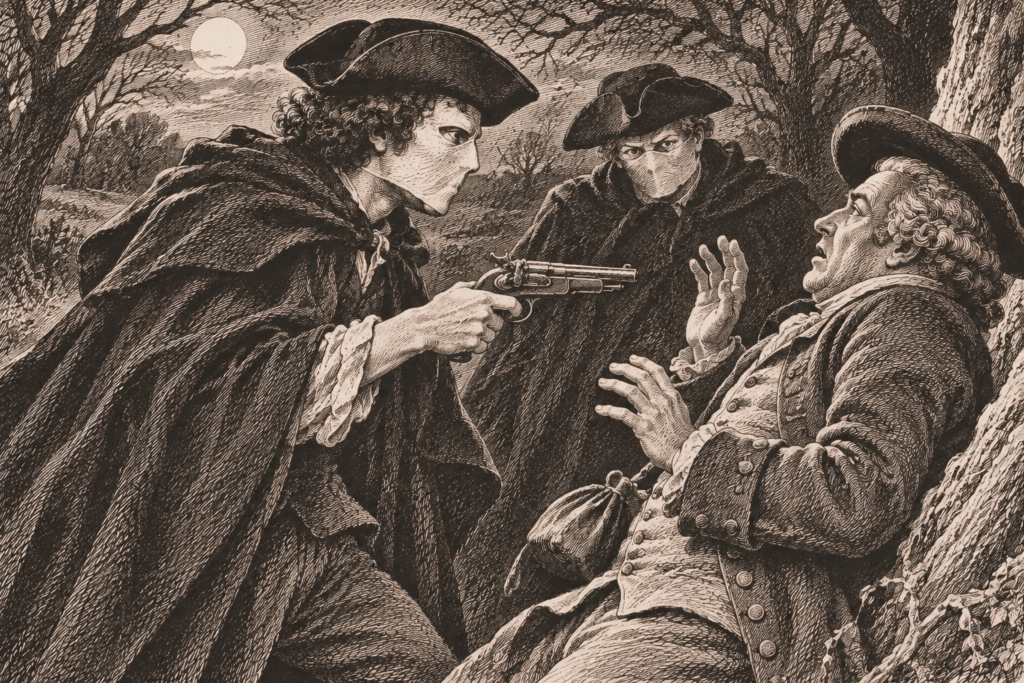
Mutton appeared to have anticipated the objection. He produced two paper masks and two black gaberdines, which he had brought with him.
“I have thought of that. Put these on and no one will know you.”
Jack examined the disguises. The masks were crude, but in the darkness they might be sufficient. The gaberdines would conceal their clothes and shape.
“You came prepared,” Jack said.
“I did not think we should waste an opportunity.”
Jack was still uncertain. Highway robbery was a more serious undertaking than stealing a dog or taking provisions from a house. It involved confronting a man on the open road, and there was always the possibility that the victim might resist or recognise them.
But the money was tempting.
“How much did you see?” he asked.
“Several guineas. Enough to make it worth our while.”
Bentley was now ready to depart. He took the high road towards Whitstable, while Jack and Mutton remained behind long enough to settle their reckoning.
They did not wish to attract attention by leaving immediately after him. Once they were outside, they took a different route, crossing the fields in order to reach the road ahead of him.
The evening had grown dark. The lanes and fields between the Red Lion and Whitstable were quiet, and the two men had little difficulty in keeping out of sight. They put on their disguises and waited for Bentley to approach.
Jack could hear the man’s footsteps before he saw him clearly.
Mutton was carrying a horse-pistol. As Bentley came within reach, he stepped forward and levelled it at his head.
“Your money,” he demanded. “Give it up, or I’ll blow your brains out.”
Bentley stopped. The sudden appearance of two masked men, one armed with a pistol, left him little room for hesitation.
He did not attempt to resist. Instead, he took out his green silk purse and threw it into Mutton’s hat.
“Take it,” he said.
Mutton caught the purse. Jack stood close by, watching Bentley and the road behind him.
“Is that all?” Mutton demanded.
“It’s all I have.”
Mutton opened the purse and glanced inside. It contained four guineas and a half, together with a sixpence. The purse itself was green silk and had a hole in it, a small detail which would later make it more recognisable.
“Then you may go,” Mutton said.
Bentley did not wait to be told twice. He continued towards Whitstable, leaving the two robbers behind him.
For a few moments neither man spoke. The affair had been carried out quickly, and the money was now in their possession. Jack felt the excitement of having taken part in something bolder than their usual thefts. There was also a certain relief that Bentley had not resisted.
Mutton looked into the purse again.
“Four guineas and a half, and sixpence. Not a bad evening’s work.”
Jack gave a short laugh.
“You were right about him.”
“I generally am.”
“Do not let that make you conceited.”
Mutton grinned and put the purse away.
They made their way back towards Canterbury, no doubt pleased with their success. But instead of separating and returning quietly to their homes, they chose to celebrate.
They went to the Crown and Thistle, in St Peter’s, Canterbury, where they spent nearly two guineas of the stolen money on what the pamphlet later described as the ladies of the town.
The remainder would not last long either. Jack and Mutton had little inclination to save their gains. Money was something to be spent while they had it, and the pleasure of a successful robbery was quickly followed by the pleasures of drink and company.
For Jack, the evening marked a change in the scale of his offending. He had stolen from houses, farms and kennels; he had deceived men who trusted him with their animals; and now he had taken part in an armed robbery on the road. The pistol had done its work, and Bentley had surrendered his purse without a struggle.
It was easy to believe that such an undertaking could be repeated.
But there was a difference between stealing property in the quiet of the night and confronting a man with a loaded weapon. A burglary might leave its victim with a loss discovered only in the morning. A robbery on the road left a frightened witness who could describe the men, the threat and the weapon they had used.
Jack and Mutton had taken their precautions with masks and disguises, but they could not be certain that they had concealed every detail. Nor could they know how long the stolen purse might remain in Bentley’s memory.
For the moment, however, they had escaped detection.
Jack returned to his mother’s house with the satisfaction of a man who believed himself fortunate. The advice of Mr Wootton, the warning implicit in the huntsman’s questions and the uneasiness he had felt before the robbery were all forgotten. He had a companion in Mutton who shared his appetite for risk and was willing to take matters further than Jack might have done alone.
The two men had begun by stealing dogs and selling them to those who wanted them. Now they had discovered that a purse could be taken from a traveller on the road, and that a few minutes of violence might bring more money than several nights spent breaking into houses.
It was a dangerous lesson, and one that Jack would not be slow to learn.
* bumbo – an eighteenth-century sea-drink or punch compounded of rum, water, sugar, and nutmeg