1787
Jack continued working in the woods until Michaelmas*.
As the summer gave way to autumn, the countryside was busy with the harvest. The days were shortening, and the agricultural year was turning towards its close. Jack had been earning his money honestly, and for several months there was no indication that he intended to return to his former activities.
Then came a wager.
The waggoner’s challenge
Mr Twyman employed a waggoner who was fond of cock-fighting. He and Jack fell into conversation about the sport, and before long the talk had turned into a challenge.
They agreed to fight a cock for half a guinea and a supper.
Jack accepted readily enough, but there was one difficulty.
He had no gamecock of his own.
The waggoner, on the other hand, possessed two birds, and Jack knew that one was particularly good. He might have declined the contest, or tried to borrow a bird from someone else, but that was not his way. He began to consider how he might obtain the very cock that would give him the best chance of winning.
He knew where the waggoner kept his birds.
That evening, Jack went to Mr Twyman’s property and stole the waggoner’s best cock. He took it to a friend in St Mildred’s, Canterbury, who agreed to keep it until the day of the fight.
It was a bold arrangement. Jack intended to compete against the waggoner with the waggoner’s own bird, without the man having the slightest idea that it had been stolen.
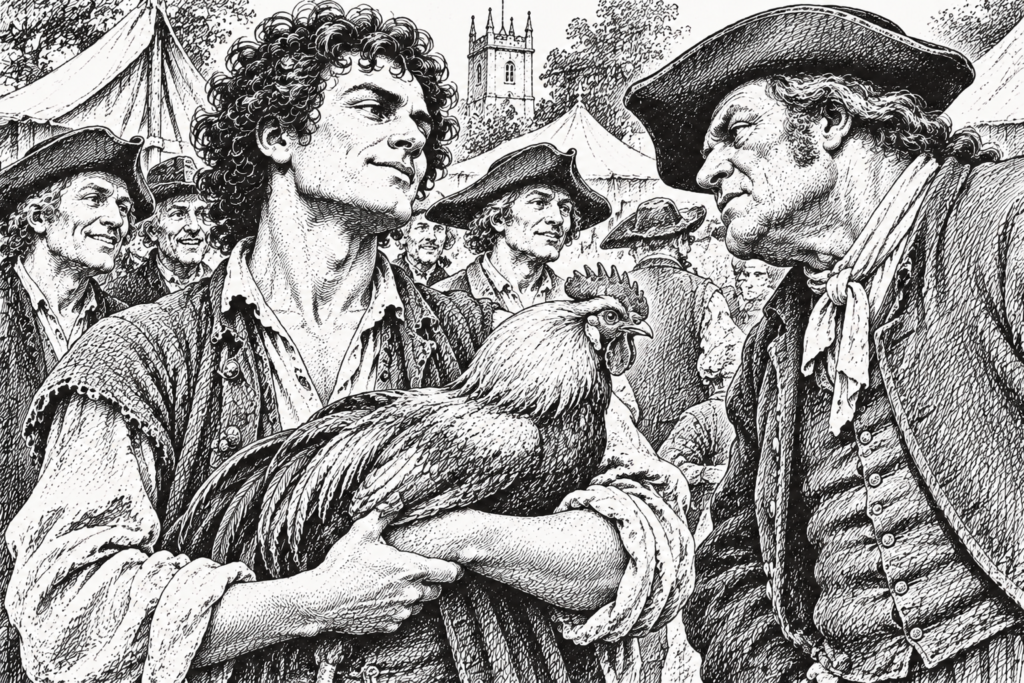
When the day of the match arrived, Jack brought the cock forward.
The waggoner looked it over with interest.
“That’s a fine bird,” he remarked.
Jack smiled. “I think he’ll do well enough.”
“Better than mine, perhaps?”
“We shall see.”
The birds were set against one another, and the contest began. Jack’s cock proved the stronger and won.
Jack collected the half-guinea wager.
The waggoner was so impressed by the winning bird that he offered to buy it as well. He gave Jack another half-crown for the cock, apparently delighted to have acquired such a good animal.
Jack accepted the money without hesitation.
The transaction was almost absurd in its simplicity. He had stolen the waggoner’s best cock, used it to win a wager against him, and then persuaded the same man to pay him for the bird.
He left with the half-guinea and the additional half-crown.
For Jack, it must have seemed a particularly successful day’s work.
Old acquaintances
The money did not remain in his possession for long.
Jack soon returned to the company of some of his old female acquaintances. He had been warned by Mutton, in their last conversation before the execution, that the company he kept might bring about his ruin. Jack had remembered that warning well enough to repeat it later, but remembering advice and following it were two very different things.
He spent his winnings, and before long the half-guinea and half-crown had disappeared.
He was once again in the familiar position of wanting money.
This time, he turned to the household whose property he knew well.
A visit to Mr Twyman’s stable
One evening, while the Twyman family were sitting down to supper, Jack made his way to their stable.
He entered and stole a pair of pumps, a waistcoat and a frock.
The pumps were particularly useful to him because they could be sold readily. Clothing was also easy to carry away and dispose of, provided he could find someone prepared to buy it.
Having taken the garments, Jack went on to the hen-house.
There he stole a couple of fowls and a couple of ducks.
The family remained at supper, apparently unaware that their property was being removed only a short distance away. Jack made his escape with the goods and later took the pumps to a pawnbroker, who gave him four shillings and sixpence for them.
He did not sell the poultry.
Instead, he used the fowls and ducks to entertain the women whose company had once again become a drain upon his money. It was not simply a matter of stealing to buy food or meet an immediate need. He was using stolen property to maintain the social life he wanted.
The irony was that Mr Twyman’s waggoner had recently paid Jack for a cock that belonged to him. Now Jack had returned to the same property to steal from the stable and hen-house.
His earlier success had evidently given him little pause for thought.
Thomas Cullen’s geese
The theft from Mr Twyman was not the end of the week’s activity.
During the same week, Jack went again to the property of Thomas Cullen at Blean and stole three geese.
He carried them to Canterbury, where he sold them for six shillings. It was a modest sum, but one that required far less effort than a day’s honest labour
The theft was, however, another reminder that Jack was still taking property from the community in which he had grown up.
The old habits return
Jack’s return to Blean had begun with an act of kindness from the parish officers. They had provided him with clothes and he had found work in the woods. For a time, he had appeared to be making a genuine effort to live differently.
Yet the cock-fight had provided an easy way to make money, and the winnings had quickly been spent. Within a short time, he had stolen from Mr Twyman and Thomas Cullen.
There was something almost playful about the deception involving the waggoner’s cock. Jack had taken a bird, won a wager with it and then persuaded its rightful owner to pay him for it. But beneath the amusement lay the same recklessness that had brought him into trouble so many times before.
He was not stealing because he could not work. He was stealing because he wanted money quickly, and because he had grown accustomed to satisfying his wants without considering the consequences.
Mutton’s warning had come back to him, but it had not changed his behaviour.
The parish had given Jack another chance. He had been offered work, clothes and the opportunity to return to a respectable life. By Michaelmas, that opportunity was already slipping away.
And the thefts were about to become more frequent.
* Michaelmas – the Feast of Saint Michael and All Angels) is observed every year on 29 September