1784–1785
The robbery of William Bentley had given Jack Kirby and William Mutton a taste for a more daring kind of enterprise. They had taken money from a man on the open road, using a pistol and disguises, and had escaped without immediate consequence. For a time, the success of the affair seemed to confirm their belief that they could outwit almost anyone.
Yet Jack’s life was not made up entirely of planned robberies and carefully chosen opportunities. He was also impulsive, easily provoked and inclined to take offence when anyone questioned his character. An insult, however small, could be enough to make him act without considering what might follow.
It was this temper that brought him into trouble at Whitstable.
He had been invited to take part in a running match there, an event which promised the usual excitement of a country gathering. Such competitions attracted considerable interest. Men ran against one another for wagers, and the spectators came as much for the entertainment and companionship as for the contest itself. There would be money changing hands, arguments over the competitors and plenty of opportunity for those who preferred to watch rather than run.
Before setting out, Mutton called upon Jack.
“I have a mind to go to Appledore,” he said. “Will you come with me?”
“Not until the running is over,” Jack replied. “I have promised to take part.”
“Then I shall wait for you.”
“You need not wait if you have business elsewhere.”
“I can find something to occupy myself.”
Jack was pleased enough to have Mutton’s company, but he did not intend to miss the match. The two men made arrangements to meet afterwards, and Jack went on to Whitstable.
The gathering was already in good spirits when he arrived. The runners were making their preparations, and groups of spectators stood about discussing the likely winner. Some had come from nearby villages, others from further afield, and the prospect of a wager added to the general excitement.
Jack was well known to some of those present. He had a reputation, and not everyone was pleased to see him. One of the young men there was Henry York, who had a particularly fine pair of silver buckles in his shoes. York had evidently heard enough about Jack’s conduct to have formed a poor opinion of him.
The two men exchanged words before the race began.
“You are here to run, Kirby?” York asked.
“That is what I have come for.”
“I should have thought you had better things to do.”
“Such as?”
York gave him a look of open disapproval.
“Perhaps finding something that does not belong to you.”
Jack smiled, though he did not enjoy the remark.
“You seem very interested in my affairs.”
“I have heard enough about them.”
“Then you have been listening to the wrong people.”
“I doubt it.”
There was an edge to York’s voice, and Jack felt the insult more keenly than he cared to show. He was accustomed to being spoken of, but he did not like being challenged to his face, especially in front of others.
York turned away, apparently satisfied that he had made his point. Jack watched him for a moment, then looked down at the man’s shoes. The silver buckles caught the light, and an idea occurred to him.
He would have his revenge.
As the runners gathered and attention shifted towards the start, Jack waited for a moment when York was occupied elsewhere. He moved close enough to take the shoes and buckles without attracting notice, concealing them beneath his loose greatcoat. He then made his way up a nearby hill and hid them in a bush.
Having done so, he returned to the gathering as though nothing had happened.
The race was about to begin.
Jack took his place among the competitors. He was quick on his feet and had no difficulty joining the others, while the spectators turned their attention to the runners. He made a show of being entirely absorbed in the contest, and for a while his plan appeared to have succeeded.
When the match was over, York discovered that his shoes and buckles had disappeared.
He searched about the place, asking whether anyone had seen them. At first there was confusion, and then suspicion began to settle upon Jack. York had already challenged him about his reputation, and the disappearance of his property during the gathering seemed too convenient to be a coincidence.
Jack was aware of the growing attention, and he was anxious to get away. He did not remain to hear all that was said. Instead, he left early, while Mutton remained behind.
The unfortunate Mutton had played no part in the theft, but he was left to bear the consequences of Jack’s behaviour. The anger which should have been directed at the thief fell upon his companion, and he received a severe beating.
When Jack learned what had happened, he seems to have regarded it as an unfortunate inconvenience rather than a reason for remorse. He had obtained the shoes and buckles, and Mutton had been unlucky enough to remain behind.
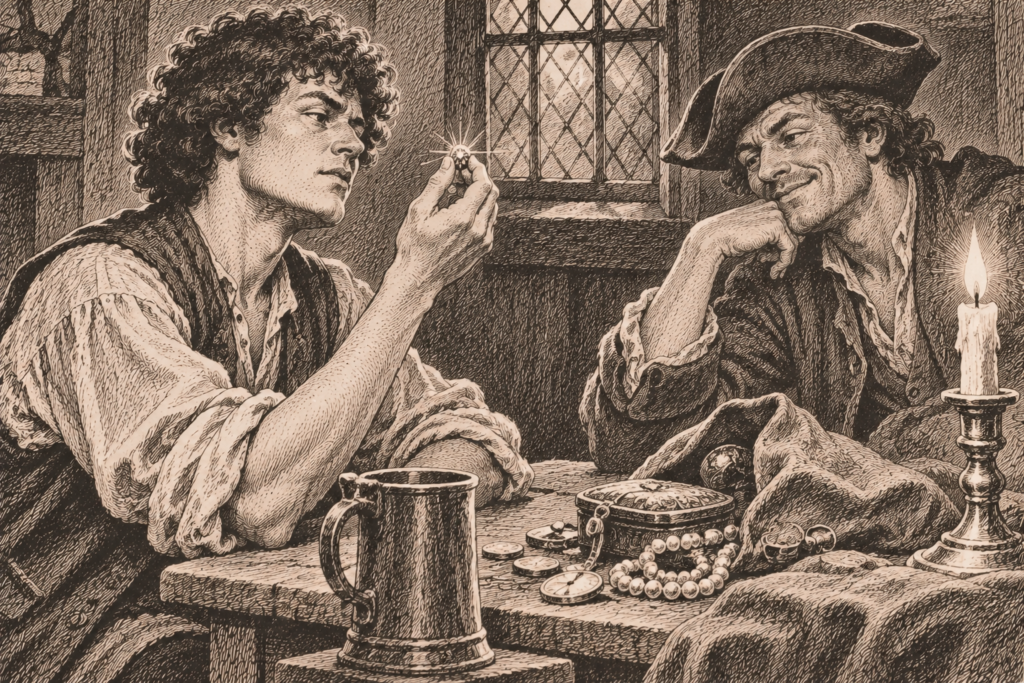
The buckles were worth a considerable sum. Jack sold them for seventeen shillings and gave Mutton a share of the proceeds. He kept the shoes for himself and began wearing them.
It was an unwise decision. The buckles might have been sold and forgotten, but the shoes were distinctive enough to attract attention. Jack had taken them from a man who knew him, and it was only a matter of time before someone noticed them on his feet.
The next day, his older brother, Nat, and Henry York made enquiries and followed the trail to Canterbury. They eventually found Jack at a house in Knott’s Lane, a place of ill repute where he had taken to spending some of his time.
Jack was there when they arrived. Nat recognised the shoes immediately.
“Those are York’s shoes,” he said.
Jack looked down at his feet, then back at him.
“What of it?”
“You know very well what of it. Where did you get them?”
“They are mine.”
“They were not yours yesterday.”
York stepped forward.
“I want them back, Kirby.”
“You had better find yourself another pair.”
“I know you took them.”
“Then you should have watched them more carefully.”
Nat was growing angry.
“Give them back. You have caused enough trouble.”
Jack had no intention of surrendering them. He was also irritated that his own brother had joined York in pursuing him. Whatever the rights and wrongs of the matter, he considered it a betrayal to be challenged by his family in front of others.
“Get out of my way,” he said.
Nat stood firm.
“You will not walk away wearing another man’s shoes.”
Jack seized a broomstick and struck him, knocking him to the ground. York moved towards him, and the room quickly became a scene of confusion. Others joined in, either to separate the men or to take sides, and a general fight followed.
Jack and his companions managed to escape from the disturbance. He was not prepared to remain and face the consequences of the quarrel, and he made his way away from Knott’s Lane before anyone could detain him.
He was angry with his brother, angry with York and, above all, annoyed that the stolen shoes had brought him so much trouble. Yet he continued to wear them.
He had arranged to meet Mutton the following day and, having told him where he would be, returned to his lodging. He was tired after the day’s events and, believing the immediate danger to have passed, went to bed.
He had not been there long when the door opened and Nat and York entered.
This time they were carrying sticks.
Jack was taken by surprise. He had expected that the quarrel in Knott’s Lane was over, at least for the night, but the two men had come to settle matters in their own fashion. They approached the bed and began beating him while he was still lying down.
Jack tried to protect himself, but the attack was sudden and he was at a disadvantage. His anger soon overcame any fear he might have felt. He had kept a bill* concealed in the house, It was not a weapon one would ordinarily expect to find beside a bed, but Jack had evidently thought it prudent to have something close at hand in case of trouble.
He reached for it and sprang up.
“Get away from me!”
His brother and York stepped back.
“I’ll chop your heads off!” Jack shouted, raising the bill.
The threat was enough to send them retreating from the room. They had come to give him a beating, but had not expected him to answer with a weapon. Jack followed them out, still furious, and caught up with one of them. He struck him to the ground.
The noise brought a neighbour from the adjoining house. An old woman, alarmed by the shouting and commotion, came outside to discover what was happening.
“What is all this noise?” she called.
Jack turned towards her, still holding the bill. He was in no mood to explain himself or to have anyone interfere.
“Go inside!” he shouted.
The woman hesitated.
“What’s happened here?”
“I said go inside, or I’ll throw you into the pond!”
The threat frightened her sufficiently. She withdrew, but the incident had made a lasting impression. She had heard the disturbance and seen Jack in an alarming state, armed with the bill and threatening violence.
By the following day, the matter had taken a more serious turn. The old woman swore the peace against him.
To swear the peace was not simply to complain about an unpleasant encounter. It was a formal declaration that a person feared violence or bodily harm from another and sought protection against the threat. Jack’s conduct had given her sufficient cause to make such a complaint, and the authorities were once again involved.
He was committed to St Dunstan’s Gaol.
For Jack, this was a familiar but unwelcome return. He had been taken into custody before, but on this occasion the circumstances were different. The complaint arose from a direct threat made against a neighbour, and the affair with York had already brought him into conflict with his brother. His temper had turned a relatively straightforward theft into a series of violent confrontations.
At the ensuing sessions, he was sentenced to remain in prison until the next Quarter Sessions.
It was a punishment that might have given him time to reflect upon the consequences of his behaviour. But Jack was not inclined to spend his days in gaol contemplating the errors of his ways. He had already learned that confinement did not necessarily mean the end of his freedom, and he began to consider how he might escape.
The opportunity came when he was being returned to gaol after the proceedings.
He was wearing handcuffs, as a prisoner in his position would expect. Yet Jack had a knack for finding a weakness in arrangements which others accepted without question. He worked at the restraints, testing them and looking for a way to slip free.
At some point on the journey back, he managed to ease his hands out of the handcuffs.
The moment he was free, he took his opportunity and made off.
It was a remarkable escape, and one which must have taken both nerve and a good deal of dexterity. The authorities had every reason to believe that he was securely in their custody, yet Jack had managed to slip away before he could be returned to his cell.
Once again, he was at liberty.
The escape would have brought him a sense of triumph, but it did nothing to improve his position. He was now a man who had not only been committed for threatening violence but had also escaped from custody. He could not safely return to the life he had been leading without the risk of being recognised and taken again.
For the time being, however, he was free to move about and to seek another opportunity.
The running match at Whitstable had begun with an insult and ended with a beating, a threat against an old woman, imprisonment and escape. Jack had taken York’s shoes because he could not bear to be humiliated in front of others. He had then refused to surrender them, fought his brother and threatened a neighbour who had done no more than come out to see what was happening.
There was a pattern in his behaviour which was becoming increasingly difficult to ignore. He could be clever, resourceful and bold, but he was also governed by pride and impulse. He rarely stopped to consider whether a small act of revenge might bring consequences far greater than the original offence.
Mutton, meanwhile, had once again found himself caught up in the aftermath of Jack’s actions. He had been beaten for a theft he had not committed, and although Jack had shared the proceeds of the buckles with him, it was a poor compensation for the trouble he had endured.
Yet the two men remained companions. Their friendship, if that is what it could be called, had survived imprisonment, theft and violence. Jack’s escape meant that they might soon be together again, although the next stage of his life would take him away from the familiar roads around Blean and Canterbury.
For now, he had escaped the gaol, but he had not escaped the consequences of his own reputation.
* an agricultural implement with a sharp blade used for cutting branches and trimming trees.