1761–1776
The winter of 1761 had settled over the Kentish countryside when John Kirby was born. It was the last day of November, St Andrew’s Day, and the village of Blean lay beneath the dull grey skies of an English winter.
The Kirby household was a modest one, as were most of the homes in the parish. Nathaneal Kirby earned his living through husbandry and woodland work, occupations that demanded strength, patience and a willingness to work in all weathers. His wife, Mary, kept the household and cared for their growing family. They had already welcomed a son, Nathaneal, born in October 1759, and the arrival of another boy brought both happiness and another mouth to feed.
The new baby was named John, although he would become known to almost everyone as Jack.
There was little ceremony surrounding his arrival. Mary had a household to manage, a young child to care for and a husband whose work took him away from home for long hours. Yet the birth of a son was a welcome event, and Nathaneal was pleased to have another boy. He hoped, as any father might, that his sons would grow into industrious men, able to earn their living and establish respectable households of their own.
The family continued to grow. Samuel arrived in February 1764, William in April 1766, Susannah in June 1769 and Joseph in November 1772. By the time Jack was eleven, there were six children in the household, ranging from the sixteen-year-old Nathaneal to little Joseph, who was still a small boy.
Their home was busy, and money was not plentiful. Nathaneal’s earnings depended upon the work available to him, while Mary made every penny stretch as far as it would go. The children shared in the ordinary responsibilities of family life. Older ones helped with younger ones, and there was always something to be done: fetching water, carrying wood, tending animals or helping with the preparation of meals.
Nathaneal was regarded as an honest and industrious man. He was plain in his manner, well-meaning and respected by his neighbours. He did not possess great wealth or influence, but he had something perhaps more valuable in a small community: a good reputation.
He expected his children to behave properly and to work hard. He believed in the value of education, even though his own circumstances had not afforded him much opportunity. He wanted his sons to learn to read and to acquire enough knowledge to make their way in the world.
Mary, too, understood the importance of bringing up the children properly. She was a practical woman, accustomed to the demands of a large family, and she relied upon routine and discipline to keep the household running. There was affection in the family, but there was also work to be done, and little time for idleness.
Blean and the forest
Blean was a small rural parish a few miles north of Canterbury. Its scattered houses and farms were surrounded by countryside that had once formed part of the ancient Forest of Blean. Woodland, pasture and cultivated fields lay close together, and the lives of the villagers were closely connected with the land.
The forest was not simply a place of trees. It provided work, fuel and materials, and its paths and clearings were familiar to those who lived nearby. Men worked among the timber, gathered wood and undertook the many tasks associated with the management of the countryside. Children grew up knowing the lanes and tracks, the fields and hedgerows, and the places where they might find birds, rabbits or other small creatures.
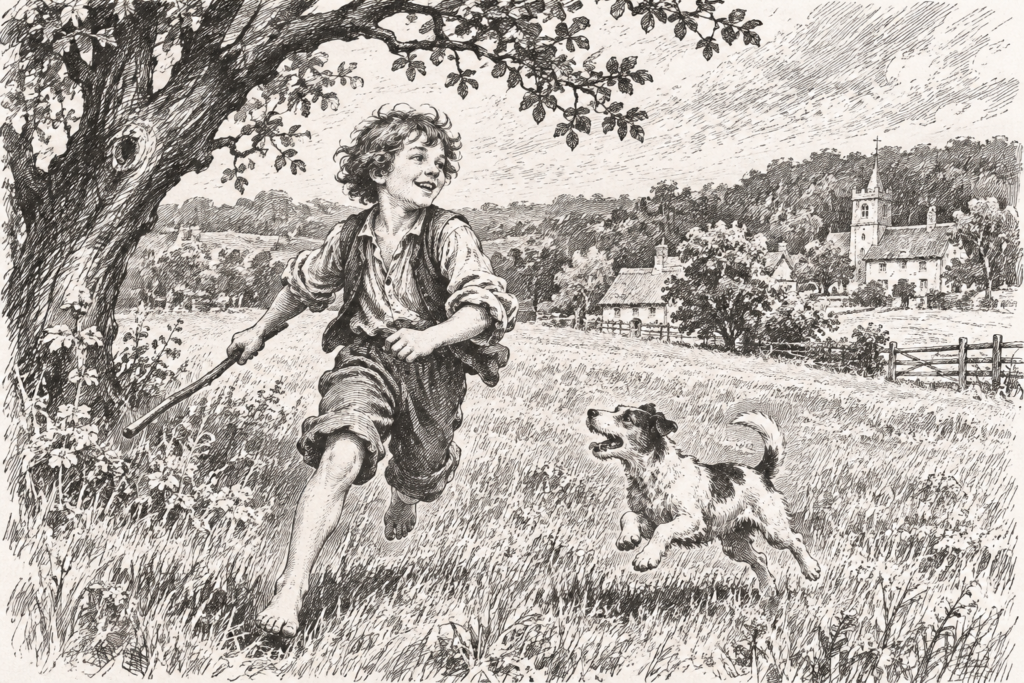
For Jack, the woods were a source of fascination.
He was an active boy, curious about what lay beyond the immediate surroundings of his home. The open fields offered freedom, while the woodland paths promised adventure. He was particularly interested in the hounds that were kept and exercised in the district. When he heard the sound of them, he was inclined to abandon whatever he was doing and follow.
His father did not entirely approve. Nathaneal wanted his son to learn useful habits and to understand the value of work. He knew that a boy who spent too much time wandering the countryside might become difficult to manage. But Jack was not easily persuaded to remain where he was told.
The countryside around Blean was also crossed by the road between Canterbury and Whitstable. It was a rough and uneven route, rising and falling over the hills, and travelling it by carriage could be an uncomfortable business. The road was used by farmers, tradesmen and travellers, and Jack became fascinated by the carriages that passed through the parish.
Sometimes he would follow them, hoping to obtain a ride or simply to see how far they were going. He was not always concerned about the distance from home or the trouble he might cause by staying away too long. The journey itself was enough to attract him.
The road gave him a glimpse of a wider world beyond Blean. Canterbury, with its streets, shops, inns and markets, was only a few miles away, while Whitstable offered the sights and sounds of the coast. To a boy who found the routine of home and school restrictive, the movement of people and vehicles along the road was irresistible.
The schoolroom
Nathaneal was determined that his sons should receive some education. He had been brought up to the business of husbandry and knew the limitations of a life in which reading and writing were beyond one’s reach. He wanted better for his children, within the means available to him.
Jack was therefore sent to school with his brothers.
The lessons were elementary, and reading was at the centre of much of the instruction. The children learned from books and religious texts, and the schoolroom demanded a degree of attention and obedience that Jack found difficult to give.
He had little patience for sitting still and repeating words from a page. His thoughts wandered towards the fields and woods, and the prospect of spending the day outside was far more appealing than struggling with his letters.
His brothers were more willing to apply themselves. Nathaneal, Samuel and William understood that their father expected them to learn, and they made a better effort to please him. Jack, by contrast, became increasingly skilled at finding reasons to be elsewhere.
One morning, when the boys were expected at their lessons, Jack slipped away before the schoolmaster had properly settled the class. He made his way towards the fields, where he had heard that the hounds were to be out. He followed them for much of the morning, keeping at a distance but close enough to enjoy the excitement.
When he eventually returned home, his father wanted to know where he had been.
“At school?” Nathaneal asked, looking at him over the table.
Jack hesitated.
“Then why have you come home with mud to your knees and no book?”
Jack had little answer. His father did not need one. He knew that his son had been playing truant.
There were other occasions when Jack followed the carriages towards Whitstable, or disappeared into the woodland rather than attend his lessons. He was repeatedly told that he must apply himself, but the good advice of his parents made little impression.
He could understand the words well enough. He simply did not wish to obey them.
As he grew older, the differences between him and his brothers became more noticeable. They were prepared to accept the discipline of school and the expectations of their parents. Jack increasingly regarded such things as burdens imposed upon him.
His father was disappointed, but he did not give up on him.
Working in the woods
Nathaneal recognised that his son was unlikely to become a scholar. He also understood that Jack’s restless nature might be better directed towards practical work.
When Jack was old enough, his father began taking him into the woods.
The work was physical and demanding. It required an understanding of trees, timber and the use of tools, together with an ability to work steadily through the day. There was no room for the kind of wandering that Jack enjoyed when he was alone. His father expected him to listen, learn and do his share.
Nathaneal showed him how to recognise suitable timber and how to carry out the ordinary tasks of woodland work. He taught him to use tools safely and to understand the value of what they were handling. Jack learned about the woods not from books but from the experience of working in them.
He came to know the paths, the clearings and the places where timber was gathered. He learned where work was being undertaken and where a man might find employment. He also became familiar with the people who worked in the surrounding countryside.
There were moments when father and son worked together without much conversation. Nathaneal was not a man who needed to fill every hour with words. He expected Jack to watch and learn, and he was pleased when the boy showed some willingness to do so.
Jack could be useful when he chose to be. He was strong for his age and knew the countryside well. Yet his enthusiasm remained uncertain. He might work diligently for a time, then become distracted by something happening nearby.
His father sometimes had to call him back to the task in hand.
“You’ll never earn a living by watching the road,” he told him on one occasion, when Jack had stopped to look at a passing cart.
Jack returned to his work, but his attention was already elsewhere.
For several years he continued to work with his father in the woods. It was the closest they came to sharing a regular occupation, and Nathaneal hoped that the experience would give his son a sense of responsibility.
But the arrangement was not to last.
The illness
In the spring of 1776, Nathaneal began to complain of feeling unwell.
At first, Mary thought little of it. He had worked hard throughout his life and was accustomed to aches and pains. A day’s rest, she supposed, might be enough to put him right.
But his condition worsened. He developed a fever and became increasingly weak. He no longer had the strength to go out to work, and the household began to feel the absence of his earnings almost immediately.
Mary did what she could to nurse him. She kept him warm, prepared what food he could manage and stayed close by when his fever was bad. The children were quieter than usual, aware that something was wrong even if they did not fully understand how serious it had become. Jack was old enough to recognise the fear in his mother’s face, but perhaps not old enough to understand that his father’s illness might end in death.
As the days passed, Nathaneal grew weaker. Mary remained beside him, hoping that the fever would break. The children came in and out of the room, sometimes to speak to him, sometimes simply to look at him before being sent away to allow him to rest.
Jack found it difficult to remain indoors. He was used to being outside, and the atmosphere in the house unsettled him. Yet he could not ignore what was happening. His father, who had always seemed strong and dependable, was now confined to his bed.
Nathaneal died before the summer had properly begun.
Mary was left with six children and no husband. The man whose labour had supported the household was gone, and the family had to face the future without him.
The funeral
Nathaneal was buried on 2 June 1776 at the parish church of Saints Cosmus and Damian.
The morning was overcast, with a dampness in the air that suggested rain. Mary dressed in her darkest gown and tied a plain black ribbon around her bonnet. She had spent much of the previous evening preparing the children, making sure that they were clean and suitably dressed. There was little money for mourning clothes, but she was determined that they should look respectable.
The boys wore their best coats, brushed as carefully as Mary could manage. Susannah had been given a clean dress, and little Joseph was dressed in his Sunday clothes. He was too young to understand the occasion and was more concerned with being kept close to his mother.
The coffin was brought to the church, carried by men who had known Nathaneal through his work. Among them were neighbours and fellow labourers, men who had shared the woodland paths and the ordinary hardships of rural life with him.
Jack walked with his brothers behind the coffin.
He had known his father as a man of few indulgences, someone who expected work to be done properly and who did not approve of idleness. Yet he had also known him as the person who took him into the woods, showed him how things were done and tried, in his own way, to guide him.
The church was familiar to the family. Nathaneal and Mary had married there in 1759, and all their children had been baptised within its walls. Now the same building received Nathaneal for the last time.
The congregation stood as the coffin was brought inside. The vicar conducted the service, reading the prayers in the measured voice that was customary on such occasions. Mary kept her eyes lowered. She held Joseph’s hand, while Susannah stood close against her skirts.
The older boys stood together. Jack tried to remain composed, conscious of the people around him and of the solemnity of the occasion. He watched as the coffin was carried out to the churchyard and lowered into the earth.
The men who had carried it stood nearby. A few of them spoke quietly to Mary afterwards, offering their condolences and telling her that Nathaneal had been a good and honest man. One promised that if there was work available for the boys, he would let her know.
Mary thanked them, though she was scarcely able to speak.
When the family returned home, the house seemed strangely empty. Nathaneal’s place at the table remained vacant, and his tools were still where he had left them. Mary would have to decide what to do with them, but not that day.
For the moment, she had six children to feed and a household to keep together.
A different household
The death of Nathaneal changed the family immediately.
Mary had to find a way of managing without the income her husband had brought home. She could no longer rely upon his regular work, and the older children would have to help wherever they could.
Nathaneal, the eldest, was now sixteen. He was old enough to seek work and to understand that the family depended upon him. Samuel and William would also be expected to contribute as they grew older. Susannah and Joseph still needed their mother’s care.
Jack was fourteen and a half, an age at which he might reasonably have been expected to begin earning regularly. His father had already introduced him to woodland work, and there were men in the district who knew him and might employ him.
But Jack had lost the person most likely to insist that he did so.
Mary tried to maintain the standards her husband had established. She reminded the boys of their father’s expectations and urged them to behave honestly and industriously. She did not want them to become idle or to bring shame upon the family.
The older boys responded in their own ways. Nathaneal accepted the responsibilities placed upon him, and Samuel and William continued to grow into useful members of the household. Jack was less willing to settle into a regular routine.
He was still drawn towards the woods, the roads and the company of other boys. Without his father beside him, he had greater freedom to come and go, and there was no longer anyone waiting at the end of the working day to ask what he had achieved.
Mary could not be everywhere at once. She had to manage the younger children, attend to household work and find ways of earning or saving enough to keep them. She could not watch Jack as closely as Nathaneal had done.
The boy who had once been taken into the woods by his father now had to make his own arrangements.
Jack was growing older, and the loss of his father had brought changes to his life that he was still learning to understand. He had always been restless, more inclined to follow his own interests than to settle to the tasks expected of him. With his father no longer there to guide him, he found himself with greater freedom, although his mother still did her best to keep him on the right path. He was beginning to make his own choices, sometimes without thinking too carefully about where they might lead.
The woods remained familiar to him. So did the lanes leading towards Canterbury and Whitstable. But the world around him had changed.
For Jack, the loss of his father marked the end of childhood, though he was not yet ready to accept the responsibilities that came with growing up.
The years ahead would take him far beyond the quiet parish in which he had been born. But for now, he remained a boy of Blean, with the countryside at his door and a widowed mother trying to hold her family together.
Part II – The Road to Crime
Chapter Two – A Wadow’s Household